wayground logo

Free Printable Worksheets

NEW

Font size

S
M
L
XL
Worksheets

Water

Total questions: 26

Worksheet time: 21mins

Name
Class
Date
1.
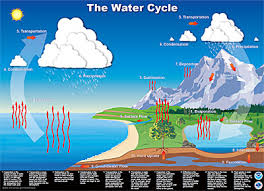
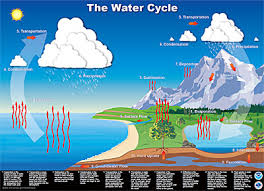
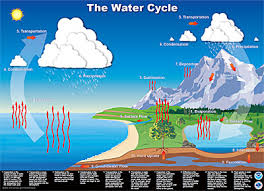
What is it called when plants give off water vapor as a waste product?
a)
condensation
b)
evaporation
c)
sublimation
d)
transpiration
2.
During which stage do clouds form?
a)
condensation
b)
evaporation
c)
precipitation
3.
Which stage does ground water try to return to the ocean or soak into the ground?
a)
condensation
b)
evaporation
c)
precipitation
d)
run off
4.
Which stages does liquid water from the ocean turn into water vapor?
a)
condesantion
b)
evaporation
c)
precipitation
d)
run off
5.

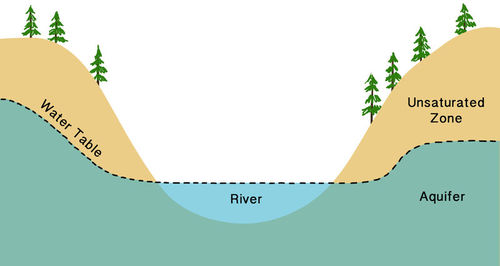
What is the best definition of a water table?

a)

The level to which a river rises when it floods

b)

The boundary between the land and the ocean

c)

The top of the saturated zone in an aquifer

d)

The bottom of the saturated zone in an aquifer

e)

The top of the unsaturated zone in an aquifer

6.

What is infiltration?

a)

The process by which water sinks into the ground

b)

The zone where there are still air spaces left between the particles.

c)

The process by which water vapor turns into liquid water and forms fog or clouds.

d)

The process by which water does not sink into the ground, but rather travels along the surface.

7.

Which surface would be impermeable?

a)
b)
c)
d)
8.

What affects the density of water?

a)

Salt

b)

Temperature

c)

The seasons of the year

d)

Salt and Temperature

9.
Two types of ocean currents are
a)
local and global
b)
sea and land
c)
surface and deep
d)
warm and cold
10.
Surface currents are mainly caused by
a)
The Coriolis Effect
b)
Cold and Warm Water
c)
Convection
d)
Wind
11.

What heats the Earth's oceans?

a)

People

b)

Boats

c)

a heater

d)

sun

12.
What causes ocean currents in the Northern Hemisphere to curve to the right?
a)
Earth's orbit around the Sun
b)
Earth's spinning on its axis
c)
Earth's magnetic field
d)
Earth's force of gravity
13.
Warm ocean currents generally come from
a)
The North Pole
b)
The South Pole
c)
The Equator
d)
Both A and B
14.
What is represented at point 1?
a)
wave height
b)
wavelength
c)
crest
d)
trough
15.
What is represented at point 2?
a)
wave height
b)
wavelength
c)
crest
d)
trough
16.
What is represented at point 3?
a)
wave height
b)
wavelength
c)
crest
d)
trough
17.
What is represented at point 4?
a)
wave height
b)
wavelength
c)
crest
d)
trough
18.
Which statement correctly describes the motion of water particles due to the action of waves?
a)
they travel from one crest to another
b)
they move in opposite direction of the wave
c)
they rise and fall in a circular motion
d)
they move back and forth
19.
What is the primary source of energy that generates most ocean waves?
a)
earthquakes
b)
wind
c)
asteriods falling in the ocean
d)
volcanic eruptions
20.
Stronger winds create __________ waves.
a)
larger
b)
smaller
21.
A wave can make a leaf bob up and down on the water, but it cannot move the leaf toward the shore. This is because waves only transfer ________
a)
A. matter  
b)
B. energy  
c)
C. media 
d)
D. crests
22.

As depth increases..........

a)

Things become shallow

b)

temperature decreases, pressure increases, and light decreases

c)

It is more salty

d)

An Ocean Current

23.

Flat, deep, and smooth part of the ocean floor. Cold temperatures are found here.

a)

Continental Shelf

b)

Abyssal Plain

c)

Continental Slope

d)

Seamounts

24.

Underwater Volcanoes and Mountains?

a)

Seamounts or Mid- Ocean Ridge

b)

Mountain Ridge

c)

Coastal Plains

d)

Abyssal Plains

25.

gently sloping shelf of land extending from the shoreline to the continental edge

a)

Continental Slope

b)

Continental Shelf

c)

Continental Rise

d)

Abyssal Plain

26.

Sharp underwater hill connecting the continent to the ocean floor?

a)

Ocean

b)

Coral Reef

c)

Plankton

d)

Continental Slope