
 Worksheets
MMS Weather Review
Total questions: 45
Worksheet time: 48mins
Name
Class
Date
1.
What is the best description of the atmosphere?
a)
All of Earth's water
b)
The living things on Earth
c)
The soil and rocks on Earth's surface
d)
A blanket of air that surrounds Earth
2.
What tool measures wind speed?
a)
anemometer
b)
rain gauge
c)
thermometer
d)
wind vane
3.
Why is it important to know the different types of clouds?
a)
clouds can indicate the time of day that it is
b)
clouds can indicate the type of weather that will occur
c)
clouds can indicate the temperature of different layers of the atomspehere
d)
clouds are not important to weather
4.
A low pressure system moves into North Carolina, which kind of weather will most likely occur?
a)
cold and dry
b)
fair and sunny
c)
clear and humid
d)
rainy and windy
5.
Which type of air pressure causes a storm to form on a spring day?
a)
low pressure, causing air to rise, cool, and form water droplets
b)
high pressure, causing air to rise, cool and form water droplets
c)
low pressure, causing air to sink and bring water droplets to the ground
d)
high pressure, causing air to sink and bring water droplets to the ground
6.
How does the Gulf Stream affect weather conditions along the eastern coast of the United States?
a)
The Gulf Stream causes temperatures to increase.
b)
The Gulf Stream causes more overcast skies.
c)
The Gulf Stream causes temperatures to decrease.
7.
Which type of weather results from a warm front moving into an area?
a)
There is a change in wind direction, a decrease in temperature, and no clouds appear.
b)
There is a change in wind direction, an increase in temperature, and stratus clouds appear.
c)
The wind speed decreases, the temperature increases, and nimbus clouds appear
d)
The wind speed increases, the temperature decreases, and stratus clouds appear.
8.
What is the primary cause of wind?
a)
the uneven heating of Earth
b)
precipitation falling to Earth
c)
many gases released into the air
d)
water constantly evaporating into the atmosphere
9.
In which direction do prevailing westerlies flow?
a)
from south to north
b)
from east to west
c)
from east to south
d)
from west to east
10.
Which best describes a storm that forms over warm sections of the ocean normally off the coast of Africa?
a)
hurricanes
b)
tornados
c)
thunderstorms
d)
blizzards
11.
What type of air does tropical moisture bring?
a)
cool
b)
warm
c)
dry
d)
arctic
12.
When a boundary of a cold air mass moves in and replaces a boundary of a warm air mass, what is the name of this process?
a)
cold front
b)
warm front
c)
high pressure
d)
jet stream
13.

What does this tool measure?
a)
Wind speed
b)
Wind direction
c)
Air pressure
d)
Temperature
14.
A high pressure system means we might have this weather.
a)
Snow blizzard
b)
Sunny and dry
c)
Rain storm
d)
Tornado
15.
A low pressure system means we might have this weather.
a)
Sunny
b)
A clear sky
c)
Dry day
d)
Stormy or wet
16.
The amount of water vapor in the atmosphere is called __________.
a)
Humidity
b)
Condensation
c)
Saturation
d)
Precipitation
17.
Air pressure is...
a)
the weight of the air pushing down on us
b)
hot hot or cold the air feels
c)
how much water vapor is present in the air
d)
water falling from the sky
18.
Which layer of the atmosphere do thunderstorms take place in?
a)
Troposphere
b)
Stratosphere
c)
Mesosphere
d)
Thermosphere
19.
What gas makes up the largest component of the atmosphere?
a)
oxygen
b)
carbon dioxide
c)
ozone
d)
nitrogen
20.

What is represented by the diagram below?
a)
radiation
b)
conduction
c)
convection
d)
condensation
21.
When a warm air mass gently slides on top of a cold air mass, and you have drizzly rain and then warmer weather, what type of front is it?
a)
warm front
b)
cold front
c)
occluded front
d)
stationary front
22.
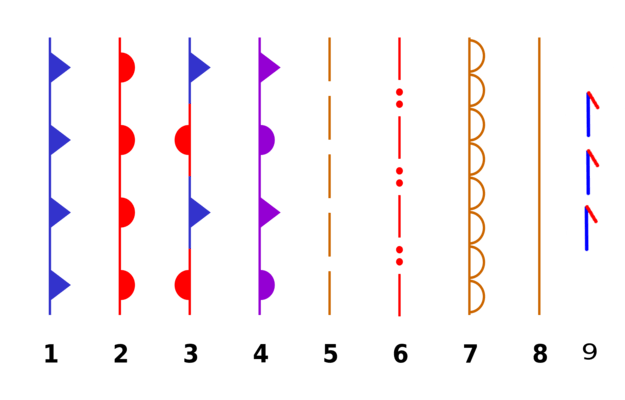
What does symbol # 3 mean?
a)
stationary front
b)
occluded front
c)
warm front
d)
cold front
23.
A front is
a)
where warm air is cooling at earth's surface
b)
a line where hot and cold air are separating
c)
a line where two different air masses meet
d)
where cold air is rising and forming rain clouds
24.
_____________ air is more dense and tends to sink
a)
cold
b)
warm
c)
moist
d)
dry
25.
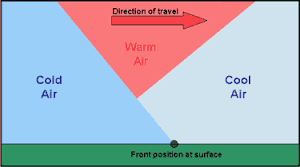
Which type of front is pictured?
a)
Cold front
b)
Warm front
c)
Occluded front
d)
Stationary front
26.

What symbol is this?
a)
warm front
b)
cold front
c)
stationary front
d)
occluded front
27.
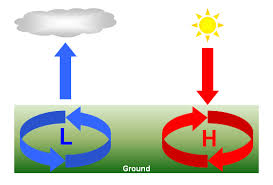
Which system results in drier, fairer weather?
a)
high pressure
b)
low pressure
c)
hurricane
d)
weather system
28.
Where you will find the ozone layer.
a)
stratosphere
b)
thermosphere
c)
exosphere
d)
mesosphere
29.
The hottest layer.
a)
troposphere
b)
thermosphere
c)
exosphere
d)
mesosphere
30.
Which order is correct from the earth to space?
a)
thermosphere
troposphere
exosphere
mesosphere
stratosphere
ionosphere
troposphere
exosphere
mesosphere
stratosphere
ionosphere
b)
thermosphere
troposphere
stratosphere
exosphere
mesosphere
ionosphere
troposphere
stratosphere
exosphere
mesosphere
ionosphere
c)
exosphere
ionosphere
thermosphere
mesosphere
stratosphere
troposphere
ionosphere
thermosphere
mesosphere
stratosphere
troposphere
d)
troposphere
thermosphere
troposphere
stratosphere
exosphere
mesosphere
thermosphere
troposphere
stratosphere
exosphere
mesosphere
31.
As you go higher in the troposphere, the temperature _______________.
a)
decreases
b)
increases
c)
stays the same
d)
gets very hot
32.
What is the function of the ozone layer?
a)
to allow UV rays to get to Earth
b)
to block UV rays from getting to Earth
c)
To keep oxygen in
d)
to allow meteors to get to Earth
33.
The higher you go, the air becomes _____ _____.
a)
More dense
b)
Less dense
34.
what are isobars?
a)
lines connecting places of equal temperature
b)
lines drawn connecting places of equal pressure
c)
lines drawn to places of different temperatures
d)
lines drawn to places of different pressures
35.
What happens to the amount of oxygen molecules as altitude increases?
a)
fewer molecules
b)
more molecules
c)
same amount of molecules
d)
nothing happens to the molecules
36.
78% of earth's atmosphere is composed of ______________.
a)
methane
b)
oxygen
c)
argon
d)
nitrogen
37.
This is when the rotation of the Earth deflects the direction of the wind.
a)
convergent effect
b)
marginal effect
c)
Coriolis effect
d)
Mariolis effect
38.
Polar Easterlies – blow __________.
a)
from the West
b)
from the East
c)
toward the North
d)
toward the East
39.

What kind of breeze is this and when would it form?
a)
Land breeze - daytime
b)
Land breeze - nighttime
c)
Sea breeze - daytime
d)
Sea breeze - nighttime
40.

What kind of breeze is this & what time of day/night would it form?
a)
Land breeze - daytime
b)
Land breeze - nighttime
c)
Sea breeze - daytime
d)
Sea breeze - nighttime
41.
Where does the initial source of energy come from that creates winds?
a)
the moon
b)
the sun
c)
the Earth's surface
d)
the rotation of the Earth
42.
Warm air rising at the equator and cold air sinking at the poles is one reason for which event?
a)
hurricanes
b)
Coriolis Effect
c)
Earth's rotation
d)
convection currents
43.
This indicates to the public the health risk at a location and time.
a)
Air Quality Index
b)
Air Safety Index
c)
Atmospheric Safety Quotient
d)
Clean Air Index
44.
What organization regulates and protects our air quality?
a)
North Pole
b)
Wal-Mart
c)
EPA - Environmental Protection Agency
d)
South Asheboro Middle School
45.
A meteorologist used radar to analyze the wind during a storm in the central plains of the United States. The winds were measure at 145 miles per hour and were moving in a circular pattern. According to the data, which event was the meteorologist most likely observing?
a)
Lightning storm
b)
Tornado
c)
Rainbow
d)
Cloud formation
100 %

