wayground logo

Free Printable Worksheets

Font size

S
M
L
XL
Worksheets

Human Population

Total questions: 32

Worksheet time: 23mins

Name
Class
Date
1.

Which correctly describes the term demographic transition?

a)

The transition from low birth rates and death rates to high birth rates and death rates as a country develops.

b)

The transition from high birth rates and death rates to low birth rates and death rates as a country develops.

c)

The transition from high birth rates to low death rates as a country develops.

d)

The transition from low birth rates to high death rates as a country develops.

2.

VOCAB: The average number of children a female member of a population has during her lifetime

a)

total fertility rate

b)

replacement fertility rate

c)

growth rate

d)

death rate

3.

The ____ describes the relative numbers of organisms of each age & gender within a population and is often represented by a double bar graph

a)

age structure diagram

b)

population growth rate

c)

demographic transition

d)

fertility rate

4.
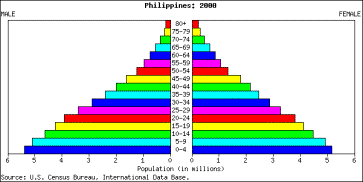
According to the population pyramid of this country, its population is most likely...
a)
growing slowly.
b)
growing rapidly.
c)
decreasing.
d)
not changing.
5.

In the past 100 years, the human population has

a)

increased exponentially

b)

decreased exponentially

c)

decreased slowly

d)

increased slowy

6.

Which of the following leads to a decrease in birthrates among women?

a)

Higher Education

b)

High Infant Mortality Rate

c)

No Prenatal Care

d)

No contraceptives

7.
Which of the following makes it difficult to reduce population growth?
a)
High literacy rates result in women wanting to have more children
b)
Population sizes will not decline until some people start having to do without food and other necessities of life
c)
Many people live in cities, where large families are an advantage
d)
Many people have low literacy and limited access to healthcare
8.
Which region of the world has the fastest growing population?
a)
Southeast Asia
b)
Eastern Europe
c)
Sub-Saharan Africa
d)
Latin America
9.
Which of the following is likely to be affected by a population of 7 billion?
a)
amount of land for agriculture
b)
amount of clean water
c)
number of people who are unemployed
d)
all of the above
10.

Which problem today is primarily the result of the Industrial Revolution?

a)

extensive air and water pollution

b)

increased transmission of disease between people living in close proximity

c)

decline in quality of agricultural soil

d)

erosion from deforestation as more fuel wood is harvested

11.
Population growth and fertility rates are lowest in
a)
upper-income countries
b)
upper- and middle-income countries
c)
middle- and low-income countries
d)
lower-income countries
12.

The most populous country in the world is ____ but not by much.

a)

China

b)

India

c)

US

d)

Brazil

13.
The number of babies out of 1,000 that die during their first year of life is called
a)
infant mortality
b)
growth rate
c)
demography
14.

The human population is now about

a)

300 million

b)

1.3 billion

c)

7 billion

d)

12 billion

15.
Birthrate remains high, death rate begins to fall, total population increasing
a)
Stage 1 Demographic Transition
b)
Stage 2 Demographic Transition
c)
Stage 3 Demographic Transition
d)
Stage 4 Demographic Transition
16.

A country that represents stable (neither increasing nor decreasing) growth

a)

Japan

b)

Germany

c)

Afghanistan

d)

Canada

17.
A population experiencing declining growth
a)
Russia
b)
Nigeria
c)
United States
d)
Australia
18.
The movement of individuals away from a population
a)
emigration
b)
immigration
c)
dispersion
d)
population density
19.
The average number of people living in a square kilometer is called...
a)
urbanization. 
b)
internal migration. 
c)
population density. 
d)
pull factors. 
20.
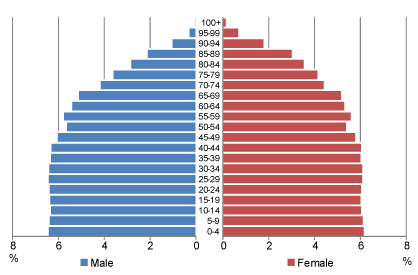
What kind of growth is this country experiencing?
a)
Exponential Growth
b)
Stable Growth
c)
Declining Growth
21.
Population size can be estimated using the formula
a)
(CBR + Immigration) + (CDR + Emigration)
b)
(CBR + Immigration) - (CDR + Emigration)
c)
(CBR - Immigration) + (CDR - Emigration)
d)
(CBR - Immigration) - (CDR - Emigration)
22.
Which of the following is a true statement about replacement-level fertility?
a)
It equals the average number of children a woman will give birth to during her child-bearing years
b)
It equals the annual number of live births per 1,000 people in a population
c)
It equals the natural increase of a population in one year
d)
It is greater in countries with high infant-mortality rates than in countries with low infant-mortality rates
23.
The most critical factor in controlling human population growth is
a)
controlling reproductive lifespan.
b)
decreasing the age of first birth.
c)
decreasing the average number of births per woman.
d)
decreasing infant death.
24.

According the population pyramid of this country at this point in time, the country's population is

a)

growing

b)

getting smaller

25.

Population growth rates are high in developing countries because

a)

infant mortality rates are low.

b)

women tend to have children late in life.

c)

family planning is common.

d)

children are often an economic advantage.

e)

net immigration is high.

26.

According to the theory of demographic transition, birth rates decline during phase

a)

1

b)

2

c)

3

d)

4

e)

Between 2 and 3

27.
When the IPAT model is applied to the United States, the least important factor in determining the environmental effects of the US population is?
a)
Value of P
b)
Value of A
c)
Value of T
d)
Value of A and T
28.
Replacement fertility:
a)
Restores population size after a catastophic event
b)
Is a contraceptive technique
c)
is below 2.1 in Africa
d)
is equal to 2.1 in stable populations
29.
If a population doubles in the course of 30 years, its growth rate would be close to __%.
a)
4.6
b)
2.3
c)
5.0
d)
10
30.

DT = 70 / Growth Rate

a)

Emigration

b)

Crude death rate

c)

Crude birth rate

d)

Population doubling time

31.
How might we reduce fertility rates in the world?
a)
Improve women's status and educational opportunities.
b)
Increase the life expectancy of men.
c)
Increase the number of housewives.
d)
Decrease literacy rates.
32.

What are some consequences of the One-Child Policy that led China to adopt a 2-Child Policy?

a)

Girls were often hidden or abandoned

b)

Boys are outnumbering girls and may have nobody to marry later.

c)

Female infanticide

d)

All of these