wayground logo

Free Printable Worksheets

Font size

S
M
L
XL
Worksheets

The Great Depression

Total questions: 80

Worksheet time: 55mins

Name
Class
Date
1.

What was the "New Deal" of the 1930s?

a)

a government program that gave free land to homesteaders

b)

a government program that helped women get the vote

c)

a government program that spread civil rights throughout the country

d)

a government program designed to help people during the depression

2.
President Franklin Roosevelt won the election of 1932. The country was in the Great Depression, and Roosevelt introduced the New Deal. Which was the MOST important goal of President Franklin Roosevelt's New Deal programs?
a)
to strengthen the economy 
b)
to avoid going to war 
c)
to improve public education 
d)
to end racial discrimination 
3.
President Franklin Roosevelt asked Congress to pass a series of acts called the New Deal. Which is one way the New Deal helped people during the Great Depression?
a)
It gave all people the right to vote. 
b)
It created programs to put people back to work.    
c)
It let all new immigrants become American citizens. 
d)
It let people travel around the country freely. 
4.
The Great Depression was an economic slowdown in the 1920s and 1930s. Which of the following was one cause of the Great Depression in the United States?
a)
the end of the gold rush 
b)
the crash of the stock exchange 
c)
the ending of World War II 
d)
the high price of oil 
5.
The Great Depression that began in 1929 hit farmers especially hard. Farmers had not been doing well in the 1920s and several years of severe drought turned the land into a "dust bowl." What was an immediate result of this?
a)
Many farmers decided to grow crops that did not use as much water. 
b)
The government built large dams in the West for irrigation. 
c)
Many farmers and their families lost their farms and moved west. 
d)
The government helped farmers by buying their land and equipment. 
6.
Many people lost their jobs during the Great Depression. People did not have money to pay for necessities, such as shelter, food, and clothing. The national government responded with President Franklin Roosevelt's "New Deal," a program that
a)
provided programs to help people make money to provide for their needs. 
b)
provided new ways for people to apply for unemployment insurance. 
c)
forced people to join the military forces to make money for their needs. 
d)
forced people to use charities to help them provide for their needs. 
7.
In 1929, the stock market crash was the beginning of the "Great Depression." Which of the following BEST describes the Great Depression?
a)
The depression was severe, but only in the United States. 
b)
Governments acted quickly and the depression only lasted two years
c)
The depression caused revolutions all across the world. 
d)
Many countries around the world experienced the economic depression
8.
When the stock market crashed in 1929, Herbert Hoover was president of the United States. The president who followed President Hoover began the New Deal, a program to help people during the Great Depression. This president was
a)
Warren Harding
b)
Calvin Coolidge
c)
Franklin Roosevelt
d)
Herbert Hoover
9.
In 1929, the United States entered an economic slowdown called the Great Depression. One of the early events was the stock market crash. What was a major cause of the stock market crash?
a)
Stock prices went up so fast that investors could not keep up with the changes. 
b)
Stock prices fell, investors panicked and sold their stocks, which led to more panic. 
c)
The government decided to close the stock market in New York. 
d)
People decided to invest their money in stock markets in Europe. 
10.
In 1929 the Great Depression started in the United States. In 1932 Franklin D. Roosevelt was elected president and he promised a "New Deal" to the American people. Which of the following BEST describes the role of the government during the New Deal?
a)
) The government wanted people to take care of themselves and not use the government. 
b)
The New Deal led to the government being more involved in the economy of the country. 
c)
The government wanted people to let the government provide everything they needed. 
d)
The New Deal led to the government being less involved in the economy of the country. 
11.
The Great Depression was a very difficult time period for most Americans, including farmers.  People looked for ways to forget their troubles.  Which of the following is NOT a way people tried to escape their troubles?
a)
Going to the movies 
b)
Running track and field 
c)
Listening to popular music 
d)
Reading books 
12.
This natural disaster served to worsen the effects of the Great Depression on Farmers in the Midwest 
a)
Tornados
b)
Dust Bowl
c)
Black Tuesday 
d)
Hurricanes
13.
When people went to the bank to withdraw their money and the banks had no money was known as the 
a)
Bank Crisis 
b)
Black Tuesday
c)
Stock Market Crash
d)
New Deal 
14.
The President who was mostly blamed for worsening the Great Depression 
a)
Roosevelt 
b)
Eisenhower
c)
Hoover
d)
Jefferson
15.
The collection of markets and exchange where the issuing and trading of equities, bonds and other sorts of securities takes place.
a)
Margin
b)
New Deal
c)
Deficit Spending 
d)
Stock Market 
16.
The name given to the programs enforced by FDR to ensure relief, recovery and reform. 
a)
Stock Market 
b)
Great Depression
c)
Margin 
d)
New Deal 
17.
This President enforced both New Deals and saw America through the Great Depression and World War II. 
a)
Eisenhower
b)
Truman
c)
Hoover
d)
Roosevelt 
18.
On October 29, 1929 share prices on the New York Stock Exchange completely collapsed and partially caused the Great Depression.
a)
Black Thursday
b)
Black Tuesday 
c)
Black Friday
d)
Black Sunday 
19.
What was a economic impact of the Great Depression?
a)
Stock market crashed and millions of Americans lost their jobs
b)
Many Americans moved to California in search for Gold
c)
Many Americans began to become wealthy due to Oil being found in Texas
20.
How is the Dust Bowl and the Great Depression related?
a)
Both events caused Americans to struggle financially
b)
Both events caused riots throughout the nation
c)
Both events led to World War II beginning 
21.

President Hoover believed that direct economic relief was not an answer to the Great Depression because

a)

it would hurt the American spirit.

b)

government should keep a balanced budget.

c)

relief should come from state and local governments.

d)

All of the above

22.

President Hoover had federal troops drive the _______________ out of Washington, D.C.

a)

Bonus Army

b)

police

c)

jobless

23.
How did "bank runs" impact the American people during the Great Depression?
a)
Banks eventually ran out of money to loan, and people's life savings were gone.
b)
Banks made loans throughout the Great Depression, helping people pays bills until they could find work.
c)
Banks were able to people's deposits safe, but they could not loan out any more money.
d)
Banks were not at all involved in the Great Depression because people did not use them.
24.
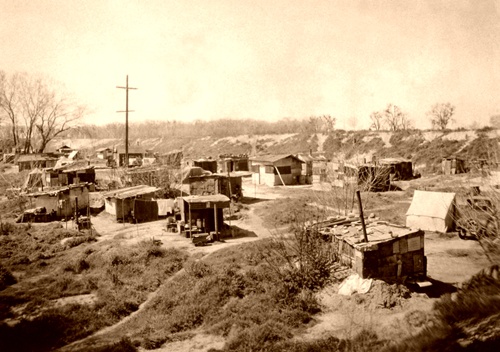
What was the main reason for the emergence of “Hoovervilles” like the one shown in the photograph?
a)
Many Americans had lost jobs during the Great Depression.
b)
Thousands of homes had been destroyed by the effects of the Dust Bowl.
c)
Housing projects could not keep up with the demand for homes needed by the poor.
d)
Preparations for World War I had created a shortage of building materials.
25.
During the early 1930s, the main goal of the Bonus Army was to pressure the Hoover administration to
a)
strengthen the nation’s defenses
b)
end the military draft
c)
bring American troops home from overseas
d)
support the early payment of money promised to veterans
26.
During the 1930s, poor land management and severe drought conditions across parts of the Midwest resulted in the
a)
formation of the United States Department of Agriculture
b)
creation of wheat surpluses
c)
growth of the Populist movement
d)
development of Dust Bowl conditions on the Great Plains
27.
A major difference between the philosophies of President Herbert Hoover and President Franklin D. Roosevelt in responding to the Great Depression is that Roosevelt
a)
wanted to rely on private charities to provide assistance
b)
stressed the need for individual rugged individualism
c)
supported direct relief to people out of work
d)
thought the government should not be involved in economic reform
28.
FDR addressed the American public in weekly broadcasts known as:
a)
FDR Hour
b)
Hangin' With Franklin
c)
Fireside Chats
d)
Around the Fire
29.
What was a guiding principle of the New Deal economic policies?
a)
Pro-business tax breaks would solve the problems associated with urban poverty.
b)
Antitrust legislation would destroy the free market economy of the United States.
c)
Rugged individualism must be allowed to solve social inequality.
d)
Government must assume more responsibility for helping the poor.
30.
As part of the New Deal, the Securities and Exchange Commission (SEC) and the Federal Deposit Insurance Corporation (FDIC) were created to
a)
allow for a quick recovery of stock prices
b)
provide direct loans to businesses
c)
protect individual investors from stock fraud and bank failure
d)
allow banks and companies to invest in the stock market
31.
The Civilian Conservation Corps (CCC) and the Works Progress Administration (WPA) were both New Deal programs developed to address the problem of
a)
excessive stock market speculation
b)
high unemployment
c)
increased use of credit
d)
limited income of senior citizens
32.
Passage of the Social Security Act (1935) helped American workers by 
a)
creating jobs for the unemployed
b)
guaranteeing a minimum wage
c)
legalizing the right to join labor unions
d)
providing financial assistance after retirement
33.
Hoovervilles were nicknames for what?
a)
Nickelodeons
b)
The White House during the Depression
c)
Shantytowns
d)
Stock Exchange
34.
Which was NOT one of the 3 goals of the New Deal?
a)
Relief for the unemployed
b)
Plans for recovery
c)
Repay bankers
d)
Reform to prevent another Great Depression
35.
Which of the following was NOT a cause of the Great Depression?
a)
uneven distribution of wealth
b)
stock market crash
c)
weak banking system
d)
strong economy
36.
Who was the president at the BEGINNING of the Depression?
a)
Warren G. Harding
b)
Herbert Hoover
c)
Franklin D. Roosevelt
d)
Calvin Coolidge
37.
This act provided monthly pensions for retired people.
a)
Social Security Act (SSA)
b)
Works Progress Administration (WPA)
c)
Townsend Act
d)
Revenue Act
38.
President Roosevelt's first ____ days as president were especially important since major laws were passed to help the Great Depression.
a)
Thousand
b)
Fifty
c)
Two
d)
Hundred
39.
True or False? The New Deal ended the Depression.
a)
True
b)
False
40.
In 1932, this group marched on Washington demanding a promised payment for fighting in World War I.
a)
the Payment Army
b)
the Bonus Army
c)
the RFC
d)
the Hoovervilles
41.
Which of the following was NOT a cause of the Dust Bowl?
a)
overgrazing by cattle
b)
tornadoes
c)
drought
d)
high winds
42.
To escape the horrible poverty and dust, many Dust Bowl residents moved to what state?
a)
Oregon
b)
New York
c)
California
d)
Oklahoma
43.
President Roosevelt hosted these weekly radio shows to reassure the American people during the Depression.
a)
Nickelodeons
b)
shantytowns
c)
sporting events
d)
Fireside Chats
44.
Buying stocks with loans
a)
default
b)
on margin
c)
stock exchange
45.
system for buying and selling shares
a)
default
b)
on margin
c)
stock exchange
46.
Paid farmers not to grow certain crops
a)
FDIC
b)
CCC
c)
TVA
d)
AAA
47.
Insured bank deposits
a)
FDIC
b)
CCC
c)
TVA
d)
AAA
48.
What nickname did people in California give to migrant farmers from the Dust Bowl?
a)
nomads
b)
Texans
c)
Okies
d)
Kansanites
49.
What did people do to try and escape the reality of the Depression?
a)
play sports
b)
go to the movies
c)
work
d)
sleep
50.
What finally brought us out of the Great Depression?
a)
World War II
b)
World War I
c)
the Second New Deal
d)
the New Deal
51.
The day of the stock market crash was nicknamed...
a)
Manic Monday
b)
Weird Wednesday
c)
Black Tuesday
d)
Freaky Friday
52.
The Dust Bowl devastated what part of the U.S. during the Great Depression?
a)
West Coast
b)
New England
c)
Deep South
d)
Great Plains
53.
Buying stock without knowing the risks, assuming it will just go up is known as ________.
a)
speculation
b)
buying on margin
c)
market capitalization
d)
hammering the market
54.
The collection of markets and exchange where the issuing and trading of equities, bonds and other sorts of securities takes place.
a)
Margin
b)
New Deal
c)
Deficit Spending 
d)
Stock Market 
55.
When people went to the bank to withdraw their money and the banks had no money was known as the 
a)
Bank Crisis 
b)
Black Tuesday
c)
Stock Market Crash
d)
New Deal 
56.
A time in America following the roaring 20's where America experience rising unemployment that did not end until the onset of World War II. 
a)
New Deal
b)
Roaring 20's
c)
Great Depression
d)
Cold War 
57.
What percentage of Americans were unemployed in 1933?
a)
25%
b)
35%
c)
50%
d)
2%
58.
What effect did the Dust Bowl storms have on the Great Depression?
a)
Many farmers were forced to leave the Great Plains.
b)
Unemployment decreased gradually.
c)
Many homes long the Mississippi River were flooded.
d)
Hoover was re-elected as president.
59.
The Bonus Army incident in 1932 best illustrates the idea that
a)
F.D.R.'
s relief programs were unsuccessful.
b)
many felt that Herbert Hoover was not handling the Depression well.
c)
protests by veterans during the Depression were effective.
d)
the U.S. Army had increased in size and power during the Depression.
60.
Which was NOT a LONG-TERM cause of the Great Depression?
a)
Buying stock on margin
b)
Stock market crash (Black Tuesday)
c)
too much production and consumer spending
d)
Laisezz-faire economic policies
61.
What were the villages full of shacks located in cities filled with unemployed Americans called?
a)
Hoovervilles
b)
Okies
c)
Bonus Army Bases
d)
Rooseveltowns
62.
Which economic factor contributed most directly to the start of the Great Depression?
a)
low worker productivity
b)
high income taxes
c)
decreasing tariff rates
d)
buying stocks on margin
63.
Pick the best answer.  Over-production of what led to the Great Depression?
a)
farm goods
b)
consumer goods
c)
farm and consumer goods
d)
iPhones
64.
What is a good title for this list?
a)
Culture of the 1920s
b)
The Great Migration
c)
Impact of the Great Depression
d)
Features of the New Deal
65.
Which cause of the Great Depression led to the decrease in the prices of goods and food?
a)
Stock Market Crash
b)
Overproduction
c)
Federal Reserve did not help failing banks
d)
High Tariffs 
66.
All of the following were causes of the Great Depression except - 
a)
Prohibition
b)
Overspeculation on stocks
c)
failing banks
d)
high tariffs
67.
Which government agency gives benefits to people when they are retired or unemployed?
a)
Federal Deposit Insurance Corporation
b)
Securities and Exchange Commission
c)
Tennessee Valley Authority
d)
Social Security Admistration
68.
Roosevelt's fireside chats used what technology to spread his message?
a)
Television
b)
Radio
c)
Newspaper
d)
Instragram
69.
The President who was mostly blamed for worsening the Great Depression 
a)
Roosevelt 
b)
Eisenhower
c)
Hoover
d)
Jefferson
70.
The name given to the programs enforced by FDR to ensure relief, recovery and reform. 
a)
Stock Market 
b)
Great Depression
c)
Margin 
d)
New Deal 
71.
This President enforced both New Deals and saw America through the Great Depression and World War II. 
a)
Eisenhower
b)
Truman
c)
Hoover
d)
Roosevelt 
72.
In the 1930's, people would line up at ____________ to get food.  These were normally run by charities.
a)
churches
b)
businesses
c)
soup kitchens
d)
work
73.

As a result of farmers trying to increase crop production, what happened to farm prices?

a)

Prices increased

b)

Prices stayed the same

c)

Prices decreased.

74.

What was it called when FDR closed all of the banks?

a)

Bank Vacation

b)

Banking Crisis

c)

Bank Holiday

d)

Bank Recovery

75.
What was the Great Depression?
a)
the feelings of sadness felt by many Americans in the 1970's
b)
the most severe period of economic hardship in the 20th century
c)
a weather pattern that caused the worst hurricane season of the 20th century
d)
the discovery in the 1934 of a huge cave in Arizona
76.
When did the Great Depression Begin?
a)
1829
b)
1889
c)
1929
d)
1999
77.
Why would a person want to buy stock in a company?
a)
to make money
b)
so they could show all their neighbors
c)
to get discounts on goods and services
d)
to keep their money safe
78.
The most popular home appliance in the 1930's 
a)
Television
b)
Radio
c)
Movies
d)
Telephone 
79.
Why did FDR propose the Supreme Court Packing Plan?
a)
to influence the Supreme Court to keep the New Deal going
b)
to make it more conservative
c)
to make the Supreme Court more efficient
d)
to make the Supreme Court more diverse
80.
What New Deal program gives you a monthly pension when you turn 65?
a)
Social Security
b)
TVA
c)
Medicare
d)
FDIC