
 Worksheets
30 Week Review (New Content)
Total questions: 76
Worksheet time: 2hrs 39mins
Name
Class
Date
1.
Holly has an unknown substance in a beaker. She wants to determine the relative pH of the unknown substance. She places a piece of blue litmus paper into the substance, and the litmus paper stays blue.
The substance in the beaker
The substance in the beaker
a)
is a base.
b)
has a neutral pH.
c)
is an acid.
d)
does not have a pH.
2.
Which of the following statements is correct?
a)
Blue litmus paper turns red when placed in a base.
b)
Red litmus paper turns blue when placed in a base.
c)
Blue litmus paper stays blue when placed in an acid.
d)
Red litmus paper stays red when placed in a base.
3.
Human blood has a pH between 7.35 and 7.45. Which of the following best describes human blood?
a)
strongly acidic
b)
slightly acidic
c)
strongly basic
d)
slightly basic
4.
When dissolved in water, acids produce:
a)
bases
b)
salts
c)
hydrogen ions
d)
hydroxide ions
5.
When dissolved in water, acids produce:
a)
bases
b)
salts
c)
hydrogen ions
d)
hydroxide ions
6.
Which of the following is true about acids and bases?
a)
The lower the pH, the stronger the acid
b)
the higher the pH, the stronger the acid
c)
The lower the pH, the more neutral the acid
d)
The higher the pH, the weaker the base
7.
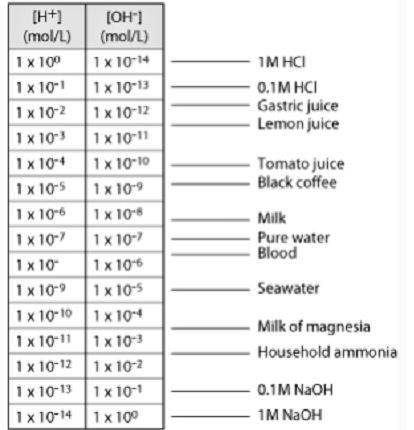
What is the approximate pH of seawater?
a)
2
b)
5
c)
7
d)
9
8.

Which food is the most acidic?
a)
bananas
b)
lemon juice
c)
orange juice
9.

Bleach is a strong base, what is the pH level of bleach?
a)
13
b)
14
c)
1
d)
2
10.
In a neutralization reaction, what are the products of a reaction between an acid and a base?
a)
Another acid and base
b)
Carbon dioxide and a salt
c)
Water and a salt
d)
Either two acids or two bases
11.
The pH scale measures...
a)
...the strength of an acid.
b)
...the strength of hydrogen ions.
c)
...the concentration of hydrogen ions.
d)
...the concentration of an acid
12.
Given the equation for a system at equilibrium:
N2(g) + 3H2(g) --> 2NH3(g) + energy
If only the concentration of N2(g) is increased, the concentration of
N2(g) + 3H2(g) --> 2NH3(g) + energy
If only the concentration of N2(g) is increased, the concentration of
a)
NH3(g) increases
b)
NH3(g) remains the same
c)
H2(g) increases
d)
H2(g) remains the same
13.
I am titrating 1M HCl with 1M NaOH. I have 25mL of HCl. How much NaOH will I need?
a)
2.5mL
b)
5mL
c)
25mL
d)
50mL
14.
Identify the products of the chemical equation
3 LiOH + H3PO4 →
3 LiOH + H3PO4 →
a)
Li3PO4 + 3 H2O
b)
LiPO4 + 3 H2O
c)
Li(PO4)3 + 3 H2O
d)
BOY + La + N2
15.
A 50.0 mL sample of Ca(OH)2 is neutralized by 300.0 mL of HCl solution with a pH of 1.3. Calculate the molarity of the Ca(OH)2 solution.
a)
1.0 M
b)
0.50 M
c)
0.15 M
d)
0.30 M
16.
How many moles of Ca(OH)2 are needed to neutralize three moles of HCl?
a)
8
b)
1.5
c)
6
d)
3
17.
If phenolphthalein turns bright pink, it indicates
a)
an acid
b)
a base
c)
a neutral
18.
Which of the following is a conjugate acid/base pair?
a)
HCl/OCl-
b)
H2SO4/SO42-
c)
NH4+/NH3
d)
H3O+/OH-
19.
HCl is:
a)
an Arrhenius acid
b)
a Bronsted Lowry acid
c)
both an Arrhenius and Bronsted Lowry acid
d)
a base
20.
NaOH is:
a)
an Arrhenius base
b)
an Arrhenius acid
c)
neither an acid nor a base
d)
both an acid and a base
21.
An Arrhenius acid:
a)
donates H+ to another substance
b)
accepts H+ from another substance
c)
produces H+
d)
produces OH-
22.
A Bronsted Lowry base:
a)
donates H+ to another substance
b)
accepts H+ from another substance
c)
produces H+
d)
produces OH-
23.
In the equation below, what is the Bronsted Lowry acid?
HCl + NH3 --> Cl- + NH4+
a)
HCl
b)
NH3
c)
Cl-
d)
NH4+
24.
In the equation below, what is the Bronsted Lowry base?
HCl + NH3 --> Cl- + NH4+
a)
HCl
b)
NH3
c)
Cl-
d)
NH4+
25.
Select the name for the following acid: H2S
a)
Hydrosulfuric acid
b)
Sulfuric acid
c)
Sulfurous
26.
Select the formula for the following acid: hydrobromic acid
a)
HBr
b)
HBrO4
c)
HBrO3
27.
Select the name for the following acid: H2SO3
a)
Sulfurous acid
b)
Sulfuric acid
c)
Hydrosulfuric acid
28.
What are the products of the following reaction?
H2SO4 + KOH -->
H2SO4 + KOH -->
a)
HK + HSO4
b)
H2O + KSO4
c)
H2O + K2SO4
d)
H2 + K2SO4
29.
Identify the salt in the following equation:
Zn(OH)2 + HNO3 ---> H2O + Zn(NO3)2
Zn(OH)2 + HNO3 ---> H2O + Zn(NO3)2
a)
Zn(OH)2
b)
HNO3
c)
H2O
d)
Zn(NO3)2
30.
What is the name of the acid that can produce NH4NO3?
a)
HNO3
b)
HCl
c)
NH4OH
d)
NH3
31.
What is the name of the base that can produce NH4NO3?
a)
HNO3
b)
HCl
c)
NH4OH
d)
NH3
32.
If the [H3O+1] > [OH-1] the solution is...
a)
acidic
b)
basic
c)
neutral
33.
If the [H3O+1] < [OH-1] the solution is...
a)
acidic
b)
basic
c)
neutral
34.
If the [H3O+1] = [OH-1] the solution is...
a)
acidic
b)
basic
c)
neutral
35.
Electrolyte
a)
Acids
b)
Bases
c)
Salts
d)
All
36.
What is the pH of a 1 x 10⁻⁸ solution of HNO3?
a)
8
b)
6
c)
7
d)
7.5
37.
What is the pOH of a 1 x 10⁻⁸ solution of HNO3?
a)
8
b)
6
c)
7
d)
7.5
38.
The pOH of sea water is 5.9. What is its pH?
a)
0.0000000083
b)
0.0000013
c)
5.9
d)
8.1
39.
If a solution has a [H+] of 1.2 x 10⁻⁴M what is the [OH-]?
a)
8.3 x 10⁻⁴M
b)
8.3 x 10⁻¹¹M
c)
1.2 x 10¹⁰M
d)
1.2 x 10⁻⁴M
40.
What is the pH of a solution that has a [H+] of 2.5 x 10⁻⁵?
a)
4.60
b)
5.0
c)
2.5
d)
7
41.
What is the pOH of a solution where the [OH-] is 7.3 x 10⁻² M?
a)
-1.14
b)
2.0
c)
1.14
d)
7.3
42.
What is the [H+] if the pH is 4.0?
a)
1.0 x 10⁻¹⁰ M
b)
1.0 x 10⁻⁴ M
c)
1.0 x 10⁻¹⁴ M
d)
1.0 x 10⁻⁷ M
43.
What is the pOH of a solution that has a pH of 2?
a)
10
b)
12
c)
14
d)
1
44.
What is the [OH-] if the pH is 4.9?
a)
7.94 x 10⁻¹⁰ M
b)
1.0 x 10⁻⁴ M
c)
7.94 x 10⁻¹⁴ M
d)
4.9 x 10⁻¹⁰ M
45.
For the reaction...
SO2 + O2 <−> SO3
If the concentration of SO2 is increased, the equilibrium of the reaction will shift ___________.
SO2 + O2 <−> SO3
If the concentration of SO2 is increased, the equilibrium of the reaction will shift ___________.
a)
left
b)
right
c)
left and right
d)
neither left nor right
46.
For the reaction...
SO2 + O2 <−> SO3
If the equilibrium shifts to the right, the concentration of O2 will ___________.
SO2 + O2 <−> SO3
If the equilibrium shifts to the right, the concentration of O2 will ___________.
a)
increase
b)
decrease
c)
remain the same
d)
double
47.
For the reaction...
SO2 + O2 <−> SO3
If the equilibrium shifts to the right, the concentration of SO3 will ___________.
SO2 + O2 <−> SO3
If the equilibrium shifts to the right, the concentration of SO3 will ___________.
a)
increase
b)
decrease
c)
remain the same
d)
double
48.
For the reaction...
SO2 + O2 <−> SO3
If the concentration of O2 is decreased, the equilibrium of the reaction will shift ___________.
SO2 + O2 <−> SO3
If the concentration of O2 is decreased, the equilibrium of the reaction will shift ___________.
a)
left
b)
right
c)
left and right
d)
neither left nor right
49.
For the reaction...
SO2 + O2 <−> SO3
If the equilibrium shifts to the left, the concentration of SO3 will ___________.
SO2 + O2 <−> SO3
If the equilibrium shifts to the left, the concentration of SO3 will ___________.
a)
increase
b)
decrease
c)
stay the same
d)
triple
50.
For the reaction...
heat + N2 + O2 <−> 2NO
If NO is removed from the system, the concentration of N2 will _______.
heat + N2 + O2 <−> 2NO
If NO is removed from the system, the concentration of N2 will _______.
a)
increase
b)
decrease
c)
remain the same
d)
double
51.
For the reaction...
heat + N2 + O2 <−> 2NO
If the heat is added to the chemical system, the equilibrium will shift _______.
heat + N2 + O2 <−> 2NO
If the heat is added to the chemical system, the equilibrium will shift _______.
a)
left
b)
right
c)
left and right
d)
neither left nor right
52.
For the reaction...
H2 (g) + Cl2 (g) <−> 2HCl (g) + heat
If the pressure in the system is increased, the equilibrium will _______.
H2 (g) + Cl2 (g) <−> 2HCl (g) + heat
If the pressure in the system is increased, the equilibrium will _______.
a)
shift left
b)
shift right
c)
not shift
53.
For the reaction...
H2 (g) + Cl2 (g) <−> 2HCl (g) + heat
If the temperature is cooled, the _________ reaction will be favored.
H2 (g) + Cl2 (g) <−> 2HCl (g) + heat
If the temperature is cooled, the _________ reaction will be favored.
a)
forward
b)
reverse
c)
forward and reverse
54.
For the reaction...
N2 (g) + 3 H2 (g) <−> 2 NH3 (g)
If the pressure in the system is increased, which substance will increase in concentration?
N2 (g) + 3 H2 (g) <−> 2 NH3 (g)
If the pressure in the system is increased, which substance will increase in concentration?
a)
N2
b)
H2
c)
N2 and H2
d)
NH3
55.
For the reaction...
N2 (g) + 3 H2 (g) <−> 2 NH3 (g)
If the pressure in the system is decreased, which substance will increase in concentration?
N2 (g) + 3 H2 (g) <−> 2 NH3 (g)
If the pressure in the system is decreased, which substance will increase in concentration?
a)
N2
b)
H2
c)
N2 and H2
d)
NH3
56.
2SO2(g)+O2(g)⇌2SO3(g)
Removing O2(g) will
Removing O2(g) will
a)
shift equilibrium right
b)
shift equilibrium left
c)
decrease temperature
d)
have no change
57.
2SO2(g)+O2(g)⇌2SO3(g)
Adding SO2(g) will
Adding SO2(g) will
a)
shift equilibrium right
b)
shift equilibrium left
c)
increase rate of reaction
d)
have no change
58.
2SO2(g)+O2(g)⇌2SO3(g)
Adding SO3(g) will
Adding SO3(g) will
a)
shift equilibrium right
b)
shift equilibrium left
c)
increase K
d)
have no change
59.

At what time does the reaction reach equilibrium?
a)
t1
b)
t2
c)
t3
d)
t4
60.
Which of the following is NOT true at equilibrium?
a)
The forward and reverse reactions proceed at the same rate.
b)
The concentrations of reactants and products do not change.
c)
The concentration of the reactants is equal to the concentration of the products.
d)
The forward and reverse reactions continue to occur.
61.
For the reaction...
N2 (g) + 3 H2 (g) <−> 2 NH3 (g)
If the pressure in the system is increased, the reaction will __________________.
N2 (g) + 3 H2 (g) <−> 2 NH3 (g)
If the pressure in the system is increased, the reaction will __________________.
a)
shift to the left
b)
shift to the right
c)
not shift
62.
What is the proper Keq for the following reaction?
2 NO(g) + O2(g) ⇌ 2 NO2(g)
2 NO(g) + O2(g) ⇌ 2 NO2(g)
a)
Keq = [NO2]2 / [NO]2[O2]
b)
Keq = [NO]2[O2] / [NO2]2
c)
Keq = [NO]2[O2][NO2]2
d)
Keq = 2[NO][O2] / 2[NO2]
63.

What is [A] and [B]?
a)
Concentration of Reactants
b)
Concentration of Products
c)
Energy of Reactants
d)
Energy of Products
64.
When Keq > 1,
a)
There are more products than reactants when the reaction reached equilibrium.
b)
There are more reactant than products when the reaction reached equilibrium.
c)
The amount of reactants is equal to the amount of products.
65.

a)
The graph represents an exothermic reaction
b)
The graph represents a specific heat reaction
c)
The graph represents a constant pressure reaction
d)
The graph represents an endothermic reaction
66.
When ΔH is negative it represents a(n)
a)
exothermic reaction
b)
endothermic reaction
67.
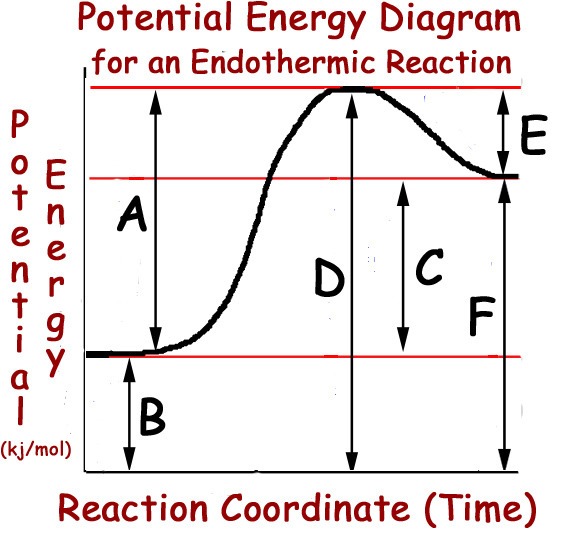
What letter represents the activation energy?
a)
A
b)
B
c)
C
d)
D
68.
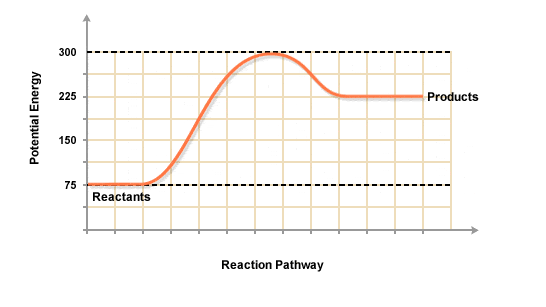
What is the energy of the activated complex?
a)
75 kJ
b)
225 kJ
c)
300 kJ
d)
225 kJ
69.
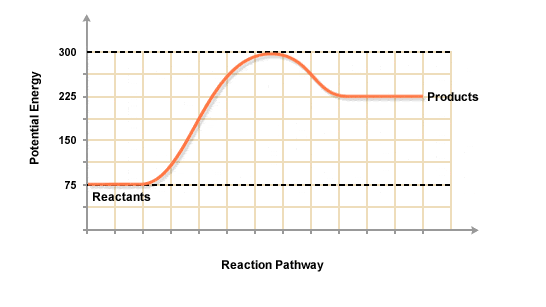
What is the activation energy of the reverse reaction?
a)
75 kJ
b)
300 kJ
c)
150 kJ
d)
225 kJ
70.
A substance that increases speed of chemical reaction without being being changed is called:
a)
Catalyst
b)
Acid
c)
Base
d)
pressure
71.
Grinding a seltzer tablet into powder increases the rate of reaction due to increased
a)
concentration
b)
surface area
c)
temperature
d)
reactants
72.
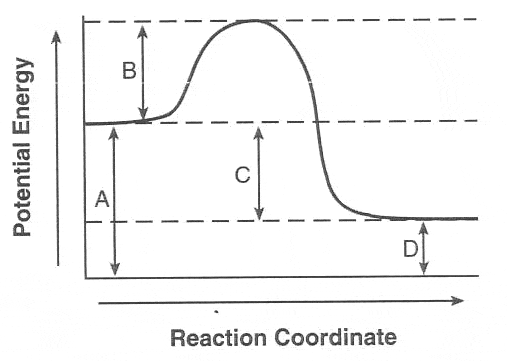
What letter represents the energy of the products?
a)
A
b)
B
c)
C
d)
D
73.
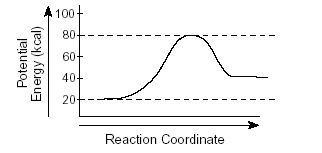
What is the ΔH of this reaction?
a)
40 kJ
b)
20 kJ
c)
80 kJ
d)
60 kJ
74.
What is the activation energy of the reverse reaction?
a)
75 kJ
b)
300 kJ
c)
150 kJ
d)
225 kJ
75.
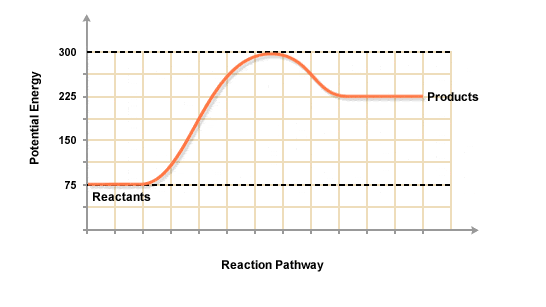
How much potential energy do the products of the reverse reaction have?
a)
225 kJ
b)
300 kJ
c)
75 kJ
d)
250 kJ
76.
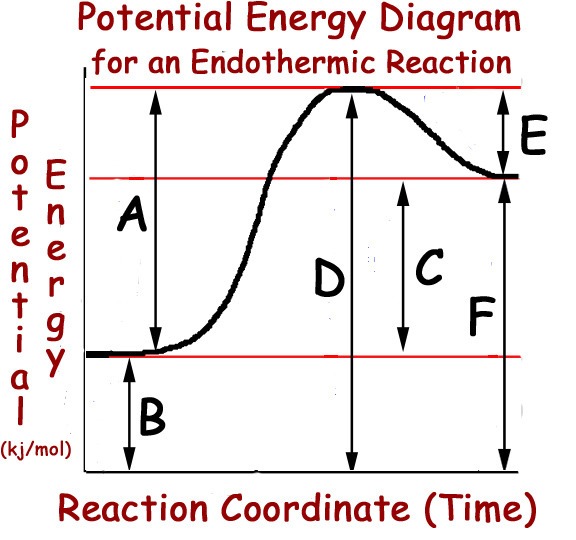
What letter represents ΔH?
a)
A
b)
B
c)
C
d)
D
100 %

