wayground logo

Free Printable Worksheets

NEW

Font size

S
M
L
XL
Worksheets

Relative Dating

Total questions: 30

Worksheet time: 33mins

Name
Class
Date
1.

States that younger rocks lie above older rocks if the layers have not been disturbed

a)

Law of superstition

b)

Law of superposition

c)

Relative Dating

d)

Disturbance

2.
Relative dating of rock layers tells us that the deeper we dig, _______.
a)
the younger the rocks get
b)
the smellier the rocks get
c)
the harder the rocks get
d)
the older the rocks get
3.
The Law of Superposition helps scientists to determine what?
a)
The absolute age of rock layers
b)
The age of fossils
c)
The relative age of rock layers
d)
the super powers of rocks
4.
According to the law of superposition, the oldest fossils are found 
a)
At the top of the rock layers
b)
Near the bottom of the rock layers
c)
In the middle of the rock layers
d)
Somewhat near the surface
5.
Which rock layer in the diagram seems to be the oldest?
a)
F
b)
E
c)
B
d)
A
6.
According to the law of superposition, which layer is the youngest?
a)
A
b)
B
c)
C
7.
Which type of dating method can be used on rock layers by applying the Law of Superposition?
a)
relative dating
b)
absolute dating
c)
radioactive dating
d)
radiometric dating
8.
What is the oldest layer in the outcrop?
a)
B
b)
C
c)
D
d)
E
9.
What is the youngest layer in the outcrop?
a)
A
b)
B
c)
C
d)
D
10.
The rock formation labeled "P" is a(n)...
a)
fault
b)
intrusion
c)
inclusion
d)
unconformity
11.
Letter "F" is a....
a)
inclusion
b)
intrusion
c)
fault
d)
unconformity 
12.
In this rock layer diagram there are two unconformities, a fault at E and an intrusion at D. Which unconformity occurred first?  How do you know?
a)
Intrusion D occurred first because the instrusion has been moved by the fault.
b)
The fault occurred first because it has moved the intrusion D.
c)
Intrusion D occurred first because it can be seen in all of the rock layers.
d)
Fault E occurred first because it is a normal fault.
13.
An archaeologist made the following diagram of a dig site. What can be said about the pottery as compared to the skull found in the site?
a)
The rock layer with the pottery is more recent than the rock layer with the skull.
b)
The rock layer with the skull is more recent than the rock layer with the pottery.
c)
The rock layer with the skull is approximately the same age as the rock layer with the pottery.
d)
The rock layer with the skull has an absolute date of 17,000 years.
14.
Which layer is the oldest?
a)
D
b)
C
c)
B
d)
A
15.
Relative age dating assumes that the lower layers in any particular cross section are ____________ than the upper layers in that cross section
a)
Younger
b)
Smaller
c)
Bigger
d)
Older
16.
Which of the following orders the rock layers accurately from youngest to oldest?
a)
1, 2, 3, 4, 5
b)
5, 4, 3, 2, 1
c)
2, 3, 4, 5, 1
d)
1, 2, 3, 5, 4
17.
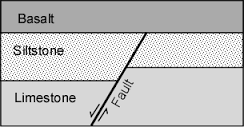
What are the relative ages of the features in order from oldest to youngest?
a)
Limestone, Basalt, Fault, Siltstone
b)
Siltstone, Fault, Basalt, Limestone
c)
Limestone, Fault, Basalt, Siltstone
d)
Limestone, Siltstone, Fault, Basalt
18.
What is the correct order of the rock layers from oldest to youngest?
a)
B, C, D, E, A
b)
A, B, C, D, E
c)
E, D, C, B, A
d)
B, C, D, A, E
19.
The best index fossils have which two traits?
a)
widespread geographically, long lifespan
b)
widespread geographically, short lifespan
c)
specific place, long lifespan
d)
specific place, short lifespan
20.
Which layer is oldest?
a)
A
b)
W
c)
G
d)
Z
21.
What does "RELATIVE AGE" tell about fossils & rock strata?
a)
the actual age
b)
a comparison age (1 fossil or rock is older than another)
c)
an age range
d)
the age in numbers
22.
Which is an example of "relative age"?
a)
My grandmother is 67.
b)
The students are 12-13 years old.
c)
I am younger than my mother.
d)
My dog is 7.
23.
Could the shell be considered an index fossil in this diagram?
a)
Yes
b)
No
24.
Could the Trilobite be considered an index fossil in this diagram?
a)
Yes
b)
No
25.
Which fossil could be classified as an index fossil? 
a)
Fossil 1
b)
Fossil 2
c)
Fossil 3
d)
Fossil 4
26.
In the diagram there are 4 outcrops or 4 different locations for rock layers shown.  Fossils are found at all 4 locations.  Looking at the diagrams, which letter (A, B, C, or D) most likely represents an index fossil?
a)
A
b)
B
c)
C
d)
D
27.
A scientist says that layers Y and M are the same age. How does he know this?
a)
They are found in the same type of rock.
b)
They are the lowest layers.
c)
They have the same type of fossil.
d)
They are near each other.
28.

Which correctly compares the layers in the outcrops shown?

a)

F is older than B.

b)

G is younger than Z.

c)

B is the same relative age as W.

d)

B is the same relative age as X.

29.

Which statement correctly compares the layers in the outcrops shown?

a)

Layers E, K, and Q are the same relative age.

b)

Layers C, H, and O are the same relative age.

c)

Layers A, K, and Q are the same relative age.

d)

Layers D and P are the same relative age.

30.

Which statement correctly compares the layers in the outcrops from Europe and Australia?

a)

Layer 3 and Layer c are the same age.

b)

Layer c is younger than Layer 4.

c)

Layer 1 and Layer c are the same age.

d)

Layer 1 and Layer a are the same age.