
 Worksheets
Reconstruction Spiral Review
Total questions: 46
Worksheet time: 2hrs 39mins
Name
Class
Date
1.
The 13th amendment to the Constitution was the first of the "Reconstruction Amendments," What was the purpose of this amendment?
a)
to give women the right to vote
b)
to allow the Confederate States to re-enter the Union
c)
to give African Americans the right to vote
d)
to abolish slavery
2.
The 15th amendment to the Constitution was the last of the "Reconstruction Amendments," and it was ratified in 1870. What was the purpose of this amendment?
a)
to give African American men the right to vote
b)
to establish a federal income tax
to establish a federal income tax
c)
to give women the right to vote
to give women the right to vote
d)
to officially end the "Reconstruction Era"
3.
Strict punishment of Confederate veterans and financial assistance to African Americans were policies pushed by which of the following group during the Reconstruction Era?
a)
Radical Democrats
Radical Democrats
b)
Moderate Republicans
c)
Radical Republicans
d)
Moderate Democrats
4.
The 14th amendment to the Constitution was the second of the "Reconstruction Amendments." What was the purpose of this amendment?
a)
to give African Americans the right to vote
b)
to give all American citizens equal protection under the law
c)
to abolish slavery
d)
to officially terminate the government of the Confederate States of America
to officially terminate the government of the Confederate States of America
5.
One of the most heavily debated programs of Reconstruction was the Freedman's Bureau. While it had mixed results, the primary goal of this program was to:
a)
prevent the African American population from voting in federal elections.
b)
establish the "sharecropping" system to make sure that white farmers continued to employ African Americans.
c)
provide newly freed slaves with food, shelter, work, and education.
d)
to enforce "Black Codes," or laws that treated African Americans as second-class citizens
6.
The members of Congress battled with both presidents because they felt that the Presidential Reconstruction Plans:
a)
were too focused on helping the freed African slaves, but not on helping the poor, white farmers.
b)
were too strict to allow the Union to ever be reunited as it was prior to the Civil War.
c)
were too lenient on the Southern states that had rebelled against the Union.
d)
were created too quickly without consulting the former leaders of the Confederate states.
7.
Which of the following describes Abraham Lincoln's "10 percent" plan?
a)
A Confederate state could re-enter the Union whenever it repaid 10 percent of the damages that were suffered in the state during the Civil War
b)
A Confederate state could re-enter the Union 10 percent of the states already included in the United States agreed that it could enter.
c)
A Confederate state could re-enter the Union only if it agreed that it would be given 10 percent less representation in the federal government than it had prior to the Civil War
d)
A Confederate state could re-enter the Union whenever 10 percent of its voters took a vow of allegiance to the United States
8.
The most immediate and important outcome of the Civil War was that:
a)
the South gained its independence.
b)
slavery was ended in the United States.
c)
tensions between different areas of the nation finally ended.
tensions between different areas of the nation finally ended.
d)
the South was able to become an industrial center for the entire nation.
the South was able to become an industrial center for the entire nation.
9.
These people proposed that the federal government should preside over these areas, and the freed African slaves should be helped at the expense of the white population. People who felt this way were probably members of which political group?
a)
Red Shirt Democrats
b)
Ku Klux Klan
c)
Tillmanites
d)
Radical Republicans
10.
The Ku Klux Klan was a terrorist organization that started during Reconstruction. The group targeted African Americans.
a)
True
b)
False
11.
After two centuries of slavery, the Black Codes passed following the Civil War finally gave African Americans the same freedoms as the white population.
a)
True
b)
False
12.
After the Civil War, the South
a)
was destroyed and laid in ruins
b)
kept African Americans in slavery
c)
was renamed the Confederate States of America
d)
made sharecropping illegal
13.
The 13th Amendment of the United States Constitution...
a)
guarantees African Americans free speech
b)
Outlawed slavery in the United States
c)
gave African Americans the right to vote
d)
rejoined the South and the North
14.
Who wanted to readmit states to the Union when 10% of the voters took an oath of allegiance?
a)
Andrew Johnson
b)
Andrew Jackson
c)
Abraham Lincoln
d)
The Radical Republicans
15.
The 15th Amendment of the United States Constitution...
a)
Gave African Americans the right to own businesses
b)
Freed the Slaves
c)
Gave African American men the right to vote
d)
Forced African Americans back into slavery
16.
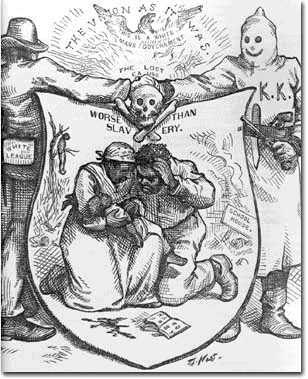
What does this photo say about how newly freed slaves were treated during Reconstruction?
a)
Everyone was getting along, regardless of race
b)
They were treated worse than slaves
c)
They were provided more opportunities
d)
Whites worked with African Americans to fix the problems of the South
17.
The 14th Amendment of the United States Constitution...
a)
Gave African Americans citizenship
b)
Gave African Americans the right to vote
c)
Freed the slaves
d)
Gave landowners the right to sharecrop
18.
What ended Reconstruction?
a)
Plessy v. Ferguson
b)
the Civil Rights Cases
c)
Compromise of 1877
d)
Lincoln's assassination
19.
This was the rebuilding of the country after the Civil War?
a)
Sherman's March to the Sea
b)
Reconstruction
c)
WWI
d)
Freedmen's Bureau
20.
Who took the office of President after President Lincoln was assassinated?
a)
Andrew Jackson
b)
Andrew Johnson
c)
Andrew Livingston
d)
Andrew Young
21.
Which of the following was NOT a goal of A. Lincoln?
a)
He wanted 10% of the people in the state to pledge their allegiance to the USA.
b)
keep slavery
c)
abolish slavery
d)
protect the rights of African Americans
22.
Which of the following is NOT A. Johnson's goals for Reconstruction?
a)
humiliate the south
b)
required southerners to ask for presidential pardons
c)
be treated like a king
d)
gave African Americans full rights
23.
Which organization, made by Congress, helped African Americans?
a)
Lincoln
b)
Freedmen's Bureau
c)
Red Cross
d)
Black Codes
24.
What was the main aim of the southerners, despite not being willing to grant rights to the freedmen?
a)
freedom
b)
returning to normal lives
c)
gaining equality
25.
Abraham Lincoln's plan for Reconstruction was known as:
a)
Wade-Davis Bill
b)
14th Amendment
c)
Ten Percent Plan
d)
Radical Republican Reunification
26.
The members of Congress battled with both presidents because they felt that the Presidential Reconstruction Plans:
a)
were too focused on helping the freed African slaves, but not on helping the poor, white farmers.
b)
were too strict to allow the Union to ever be reunited as it was prior to the Civil War.
c)
were too lenient on the Southern states that had rebelled against the Union.
d)
were created too quickly without consulting the former leaders of the Confederate states.
27.
What option below best describes Andrew Johnson?
a)
Wants to continue Lincoln's attempt to make freed slaves equal in American society.
b)
A supporter of the right to vote for freed slaves.
c)
One that does not care much for the lives of freed slaves.
d)
A president that can compromise with the opposing political party.
28.
What was the aim or aims of African Americans during Reconstruction?
a)
Reunite with their families
b)
Enjoy the freedom that had been denied to them
c)
Establish strong communities and places to worship
d)
All of these
29.
This plan required 10% of a state's population to swear an oath of loyalty and abolish slavery before being readmitted to the Union.
a)
Radical Reconstruction
b)
Lincoln's Plan
c)
Johnson's Plan
d)
Wade-Davis Bill
30.
While congress was not in session, allowed southern states to form new state governments.
a)
Lincoln
b)
Johnson
c)
African Amercans
d)
southerners
31.
Continue Lincoln's Reconstruction Plan
a)
Johnson
b)
Lincoln
c)
African Americans
d)
southerners
32.
right to get an education
a)
Lincoln
b)
Johnson
c)
African Americans
d)
southerners
33.
gain as much independence as possible
a)
Lincoln
b)
Johnson
c)
African Americans
d)
southerners
34.
elected former confederates to congress
a)
southerners
b)
congress
c)
African Americans
d)
Johnson
35.
did not want society to change
a)
southerners
b)
Lincoln
c)
African Americans
d)
Johnson
36.
passed Black Codes
a)
southerners
b)
African Americans
c)
congress
d)
Johnson
37.
refused to allow former confederates who were elected to congress to take their seats.
a)
southerners
b)
Johnson
c)
congress
d)
Lincoln
38.
Required southerners who owned large amounts of property to ask for a presidential pardon..
a)
Lincoln
b)
Johnson
c)
African Americans
d)
congress
39.
Humiliate the Southern Elite.
a)
Lincoln
b)
Johnson
c)
African Americans
d)
congress
40.
End the Civil War quickly
a)
Lincoln
b)
Johnson
c)
African Americans
d)
congress
41.
establish churches
a)
Lincoln
b)
Johnson
c)
African Americans
d)
southerners
42.
preserve the Union
a)
Lincoln
b)
Johnson
c)
African Americans
d)
southerners
43.
equal citizenship
a)
Lincoln
b)
Johnson
c)
African Americans
d)
southerners
44.
created the Freedman's Bureau
a)
Johnson
b)
African Americans
c)
southerners
d)
congress
45.
passed the 14th amendment which granted citizenship to African Americans
a)
congress
b)
southerners
c)
Lincoln
d)
Johnson
46.
Many southern states passed laws after the Compromise of 1877. The laws that legalized the segregation of whites and blacks were called
a)
Jim Crow Laws
b)
Black Codes
c)
Freedman's Bureau
d)
Reconstruction
100 %

