wayground logo

Free Printable Worksheets

NEW

Font size

S
M
L
XL
Worksheets

Gravity & Circular Motion Review

Total questions: 20

Worksheet time: 36mins

Name
Class
Date
1.

How does the gravitational force the Earth exerts on the sun compare to the gravitational force the sun exerts on the Earth?

a)

The gravitational force the sun exerts on the Earth is larger

b)

The gravitational force the Earth exerts on the sun is larger

c)

Their gravitational forces are equal

d)

There is not enough information

2.

As two objects get closer together, what happens to the force of gravity between them?

a)

The force of gravity increases

b)

The force of gravity decreases

c)

The force of gravity stays the same, since their masses are constant

d)

Not enough information

3.

A ball on a string is spun around in a circle. Which of the following quantities is not constant?

a)

mass

b)

force

c)

velocity

d)

acceleration

4.

A yo-yo is whirled on a string, then the string breaks. What causes the yo-yo to move off in a straight line?

a)

centrifugal force

b)

centripetal force

c)

inertia

d)

centripetal acceleration

5.

As an astronaut travels far away from Earth, his weight

a)

increases because gravity increases.

b)

decreases because her mass decreases.

c)

remains the same because her mass remains the same.

d)

decreases because gravity decreases.

6.

How does the force of gravity between two objects change when the mass of one of the objects increases?

a)

Fg increases

b)

Fg decreases

c)

It depends on the distance between the objects

d)

Fg stays the same

7.

A 12 kg object undergoes circular motion with a radius of 4 m and a speed of 18 m/s. What is the centripetal acceleration of the object?

a)

1.125 m/s2

b)

81 m/s2

c)

4.5 m/s2

d)

36 m/s2

8.

The diagram shows an object traveling at a constant speed in a circular path. Which labeled arrow represents the centripetal force acting on the object?

a)

W

b)

Z

c)

X

d)

Y

9.
As mass increases, what happens to gravitational force?
a)
increases
b)
decreases
c)
stays the same
d)
i don't know
10.
As the distance between 2 objects increases, what happens to gravitational force?
a)
increases
b)
decreases
c)
stays the same
d)
i don't know
11.
If I double the mass of one object, but don't change anything else... WHat happens to the gravitational force between two objects?
a)
Doubles
b)
Quadruples
c)
Cut in Half
d)
4x Smaller
12.
The number 6.67 x 10 -11 N* m^2 / kg^2 is called the _______________.
a)
universal speed constant
b)
the speed force
c)
universal gravitational constant
d)
Earth's gravitational constant
13.
Two factors effecting the magnitude of the force of gravity between 2 objects are...
a)
mass and distance 
b)
mass and matter
c)
distance and weight 
d)
weight and mass
14.
Centripetal acceleration always points
a)
in the direction of the object's motion
b)
in the opposite direction of the object's motion
c)
towards the center of the circle
d)
towards the outside of the circle
15.
A ball on a string is travelling in circular motion. Which vector represents the centripetal force?
a)
The green vector because it points towards the center of the circular path
b)
The blue vector because it shows the direction of the object's inertia
c)
The green vector because it shows the path of the ball
d)
The blue vector because this is the way the ball will move when it is released.
16.
Calculate the centripetal force required to make a 5 kg ball move 4 m/s in a circle with a radius of 2 m.
a)
10 N
b)
20 N
c)
30 N
d)
40  N
17.
A horse gallops around a circular arena.  The centripetal force on the horse is ___.
a)
directed outward
b)
tension
c)
directed toward the center of the arena
d)
9.8 N
18.
Which represents the acceleration of the ball?
a)
A
b)
B
c)
C
d)
D
19.
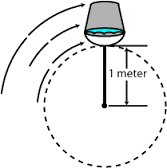
You swing a bucket of water attached to a string in a circle above your head. What keeps the water in the bucket?
a)
Friction
b)
Centripetal Force
c)
Gravity
d)
Inertia
20.

How does the force of gravity between two objects change when the distance between them is 3 times larger?

a)

3 times more

b)

3 times less

c)

9 times more

d)

9 times less