wayground logo

Free Printable Worksheets

NEW

Font size

S
M
L
XL
Worksheets

Earthquakes and Volcanoes Unit Test

Total questions: 39

Worksheet time: 23mins

Name
Class
Date
1.
Where is the point at which the first movement occurs during an earthquake?
a)
Epicenter
b)
Focus
c)
Fault
d)
Plate
2.
Where is the point on the Earth’s surface directly above the focus of an earthquake?
a)
Epicenter
b)
Fault
c)
Hypocenter
d)
Tremor
3.
Which type of wave is the first to arrive after an earthquake occurs?
a)
P Wave
b)
Rayleigh Wave
c)
S Wave
d)
Shear Wave
4.
Which body wave squeezes and stretches rock materials as they pass through the Earth?
a)
Body Waves
b)
P Waves
c)
S Waves
d)
Surface Waves
5.
What is the measure of the amount of energy released in an earthquake?
a)
Earthquake
b)
Epicenter
c)
Magnitude
d)
Seismogram
6.
Which scale rates earthquakes based on the amount of damage done?
a)
Mercalli Scale
b)
Richter Scale
c)
Seismogram Scale
d)
Bernoulli Scale
7.
The epicenter of an earthquake is
a)
The point below the surface where rock begins to break and the first motion occurs
b)
The seismic station closest to the earthquake
c)
The place where the greatest damage occurs
d)
The point on the surface directly above the focus
8.
Which travels fastest, always being the first detected by seismic stations?
a)
P waves
b)
S waves
9.
An instrument that detects and measures earthquakes is a 
a)
seismogram
b)
focus seismic map
c)
focus
d)
seismograph 
10.
Stress that squeezes rock!
a)
tension 
b)
compression
c)
shear
d)
boa constriction
11.
Stress that pushes masses of rock in opposite directions, in a sideways movement?
a)
shear
b)
compression
c)
tension
d)
constriction
12.
A type of fault where the hanging wall slides down...caused by tension.
a)
normal fault
b)
strike-slip fault
c)
reversynclinese fault
13.

The block of rock that forms the upper half of a fault?

a)

hanging wall

b)

cliff wall

c)

fault

d)

reverse fault

14.
A scale that rates earthquakes by estimating the total energy released by an earthquake?
a)
Richter scale
b)
moment magnitude scale
c)
Mercalli scale
d)
ph scale
15.
A type of fault where the hanging wall slides upward...caused by compression.
a)
hanging wall
b)
strike-slip fault
strike-slip fault
c)
normal fault
d)
reverse fault
16.
An upward fold in rock formed by compression of Earth's crust?
a)
anticline
b)
syncline
c)
normal fault
d)
fracture
17.
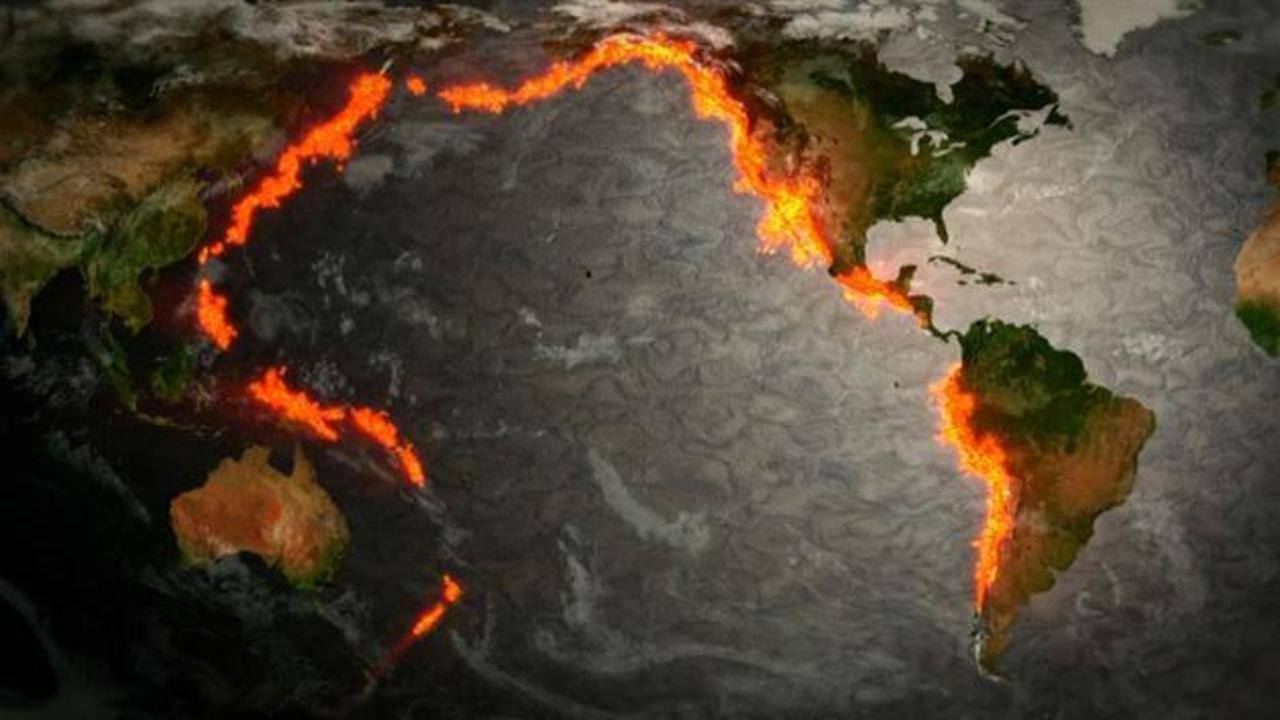
Which ocean in the world is also known as the "Ring of Fire"
a)
Atlantic
b)
Indian
c)
Arctic
d)
Pacific
18.
Which of these seismic waves creates the most damage during an earthquake?
a)
primary
b)
secondary
c)
surface
19.
The area around the Pacific Ocean where lots of earthquakes and volcanoes happen is called the ____________.
a)
Ring of Earth
b)
Ring of Fire
c)
Ring of Stone
d)
Ring of Diamond
20.

This type of fault is....

a)

normal fault

b)

reverse fault

c)

strike-slip fault

21.

This type of fault is....

a)

normal fault

b)

reverse fault

c)

strike-slip fault

22.
Stretching rock so it becomes thinner in the middle is what kind of stress?
a)
tension
b)
compression
c)
shearing
23.
What is molten rock that has formed deep within the Earth?
a)
Hot Spot
b)
Magma
c)
Lava
d)
Volcano
24.
The volcanoes on the Hawaiian Islands form due to which of the following?
a)
Divergent Boundary
b)
Hot Spot
c)
Subduction Boundary
d)
Transform Boundary
25.
What is molten rock that has reached the Earth's surface?
a)
Aa
b)
Lava
c)
Magma
d)
Pahoehoe
26.
Where do volcanoes come from?
a)
Places where plates move apart
b)
Places where plates are moving together
c)
Hot Spots
d)
All of these options
27.
What are scientists that study volcanoes called?
a)
doctor
b)
vet
c)
volcanologist
d)
volcano scientist
28.
What is the opening that extends from the magma chamber to the top of the volcano called?
a)
magma
b)
lava
c)
vent 
d)
crater
29.
Dormant volcanoes might erupt in the future.
a)
True
b)
False
30.

A volcano that erupts often is more dangerous than one that has been inactive for hundreds of years.

a)

True

b)

False

31.

Which 2 properties of magma determine the type of eruption?

a)

Amount of iron and viscosity

b)

Amount of iron and shearing

c)

amount of silica and viscosity

d)

amount of silica and shearing

32.

Which part of the volcano is the pipe?

a)

A

b)

B

c)

E

d)

F

33.

A volcanic island was created 150,000 years ago. Since then, the tectonic plate has moved. What stage is this volcano likely in?

a)

Active

b)

Dormant

c)

Extinct

34.

Mt. Kilauea erupts continuously. Why stage of it's life cycle is it likely in?

a)

Active

b)

Dormant

c)

Extinct

35.

Which is NOT a type of volcanic eruption?

a)

Quiet

b)

Explosive

c)

Magnitude

36.

Which eruption is likely to keep occurring over a long period of time?

a)

Quiet

b)

Explosive

c)

Magnitude

37.

Which boundary is LEAST likely to have volcanic activity?

a)

Transform

b)

Convergent

c)

Divergent

38.

Which of the following are ways geologists use seismic data?

a)

Mapping Faults

b)

Monitoring changes on faults

c)

Trying to predict EQ's and volcanoes

d)

all of the above

39.

Which is NOT a device used to monitor faults?

a)

GPS satellites

b)

tiltmeters

c)

laser-ranging devices

d)

scales