
 Worksheets
Physical Science Milestones Review
Total questions: 115
Worksheet time: 2hrs 40mins
Name
Class
Date
1.
The positive particles of an atom are
a)
electrons
b)
positrons
c)
neutrons
d)
protons
2.
True or False? Neutrons have a negative charge
a)
True
b)
False
3.
A particle that moves around the nucleus is a(n)...
a)
Proton
b)
Neutron
c)
Electron
d)
Quark
4.
In the modern periodic table elements are arranged by:
a)
atomic mass
b)
atomic number
c)
valence electrons
d)
number of isotopes
5.

What does the 1.00794 stand for?
a)
Hydrogen
b)
atomic number
c)
atomic mass
d)
atomic explosion
6.
all matter is made of what
a)
energy
b)
atoms
c)
electrons
d)
compounds
7.
The positive particles of an atom are
a)
electrons
b)
positrons
c)
neutrons
d)
protons
8.
the central region of an atom where its neutrons and protons are is its
a)
nucleus
b)
electron cloud
c)
core
d)
center
9.

What is the atomic mass of "F"
a)
9
b)
18
c)
17
d)
19
10.
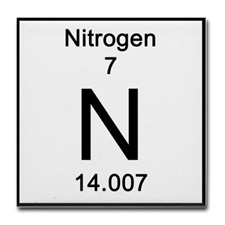
What is the number of protons that the element in this image contain?
a)
14
b)
7
c)
15
d)
18
11.
An atoms overall charge is
a)
positive
b)
depends on its mood
c)
neutral
d)
negative
12.
The particles that are found in the nucleus of an atom are
a)
neutrons and electrons
b)
electrons only
c)
protons and neutrons
d)
protons and electrons
13.
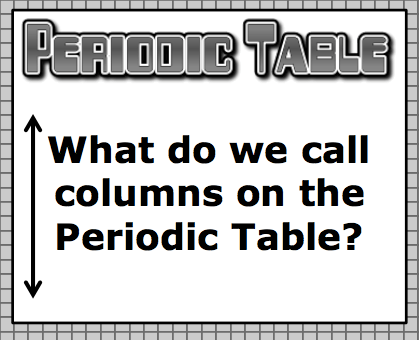
a)
Periods
b)
Groups
14.
a)
Periods
b)
Groups
15.
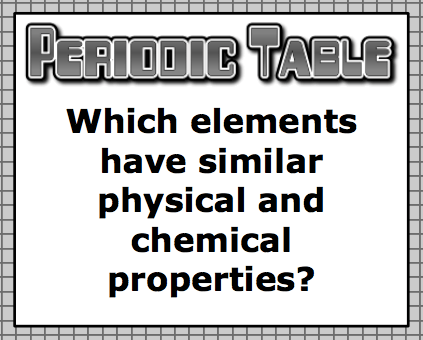
a)
Same group
b)
Same period
16.

The atoms along the staircase are called
a)
metals
b)
nonmetals
c)
metalloids
d)
noble gases
17.
The simplest substance is..?
a)
Carbon
b)
An element
c)
Water
d)
A simple compound
18.
Element is a
a)
pure substance
b)
compound
c)
mixture
d)
molecule
19.
How many elements are in HHe
a)
3
b)
4
c)
2
d)
5
20.

What does the element AI stand for ?
a)
Gold
b)
Actinium
c)
Iron
d)
Aluminum
21.
Is salt (NaCI) a compound or a element
a)
Compound
b)
element
22.
which one can be found on the periodic table
a)
Compound
b)
Element
23.
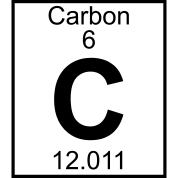
What does the C represent?
a)
atomic mass
b)
atomic number
c)
element name
d)
chemical symbol
24.
Which of the following is not a compound?
a)
HCl
b)
Cl
c)
NaCl
d)
CO2
25.
What is a PUSH or PULL of an object?
a)
Motion
b)
Force
c)
Friction
d)
Gravity
26.
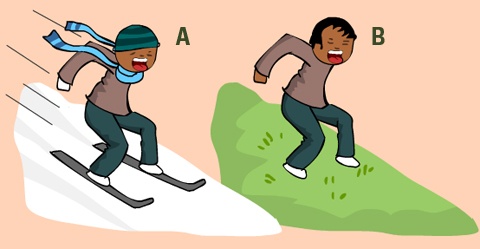
Why is it harder for the boy in Image B to get down the hill?
a)
Motion
b)
Friction
c)
Work
d)
Displacement
27.
Which force produces a change in motion?
a)
unbalanced force
b)
balanced force
c)
gravitational force
d)
frictional force
28.
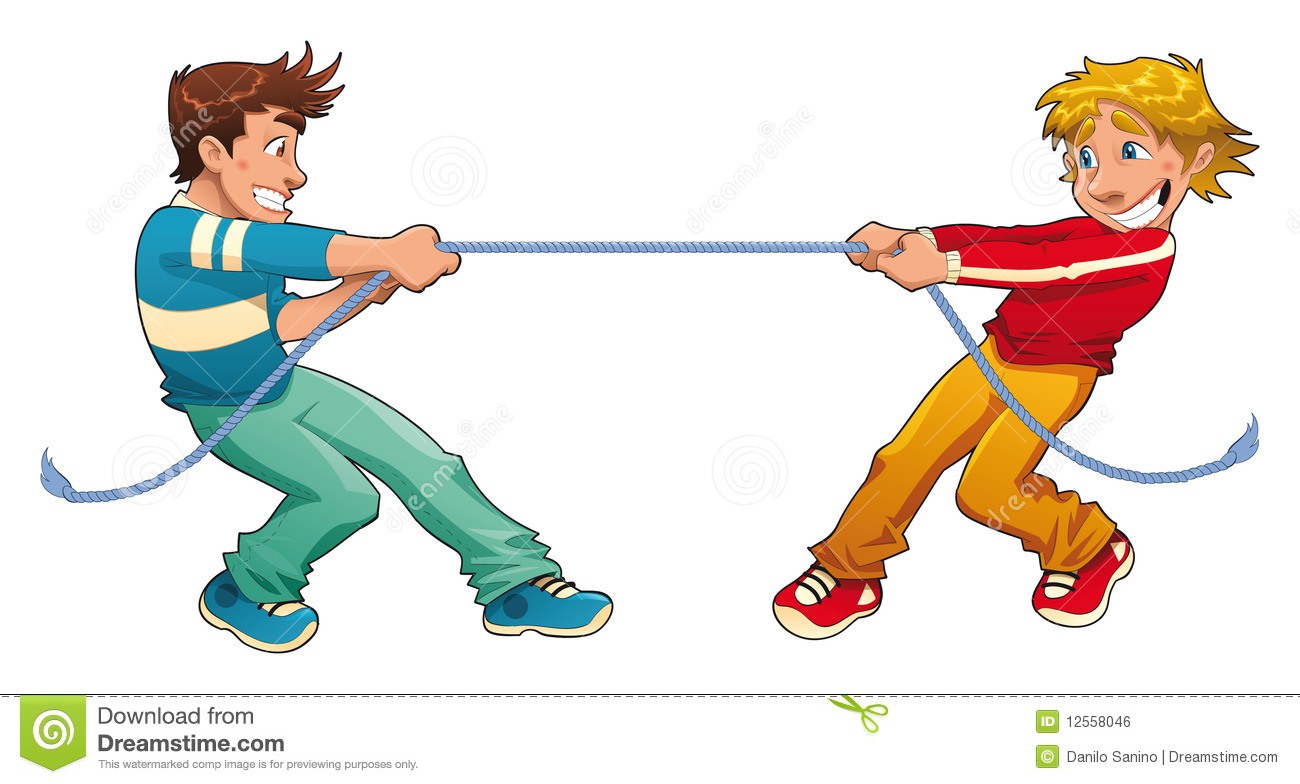
If these boys are pulling with the same amount of force. What will happen?
a)
The boy in blue will win.
b)
They will not move at all.
c)
The boy in red will win.
d)
Both will fall down.
29.
_______________ is how fast an object changes over time.
a)
speed
b)
velocity
c)
momentum
d)
acceleration
30.
What happens when two forces act in the same direction?
a)
They cancel each other out.
b)
The stronger one prevails.
c)
Their strengths are added.
d)
Their sum divided by the two is the total force.
31.
Any time the forces are unbalanced, an object will remain at rest. True or false?
a)
true
b)
false
32.
When you tell the direction and speed of an object, you give its
a)
motion
b)
velocity
c)
acceleration
d)
mass
33.
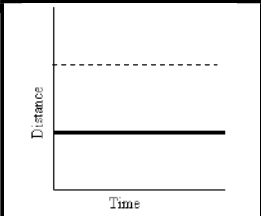
What does this graph represent?
a)
Constant speed
b)
Acceleration
c)
Not moving
34.
Which of the following objects has the least acceleration?
a)
a. an empty shopping cart pushed with a hard force
b)
b. a full shopping cart pushed with a hard force
c)
c. an empty shopping cart pushed with a light force
d)
d. a full shopping cart pushed with a light
force
35.

During which interval is the object speeding up?
a)
A to B
b)
B to C
c)
D to E
d)
E to F
36.

What is this graph showing?
a)
Constant Speed
b)
Acceleration (speeding up)
c)
Deceleration (slowing down)
d)
No motion
37.

During which interval are the forces on the object BALANCED (Net Force= 0 N)?
a)
A to B
b)
B to C
c)
D to E
d)
F to G
38.

Which runner stopped for a rest?
a)
Albert
b)
Bob
c)
Charlie
39.

Which runner won the race?
a)
Albert
b)
Bob
c)
Charlie
40.
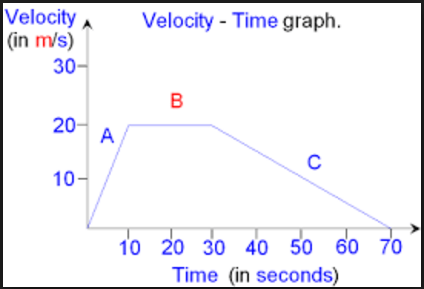
This is a velocity-time graph. What is the object doing in segment A?
a)
Positive acceleration
b)
Negative acceleration
c)
Constant Velocity
d)
Not moving
41.

This is a velocity-time graph. What is the object doing in segment B?
a)
Positive acceleration
b)
Negative acceleration
c)
Constant Velocity
d)
Not moving
42.

What does this graph represent?
a)
Constant speed
b)
Acceleration
c)
Not moving
43.
What is the standard unit force is measured in?
a)
Newtons
b)
pounds
c)
grams
d)
meters
44.
What is Newton's First Law known as? The Law of
a)
Friction
b)
Mass
c)
Inertia
d)
Gravity
45.
What is Newton's Third Law?
a)
Object in motion stays in motion and an object at rest stays at rest unless acted on by a outside force
b)
Force = mass x acceleration
c)
For every action there is an equal and opposite reaction
46.
According to Newton's second law, if you increase the force applied to an object :
a)
it accelerates more
b)
it doesn't move
c)
you get more inertia
d)
it decelerates
47.
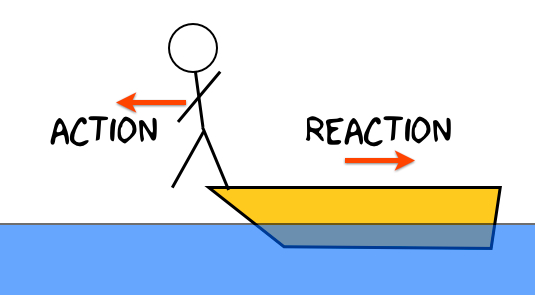
What law of motion does this picture represent?
a)
Newtons 1st law
b)
Newtons 4th law
c)
Newtons 3rd law
d)
Newtons 2nd law
48.
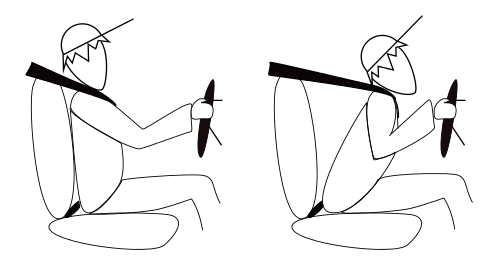
What Newtons law does this picture represent
a)
Newtons 2nd law
b)
Law of gravity
c)
Newtons 1st law
d)
Newtons 5th law
49.

What type of energy is in this picture?
a)
Kinetic
b)
Potential
c)
Electromagnetic
50.
When plants convert the sun's energy into food, which type of energy does the sun energy become?
a)
kinetic
b)
chemical
c)
thermal
51.

What form of energy?
a)
Mechanical (kinetic) energy
b)
Chemical (kinetic) energy
c)
Sound (potential) energy
d)
Sound (kinetic) energy
52.

What kind of energy?
a)
Thermal (kinetic) energy
b)
Thermal (potential) energy
c)
Nuclear (kinetic) energy
d)
Mechanical (kinetic) energy
53.

What form of energy?
a)
Thermal
b)
Electrical
c)
Mechanical
d)
Radiant
54.

What kind of energy?
a)
Radiant
b)
Electrical
c)
Thermal
d)
Chemical
55.

What kind of energy?
a)
Thermal (kinetic) energy
b)
Chemical (kinetic) energy
c)
Chemical (potential) energy
d)
Mechanical (kinetic) energy
56.

What form of energy is stored in the bonds between molecules of matter?
a)
chemical energy
b)
heat energy
c)
kinetic energy
d)
mechanical energy
57.
Stored energy that results from the position or shape of an object is called...
a)
Thermal
b)
Potential
c)
Kinetic
d)
Gravitational
58.

All of the different forms of energy move making them kinetic energy
a)
True
b)
False
59.
Which of the followings are examples of thermal energy?
a)
a violin string plucked, talking, ringing telephone
b)
boiling water, steam, heat from a flashlight
c)
candle flame, light bulb light
d)
energy from the sun (fusion, energy from a nuclear power plant (fission)
60.
Energy takes up space
a)
True
b)
False
61.
A baseball held by a pitcher has _____________energy.
a)
Kinetic
b)
Chemical
c)
Potential
d)
Thermal
62.

At which point is potential energy greatest?
a)
W
b)
X
c)
Y
d)
Z
63.

What kind of energy is in a moving skateboard?
a)
Potential
b)
Kinetic
c)
Both potential and kinetic energy
d)
none of the above
64.

What kind of energy is in a rock at the edge of a cliff?
a)
Potential
b)
Kinetic
c)
Both potential and kinetic energy
d)
none of the above
65.

What kind of energy is in a person climbing a ladder?
a)
Potential
b)
Kinetic
c)
Both
66.
Gravitational potential energy depends on the ________ and ________ of the object.
a)
Height and mass
b)
Friction and movement
c)
Mass and Movement
d)
Height and Friction
67.
Energy due to motion is ____________ energy.
a)
Potential
b)
Energy
c)
Kinetic
d)
Friction
68.
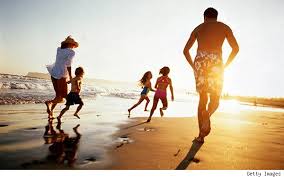
The sun shines down on this family as the play on the beach.
a)
conduction
b)
convection
c)
radiation
69.

A group of friends gather around a fire to stay warm.
a)
conduction
b)
convection
c)
radiation
70.

Blow drying your wet hair.
a)
conduction
b)
convection
c)
radiation
71.

Which direction will the heat flow while this person holds a hot cup of tea?
a)
from the cup to her hand
b)
from her hand to the cup
c)
no heat is transferred
72.
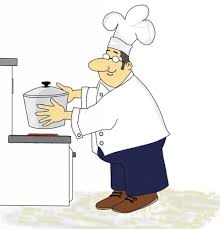
The man goes to take the hot pot off the stove with his bare hands.
a)
conduction
b)
convection
c)
radiation
73.
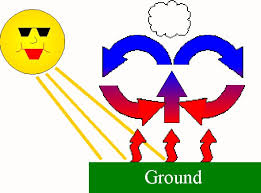
Warm air rises and the cool air sinks.
a)
conduction
b)
convection
c)
radiation
74.
Electricity that flows in a closed path is called a
a)
path
b)
current
c)
circuit
75.
Magnetism created by an electric current
a)
electricity
b)
electromagnetism
c)
wind energy
76.
____________ allows electricity to flow.
a)
A conductor
b)
An insulator
c)
A magnet
77.
____________ stops the flow of electricity.
a)
A conductor
b)
An insulator
c)
A magnet
78.

What kind of magnet can be turned on and off? (Man-made magnet)
a)
refrigerator magnet
b)
electromagnet
c)
magnetite
d)
iron
79.
How do like poles interact with each other? (north to north)
a)
They repel each other.
b)
They attract each other.
c)
Throw a toaster into a bathtub.
d)
No relationship.
80.

Choose the best option to complete this gap:
A magnetic field is the ________ around a magnet in which the magnetic force acts.
A magnetic field is the ________ around a magnet in which the magnetic force acts.
a)
pole
b)
electron
c)
area
d)
iron
81.
When you put the poles of two magnets together they will either attract or repel each other. Which of these sentence is correct?
a)
If the two poles are the same the magnets repel each other.
b)
If the two poles are the same the magnets attract each other.
c)
If the two poles are different the magnets repel each other.
82.
Opposite poles _____ .
a)
attract
b)
push away
c)
are balanced
d)
transfer electrons
83.
What is an electromagnet?
a)
a magnet that creates an electric current
b)
a device that created electricity
c)
a magnet that creates kinetic energy
d)
a device that creates a magnet
84.
What is the flow of electricity?
a)
electric motor
b)
Electric current
c)
Electric eel
d)
electric circuit
85.
What is the attraction and repulsion of magnetic materials called?
a)
A. electric generator
b)
B. magnetism
c)
C. solenoid
d)
D. electromagnet
86.

How do you make an electromagnet?
a)
wrap a battery in wire and connect it to an iron nail.
b)
wrap a wire with another wire and connect it to an iron nail.
c)
wrap an iron nail in wire and connect it to a power source.
d)
wrap an iron nail in wire and connect it to another iron nail.
87.
What is created when a wire moves between the poles of a magnet?
a)
A. a ferromagnet
b)
B. a solenoid
c)
C. an electromagnet
d)
D. an electric current
88.
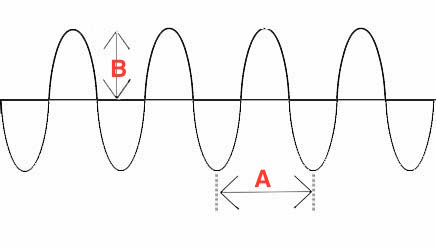
What property of this wave is represented by the letter "A"
a)
amplitude
b)
crest
c)
trough
d)
wavelength
89.
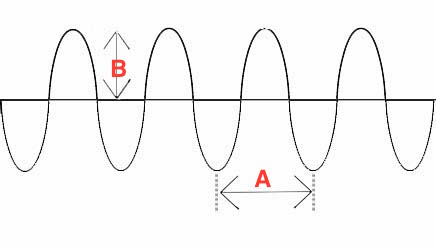
What property of the wave is represented by the letter "B"?
a)
amplitude
b)
crest
c)
trough
d)
wavelength
90.
The highest point on a wave is:
a)
the crest
b)
the trough
c)
the top
d)
the coast
91.
The lowest point on a wave is the:
a)
Amplitude
b)
Crest
c)
Trough
d)
Wavelength
92.
The number of wavelengths that pass a point each per second is:
a)
frequency
b)
period
c)
longitudinal
d)
transverse wave
93.
The type of waves that require medium to pass:
a)
Mechanical Waves
b)
Electromagnetic Waves
94.

Which vocabulary term is used to identify the distance between points C & G?
a)
Amplitude
b)
Crest
c)
Frequency
d)
Wavelength
95.
When the frequency of a wave increases, what happens to the wavelength?
a)
The wavelength is not directly affected by the frequency of a wave.
b)
The wavelength increases.
c)
The wavelength decreases.
d)
More specific information is needed to form a conclusion about the wavelength.
96.
A mechanical wave cannot travel through...
a)
a vacuum(empty space).
b)
water.
c)
air.
d)
glass.
97.
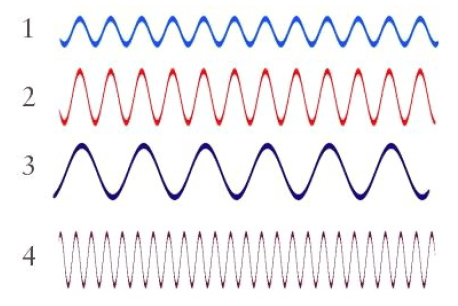
Which wave in the diagram has the greatest frequency?
a)
1
b)
2
c)
3
d)
4
98.
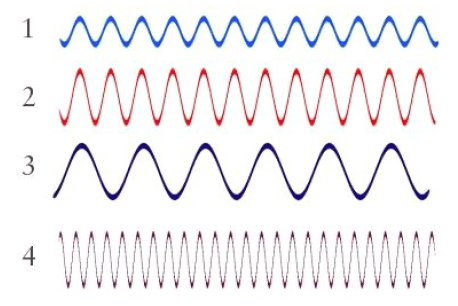
Which wave in the diagram has the greatest wavelength?
a)
1
b)
2
c)
3
d)
4
99.
Which of the following can sound travel through?
a)
solid
b)
liquid
c)
gas
d)
all of the above
100.
Electromagnetic waves include the following except
a)
radio waves
b)
X-rays
c)
doing the wave at a football game
d)
microwaves
101.
which material does sound travel the fastest?
a)
solid
b)
liquid
c)
gases
102.
A disturbance that travels through a medium as a longitudinal wave
a)
sound
b)
wavelength
c)
pitch
d)
frequency
103.
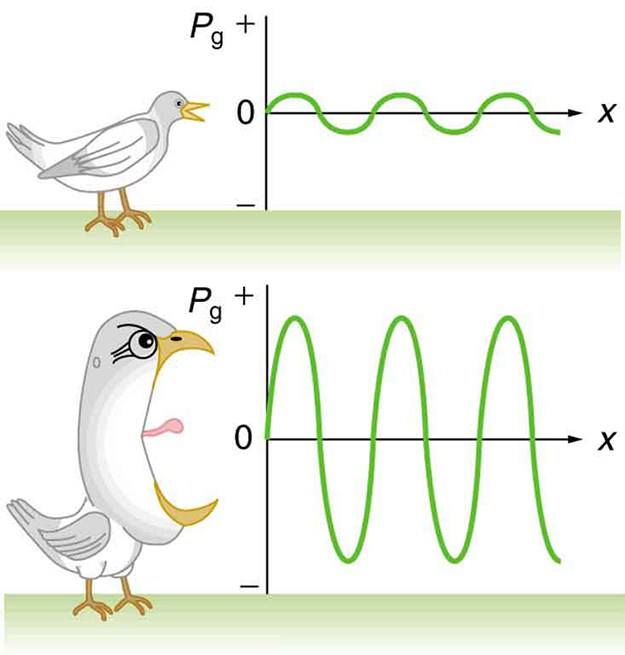
When a sound is louder what measurement gets bigger?
a)
Frequency
b)
Amplitude
c)
Wavelength
d)
Crest
104.
What does pitch depend on?
a)
amplitude
b)
frequency
c)
intensity
d)
volume of sound
105.
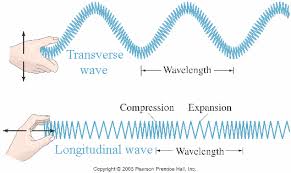
Sound waves are ALWAYS what type of wave?
a)
Transverse
b)
Longitudinal
c)
Depends
d)
always different
106.

What is B?
a)
crest
b)
trough
c)
compression
d)
rarefaction
107.
True or False: Sound travels better through solids than through liquids
a)
True
b)
False
108.
All waves carry
a)
energy
b)
light
c)
matter
d)
particles
109.
What do we call the part of a compressional wave that is spread a part?
a)
compression
b)
rarefaction
c)
crest
d)
trough
110.
Which statement best explains the difference between longitudinal and transverse waves?
a)
Longitudinal waves have troughs, while transverse waves have crests.
b)
Longitudinal waves produce energy, while transverse waves consume energy.
c)
Particles in longitudinal waves travel towards a force, while particles in transverse wave travel away from a force.
d)
Particles in longitudinal waves travel in the direction of the wave, while particles in transverse waves travel perpendicular to the wave.
111.
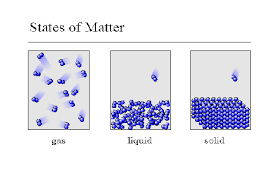
At higher temperatures
a)
particles in an object have less energy
b)
particles in an object move faster
c)
a gas contracts
112.
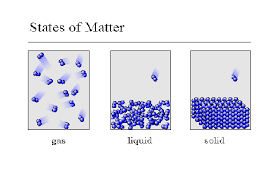
A gas
a)
has a definite shape but no definite volume
b)
has a definite volume but no definite shape
c)
has fast-moving particles
113.
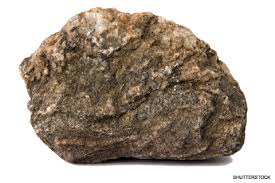
Which state of matter has tightly packed molecules?
a)
solid
b)
liquid
c)
gas
114.
Particles (molecules) in a ______________________ have more energy than the other states of matter.
a)
gas
b)
solid
c)
liquid
115.
Particles of a liquid
a)
are tightly packed together and stay in a fixed position.
b)
have no viscosity.
c)
decrease in volume with increasing temperature.
d)
are free to move around one another but still touch.
100 %

