wayground logo

Free Printable Worksheets

Font size

S
M
L
XL
Worksheets

Yr9 Particle Theory

Total questions: 110

Worksheet time: 2hrs 34mins

Name
Class
Date
1.

What is MATTER?

a)

Anything that has MASS

b)

Anything that takes up SPACE

c)

Anything that has MASS and takes up SPACE

d)

Anything that DOES NOT have mass or take up space

2.

All matter is made up of tiny _______________

a)

energy

b)

particles (atoms and molecules)

c)

bits

d)

antimatter

3.

Particles are always moving.

a)

True

b)

False

4.

Particles always ________________ each other, this gets stronger as the particles get ___________________.

a)

attract, farther apart

b)

attract, closer together

c)

repel, farther apart

d)

repel, closer together

5.

Particles at a higher temperature, move _____________ than those at a lower temperature.

a)

faster

b)

slower

6.
a)

Solid

b)

Liquid

c)

Gass

7.

These have a FIXED volume, but NOT a fixed shape, taking the shape of their container.

a)

Solid

b)

Liquid

c)

Gas

8.

In which state of matter will there be the LARGEST space between molecules?

a)

Solid

b)

Liquid

c)

Gas

9.

What is between atoms and molecules

a)

Air

b)

Empty space

c)

Magic

d)

Gas

10.
Number 2 represents a ________
a)
solid
b)
liquid
c)
gas
d)
plasma
11.
Particles in a _____________ are tightly packed together.
a)
solid
b)
liquid
c)
gas
d)
plasma
12.
Particles in a _________ take the shape of the container.
a)
solid
b)
liquid
c)
gas
d)
plasma
13.
As particles are exposed to warmer temperatures they __________
a)
speed up
b)
slow down
c)
stay the same
d)
vibrate
14.
As particles are exposed to colder temperatures they _____
a)
speed up
b)
slow down
c)
stay the same
d)
become ions
15.
What is the change of state from a solid straight to a gas called?
a)
melting
b)
evaporating
c)
freezing
d)
sublimation
16.
What am I? I have a fixed mass, a fixed volume, I cannot be squashed and I have a shape that changes to fit the bottom of my container?
a)
solid
b)
liquid
c)
gas
d)
plasma
17.
Which point of the particle theory is depicted by this picture?
a)
all matter is made of particles
b)
The attraction between particles increases as they get closer
c)
particles are in constant, random motion
d)
particles speed up as heat is added
18.
The amount of matter in an object is a measure of the object's ________________.
a)
volume
b)
density
c)
mass
d)
solubility
19.
At higher temperatures
a)
particles in an object have less energy
b)
particles in an object move faster
c)
a gas contracts
20.
Which of the following occurs when a liquid becomes a gas?
a)
the particles slow down
b)
the particles beak away from one another
c)
the particles move closer together
21.
Which state of matter has molecules that slide past each other but stay close together? They do not form a regular pattern.
a)
solid
b)
liquid
c)
gas
22.
Which state of matter has molecules that vibrate the least?
a)
solid
b)
water
c)
gas
23.
Which state of matter has a definite shape?
a)
solid
b)
liquid
c)
gas
24.
Which has particles that travel faster?
a)
gas
b)
solid
25.
What does the particle diagram show?
a)
solid
b)
liquid
c)
gas
d)
plasma
26.
In the above diagram, "State of Matter B" is a liquid. This means that it has:

a)
definite shape and volume.
b)
no definite shape or volume.
c)
definite volume, but changing shape.
d)
definite shape, but changing volume.
27.
What does the particle diagram show?
a)
solid
b)
liquid
c)
gas
d)
plasma
28.
What is the change of state from a gas to a liquid called?
a)
melting
b)
evaporation
c)
condensation
d)
sublimation
29.
What is the change of state from a solid straight to a gas called?
a)
melting
b)
evaporating
c)
freezing
d)
sublimation
30.
What am I? I have a fixed mass, a volume that changes, I can be squashed and I take the shape of all of my container.
a)
solid
b)
liquid
c)
gas
d)
plasma
31.
What am I? I have a fixed mass, a fixed volume, I cannot be squashed and I have a shape that changes to fit the bottom of my container?
a)
solid
b)
liquid
c)
gas
d)
plasma
32.
If the temperature of a gas increases what happens to its pressure?
a)
decreases
b)
increases
c)
stays the same
d)
increases and decreases
33.
As particles are exposed to warmer temperatures they __________
a)
speed up
b)
slow down
c)
stay the same
d)
vibrate
34.
As particles are exposed to colder temperatures they _____
a)
speed up
b)
slow down
c)
stay the same
d)
become ions
35.
Which point of the particle theory is depicted by this picture?
a)
all matter is made of particles
b)
The attraction between particles increases as they get closer
c)
particles are in constant, random motion
d)
particles speed up as heat is added
36.
Which point of the particle theory is depicted by this picture?
a)
all matter is made of particles
b)
particles are in constant, random motion
c)
particles speed up as heat is added and slow down as heat is removed
d)
different substances are made of different types of particles
37.

When something goes from gas to liquid, it is called...

a)

Evaporation

b)

Condensation

c)

Deposition

d)

Freezing

38.

Which of the following is a correct description for solids?

a)

closely arranged and in fixed positions

b)

closely arranged and vibrate in fixed positions

c)

closely arranged and can move around

39.
Which of the following statements about the particle of a gas is true?
a)
Gases can be compressed because their particles are smaller than those of liquids or solids.
b)
Gases can be compressed because there is plenty of space between their particles.
c)
Gases can be compressed because they have low boiling points.
d)
Gases can be compressed because their particles are more elastic than those of liquids or solids.
40.
An inflated balloon is placed in a refrigerator. Which statement describes the movement of the gas particles in the balloon?
a)
The particles move more slowly and become closer together.
b)
The particles move more slowly and become further apart.
c)
The particles move faster and become closer together.
d)
The particles move faster and become further apart. 
41.

Particles are always moving.

a)

True

b)

False

42.

This diagram represents particles in a ______________ state.

a)

Solid

b)

Liquid

c)

Gas

43.
What is the atomic number?
a)
the number of protons
b)
the number of protons and neutrons
c)
the number of neutrons
d)
the number of protons and electrons
44.
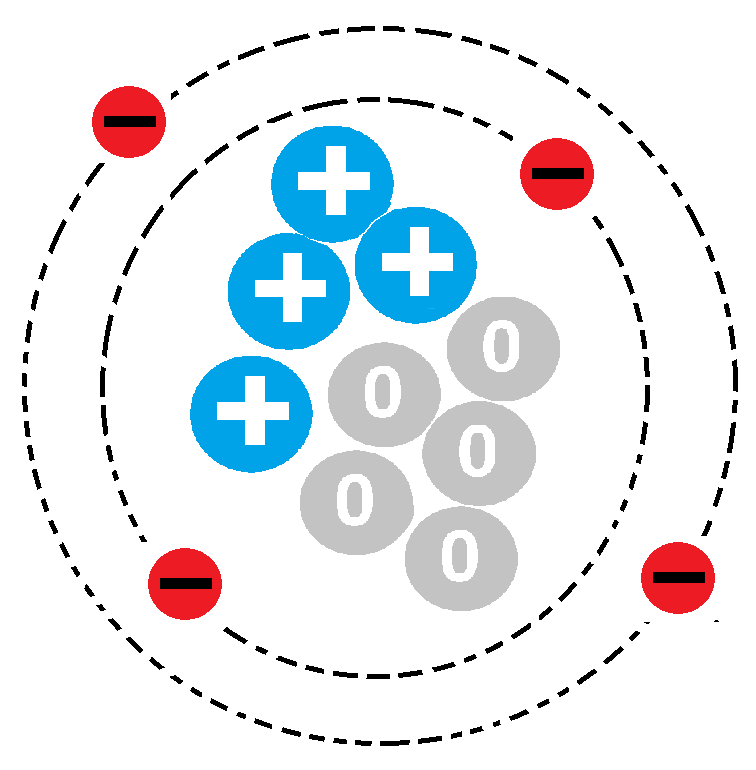
What is the atomic number of this nucleus?
a)
1
b)
3
c)
4
d)
7
45.
What is the atomic number of this atom?
a)
4
b)
5
c)
9
d)
none of the above
46.
What is the atomic number of this atom?
a)
2
b)
4
c)
6
d)
none of the above
47.
What is the atomic number of this atom?
a)
1
b)
2
c)
3
d)
4
48.
What is the atomic number of this atom?
a)
8
b)
16
c)
24
d)
none of the above
49.
Which particle has a positive charge?
a)
electron
b)
orbital
c)
proton
d)
neutron
50.
What is the mass number defined as?
a)
the number of protons
b)
the number of protons and neutrons
c)
the number of neutrons
d)
the number of protons and electrons
51.

What is the mass number of this atom?

a)

1

b)

3

c)

4

d)

7

52.

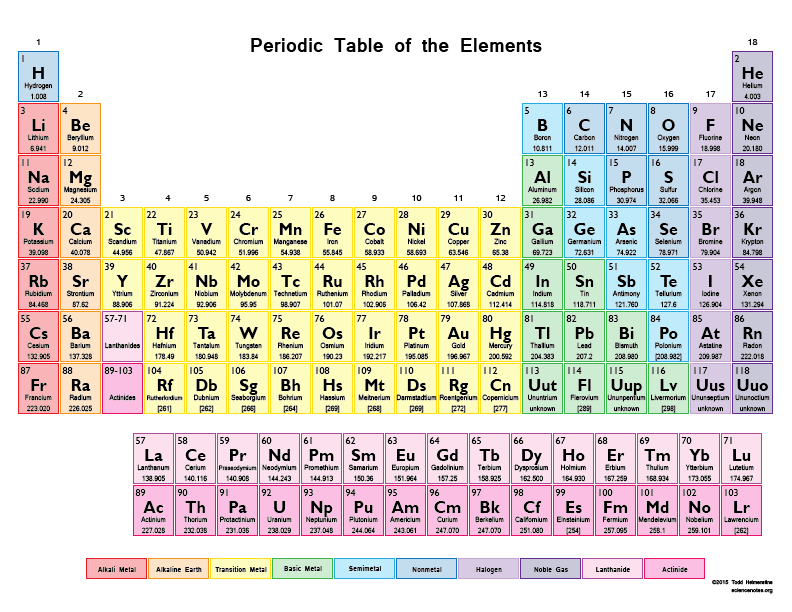
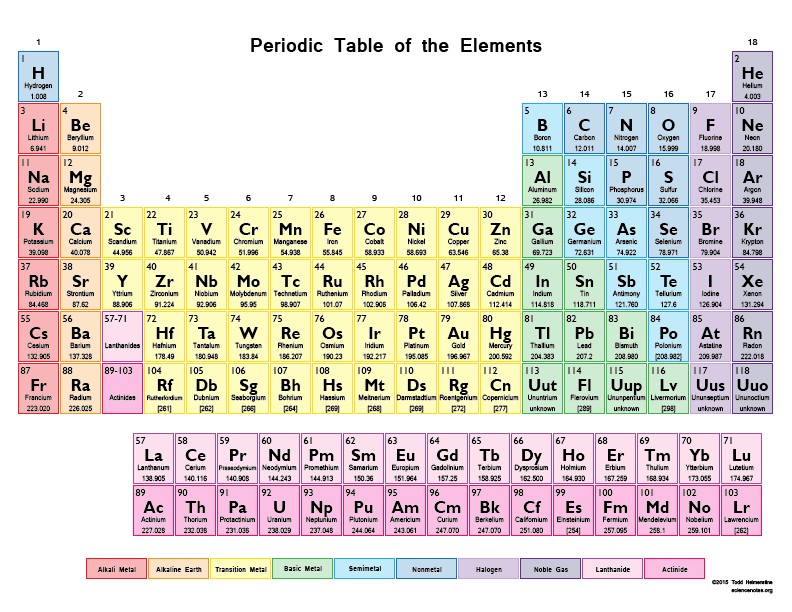
What is the atomic number of Barium, Ba? (enlarge the periodic table)

a)

20

b)

38

c)

56

d)

88

53.

How many protons are in a sodium atom, Na? (tap to enlarge the periodic table)

a)

Sodium has 1 proton.

b)

Sodium has 3 protons.

c)

Sodium has 11 protons

54.

An element has the mass number 12 and atomic number 6. The number of neutrons in it is:

a)

6

b)

10

c)

4

d)

8

55.

Which subatomic particle has a negative charge in the atom?

a)

proton

b)

neutron

c)

electron

d)

quark

56.

If an atom has 10 electrons, how many protons does it have?

a)

0

b)

1

c)

10

d)

5

57.

How many electrons are in an atom with an atomic number of 50?

a)

5

b)

8

c)

50

d)

2

58.
Choose the particle that has no charge.
a)
nucleus
b)
neutron
c)
proton
d)
electron
59.
What is the mass number of this atom?
a)
4
b)
5
c)
9
d)
none of the above
60.
What is the mass number of this atom?
a)
1
b)
2
c)
3
d)
4
61.
What is the mass number of this atom?
a)
8
b)
16
c)
24
d)
none of the above
62.
Which particles make up the nucleus of an atom?
a)
protons and neutrons
b)
electrons and protons
c)
electrons, protons, and neutrons
d)
electrons and neutrons
63.
What is the formula to solve for the neutron?
a)
Mass + Atomic Number= Neutrons
b)
Mass x Atomic Number = Neutrons
c)
Mass - Atomic Number = Neutrons
d)
Mass + Number of Protons = Neutron
64.
An atom with 19 protons, and 19 electrons and a mass of 39 has how many neutrons?
a)
19
b)
39
c)
20
d)
58
65.

James wants to seperate the salt from the water in his glass of salt water. What seperation method should James use?

a)

Magnets

b)

Evaporation

c)

Filter

d)

Using his hands

66.

Nicole wants to dissolve a substance in water. Which substance will dissolve the easiest?

a)

Rocks

b)

sugar

c)

pepper

d)

sand

67.

What mixture could you use this tool to best separate that mixture?

a)

Sugar and Salt

b)

Sand and rocks

c)

Apples and grapes

68.

The air is a mixture of different gas molecules.
a)
True
b)
False
69.
Two or more substances mingled together, but not chemically combined are known as a
a)
residue
b)
solution
c)
distillate
d)
mixture
70.
Sand and gravel may be separated from each other through using..
a)
a filter funnel
b)
a sieve
c)
an evaporating basin
d)
a distillation
71.
Which of the following pairs of substances may best be separated through distillation
a)
 sand and soil
b)
water and soil
c)
salt and sand
d)
 water and alcohol
72.
Which one of the following techniques would best be used to separate soil and water?
a)
Decanting
b)
distillation
c)
Filtration
d)
Chromatography
73.
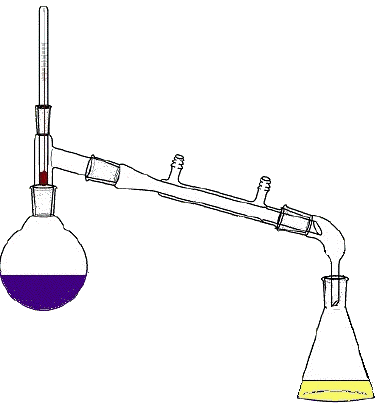
Name the separation technique shown in the diagram.
a)
evaporation
b)
distillation
c)
 filtration
d)
decanting
74.
Sodium chloride can be separated from rock salt by first adding water to the mixture to dissolve the sodium chloride. The separation then takes place in two stages:
a)
evaporation followed by filtration
b)
 distillation followed by decanting
c)
filtration followed by evaporation
d)
filtration followed by decanting
75.
Which one of the following would you use to separate sand from iron filings?
a)
a bar magnet
b)
filter paper
c)
chromatography paper
d)
alum
76.
Which one of the following would you use to separate sand from iron filings?
a)
a bar magnet
b)
filter paper
c)
chromatography paper
d)
alum
77.
Water and alcohol are easily separated by distillation because of their
a)
 different melting points
b)
different colours
c)
different densities
d)
different boiling points
78.
To separate iron filings and sulfur what method should you use?
a)
filtration 
b)
sorting
c)
magnet
d)
boiling
79.
How would you separate the ingredients of mixture Z?
a)
Water
b)
A magnet
c)
A sieve
d)
My hands
80.
How would you separate a mixture of sand and salt? 
a)
Mix them with water and let the water evaporate
b)
Mix them with water, pour the mixture through a sieve, then let the water evaporate
c)
Heat the sand and salt mixture for 5 minutes, then let it cool
d)
I would not do any of these because none of these options would work
81.
Which one of the following is NOT a mixture?
a)
Sugar
b)
Paint
c)
Crude oil
d)
Air
82.

Carbon Dioxide is an example of a __________

a)

Element

b)

Compound

c)

Homogeneous Mixture

d)

Heterogeneous Mixture

83.

Carbon Dioxide is an example of a __________

a)

Element

b)

Compound

c)

Homogeneous Mixture

d)

Heterogeneous Mixture

84.
a)
element
b)
compound
c)
mixture of elements
d)
mixture of compounds
85.
a)
element
b)
compound
c)
mixture of elements
d)
mixture of compounds
86.
a)
element
b)
compound
c)
mixture of elements and compounds
d)
mixture of compounds
87.
a)
element
b)
compound
c)
mixture of elements
d)
mixture of compounds
88.
a)
element
b)
compound
c)
mixture of elements and compounds
d)
mixture of compounds
89.
a)
element
b)
compound
c)
mixture of elements and compounds
d)
mixture of compounds
90.
a)
element
b)
compound
c)
mixture of elements and compounds
d)
mixture of compounds
91.
a)
element
b)
compound
c)
mixture of elements
d)
mixture of compounds
92.

This diagram describes particles of a __________

a)
element
b)
compound
c)
mixture of elements
d)
mixture of compounds
93.

How many atoms are found in the compound below?

NaHCO3

a)

6

b)

5

c)

4

d)

3

94.

Check a box for each element that is found in the chemical formula below:


NaHCO3

a)

Hydrogen

b)

Sodium

c)

Carbon

d)

Cobalt

e)

Oxygen

95.

Which of the following is a compound?

a)

Co

b)

CO2

c)

Na

d)

H

96.

How many different elements are in the compound?

a)

12

b)

3

c)

24

d)

6

97.

How many atoms are in the compound?

a)

12

b)

6

c)

24

d)

3

98.

How many atoms are there in Aluminium oxide?

a)

2

b)

6

c)

5

d)

3

99.

How many atoms are there in calcium carbonate?

a)

2

b)

4

c)

5

d)

3

100.

How many atoms are there in sodium bicarbonate?

a)

6

b)

4

c)

5

d)

7

101.

Check a box for each element that is found in the chemical formula below:

PCl3

a)

Iodine

b)

Carbon

c)

Chlorine

d)

Phosphorus

e)

Potassium

102.

Check a box for each element that is found in the chemical formula Borox below:

Na2B4O7

a)

oxygen

b)

barium

c)

boron

d)

Natrium

e)

sodium

103.

How many atoms are there in the compound below:

Na2B4O7

a)

12

b)

13

c)

14

d)

3

104.

How many atoms of Hydrogen are in H2O

a)

1

b)

2

c)

3

d)

more than 3

105.

How many atoms are there TOTAL in H2SO4 ?

a)

6

b)

5

c)

7

d)

3

106.
Which is the correct formula for:
 three hydrogen (H)
one sulfur (S)
four oxygen (O)
a)
H3SO4
b)
HSO4
c)
H4S3O
d)
H2O
107.

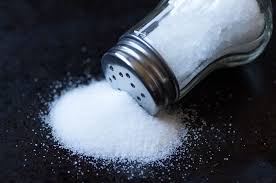
NaCl is the chemical formula for salt. Is NaCl considered a compound or an element?

a)

element

b)

compound

c)

both

d)

neither

108.

We breathe oxygen. Its chemical formula is O2. Is this formula an element or a compound?

a)

element

b)

compound

c)

neither

d)

both

109.
Which of the following is a compound?
a)
Co
b)
O2
c)
C
d)
CO2
110.

Your most favorite teacher at school is your....

a)

Science Teacher

b)

Science Teacher

c)

Science Teacher

d)

Science Teacher