wayground logo

Free Printable Worksheets

Font size

S
M
L
XL
Worksheets

Review - MC 1

Total questions: 163

Worksheet time: 4hrs 42mins

Name
Class
Date
1.

Question refers to aqueous solutions containing 1:1 mole ratios of the following pairs of substances. Assume all concentrations are 1 M.

1. A buffer with a pH less than 7

a)

sodium hydroxide and ammonia

b)

sodium hydroxide and hydrochloric acid

c)

hydrobromic acid and potassium bromide

d)

acetic acid and sodium acetate

e)

methylammine and methylammonium chloride

2.
A gas at a volume of 4 liters is at a pressure of 8 Pa. The volume is changed to 16 Liters, what must the new pressure be?
a)
1 Pa
b)
12 Pa
c)
10 Pa
d)
2 Pa
3.
This graph is an example of two variables that are:
a)
directly proportional
b)
inversely proportional
c)
Straight line
d)
No relation
4.
4.50 L of a gas has a pressure of 760.0 mmHg; what would the new volume be at 200.0 mmHg? (assuming constant temperature and amount)
a)
1.18 L
b)
1.180 L
c)
17.1 L
d)
17.10 L
5.
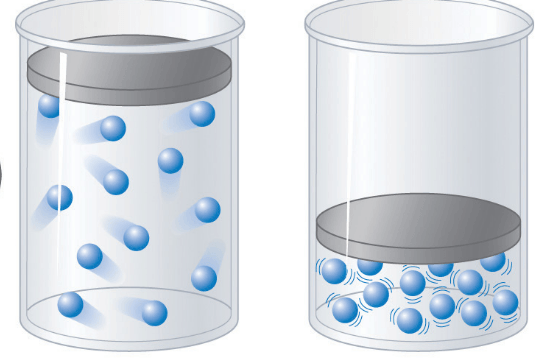
Which container will have a lower pressure?
a)
left
b)
right
c)
they both have the same pressure
d)
I don't know
6.
Calculate the volume that a 0.323-mol sample of a gas will occupy at 265 K and a pressure of 0.900 atm.
a)
7.18 L 
b)
7.81 L
c)
4.63 L
d)
4.36 L
7.
Determine the Kelvin temperature required for 0.0470 mol of gas to fill a balloon to 1.20 L under .998 atm pressure. 
a)
0 K 
b)
107 K 
c)
207 K 
d)
307 K 
8.
Each of these flasks contains the same number of molecules. In which container is the pressure highest?
a)
Flask 1
b)
Flask 2
c)
Flask 3
d)
Flask 4
9.
A reaction that releases energy is called?
a)
exothermic
b)
endothermic
c)
hypothermic
d)
hyperthermic
10.
Energy stored in the chemical bonds of the substance is called?
a)
kinetic energy
b)
chemical potential energy
c)
heat
11.
This device is used to measure the absorption or release of heat in a chemical or physical process.
a)
calorimeter
b)
calorimetry
c)
heat capacity
d)
specific heat
12.
For an endothermic reaction, the heat is on the ____ side.
a)
reactant
b)
product
c)
either side
13.
What type of reaction is shown in the reaction pathway?
a)
endothermic reaction
b)
exothermic reaction
14.
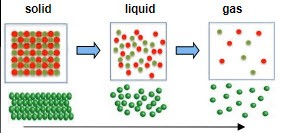
Entropy increases from solid, liquid to gas. Why?
a)
Molecular disorder increases
b)
Molecular randomness decreases
c)
Molecules are more energetic
d)
Molecules are more reactive
15.
When ammonium nitrate dissolves in water, the solution gets cold. Which is true?
a)
Reaction is ENDOTHERMIC with positive ΔH
b)
Reaction is ENDOTHERMIC with -ΔH
c)
Reaction is EXOTHERMIC with a -ΔH
d)
Reaction is EXOTHERMIC with +ΔH
16.
The reaction
A + 2 B2 + C --> CAB4
has an enthalpy change of -104 kJ and a change in entropy of -60.8 J/K at 30 °C. What is the free energy and spontaneity of the reaction?  
a)
-85.6 kJ, spontaneous
b)
-18.3 kJ, not spontaneous
c)
+18.3 kJ, spontaneous 
d)
+85.6 kJ, not spontaneous 
17.
A reaction has a positive ΔH and a positive ΔS. Which of the following is true?
a)
It will be spontaneous at all temperatures.
b)
It will be nonspontaneous at all temperatures.
c)
It will be spontaneous at low temperatures.
d)
It will be spontaneous at high temperatures.
18.
Solid magnesium dissolves in a hydrochloric acid, releasing hydrogen gas and heat from a solution of magnesium chloride. What is the sign on ΔG for this reaction?
a)
Negative because it is spontaneous
b)
Negative because it is nonspontaneous
c)
Positive because it is spontaneous
d)
Positive because it is nonspontaneous
19.
 For which of these processes is the value of ΔH expected to be positive?
1.  The temperature increases when calcium chloride dissolves in water.
2.  Steam condenses to liquid water
3.  Water boils
4.  Dry ice sublimates
a)
4 only
b)
1 only
c)
3 and 4 only
d)
2 and 3 only
20.
A 5.00 gram sample of a metal at 85.0 °C comes in contact with 100.0 grams of water at 25.0 °C.  What is the direction of the heat flow and why?
a)
Metal to water, since heat flows from low mass to high mass
b)
Water to metal, since heat flows from high mass to low mass
c)
Metal to water, since heat flows from high temp. to low temp.
d)
Water to metal, since heat flows from low temp. to high temp.
21.
If 5.00 grams of water is cooled from 65.2 °C to 35.6 °C, what is the heat change?
a)
619 J
b)
-619 J
c)
148 J
d)
-148 J
22.
From the following enthalpy changes,
 H2 (g) + F2 (g) → 2HF (g)           ∆H° = -542.2 kJ
2H2 (g) + O2 (g) → 2H2O (l)     ∆H° = -571.6 kJ calculate the value of ∆H° for the reaction:  2F2 (g) + 2H2O (l) → 4HF (g) + O2 (g)
a)
-1113.8 kJ
b)
-1656.0 kJ
c)
-512.8 kJ
d)
29.4 kJ
23.
Which of the following would have a nonzero enthalpy of formation?
a)
Fe(s)
b)
Br2(s)
c)
O2(g)
d)
Hg(l)
24.
The reaction with the largest increase in entropy is...
a)
CH4(g) + 2O2(g) → CO2(g) + 2H2O(g) 
b)
CH4(l) + 2O2(g) → CO2(g) + 2H2O(l) 
c)
CH4(g) + 2O2(g) → CO2(g) + 2H2O(l) 
d)
CH4(l) + 2O2(g) → CO2(g) + 2H2O(g)
25.

What day is the test this year (2018) ?

a)

May 6

b)

May 7

c)

May 8

d)

May 9

26.

Is the test in the morning or afternoon

a)

Morning

b)

Afternoon

27.

What is the percent ratio of the whole score of MC : FR respectively?

a)

25% : 75%

b)

50%: 50%

c)

75% ; 25%

d)

45% ; 55%

28.

How much time is given for the FR section?

a)

95 min

b)

100 min

c)

105 min

d)

110 min

29.

What is the highest score in an AP chem test?

a)

4

b)

5

c)

6

d)

7

30.

What is the minimum score you can get for college credit and scholarship elegibility?

a)

2

b)

3

c)

4

d)

5

31.
The force of attraction between nonpolar molecules:
a)
Hydrogen Bonding
b)
Dipole - Dipole Forces
c)
LDF
d)
Ionic Forces
32.
From 30 degrees to 55 degrees, what state of matter is the substance?
a)
Solid
b)
Liquid
c)
Gas
d)
Plasma
33.
Which of these is not an intermolecular force?
a)
covalent bonding
b)
hydrogen bonding
c)
London dispersion forces
d)
dipole-dipole forces
34.
Which IMF contains a temporary dipole?
a)
London Dispersion Forces
b)
Dipole Dipole
c)
Hydrogen Bonding
d)
Both London Dispersion Forces and Dipole Dipole
35.
What is the predominant IMF for NH3?
a)
London dispersion forces
b)
Dipole dipole
c)
Hydrogen bonding
d)
What is an IMFA?
36.
In general, substances with stronger intermolecular forces have ________ boiling points than those with weaker forces
a)
Higher
b)
Lower
c)
Forces and boiling point are not related
37.
If a liquid has high viscosity, it probably has:
a)
strong IMF
b)
weak IMF
38.
Which is the strongest intermolecular force below
a)
Ionic
b)
Dispersion
c)
Hydrogen bonding
d)
dipole-dipole
39.
Which of these has the strongest London forces?
a)
F2
b)
Br2
c)
Cl2
d)
I2
40.
What line segment represents only the solid state?
a)
A-B
b)
B-C
c)
C-D
d)
D-E
41.
Which process takes the longest to occur?
a)
melting
b)
boiling
c)
freezing
d)
heating the solid
42.
What state(s) of matter are present at D-E?
a)
Solid-liquid
b)
Liquid
c)
Liquid-gas
d)
Gas-Solid
43.
Which of the following diagrams best depicts an alloy of Ni and B?
a)
A
b)
B
c)
C
d)
D
44.
a)
Polar covalent bond
b)
Nonpolar covalent bond
c)
Hydrogen bond
d)
London dispersion forces
45.
a)
C4H10, because it has more H atoms, resulting in more H-bonding
b)
C4H10, because it has more electrons, resulting in greater polarizability and stronger LDFs
c)
C2H6, because its molecules are smaller and they can get closer to each other, resulting in stronger LDFs
d)
C2H6, because its molecules are more polar, resulting in stronger dipole-dipole attractions
46.
What is the predominant IMF in the molecule NOF?
a)
LDFs
b)
Dipole dipole
c)
Hydrogen bonding
d)
Polar
47.
What is the strongest IM attraction in H2S?
a)
dispersion/Van der Waal
b)
dipole
c)
hydrogen bonding
48.
What is the strongest IM attraction in CCl4?
a)
dispersion/Van der Waal
b)
dipole
c)
hydrogen bonding
49.
What is the strongest IM attraction in CH3Cl?
a)
dispersion/Van der Waal
b)
dipole
c)
hydrogen bonding
50.
Rank the IM forces from strongest to weakest.
a)
dipole, hydrogen bonding, dispersion
b)
dispersion, dipole, hydrogen bonding
c)
hydrogen bonding, dipole, dispersion
d)
hydrogen bonding, dispersion, dipole
51.
thiosulfate
a)
S2O32-
b)
SO42-
c)
SCN1-
d)
ThSO42-
52.
permanganate
a)
MnO41-
b)
MnO32-
c)
MnO21-
d)
MnO1-
53.
thiocyanate
a)
SCN1-
b)
S2O32-
c)
CN1-
d)
ThCN1-
54.
carbonate
a)
CO32-
b)
CO22-
c)
CO3
d)
CO2
55.
CN1-
a)
cyanide
b)
cyanate
c)
carbon nitride
d)
cyanite
56.
perchlorate
a)
ClO41-
b)
ClO31-
c)
ClO21-
d)
ClO1-
57.
ClO21-
a)
chlorite
b)
chlorate
c)
hypochlorite
d)
hypochlorate
58.
ClO1-
a)
hypochlorite
b)
chlorate
c)
chlorite
d)
perchlorate
59.
hydrogen phosphate
a)
HPO42-
b)
H2PO42-
c)
HPO32-
d)
H2PO41-
60.
phosphite
a)
PO33-
b)
PO42-
c)
PO32-
61.
phosphate
a)
PO43-
b)
PO42-
c)
PO33-
d)
PO32-
62.
hydroxide
a)
HO-1
b)
OH-1
c)
HO
d)
OH
63.
acetate
a)
C2H3O2-1
b)
Ac-1
c)
CH2COO-1
d)
C4H4O62-
64.
peroxide
a)
O22-
b)
O2-
c)
O21-
d)
O1-
65.
nitrite
a)
NO21-
b)
NO31-
c)
NO3
d)
NO2
66.
nitrate
a)
NO3-1
b)
NO2-1
c)
NO3
d)
NO2
67.
sulfite
a)
SO32-
b)
SO42-
c)
SO3
d)
SO4
68.
Sulfate
a)
SO42-
b)
SO32-
c)
SO4
d)
SO3
69.
Sulfate
a)
SO42-
b)
SO32-
c)
SO4
d)
SO3
70.
chromate
a)
CrO42-
b)
Cr2O72-
c)
CrO41-
d)
Cr2O71-
71.
ammonium
a)
NH4+
b)
NH4
c)
NH3
d)
NH3-
72.
What atom matches this electron configuration?
1s22s22p63s2
a)
Neon
b)
Magnesium
c)
Aluminum
d)
Potassium
73.
What atom matches this electron configuration?
1s22s22p63s23p64s23d10
a)
Zinc
b)
Copper
c)
Nickel
d)
Germanium
74.
An orbital can at most hold how many electrons?
a)
1 electron
b)
2 electrons
c)
3 electrons
d)
4 electrons
75.
The electron configuration of an atom is 1s22s22p6.  The number of electrons in the atom is 
a)
3
b)
6
c)
8
d)
10
76.
What is the electron configuration of Ag?
a)
1s2 2s2 2p6 3s2 3p6 4s2 3d10 4p6 5s1 4d10
b)
[Kr] 5s2 4d9
c)
1s2 2s2 2p6 3s2 3p6 4s2 4p6 5s2 4d9
d)
1s2 2s2 2p6 3s2 3p6 3d10 4s2 4d10 4p6 5d10 5s2 4d9
77.
1.  What is the shape of an s orbital?
a)
sphere
b)
dumbbell
c)
double dumbbell
d)
TOO COMPLEX TO KNOW IT.
78.
How many d orbitals are there in a given sublevel?
a)
1
b)
3
c)
5
d)
7
79.
How many electrons can the d sublevel hold?
a)
8
b)
10
c)
2
d)
4
80.
Which is associated with more energy? 
a)
2p
b)
2s
c)
3p
d)
1s
81.
What is this element? 
1s22s22p63s23p6
4s23d104p6
a)
Argon
b)
Krypton
c)
Selenium
d)
Bromide
82.
Electrons occupy orbitals of lowest energy first is part of what electron configuration rule?
a)
Hund’s Rule
b)
Aufbau Principle
c)
Pauli Exclusion Principle
83.
Which is a correct orbital box diagram?  
a)
a
b)
b
c)
d
d)
e
84.
How many valence electrons does an element with the following electron configuration have?
1s22s22p63s23p64s23d104p2
a)
2
b)
4
c)
14
d)
32
85.
Which of the following will have a larger radius than Zinc?
a)
Gallium
b)
Aluminum
c)
Magnesium
d)
Strontium
86.
Which of the following will have a higher electronegativity than arsenic (As)?
a)
Carbon (C)
b)
Neon (Ne)
c)
Antimony (Sb)
d)
Germanium (Ge)
87.
As atoms of elements in group 16 are considered in order from top to bottom, the electronegativity of each successive element....
a)
decreases
b)
increases
c)
remains the same
d)
none of the above
88.
Which atom has the largest atomic radius?
a)
potassium
b)
rubidium 
c)
francium
d)
cesium
89.
As you move down the periodic table atoms get bigger.  This is because ____________.
a)
The atoms have more mass.
b)
The atoms have more protons.
c)
The atoms have more energy levels
d)
The atoms have more nuetrons
90.
As you move across the periodic table atoms tend to get smaller because, ______________.
a)
the atoms have more mass.
b)
the atoms have less mass
c)
the atoms have more protons.
d)
the atoms have less electrons.
91.
The element with the lowest electronegativity in Period 3 is - 
a)
Na
b)
Cl
c)
Ar
d)
Mg
92.
Elements Z and X are compared. Element Z is larger than Element X. Based on this you could say: 
a)
Element Z is further to the left side of the periodic table
b)
Element X is closer to the top of the periodic table 
c)
Element Z and X are probably in the same group 
d)
Two of these answers are correct
93.
The element bromine is a -
a)
Period 3 alkali metal.
b)
Period 4 halogen.
c)
Period 3 noble gas.
d)
Period 4 transition metal.
94.
If a balloon is cooled what will happen to the volume?
a)
Volume will increase
b)
Volume will decrease
c)
Volume will not change
95.
The greater the speed of gas particles in a container, the:
a)
greater the pressure
b)
fewer collisions there will be
c)
lower the temperature
d)
lower the pressure
96.
Atoms with the same number of protons & different numbers of neutrons are known as ____.
a)
isotopes
b)
isomers
97.
Which of the following shows the correct dissolution reaction for BaCl2?
a)
Ba 2+(aq) + Cl2-(aq) -> BaCl2(s)
b)
BaCl2(aq) -> Ba 2+(aq) + 2Cl-(aq)
c)
 BaCl2(s) -> Ba 2+(aq) + 2Cl-(aq)
d)
Ba 2+(aq) + 2Cl-(aq) -> BaCl2(s)
98.
If K < Q, which part of the reaction will speed up?
a)
forward
b)
reverse
c)
none
99.
An unknown salt, M2Z, has a Ksp of 3.3 x 10⁻⁹. Calculate the solubility in mol/L of M2Z.
a)
2.9 x 10⁻⁵ M
b)
5.7 x 10⁻⁵ M
c)
9.4 x 10⁻⁵ M
d)
3.7 x 10⁻⁵ M
100.
The molar solubility of PbI2 is 1.52 x 10⁻³ M. Calculate the value of Ksp for PbI2.
a)
3.51 x 10⁻⁹
b)
1.40 x 10⁻⁸
c)
4.62 x 10⁻⁶
d)
1.52 x 10⁻³
101.
Calculate the [H+] in a solution that has a pH of 2.73.
a)
5.4 x 10⁻¹² M
b)
1.9 x 10⁻³ M
c)
2.7 M
d)
11.3 M
102.
The pH at the equivalence point of the titration of a strong acid with a strong base is:
a)
3.9
b)
4.5
c)
7.0
d)
8.2
103.
Which of the following is a conjugate acid/base pair?
a)
HCl/OCl-
b)
H2SO4/SO42-
c)
NH4+/NH3
d)
H3O+/OH-
104.
Silver chromate, Ag2CrO4, has a Ksp of 8.96 x 10⁻¹². Calculate the solubility in mol/L of silver chromate.
a)
1.31 x 10⁻⁴M
b)
1.65 x 10⁻⁴M
c)
2.25 x 10⁻¹²M
d)
2.08 x 10⁻⁴M
105.
The pH of a solution at 25C in which [OH-] = 3.9 x 10⁻⁵M is:
a)
4.41
b)
3.90
c)
9.59
d)
4.80
106.
Calculate the pH of a 0.47M NH3 (Kb = 1.8 x 10⁻⁵) solution.
a)
2.54
b)
8.93
c)
5.07
d)
11.46
107.
The solubility of CaSO4 in pure water at 0C is 1.14 g/L. The value of the solubility product is
a)
8.37 x 10⁻³
b)
1.14 x 10⁻³
c)
9.15 x 10⁻²
d)
7.01 x 10⁻⁵
108.
A weak acid, HF, is in solution with dissolved sodium fluoride, NaF. If HCl is added, which ion will react with the extra hydrogen ions from the HCl to keep the pH from changing?
a)
OH-
b)
Na+
c)
F-
d)
Na-
109.
The correct mathematical expression for finding the molar solubility (s) of Sn(OH)2 is:
a)
2s2 = Ksp
b)
2s3 = Ksp
c)
4s3 = Ksp
d)
8s3 = Ksp
110.
An unknown salt, M2Z, has a Ksp of 3.3 x 10⁻⁹. Calculate the solubility in mol/L of M2Z.
a)
2.9 x 10⁻⁵ M
b)
5.7 x 10⁻⁵ M
c)
9.4 x 10⁻⁵ M
d)
3.7 x 10⁻⁵ M
111.
When the chemical reaction A + B ↔ C+ D is at equilibrium,
a)
both the forward and reverse reactions have stopped.
b)
the sum of the concentrations of A and B equals the sum of the concentrations of C and D.
c)
all four concentrations are equal.
d)
neither the forward nor the reverse reactions have stopped.
112.
A substance that ionizes completely in solution is
a)
an insulator.
b)
a strong electrolyte. 
c)
a weak acid.
d)
a non-electrolyte.
113.
When citric acid is produced by the cells of an orange and dissolves in water, it produces a relatively small number of hydronium ions. Citric acid is best described as a
a)
concentrated acid. 
b)
weak acid. 
c)
dilute acid.
d)
strong acid.
114.
Which is the weakest acid?
a)
HF
b)
HNO2
c)
CH3COOH
d)
HClO
115.
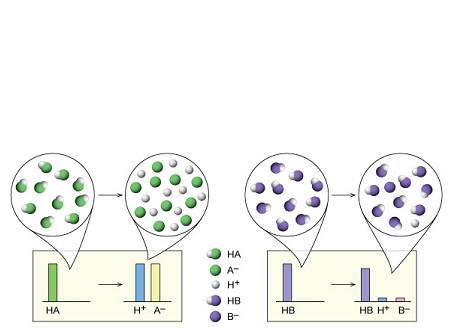
Which of the following correctly describes the strengths of the acids in solution?
a)
HA and HB are both examples of strong acids.
b)
HA and HB are both examples of weak acids.
c)
HA is an example of a strong acid, HB is an example of a weak acid.
d)
HA is an example of a weak acid, HB is an example of a strong acid. 
116.
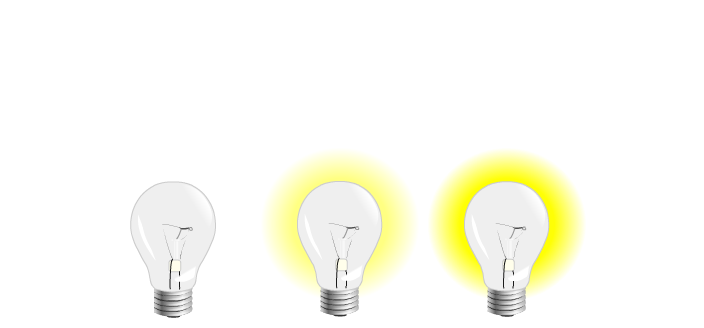
Which of the following acids in water would most likely result in a strongly lit light bulb that is connected to electrodes?
a)
HNO3; Ka > 1
b)
HClO2; Ka = 1.1x10⁻²
c)
HCH3H5O3; Ka = 1.38x10⁻⁴
d)
H2CO3; Ka = 4.3x10⁻⁷
117.
What is the correct formula for this molecule?
a)
NH
b)
N3H
c)
NH3
d)
NH4
118.
Which of the following is the correct Lewis dot structure for the molecule fluorine (F2)?
a)
A
b)
B
c)
C
d)
D
119.
How many electrons should Phosphorus have around its Lewis dot model?
a)
2
b)
4
c)
5
d)
7
120.
How many electrons should Chlorine have around its Lewis dot model?
a)
5
b)
6
c)
7
d)
8
121.
Which of the following is an ionic bond?
a)
H3N
b)
CaCl2
c)
NO2
d)
SCl
122.
Draw the Lewis structure for OF2 and determine the number of lone pairs on the central atom.
a)
none
b)
1
c)
2
d)
it's ionic
123.
When Aluminum forms an ionic compound then it will ________________ electron(s).
a)
gain 1
b)
gain 2 
c)
gain 3
d)
lose 3 
124.
What is the electron configuration of Ag?
a)
1s2 2s2 2p6 3s2 3p6 4s2 3d10 4p6 5s1 4d10
b)
[Kr] 5s2 4d9
c)
1s2 2s2 2p6 3s2 3p6 4s2 4p6 5s2 4d9
d)
1s2 2s2 2p6 3s2 3p6 3d10 4s2 4d10 4p6 5d10 5s2 4d9
125.
A diatomic element with a high ionization energy would most likely be a 
a)
nonmetal with high electronegativity
b)
metal with high electronegativity
c)
nonmetal with low electronegativity
d)
metal with low electronegativity
126.
As we move down Group 1 elements of the Periodic Table, the first ionization energy of each element decreases. One reason for this is that 
a)
the nuclear charge is decreasing
b)
the number of energy levels is decreasing
c)
distance between valence electrons and the nucleus increases
d)
the number of neutrons is increasing
127.
Within period 2 of the periodic table, as the atomic number increases, the atomic radius generally
a)
decreases
b)
increases
c)
remains the same
d)
none of the above
128.
Which atom has the largest atomic radius?
a)
potassium
b)
rubidium 
c)
francium
d)
cesium
129.
This electrode in a voltaic cell gains mass
a)
anode
b)
cathode
130.
Reactions in voltaic cells are
a)
spontaneous, redox reactions
b)
non-spontaneous, redox reactions
c)
spontaneous, non-redox reactions
d)
non-spontaneous, non-redox reactions
131.
In a voltaic cell, the half cell that receives anions from the salt bridge is
a)
cathode
b)
anode
132.
Which energy conversion shown below takes place in a galvanic cell?
a)
electrical to chemical
b)
mechanical to chemical
c)
mechanical to electrical
d)
chemical to electrical
133.
Consider the following numbered processes:
1. A -> 2B
2. B -> C + D
3. E -> 2D
ΔH for the process A -> 2C + E is
a)
ΔH1 + ΔH2 + ΔH3
b)
ΔH1 + ΔH2 
c)
ΔH1 + ΔH2 - ΔH3
d)
ΔH1 + 2ΔH2 - ΔH3
134.
Consider the following processes:
I.  condensation of a liquid
II. increasing volume of an ideal gas at constant temp
III. dissolving sugar in water
IV. heating 1.0 mol of an ideal gas at constant volume
For how many of these is ΔS positive?
a)
0
b)
1
c)
2
d)
3
135.
For the reaction A + B -> C + D, ΔH = +40 kJ and ΔS = +50 J/K. Therefore, the reaction under standard conditions is
a)
spontaneous at temps > 10K
b)
spontaneous at temps > 800K
c)
spontaneous at temps between 10K and 800K
d)
spontaneous at all temperatures
136.
Which is most acidic?
a)
pH = 8.5
b)
[H3O+] = 1 x  10-13
c)
[H3O+] = 1 x  10-2
d)
pH = 3
137.
Which is most acidic?
a)
pH = 8.5
b)
[H3O+] = 1 x  10-13
c)
[H3O+] = 1 x  10-2
d)
pH = 3
138.
For 2A + B → 2C, the rate of production of C has been found to be 12 M/s. During that reaction, the rate of reaction was?
a)
12 M/s
b)
24 M/s
c)
6 M/s
d)
Cannot tell without more data
139.
step 1: O3 → O2 + O
step 2: O3 + O → 2 O2

The oxygen atom (O) is considered to be a(n)...
a)
reactant
b)
catalyst
c)
reaction intermediate
d)
activated complex
140.
a)
rate = k[CO]2[O2]2
b)
rate = k[CO]2[O2]
c)
rate = k[CO][O2]2
d)
rate = k[CO][O2]1/2
141.
Which one of the following elements has the greatest ionization energy?
a)
Al
b)
Cl
c)
Br
d)
S
142.
Which of the following is true of an element in an excited state?
a)
It has emitted a photon and its energy has decreased
b)
It has emitted a photon and its energy has increased
c)
It has absorbed a photon and its energy has increased
d)
It has absorbed a neutron and its energy has increased
143.
Which molecular geometry tends to be nonpolar?
a)
Bent
b)
Trigonal Pyramidal
c)
Trigonal Bipyramidal
d)
Square Pyramidal
144.
The pH of a solution at 25C in which [OH-] = 3.9 x 10⁻⁵M is:
a)
4.41
b)
3.90
c)
9.59
d)
4.80
145.
A weak acid, HF, is in solution with dissolved sodium fluoride, NaF. If HCl is added, which ion will react with the extra hydrogen ions from the HCl to keep the pH from changing?
a)
OH-
b)
Na+
c)
F-
d)
Na-
146.
Which one of the following will change the value of an equilibrium constant?
a)
Adding other substances that do not react with any of the species involved in the equilibrium.
b)
Varying the initial concentrations of reactants.
c)
Varying the initial concentrations of products.
d)
Changing temperature
147.
Which of the following is a general characteristic of a nonmetal?
a)
Low Density
b)
Nonconductor of heat
c)
Brittle
d)
All of the above
148.
How many electrons can occupy the n=4 shell (energy level)?
a)
8
b)
10
c)
18
d)
32
149.
Which one of the following atoms is the largest?
a)
Rb
b)
Na
c)
Ca
d)
Te
150.
Which one of these molecules has a trigonal pyramidal molecular geometry?
a)
SO3
b)
NF3
c)
IF3
d)
BF3
151.
Which of the following electron domain geometries has an sp2 hybridized central atom?
a)
Trigonal Pyramidal
b)
Tetrahedral
c)
Trigonal Bipyramidal
d)
Trigonal Planar
152.
Which molecular geometry tends to be nonpolar?
a)
Bent
b)
Trigonal Pyramidal
c)
Trigonal Bipyramidal
d)
Square Pyramidal
153.
An alkaline earth metal is expected to have a _____ ionization energy and a _____ electron affinity.
a)
small; large
b)
small; small
c)
large; small
d)
large; large
154.
What is the molecular geometry of Cl2CO?
a)
Tetrahedral
b)
Trigonal Planar
c)
Trigonal Pyramidal
d)
Linear
155.
Which of the following compounds will have the lowest boiling point?
a)
CH4
b)
CHCl3
c)
CH3CH2OH
d)
NH3
156.
Which of the following compounds has the highest boiling point?
a)
CH3CH2CH3
b)
CH3CH2CH2CH3
c)
CH3CH3
d)
CH4
157.
At the molecular level, ideal gases:
a)
do not occupy space
b)
occupy space
c)
do not exhibit intramolecular forces
d)
exhibit intramolecular forces
158.
If both the pressure and temperature of a gas are halved, the volume is
a)
halved
b)
doubled
c)
quadrupled
d)
the same
159.
Which gas has the greatest density at STP?
a)
CO2
b)
O2
c)
N2
d)
NO
160.
Coca-Cola is carbonated by injection with carbon dioxide gas.  Under what conditions is carbon dioxide gas most soluble?
a)
high temperature, high pressure
b)
high temperature, low pressure
c)
low temperature, low pressure
d)
low temperature, high pressure
161.
What is the oxidation number of Br in NaBrO3?
a)
-1
b)
+1
c)
+3
d)
+5
162.
Which of the following would be a weak electrolyte in a solution?
a)
HBr
b)
KCl
c)
KOH
d)
HC2H3O2
163.
Under acidic conditions, what is the coefficient in front of the Fe+2 once the reaction below is balanced?
          Fe+2 + Cr2O7-2 --> Fe+3 + Cr+3
a)
1
b)
2
c)
3
d)
6