wayground logo

Free Printable Worksheets

Font size

S
M
L
XL
Worksheets

2021-2022 Final review

Total questions: 162

Worksheet time: 6hrs 43mins

Name
Class
Date
1.
What is the mass of 2.50 mol of oxygen gas O2?
a)
40.0 g
b)
80.0 g
c)
16.0 g
d)
32.0 g
2.
How many molecules are in 32.4 grams of phosphorous pentoxide?
a)
1.76 x 10²³ molecules
b)
0.29 moles
c)
1.76 x 10²² molecules
d)
0.29 molecules
3.
What is the percent by mass of sodium in NaCl?
a)
39%
b)
61%
c)
35%
d)
65%
4.
What is the percent composition by mass of magnesium in the compound MgSO4 (gram formula mass = 120 g/mol)?
a)
20%
b)
27%
c)
46%
d)
53%
5.
What is the molar mass of AuCl3?
a)
96 g
b)
130 g
c)
232.5 g
d)
303.3 g
6.

The number 6.022 x 10²³ is called...

a)

A dozen

b)

Bohr's number

c)

Buckley's number

d)

Avogadro's number

7.

What is the mass of one mole of potassium (K)?

a)

19 grams

b)

39.10 grams

c)

30.97 grams

d)

38 grams

8.

To convert from moles to grams, you should multiply by ....

a)
b)
c)
d)
9.

0.50 moles of carbon (C) is equal to how many grams?

a)

6.0 grams

b)

12.0 grams

c)

8.0 grams

d)

14.0 grams

10.

36.0 g of beryllium (Be) contains how many moles?

a)

0.25 mol

b)

4.0 mol

c)

45 mol

d)

320 mol

11.

What is the molar mass of AuCl3?

a)

96.00 g/mol

b)

130.00 g/mol

c)

232.51 g/mol

d)

303.32 g/mol

12.
What is the percent by mass of oxygen in MgO?
a)
20%
b)
40%
c)
50%
d)
60%
13.
What is the percent by mass of sodium in NaCl?
a)
39%
b)
61%
c)
35%
d)
65%
14.
What is the percent by mass of chlorine in NaCl?
a)
39%
b)
61%
c)
35%
d)
65%
15.
Ammonia has a pH of 12.  Ammonia is __________.
a)
an acid
b)
a base
c)
an element
d)
a metal
16.
When dissolved in water, bases produce:
a)
acids
b)
salts
c)
hydrogen ions
d)
hydroxide ions
17.
Which of these solutions is an acid?
a)
Dish Soap: pH of 12
b)
Tomato Soup: pH of 4
c)
Baking Soda: pH of 9
d)
Drain Cleaner: pH of 14
18.
What does the pH scale measure?
a)
the concentration of acids and bases
b)
the malleability of a metal
c)
the temperature of the water in a swimming pool
d)
the amount of phosphorus in a compound
19.
The pH of vinegar is 2.5.  Vinegar is a _____________.
a)
strong acid
b)
strong base
c)
weak base
d)
weak acid
20.
Which of the following is true about acids and bases?
a)
The lower the pH, the stronger the acid
b)
the higher the pH, the stronger the acid
c)
The lower the pH, the more neutral the acid
d)
The higher the pH, the weaker the base
21.
Which statement is true when acids and bases are mixed together?
a)
acids become stronger
b)
bases become stronger
c)
there is no change
d)
they neutralize each other
22.
What is the pH of water?
a)
0
b)
4
c)
7
d)
14
23.
Which of these pH values would indicate that a solution is a weak base?
a)
4
b)
5.6
c)
8
d)
13
24.
When dissolved in water, acids produce:
a)
bases
b)
salts
c)
hydrogen ions
d)
hydroxide ions
25.

pH of 0-6

a)

Base

b)

Acid

26.

What is the pH range of a base?

a)

0-6

b)

8-14

c)

0-14

d)

0-16

27.
Values from 0-14 that determine the acidity of a solution
a)
Molarity
b)
Polarity
c)
pH scale
d)
Solubility
28.
If the [H+] of a solution is 1 x 10⁻² mol/L the pH is
a)
2
b)
12
c)
-2
d)
1
29.
If the pH of a solution is 5.6 the pOH is
a)
6.5
b)
12.4
c)
8.4
d)
5.6
30.
A  pH and a pOH will add up to:
a)
0
b)
7
c)
14
d)
1.0 x 10⁻¹⁴
31.
If the [OH-] of a solution is 2.7 x 10⁻⁴ mol/L the pOH of the solution is
a)
10.44
b)
3.56
c)
1.00
d)
-4.43
32.
If the [H+] of a solution is 6.8 x 10⁻⁹ mol/L the pH is
a)
8.17
b)
8.2
c)
9.99
d)
8.62
33.
if the [H+] of a solution is 8.4 x 10⁻³ mol/L the pOH of the solution will be
a)
2.08
b)
11.92
c)
1.02
d)
12.98
34.
Limes have a [H3O+] of 1.3 x 10⁻² mol/L.  Their pOH is
a)
1.89
b)
12.11
c)
1.03
d)
12.97
35.
If [H3O+]=1.7 x 10⁻³ M, what is the pH of the solution?
a)
2.13
b)
1.81
c)
2.77
d)
2.42
36.
What is the pH of a
4.3 x 10⁻⁷ solution of H2CO3?
a)
7
b)
6.4
c)
7.6
d)
4.3
37.
In the chemical formula for an ionic compound, which item is written first?
a)
positive ion
b)
negative ion
c)
subscript
d)
the female
38.
Magnesium bromide is an ionic compound with the chemical formula MgBr₂.  What does the "2" tell you?
a)
There are 2 bromide ions for every magnesium ion
b)
Bromide has a 2- charge
c)
Bromide has a 2+ charge
d)
There are 2 magnesium ions to every bromide ion
39.
Which is the correct name for CaBr2?
a)
Calcium Bromine
b)
Bromine Calcium
c)
Calcium Bromide
d)
Carbon and Bromine
40.
What is the formula of Sodium oxide?
a)
Na2O
b)
NaO2
c)
Na2O2
d)
Na2O
41.
What is the formula of calcium oxide?
a)
CaO2
b)
CaO
c)
Ca2O
d)
CO
42.
What is the formula for magnesium phosphide?
a)
Mg3P2
b)
Mg2P3
c)
Mg2(PO4)3
d)
Mg3(PO4)2
43.
Write the formula for barium + nitrogen
a)
Ba2N3
b)
Ba3N2
c)
BaN
d)
BaN3
44.
Write the correct chemical formula for Ag  and  Br -
a)
AgBr
b)
silver bromide
c)
Ag2Br2
d)
gold bromide
45.
What is the formula for tin (II) nitride?
a)
Sn3N2
b)
SnN2
c)
Sn3N
d)
SnN
46.
Name the following ionic compound: MgSO4
a)
magnesium sulfoxide
b)
magnesium sulfide
c)
magnesium sulfate
d)
magnesium oxide
47.
If copper (II) and phosphate bond together, the resulting chemical formula would be:
a)
Cu2(PO4)3
b)
CuPO4
c)
Cu3(PO4)2
d)
Cu3PO4
48.
What is the formula for aluminum sulfide?
a)
Al2S3
b)
Al3S2
c)
Al2SO4
d)
AlS
49.
What is the name for CaS?
a)
calcium sulfate
b)
calcium sulfide
c)
calcium monosulfide
d)
monocalcium monosulfide
50.
What is the name for LiF?
a)
Lithium Fluoride
b)
Lithium Fluorine
c)
Fluorine Lithide
51.
A cation is a ____ ion.
a)
negative
b)
positive
52.
A anion will be a ____ ion.
a)
negative
b)
positive
53.
4Si + S8 --> 2Si2S4
a)
Synthesis
b)
Decomposition
c)
Single displacement
d)
Double displacement
54.
3Ca + 2AlCl3 --> 3CaCl2 + 2Al
a)
Synthesis
b)
Decomposition
c)
Single diplacement
d)
Double displacement
55.
3KOH + H3PO4 --> K3PO4 + 3H2O
a)
Synthesis 
b)
Decomposition
c)
Single displacement
d)
Double displacement
56.
2Pb(NO3)2 --> 2PbO + 4NO2 + O2
a)
Synthesis 
b)
Decomposition
c)
Single displacement
d)
Combustion
57.
3Mg + N2 --> Mg3N2
a)
Synthesis 
b)
Decomposition
c)
Single displacement
d)
Combustion
58.
2NO2 --> N2 + 2O2
a)
Synthesis
b)
Decomposition
c)
Single displacement
d)
Combustion
59.
P4 + 3O--> 2P2O3
a)
Synthesis 
b)
Decomposition
c)
Single displacement
d)
Combustion
60.
Fe + H2SO4 --> Fe2(SO4)3 + H2
a)
Synthesis (combination)
b)
Decomposition
c)
Single replacement
d)
Combustion
61.
Which reaction type is the following: C5H10O4 + O2 --> CO2 + H2O
a)
Decomposition
b)
Single Replacement
c)
Combustion
d)
Double Replacement
62.
Balance this equation:
 __Li + __Cl2 -> __LiCl
a)
2Li + Cl2 -> 4LiCl2
b)
2Li + Cl2 -> LiCl2
c)
2Li +  Cl2 -> 2LiCl
63.

Balance the following:

____ Fe + ____ Cl2 → ____ FeCl3

a)
1,1,2
b)
1,3,1
c)
2,2,3
d)
2,3,2
64.

Balance the following:

____ Al + ____ O2 → ____ Al2O3

a)
2,3,4
b)
4,3,2
c)
1,1,2
d)
2,1,1
65.

What is the charge of Iron in this compound. (Hint: think criss cross method):

Fe3(PO4)2

a)

+3

b)

+2

c)

+1

66.

What is the correct way of representing hydrogen gas alone, in a reaction?

a)

2H

b)

H

c)

H2

67.
Which type of radiation has the greatest penetrating power?
a)
Alpha
b)
Beta
c)
Gamma 
d)
Microwaves
68.
Balance the following equation:
146C --> 0-1e + ________
a)
145B
b)
146C
c)
147N
d)
42He
69.

In the symbol 167N what the 7 stand for?

a)

Mass number

b)

Atomic number

c)

Atomic mass

d)

Number of neutrons

70.
The time taken for half of an amount of radioactive atoms to decay.
a)
Nuclear fusion
b)
Full-life
c)
Dead time
d)
Half-life
71.
A nuclear reaction where a nucleus splits into two smaller nuclei is... 
a)
Fission
b)
Fusion
c)
Gamma decay
d)
Beta decay
72.
What element is the ?
a)
Ag-115
b)
Cd-115
c)
Pd-115
d)
Not Listed
73.
Which type of nuclear radiation is being emitted here?
a)
alpha
b)
beta
c)
gamma
d)
none
74.

Solve this equation for beta decay.

6027Co = ___ + 0-1β

a)

5625Mn

b)

6028Ni

c)

5823V

d)

5927Co

75.
The following is an example of what type of reaction?
24395Am  →  23993Np + 42He 
a)
alpha decay
b)
beta decay
c)
gamma decay
76.
When an unstable radioactive atom decays, it usually turns into:
a)
a more stable atom
b)
a less stable atom
c)
the exact same atom but with less pure energy
d)
empty space
77.
An atom's _________ is its number of protons.
a)
atomic number
b)
mass number
c)
weight number
d)
football number
78.
A helium nucleus with two protons and two neutrons is called a(n) ____.  
a)
alpha particle
b)
electroscope
c)
beta particle
d)
gamma ray
79.
When nuclei decay, massive amounts of __________ is released.
a)
energy
b)
jello
c)
protons
d)
neutrons
80.

Which type of decay is stopped by lead?

a)

Alpha

b)

Beta

c)

Gamma

81.

Which type of decay is stopped by Aluminum foil?

a)

Alpha

b)

Beta

c)

Gamma

82.

Which type of radiation is stopped by a piece of paper

a)

Alpha

b)

Beta

c)

Gamma

83.
phosphorus trichloride
a)
KCl3
b)
PCl3
c)
K3Cl
d)
P3Cl
84.
silicon dioxide
a)
SO2
b)
NaO2
c)
SiO2
d)
SiO
85.

dinitrogen pentoxide

a)

N2O5

b)

NO5

c)

N5O2

d)

N2O6

86.
SiCl4
a)
silicon tetrachloride
b)
silicon quadchloride
c)
monosilicon tetrachloride
d)
silicon chloride
87.

SO₃

a)

sulfate

b)

sulfur oxide

c)

sulfur trioxide

d)

monosulfur trioxide

88.

tetraphosphorus heptoxide

a)

K₄O₁₀

b)

P₄O7

c)

KO

d)

P₁₀O₄

89.

chlorine dioxide

a)

ClO2

b)

ClO

c)

ClO3

d)

HClO2

90.

P₄S₁₀

a)

tetrapotassium decasulfide

b)

phosphorus decasulfide

c)

tetraphosphorus decasulfide

d)

phosphorus (X) sulfide

91.

hexaboron monosilicide

a)

B6Si

b)

BSi

c)

BSi6

d)

B6Si6

92.

What is the OFFICIAL name for H2O? Hint.. This is a trick question so choose carefully!

a)

Hydrogen Oxide

b)

Oxygen Dinitride

c)

Water

d)

Dihydrogen Monoxide

93.
What two types of atoms make a covalent bond?
a)
2 Nonmetals
b)
1 Nonmetal and 1 Metal
c)
2 Metals
d)
2 Noble Gases
94.
How do covalent bonds form?
a)
Donating & receiving valence e- between atoms.
b)
Opposite slight charges attract each other between compounds.
c)
Scientists are still not sure how they form.
d)
Sharing valence e- between atoms.
95.
Which of the following is NOT considered a diatomic element?
a)
Carbon
b)
Nitrogen
c)
Chlorine
d)
Iodine
96.
How many are shared in a single bond?
a)
2 pairs
b)
4
c)
2
d)
1
97.
What is the correct name for C4H6?
a)
Carbon Hexahydride
b)
Pentacarbon Pentahydride
c)
Hexacarbon Tetrahydride
d)
Tetracarbon Hexahydride
98.
What is the correct name for NO?
a)
Mononitrogen Monoxide
b)
Nitrogen Monoxide
c)
Mononitrogen Dioxide
d)
Nitrogen Oxide
99.
P2O5
a)
Phosphorus Oxide
b)
Pentaphosphorus Dioxide
c)
Diphosphorous pentoxide
d)
Phosphoric Oxygen
100.
PBr5
a)
Phosphorus Bromide
b)
Phosphorus Pentabromide
c)
Pentaphosphorus bromide
d)
Phosphorus Bromine
101.
A covalent compound made of one sulfur and two oxygen atoms would be named
a)
sulfur dioxide.
b)
sulfur oxide.
c)
disulfur oxide.
d)
sulfide oxygen.
102.
As4O10
a)
arsenic oxide
b)
quadarsenic decoxide
c)
tetraarsenic decoxide
d)
arsenic decoxide
103.
The covalent compound N2O5 would be named
a)
nitrogen oxide.
b)
dinitrogen oxide.
c)
nitrogen pentoxide.
d)
dinitrogen pentoxide.
104.
Disulfur trioxide
a)
S3O2
b)
SO
c)
S2O3
d)
S2O
105.

The electrons in a polar covalent molecule are shared...

a)

Evenly

b)

Unevenly

c)

Electrons are not shared

d)

None of the Above

106.

The electrons in a nonpolar covalent molecule are shared...

a)

Evenly

b)

Unevenly

c)

Electrons are not shared

d)

None of the Above

107.

The electrons in an ionic molecule are shared...

a)

Evenly

b)

Unevenly

c)

Electrons are not shared

d)

None of the Above

108.

In a polar covalent bond, the electrons gather around...

a)

The atom with the Greatest Electronegativity

b)

The atom with the Lowest Electronegativity

c)

Each atom Equally

d)

None of the Above

109.

The polarity of a bond is determined by...

a)

The sum of the electronegativities of the two atoms

b)

The difference in the electronegativities of the two atoms

c)

The charges of the atoms

d)

None of the Above

110.

Partial charges are present in which type of bond?

a)

Ionic

b)

Nonpolar Covalent

c)

Polar Covalent

d)

Both Polar Covalent and Ionic

111.

When you have Br-Br, what is the polarity?

a)

Polar

b)

nonpolar

c)

Ionic

112.

When you have H-Cl, what is the polarity?

a)

nonpolar

b)

polar

c)

ionic

113.

When you have Li-O, what is the polarity?

a)

nonpolar

b)

polar

c)

ionic

114.

When you have Si-O, what is the polarity?

a)

nonpolar

b)

polar

c)

ionic

115.

When you have Be-F, what is the polarity?

a)

nonpolar

b)

polar

c)

ionic

116.

When you have Si-O, what is the polarity?

a)

nonpolar

b)

polar

c)

ionic

117.

When you have F-F, what is the polarity?

a)

nonpolar

b)

polar

c)

ionic

118.
Which of the following is a polar molecule?
a)
CH4
b)
Xe
c)
H2O
d)
CO2
119.
Which statement correctly describes NaCl?
a)
Its charge is evenly distributed
b)
It is a polar molecule
c)
It is ionic, and its charges are distributed unevenly
120.
Which formula represents a nonpolar molecule?
a)
HBr
b)
H2S
c)
CBr4
d)
PCl3
121.

When you have C-H, what is the polarity?

a)

nonpolar

b)

polar

c)

ionic

122.

When you have Mn-O, what is the polarity?

a)

nonpolar

b)

polar

c)

ionic

123.

When you have Zn-F, what is the polarity?

a)

nonpolar

b)

polar

c)

ionic

124.

When you have Ga-Se, what is the polarity?

a)

nonpolar

b)

polar

c)

ionic

125.
Which molecule contains bonds with a GREATER polarity?
a)
HCl
b)
CCl4
126.
Which molecule contains bonds of GREATER polarity?
a)
H2O
b)
OF2
127.

Is this molecule polar or non-polar?

a)

Polar

b)

Non-polar

128.

Is this molecule polar or non-polar?

a)

Polar

b)

Non-polar

129.

Is this molecule polar or non-polar?

a)

Non-polar

b)

Polar

130.

Is this molecule polar or non-polar?

a)

Non-polar

b)

Polar

131.

Is this molecule polar or non-polar?

a)

Polar

b)

Non-polar

132.
Will this molecule be polar or nonpolar? CCl4
a)
polar
b)
nonpolar
133.
Will this molecule be polar or nonpolar? H2S
a)
polar
b)
nonpolar
134.
What information do we look for on the periodic table if we  want to examine intermolecular forces?
a)
atomic mass
b)
atomic number
c)
electronegativity
d)
ionization 
135.
If fluorine is stronger then carbon, what charge will the fluorine receive?
a)
negative
b)
slight negative
c)
positive
d)
slight positive
136.
Type of intermolecular force present in HF.
a)
dipole dipole
b)
dispersion
c)
H-bond
d)
ionic
137.
Type of intermolecular force present in I2, Br2, and Cl2.
a)
dipole dipole
b)
H-bond
c)
dispersion
d)
metallic
138.
H2S has what kind of intermolecular force?
a)
dipole dipole
b)
dispersion
c)
H-bond
d)
ionic
139.
Intermolecular forces are the forces
a)
within molecules
b)
between molecules
140.
Intermolecular force present in HCl?
a)
dipole dipole
b)
dispersion
c)
H-bond
d)
ionic
141.
Does H2O have hydrogen bonding?
a)
yes
b)
no
142.
Does CH4 have hydrogen bonding?
a)
yes
b)
no
143.
Which is the second strongest intermolecular force, after hydrogen bonding?
a)
dipole-dipole attraction
b)
London forces
144.
Choose the correct shape for this molecule:
a)
linear
b)
Trigonal pyramidal
c)
Bent
d)
Tetrahedral
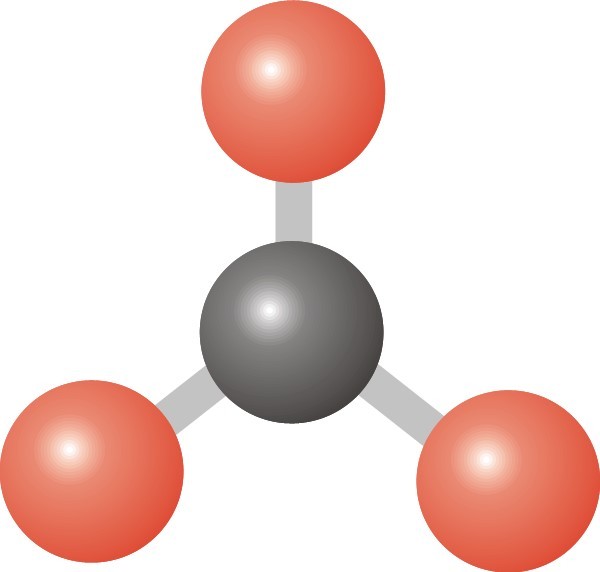
145.

Determine the molecular geometry of the given structure.

a)

Trigonal Pyramidal

b)

Trigonal Bipyramidal

c)

Trigonal Planar

d)

Tetrahedral

146.

The geometry of a molecule with 2 bonded pairs of electrons and 2 lone pairs of electrons, AB2E2

a)

Tetrahedral

b)

Trigonal Planar

c)

Bent

d)

Trigonal Pyramidal

e)

Linear

147.

The geometry of a molecule with 3 bonded pairs of electrons and 0 lone pairs of electrons, AB3

a)

Tetrahedral

b)

Trigonal Planar

c)

Bent

d)

Trigonal Pyramidal

e)

Linear

148.
*
a)
trigonal pyramid
b)
linear
c)
bent
d)
angular
149.
Who could this be?
a)
H2O
b)
NH3
c)
CO2
d)
CH4
150.
Who could this be? 
a)
CO2
b)
NH3
c)
H2S
d)
CH4
151.
Choose the correct shape for this molecule:
a)
Trigonal planar
b)
Trigonal pyramidal
c)
Bent
d)
Linear
152.
How many lone pairs are in this molecule's structure?
a)
6
b)
2
c)
0
d)
4
153.
Which of the following is octahedral?
a)
SCl6
b)
XeI4
c)
NBr5
d)
CH4
154.

Determine the molecular geometry of the given structure.

a)

Trigonal Pyramidal

b)

Trigonal Bipyramidal

c)

Trigonal Planar

d)

Tetrahedral

155.
*
a)
linear
b)
trigonal planar
c)
trigonal pyramid
d)
bent of angular
156.
SiClhas what shape?
a)
square planar
b)
square pyramidal
c)
tetrahedral
d)
octahedral
157.
What is the shape of H2O?
a)
linear
b)
tetrahedral
c)
bent
d)
trigonal pyramidal
158.
What geometry will this molecular structure have?: H2S
a)
bent
b)
tetrahedral
c)
linear
d)
trigonal pyramidal
159.
According to VSEPR, molecules adjust their shapes to keep which of the following as far away as possible?
a)
Pairs of valence electrons
b)
Inner shell electrons
c)
Mobile Electrons
d)
Electrons closest to the nucleus
160.
How many unshared pairs of electrons will a bent molecule have? 
a)
1
b)
2
c)
3
d)
4
161.

What is the molecular shape of the following?

a)

Hexahedral

b)

Square Pyramid

c)

Octahedral

d)

T-Shape

162.
What molecule could this be? 
a)
BF3
b)
CH4
c)
H2O
d)
CO2