
 Worksheets
Fall Semester Chemistry Review
Total questions: 157
Worksheet time: 6hrs 46mins
What should be done with chemical waste after completing an experiment?
Leave it at your station
Dispose of it properly
Dump it in the trash
Pour it down the sink
What should you do if a piece of equipment breaks?
Keep it to yourself
Tell your lab partner
Notify your instructor
Clean it up by yourself
What should you do if you do not understand part of the lab instructions?
Ask your instructor for help
Skip that part of the lab
Ask your lab partner
Figure it out during the lab
What should you do if you are injured during a lab?
See the school nurse after class
See a doctor after school
Attempt first aid on your own
Notify your instructor immediately
What should you do after completing a lab in which chemicals or biological specimens were used?
Wipe your hands on your clothing
Wash your hands with soap and water
Wipe your hands with a paper towel
Rub some skin lotion on your hands
What should be done with long hair before starting a lab?
Do nothing, let it hang freely
Hold it back with your hand
Tie it back out of the way
Use a hat to hold it back
What type of footwear would be best worn in a laboratory?
High Heels
Sandals
Sneakers
Flip-Flops
When is horseplay, or goofing around, acceptable in a laboratory?
Always
Sometimes
Never
Depends
What is the safest way to smell a substance during a lab?
Lean over and smell it directly
Put it on your hand and smell it
Waft the air towards your face
Lift the substance to your nose
Why are food and drink not permitted during an experiment?
They could make your lab partner hungry
They could attract ants and other insects
They could make your instructor hungry
They could contaminate the experiment
What should you do with your station after completing the lab?
Clean it up properly
Leave it for someone else
Throw everything away
Push everything to one side
What are the consequences of ignoring lab safety?
You get hurt
You fail the lab
You lose lab privileges
You bring about the zombie apocalypse
Which metal is found in period 3 and group 2?
Boron
Magnesium
Aluminum
Neon
Which noble gas has 18 protons?
Helium
Hydrogen
Argon
Calcium
Group 17 is known as the
Halogens
Noble Gases
Alkaline Earth Metals
Alkali Metals
Which group of elements have full energy levels and are considered stable?
Halogens
Alkaline Earth Metals
Alkali Metals
Noble gases
Elements that share common traits of both metals and non-metals are referred to as
metals
non-metals
halogens
metalloids
Which element has 87 protons and is considered the most reactive metal?
Francium
Fluorine
Calcium
Hydrogen
Which element is found in group 17 and is the most reactive non-metal?
Chlorine
Argon
Fluorine
Magnesium
Which alkaline earth metal is found in period 2 and group 2?
Sodium
Beryllium
Aluminum
Carbon
Which metalloid has an atomic number of 32?
Antimony
Calcium
Bromine
Germanium
What are the elements called in groups 3-12
Metalloids
Transition Metals
Alkali Metals
Halogens
Which noble gas is found in period 4?
Helium
Krypton
Argon
Neon
Calcium is a
metal
non-metal
metalloid
Chlorine is a
metal
non-metal
metalloid
Boron is a
metal
non-metal
metalloid
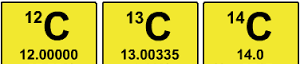

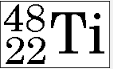

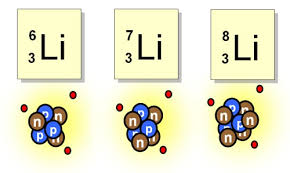
Isotopes of an element have a different number of...
Protons
Neutrons
Electrons
Mass
Bromine-80 has how many neutrons?
41
42
44
45
76 protons and 114 neutrons
Osmium-114
Osmium-76
Osmium-190
Osmium-190.23
The name of FeCl₂ is
iron chloride
iron (II) chloride
iron (I) chloride
iron dichloride
LiBr is called
lithium bromine
lithium (I) bromine
lithium bromide
lithuim (I) bromide
Name the ionic compound SnSe2
Tin diselenide
Tin (IV) Selenide
Tin selenide
Tin (II) triselenide
Which of these combinations is an ionic compound made of?
Metal and Metal
Nonmetal and Nonmetal
Metal and Nonmetal
Cation and Cation
Name the following ionic compound: BeCl2
beryllium chlorine
beryllium II chloride
beryllium chloride
beryllium dichloride
Name the following ionic compound: Cs2S
cesium sulfide
cesium sulfate
cesium II sulfate
cesium II sulfide
Which of the following combinations would need roman numerals in the name?
potassium + fluorine
beryllium + oxygen
boron + iodine
gold + oxygen
When naming a compound, which of these is written first?
Metal
Nonmetal
Anion
Cation
When naming a compound, what must the last part be?
the element with "ide" at the end
the element with the ending "ite"
the name of the element
the element with "ide" at the end, unless its a polyatomic ion
What is the name of the compound Na2(SO4)?
Sodium sulfate
Sodium sulfide
Sodium sulfite
Sodium sulfuroxide
What is the name of the compound Sc(OH)3?
Scandium (III) hydroxide
Scandium (I) hydroxide
Scandium (II) hydroxide
Scandium hydroxide
The name of the compound Ca3(PO4)2
calcium phosphate
tricalcium diphosphate
calcium phosphorus oxide
calcium phosphide
If I gain electrons I become
Positive because I've added to my atom
negative because I've added electrons
same because i'm balanced
equal because now I have electrons
1 mole of hydrogren has a mass of (a) g.
The molar mass of oxygen is (a) g.
Reorder the following in order from greatest mass to lowest mass.
1 mole of Copper
1 mole of Calcium
1 mole of Oxygen
1 mole of Carbon
1 mole of Hydrogen
Calculate the molar mass of water (H2O).
10 g/mol
17 g/mol
18 g/mol
34 g/mol
Calculate the molar mass for Al(OH)3
78.0 g/mol
72 g/mol
28 g/mol
25 g/mol
What is the molar mass of the diatomic element nitrogen?
7 g/mol
14 g/mol
28 g/mol
Calculate the molar mass of Cu2O.
37 g/mol
45 g/mol
79.5 g/mol
143 g/mol
Calculate the molar mass of Ba(C2H3O2)2
255.3 g/mol
237.3 g/mol
228.3 g/mol
196.3 g/mol
Calculate the molar mass of CO2.
14 g/mol
28 g/mol
36 g/mol
44 g/mol

How many moles are in 16.94 g of water? (hint: do you know the formula for water?)
16.94 moles
0.9403 mole
305.2 moles
1.063 moles
How many water molecules are in 5.2 moles of water?
6.0 x 10²³ molecules
5.2 molecules
3.1 x 1024 molecules
8.6 x 10⁻²⁴ molecules
If you want 1.55 moles of nitrogen trichloride, how many grams should you measure out?
0.0129 g
120. g
187 g
9.33 g


The compound with a pink square is known as a ___.
Reactant
Product

Which type of reaction is shown?
Combustion
single replacement
double replacement
decomposition

What type of reaction is shown?
Decomposition
Single replacement
Combustion
Combination (or Synthesis)

What type of reaction is this?
Combination (or Synthesis)
Single replacement
Double replacement
Decomposition

Which type of reaction is shown?
Combustion
Combination (or Synthesis)
Decomposition
Double replacement
Which type of chemical reaction involves the production of a single complex compound from several simpler reactants?
Decomposition
Combustion
Combination (or Synthesis)
Single replacement

Which type of reaction is shown?
Single replacement
Double replacement
Combustion
Decomposition
How many moles of oxygen are produced when 6.7 moles of KClO3 decompose completely?
How many grams of hydrogen are produced if 120 g of Na are available?
How many grams of potassium chloride can be produced from 356 g of chlorine and 356 g of potassium bromide?
How many moles of carbon dioxide are produced from the combustion of 110 g of CH4?
In the experiment above, 7.62 g of Fe are allowed to react with 8.67 g of S.
How much FeS is formed?
How many HCl molecules do you need to balance this equation?
2Mg + (a) HCl ---> 2MgCl2 + 2H2
What coefficient should be used to make the following equation balanced?
N2+O2--> __?__NO
1
2
3
4
Drag and drop the coefficients that balance this equation 2 Fe + (a) Cl2 ----> (b) FeCl3
Balance this equation. _CF4 + _Br2 → _CBr4 + _F2
3,1,2,1
1,2,1,2
2,2,2,2
12CO2 +H2O --> C6H12O6 + O2
CO2 + 9H2O --> C6H12O6 + O2
CO2 + H2O --> 3C6H12O6 + O2
6CO2 + 6H2O --> C6H12O6 + 6O2
Determine the coefficients to make the following equation balanced?
__N2 + __O2--> __NO
1, 1, 1
1, 1, 2
2, 2, 2
1, 2, 2
_Zn+_HCl-->_ZnCl2 +_H2

The potential energy diagram of a reaction is shown. Which statement below is correct relating to this reaction?
#1 represents the enthalpy change for this exothermic reaction.
#2 represents the enthalpy change for this endothermic reaction.
#3 represents the enthalpy change for this endothermic reaction.
#4 represents the enthalpy change for this exothermic reaction.
During an exothermic reaction, heat content in the surroundings increases because
heat energy is destroyed during reactions
the reaction absorbs heat energy
the energy contained in the reactants is lower then the products
the energy contained in the products is lower than the reactants
The amount of heat energy required to change the temperature of 12 g of gold from 45°C to 15°C is -47 J. What is the specific heat capacity of gold?
0.13 J/(g°C)
17,000 J/(g°C)
1600 J/(g°C)
0.065 J/(g°C)

The graph represents the uniform heating of a substance, starting with the substance as a solid below its melting point. Which line segment listed below represents an increase in potential energy and no change in average kinetic energy?
Line segment AB
Line segment BC
Line segment CD
Line segment EF
A cast iron skillet is used to fry bacon. For optimal frying, the pan must be heated to about 178 oC from a room temperature of 22.0 oC. It is known that 1.58 x 10⁵ J of heat energy are absorbed by the pan to reach the desired temperature and the specific heat of iron is 0.450 J/g oC. What must the mass of the skillet be?
12.7 kg
2.25 kg
110 kg
1.97 kg

Releasing heat into the surroundings occurs during an ___________________ reaction.
Exothermic
Endothermic
Kinetic Energy
Thermal Energy
A sample of iron receives 50 J of heat energy that raises the temperature of the iron 25.0°C. If iron has a specific heat of 0.10 J/g°C, what is the mass of the iron sample?
25g
30g
20g
50g
If 238 J of heat is absorbed by a sample of metal with a mass of 40.7 g, and it raises the temperature from 20.0°C to 32.4°C, what is the specific heat capacity of the metal?
2.34 J/g°C
0.472 J/g°C
6.13 J/g°C
0.163 J/g°C

How much KNO3 solute is saturated at 40 degrees?
75
55
65
85
How much C12H22O11 solute is saturated at 40 degrees?
240
220
230
250
How much Ce2(SO4)3 solute is saturated at 80 degrees?
20
15
30
2
How much NaBr solute is saturated at 70 degrees?
110
120
130
140

At what temperature can you fully dissolve 140g of NaNO3?
62
73
81
You cannot determine this
At what temperature can you fully dissolve 60g of KNO3?
27
30
37
You cannot determine this
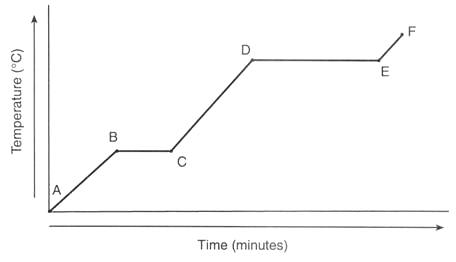
Between which points is the temperature of the substance remaining constant?
A-B only
A-B, C-D, and E-F
B-C only
B-C and D-E
__________ show the change in state of matter as heat is added.
Phase diagrams
Heating curves
Density graphs
Temperature plots

The melting point of the sample is
-60 ºC
20 ºC
60 ºC
100 ºC

Which letter indicates where water is in both the solid and liquid phase at the same time?
A
B
C
D
E

In which region(s) does temperature increase?
Region C only
Regions B and D
Regions A, C, and E
Regions A and B

