wayground logo

Free Printable Worksheets

Font size

S
M
L
XL
Worksheets

Chemistry Unit 1 Test Review

Total questions: 157

Worksheet time: 4hrs 25mins

Name
Class
Date
1.
How many significant figures: 216 m
a)
1
b)
2
c)
3
d)
0
2.
How many significant figures: 2016 m
a)
1
b)
2
c)
3
d)
4
3.
How many significant figures: 153.0 mL
a)
1
b)
2
c)
3
d)
4
4.
How many significant figures: 0.012 km
a)
1
b)
2
c)
3
d)
4
5.
How many significant figures: 0.010 L
a)
1
b)
2
c)
3
d)
4
6.
How many significant figures: 4.20 cm
a)
1
b)
2
c)
3
d)
4
7.
How many significant figures: 0.001 g
a)
4
b)
3
c)
2
d)
1
8.
How many sig figs are there?
0.000008
a)
1
b)
2
c)
6
d)
7
9.
How many sig figs are there?
100000000
a)
1
b)
9
c)
10
10.
Calculate 5.50 cm + 5.5 cm and give your answer with the correct number of significant figures.
a)
11 cm
b)
11.0 cm
c)
11.00 cm
d)
11.000 cm
11.
Calculate 12.34 + 1.234 + 0.1234 and give your answer with the correct number of significant figures.
a)
13.6974
b)
13.697
c)
13.70
d)
13.7
12.
Calculate 345.009 g - 23.00 g and give your answer with the correct number of significant figures.
a)
322.01 g
b)
322 g
c)
322.009 g
d)
322.0
13.
Calculate 1.23 m x 0.89 m and give your answer with the correct number of significant figures.
a)
1.0 m2
b)
1.1 m2
c)
1.0947 m2
d)
1.095 m2
14.
Calculate 7.987 m - 0.54 m and give your answer with the correct number of significant figures.
a)
7.45 m
b)
7.447 m
c)
7.4 m
d)
7.5 m
15.
All of the following have one significant figure except:
a)
100 cm
b)
0.0001 cm
c)
2 cm
d)
2.00 cm
16.
Which of the following numbers have four significant figures?
a)
56.75 g
b)
40.01 g
c)
0.6000 g
d)
all of the choices
17.
Calculate 0.020 cm x 50 cm x 11.1 cm and give your answer with the correct number of significant figures.
a)
10 cm3
b)
11.1 cm3
c)
11 cm3
d)
11. cm3
18.

Anthony designed an experiment to answer the following question: How does the temperature of water affect the time it takes for a sugar cube to dissolve?


What tool should Anthony use to measure how much time it takes for the sugar to dissolve?

a)

ruler

b)

stopwatch

c)

triple beam balance

d)

thermometer

19.

Anthony designed an experiment to answer the following question: How does the temperature of water affect the time it takes for a sugar cube to dissolve?


Which factor should Anthony CHANGE in his experiment with the sugar cubes?

a)

the amount of water he uses

b)

the size of the sugar cubes

c)

the temperature of the water

20.

Anthony designed an experiment to answer the following question: How does the temperature of water affect the time it takes for a sugar cube to dissolve?


Multiple answers!!! Which things should Anthony keep the same in his experiment?

a)

the amount of water

b)

the size of the sugar cubes

c)

the temperature of the water

21.
This type of VARIABLE is kept the SAME for both experimental and Control Groups
a)
Independent
b)
Dependent
c)
Control (Constant)
d)
Inference
22.
To make these you use the 5 senses:  touch, taste, smell, hear, see
a)
Observations
b)
Inferences
c)
Predictions
d)
Controls
23.
This VARIABLE is what you measure. It shows the EFFECT of what you are testing. 
a)
Independent
b)
Dependent
c)
Control
d)
Observation
24.
The classroom has 1 teacher and 27 students. WHAT KIND OF OBSERVATION IS THIS?
a)
QUANTITATIVE
b)
QUALITATIVE
c)
INFERENCE
25.
What is the DEPENDENT VARIABLE in this hypothesis?
If a dog is given a bath using DAWN dish soap,  THEN the # of fleas will decrease. 
a)
the dog
QUANTITATIVE
b)
bath in DAWN dish soap
c)
#  of fleas
26.
What is the INDEPENDENT VARIABLE in this hypothesis?
If a dog is given a bath using DAWN dish soap,  THEN the # of fleas will decrease. 
a)
the dog
QUANTITATIVE
b)
bath in DAWN dish soap
c)
#  of fleas
27.
What is the factor that an experimenter changes on purpose?
a)
Dependent Variable
b)
Independent Variable
c)
Constant
d)
Control
28.

What part of an experiment contains the data tables and graphs?

a)

Analysis

b)

Conclusion

c)

Hypothesis

d)

Materials

29.
What is a factor that is measured for change in an experiment?
a)
control
b)
constant
c)
independent variable
d)
dependent variable
30.

A summary of the experiment that includes whether hypothesis was supported or not.

a)

Hypothesis

b)

Results

c)

Conclusion

d)

Independent Variable

31.
Students used various temperatures of water to see which one dissolved candy faster. 
What was the Independent Variable?
a)
Amount of Candy
b)
Amount of Water
c)
Temperature of Water
d)
Time for Candy to Dissolve
32.

Students wanted to see if the type of material affected the temperature after being placed under a heat lamp for 10 minutes.

What is the dependent variable for this investigation?

a)

Type of material (rocks, sand etc)

b)

Temperature after 10 minutes

c)

Time under the lamp

d)

Heat lamp, amount of material

33.
a)

beaker

b)

graduated cylinder

c)

Erlenmeyer flask

d)

test tube

34.
a)

evaporating dish

b)

watch glass

c)

mortar and pestle

d)

funnel

35.
a)

evaporation

b)

watch glass

c)

mortar and pestle

d)

funnel

36.
a)

wire gauze

b)

Bunsen burner

c)

thermometer

d)

utility clamp

37.
a)

ring stand

b)

ring clamp

c)

test tube rack

d)

test tube holder

38.
a)

evaporating dish

b)

watch glass

c)

mortar and pestle

d)

funnel

39.
a)

scoopula

b)

dropper

c)

crucible tongs

d)

glassware tongs

40.
a)

evaporating dish

b)

watch glass

c)

mortar and pestle

d)

funnel

41.
a)

wire gauze

b)

Bunsen burner

c)

thermometer

d)

utility clamp

42.
a)

ring stand

b)

ring clamp

c)

test tube rack

d)

test tube holder

43.
a)

beaker

b)

graduated cylinder

c)

Erlenmeyer flask

d)

test tube

44.
a)

ring stand

b)

ring clamp

c)

test tube rack

d)

test tube holder

45.
a)

scoopula

b)

dropper

c)

crucible tongs

d)

glassware tongs

46.
a)

scoopula

b)

dropper

c)

crucible tongs

d)

glassware tongs

47.
a)

beaker

b)

graduated cylinder

c)

Erlenmeyer flask

d)

test tube

48.
a)

beaker

b)

graduated cylinder

c)

Erlenmeyer flask

d)

test tube

49.
a)

scoopula

b)

dropper

c)

crucible tongs

d)

glassware tongs

50.
Which type of glassware would you use to measure an exact amount of a liquid?
a)
Beaker
b)
Graduated Cylinder
c)
Flask
d)
Mason Jar
51.
What is pictured here and for what is it used?
a)
Fire Blanket; It keeps you warm on those cold winter nights
b)
Fire Blanket; Used to smother the flames on a person whose clothes have caught fire
c)
A red pouch; I don't have a clue what it's used for
d)
My lunch box
52.
If your clothing were catch fire, the correct response would be...
a)
Aaaaaaaahhhhhh
b)
Run as fast as possible around the room to blow out the flames
c)
Stop, drop and roll
d)
Jump on one foot and ask, "Mother, may I".
53.
In ANY safety related incident, what is the FIRST thing you need to do?
a)
Decide if you're going to be in trouble or not before doing anything
b)
Point to the person responsible and shout "He/she did it!"
c)
Tell your teacher
d)
Sit quietly until everything calms down
54.
In which situation would the eye wash/drench hose be used?
a)
You need to rinse soap from your hands
b)
Some vinegar is accidentally splashed into your eyes
c)
A small fire breaks out in the trash can
d)
Water Fight!!!
55.
The basic unit of measurement for mass is...
a)
Liters
b)
Grams/liter
c)
Meters
d)
Grams
56.
If you accidentally break some piece of glassware, you should...
a)
Ignore it. The custodian will sweep it up after school anyway
b)
Get the teachers attention and move away from the area
c)
Clean it up. It's your mess
d)
Stomp on it to break it into smaller pieces so they wont cut you
57.
A Triple Beam Balance measures the number of grams to the ______ place.
a)
ones    (1)
b)
tenths    (0.1)
c)
hundredths   (0.01)
d)
thousandths  (0.001)
58.
A mortar and pestle are used to 
a)
stir and mix chemicals for a chemical reaction
b)
evaporate liquids and recover solids
c)
transfer powdery substances from one container to another
d)
increase surface area of a reactant in order to speed up reaction
59.

Horseplay or practical jokes in the laboratory are

a)

always against the rules.

b)

okay.

c)

not dangerous.

d)

okay if you are working alone.

60.

When you finish working with chemicals, biological specimens, etc., always

a)

treat your hands with skin lotion.

b)

wash your hands thoroughly with soap and water.

c)

wipe your hands on a towel.

d)

wipe your hands on your clothes.

61.

Hot glass looks the same as cold glass.

a)

True

b)

False

62.

If a piece of equipment is not working properly, stop, turn it off, and tell

a)

the custodian.

b)

your lab partner.

c)

your best friend in the class.

d)

the science instructor.

63.

Return all unused chemicals to their original containers.

a)

True

b)

False

64.

Approved eye protection devices (goggles) are worn in the laboratory

a)

to avoid eye strain.

b)

to improve your vision.

c)

only if you don't have corrective glasses.

d)

any time chemicals, heat, or glassware are used.

65.

If a laboratory fire erupts, immediately

a)

notify your instructor.

b)

run for the fire extinguisher.

c)

throw water on the fire.

d)

open the windows.

66.

All chemicals in the lab are to be considered dangerous.

a)

True

b)

False

67.

The following footwear is best in the laboratory

a)

sandals.

b)

open-toed shoes.

c)

closed-toed shoes.

d)

shoes appropriate for the weather.

68.

In a laboratory, which of the following should not be worn?

a)

loose clothing.

b)

dangling jewelry.

c)

sandals.

d)

all of the above

69.

You are heating a piece of glass and now want to pick it up. You should

a)

use a rag or paper towels.

b)

pick up the end that looks cooler.

c)

use tongs.

d)

pour cold water on it.

70.

Never remove chemicals or other equipment from the laboratory.

a)

True

b)

False

71.

Flammable materials, like alcohol, should never be dispensed or used near

a)

an open door.

b)

an open flame.

c)

another student.

d)

a sink.

72.

If you are injured in the laboratory, you should first

a)

visit the nurse after class.

b)

see a doctor after school.

c)

notify your science instructor.

d)

apply first aid yourself.

73.

Chipped or cracked glassware is okay to use in the laboratory.

a)

True

b)

False

74.
A flat-bottomed, cylindrical piece of glassware used for mixing and heating compounds
a)
Buret
b)
Erlenmeyer flask
c)
Beaker
d)
Florence flask
75.
Used for obtaining the masses of solid and liquid samples
a)
Scoopula
b)
Condenser
c)
Balance
d)
Thermometer
76.
It's attached to a gas line and lit to provide heat for your experiments
a)
Clay triangle
b)
Thermometer
c)
Wire bauze
d)
Bunsen burner
77.
An extremely accurate device with a stopcock at the bottom used to measure volumes of reagents
a)
Beaker
b)
Burette
c)
Condenser
d)
Test tube
78.
Used for holding a test tube in place when the tube is hot or should not be touched
a)
Test tube holder
b)
Clay triangle
c)
Wire gauze
d)
Rubber stoppers
79.
Used to handle a hot crucible
a)
Rubber stoppers
b)
Test tube holder
c)
Crucible tongs
d)
Wire gauze
80.
A cup-shaped container capable of sustaining high temperatures
a)
Erlenmeyer flask
b)
Crucible
c)
Test tube
d)
Burette
81.
The general name for a glass vessel with a wide body and a narrow neck
a)
flask
b)
pipette
c)
beaker
d)
graduated cylinder
82.
A type of laboratory flask which features a flat bottom, a conical body, and a cylindrical neck
a)
Volumetric flask
b)
Florence flask 
c)
Erlenmeyer flask 
d)
Büchner flask
83.
Used together with filter paper to filter precipitates out of solutions
a)
Pipette bulb
b)
Funnel
c)
Scoopula
d)
Watch glass
84.
It's commonly used to measure the volume of a liquid
a)
Condenser
b)
Scoopula
c)
Pipette bulb
d)
Graduated cylinder
85.
They're used together to prepare substances by crushing and grinding them into a fine powder
a)
Mortar and pestle
b)
A beaker and flask
c)
Pipette bulbs
d)
Scoopulas
86.
A spatula-like scoop utensil used primarily to transfer solids from one place to another
a)
Crucible tongs
b)
Scoopula
c)
Ceramic square
d)
Buret
87.
Made from ceramic or plastic, it contains depressions for performing small-quantity reactions
a)
Clay triangle
b)
Spot plate
c)
Crucible
d)
Watch glass
88.
Cylindrical open-topped piece of glassware that comes in varying sizes
a)
Mortar and pestle
b)
Test tube
c)
Erlenmeyer flask 
d)
Funnel
89.
648 g = ____ mg
a)
6,480
b)
64,800
c)
648,000
d)
64.8
90.
7,000 g = ____ kg
a)
70
b)
700
c)
7
d)
0.07
91.
240 cm = ___________ m
a)
2400
b)
24
c)
2.4
d)
0.24
92.
3 km = ___________ mm
a)
30
b)
300
c)
3,000
d)
3,000,000
93.
 68 cm = ___________ mm
a)
0.68
b)
6.8
c)
68
d)
680
94.
32.9 km = ___________ cm
a)
32,900
b)
329,000
c)
3,290,000
d)
32,900,000
95.

What is the basic unit of mass in the metric system?

a)

Liter

b)

Meter

c)

Gram

d)

Kilometer

96.
Which unit is a a measure of volume?
a)
meters
b)
grams
c)
inches
d)
liters
97.
Which unit is the smallest?  
a)
km
b)
mm
c)
m
d)
cm 
98.

Select the smallest unit.

a)

milliliter

b)

centiliter

c)

hectoliter

d)

liter

99.

Select the largest unit.

a)

kilogram

b)

centigram

c)

decigram

d)

decagram

100.

Which of the following options is the base unit?

a)

kilometer

b)

centimeter

c)

meter

d)

millimeter

101.
Convert 5 cm to mm:
a)
5,000mm
b)
0.5 mm
c)
0.05 mm
d)
50 mm
102.
Convert 8 kilometers to meters
a)
800 m
b)
80,000 m
c)
8,000 m
d)
.008 m
103.
7,000 g = ____ kg
a)
70
b)
700
c)
7
d)
0.07
104.
Is 20 g greater than, less than, or equal to 2 kg?
a)
greater than
b)
less than
c)
equal to
105.
Which of the following correctly compares 56 cm and 6 m?
a)
56 cm 〉 6 m
b)
56 cm 〈 6 m
c)
56 cm = 6 m
d)
Impossible to tell
106.
Which of the following correctly compares 7 g and 698 mg?
a)
7 g 〉 689 mg
b)
7 g 〈 689 mg
c)
7 g = 689 mg
d)
Impossible to tell
107.
What did I measure if I record that something was 56 mL?
a)
Volume
b)
Mass
c)
Time
d)
Distance
108.
What did I measure if I record that something was 73 s?
a)
Volume
b)
Mass
c)
Time
d)
Distance
109.
When a measurement is repeatable and consistent it is said to have...
a)
High precision
b)
Low precision
c)
High accuracy
d)
Low accuracy
110.

How close a measurement is to the accepted value is called..

a)

Accuracy

b)

Precision

c)

Significant

d)

Estimate

111.
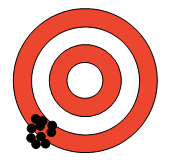
This bullseye demonstrates...
a)
High Accuracy & High Precision
b)
High Accuracy & Low Precision
c)
Low Accuracy & High Precision
d)
Low Accuracy & Low Precision
112.
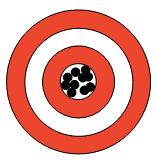
?
a)
High Accuracy & High Precision
b)
High Accuracy & Low Precision
c)
Low Accuracy & High Precision
d)
Low Accuracy & Low Precision
113.
The students measured length during a science experiement, they got 12 cm. But the actual measurement was 14.25 cm. What was the percent error?
a)
15.79%
b)
18.75%
c)
2.25%
d)
18%
114.
The deer population is estimated to be 17,600 in northern Illinois, but an actual count was 21,300. What is the percent error?
a)
21%
b)
17.37%
c)
17.4%
d)
21.02%
115.
Jessie estimates the weight of her cat to be 8 pounds.  The actual weight of the cat was 10 pounds.  Find the percent error.  
a)
15%
b)
20%
c)
25%
d)
30%
116.
Which is the more precise measurement?
a)
4 mL
b)
4.3 mL
117.
When a measurement is repeatable and consistent it is said to have...
a)
High precision
b)
Low precision
c)
High accuracy
d)
Low accuracy
118.
The difference between an experimental value and an accepted value
a)
graph
b)
density
c)
percent error
d)
error
119.
A scientific theory...
a)
is based on lots of evidence
b)
is not valid
c)
is not reliable
d)
has not been tested many times
120.
A scientific ____________ is a statement that describes what always happens under certain conditions in nature.
a)
law
b)
theory
c)
method
d)
variable
121.

Theory or Law? _________ of Thermodynamics: Matter can never be created or destroyed. Tells what happens with matter.

a)

Theory

b)

Law

122.

Theory or law: Atomic _____ of matter: all matter is made up of atoms. Explains why matter behaves a certain way.

a)

Theory

b)

Law

123.

Universal ______ of Gravitation: any 2 objects have a force of gravity between them. Tells what happens when 2 objects are near each other.

a)

Theory

b)

Law

124.
Factor that you keep the same in an experiment
a)
Independent Variable
b)
Dependent Variable 
c)
Controlled Variable
d)
Operational Definition
125.
What variable in an experiment is measured? - it is also called the responding variable.
For example: measuring the amount of mold on bread 
a)
Dependent variable
b)
Operational Definition
c)
Independent Variable
d)
Control Variable
126.
What variable in an experiment is the manipulated variable?
For example: keep bread at room temp, and keep another one in the refrigerator- here you are changing the temps on purpose to see what happens. 
a)
Operational Definition
b)
Control Variable
c)
Dependent Variable
d)
Independent Variable
127.
Dolphin colors range from gray to white
a)
quantitative observation
b)
qualitative observation
128.
Dolphins eat the equivalent of 4% of their body mass each day.
a)
quantitative observation
b)
qualitative observation
129.
There are 25 Liters of water in the buckets. 
a)
quantitative 
b)
qualitative 
130.

For your safety, what must you do after you complete every lab?

a)

Clean up my lab station

b)

Wash my hands

c)

Dump everything into the sink

d)

Throw all chemicals away

131.

What Table can you use to look up different units?

a)

A

b)

B

c)

C

d)

D

132.

What table can you use when performing metric conversions?

a)

A

b)

B

c)

C

d)

D

133.
What is scientific notation?
a)
A long way to write really short  numbers
b)
A short way to write really long numbers
c)
I don't know...
d)
None of the above
134.
Scientific Notation is made up of two number parts. The second part is a power of base 10.
a)
True
b)
False
135.
When writing a number in scientific notation, the first number must be greater than 1, but less than 10.
a)
False
b)
True
136.
Scientific Notation is made up of two number parts. The first part should be a number between 1 and 100.
a)
True
b)
False
137.
The rule of scientific notation is to write all exponents with a base of ____.
a)
50
b)
5
c)
100
d)
10
138.
UNDERSTANDING
If the exponent is a positive number...
a)
you will get a large number
b)
you will get a smaller number
139.
UNDERSTANDING
If the exponent is a negative number...
a)
you will get a large number
b)
you will get a small number
140.
ANY number raised to a power of 0 will be....
a)
10
b)
itself
c)
1
d)
0
141.
What is it called when you go from this form to this next form?
0.0088 to 8.8 x 10³
a)
Standard form to scientific notation
b)
Scientific notation to regular form
c)
Scientific notation to standard form
d)
Standard form to regular form
142.
When your exponent is negative, you move your decimal....
a)
to the right
b)
to the left
c)
to both sides
d)
nowhere.... the decimal goes nowhere
143.
Write in standard form: 
8 x 10⁴
a)
8,000
b)
80,000
c)
.00008
144.
How would you write 4.3756 x 10in standard form?
a)
437,560,000
b)
0.00043756
c)
43,756
d)
4,3756
145.
Which number is correctly written in scientific notation?
a)
5.67 x 10⁵
b)
56.7 x 10³
c)
0.567 x 10⁶
146.
Write in scientific notation: 
0.0000378 
a)
3.78 x 10⁻⁵
b)
3.78 x 10⁻⁶
c)
0.378 x 10⁻⁵
147.
Which of the following is correct scientific notation?
a)
20.35 x 10⁴
b)
.2035 x 104
c)
2035 4
d)
2.035 x10⁴
148.
What is the standard form?
1.245 x 10³
a)
0.001245
b)
12.45
c)
1245
149.
How would you write 4.3756 x 10in standard form?
a)
437,560,000
b)
0.00043756
c)
43,756
150.
How do you write
8.317 x 10⁶
in standard form?
a)
8, 371, 000
b)
83, 170, 000
c)
837, 100
d)
8, 317, 000
151.
Convert to scientific notation:
520,000,000  
a)
52 x 107
b)
5.2 x 10⁷
c)
5.2 x 10⁸
d)
0.52 x 10⁹
152.
The rule of scientific notation is to write all exponents with a base of ____.
a)
50
b)
5
c)
100
d)
10
153.
What is the measurement using the correct number of sig. figs.?
a)
8.5mL
b)
8.50mL
c)
8.45mL
d)
8.4mL
154.
What is the measurement using the correct number of sig. figs.?
a)
89cm
b)
88.9cm
c)
88.90cm
d)
88cm
155.

What is the reading of the meniscus?

a)

36mL

b)

45mL

c)

35.0mL

d)

30.5mL

156.
In the measurement 0.503 L, which digit is the estimated digit?
a)
5
b)
3
c)
the 0 immediately to the left of the 3
d)
the 0 t the left of the decimal point
157.
Which group of measurements  is the most precise? (Each group of measurements is for a  different object)
a)
2.0 g, 3.0 g, 4.0 g
b)
1 g, 3 g, 5 g
c)
2 g, 2.5 g, 3 g
d)
2 g, 3 g, 4 g