wayground logo

Free Printable Worksheets

Font size

S
M
L
XL
Worksheets

(Chemistry) Quarter 1 final revision G11

Total questions: 153

Worksheet time: 3hrs 37mins

Name
Class
Date
1.
The amount of matter in an object is a measure of the object's ________________.
a)
volume
b)
density
c)
mass
d)
solubility
2.
Which of the following units provides the best measure for the amount of space that matter occupies?
a)
mL
b)
grams
c)
cm3
d)
Both mL and cm3
3.
What is the formula for calculating density?
a)
Mass ∗ Volume
b)
Volume ∗ Mass
c)
Mass ÷ Volume
d)
Volume ÷ Mass
4.
What is the density of water?
a)
1 mL
b)
1 gram
c)
1 g/cm3
d)
All of the above
5.
In which state does matter completely fill its closed container?
a)
Gas
b)
Liquid
c)
Solid
d)
Ice
6.
Which state of matter has a fixed shape and volume and it's molecules move very slowly?
a)
Liquid
b)
Gas
c)
Solid
d)
Plasma
7.
When a gas turns into a liquid, it is called ___________________.
a)
Condensation
b)
Evaporation
c)
Melting
d)
Freezing
8.

Anything that has mass and takes up space

a)

Matter

b)

Volume

c)

Temperature

9.

A characteristic of a type of matter that can be observed or measured

a)

Description

b)

Physical Property

c)

Investigation

10.

Which set of properties, intensive or extensive, are based on the size of a sample?

a)

intensive

b)

extensive

11.

What kind of physical property is this? Color

a)

intensive

b)

extensive

12.

What kind of physical property is this? Temperature

a)

intensive

b)

extensive

13.

What kind of physical property is this? Hardness

a)

intensive

b)

extensive

14.

What kind of physical property is this? Density

a)

intensive

b)

extensive

15.

What kind of physical property is this? Boiling Point

a)

intensive

b)

extensive

16.

What kind of physical property is this? Volume

a)

intensive

b)

extensive

17.

What kind of physical property is this? Melting Point

a)

intensive

b)

extensive

18.

Flammability

a)

Physical Property

b)

Chemical Property

19.

Density

a)

Physical Property

b)

Chemical Property

20.

Reacts with water

a)

Physical Property

b)

Chemical Property

21.

NaCl (salt) dissolves in water

a)

Physical Change

b)

Chemical Change

22.

A 10 pound block of ice takes longer to melt than a 10 pound bag of ice cubes. What kind of property is this?

a)

Extensive

b)

Intensive

c)

Both are correct

23.
Particles in this state of matter are moving the slowest.
a)
solid
b)
gas
c)
liquid
24.
This state of matter keeps its shape and volume.
a)
gas
b)
solid
c)
liquid
25.
This state of matter takes both the shape and volume of it container.
a)
gas
b)
solid
c)
liquid
26.
In this state of matter, the molecules have enough energy to separate from each other. 
a)
gas
b)
solid 
c)
liquid
27.
When water beads on the outside of a cold glass of water.
a)
vaperization
b)
condensation
c)
melting
d)
freezing 
28.
When boiling water creates steam.
a)
condensation
b)
melting 
c)
freezing
d)
vaporization
29.
When a scoop of ice cream drips down the side of the cone.
a)
freezing 
b)
vaporization
c)
melting
d)
condensation
30.
The state of matter in which the atoms are locked and vibrate in place. 
a)
solid
b)
liquid
c)
gas
31.
Two of more substances that are mixed together but can be separated is...
a)
solutes
b)
solutions
c)
liquids
d)
mixtures
32.
Mixtures can always be separated into their parts 
a)
True
b)
False
33.

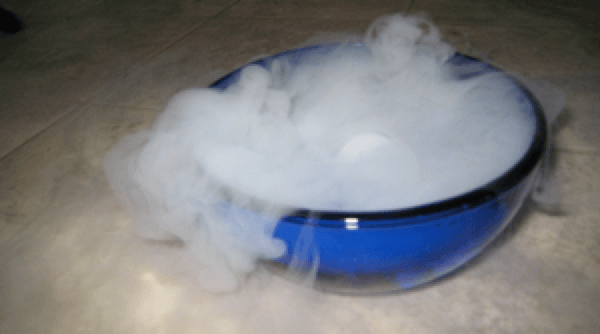
Dry ice is solid carbon dioxide, or CO2. Dry ice may be used as a cooling agent and contains two oxygen atoms bonded to a carbon atom. Dry ice is a ___________________ .

a)

pure substance

b)

mixture

34.

Baking soda is the common name for sodium bicarbonate, or NaHCO3. It can be produced through chemical reactions involving carbon dioxide and sodium hydroxide.

a)

pure substance

b)

mixture

35.

Cake batter is a substance that may contain flour, eggs and sugars mixed by hand or with an electric mixer. Cake batter is a ___________________ .

a)

pure substance

b)

mixture

36.
A student took ice cream outside on a summer day. The heat would cause what kind of change?
a)
a solid becoming a liquid
b)
a liquid becoming a gas
c)
a liquid becoming a solid 
d)
a gas becoming a liquid
37.
Removing heat from water vapor causes what change in it's physical state?
a)
a liquid changing into a gas
b)
a solid changing into a gas
c)
a gas changing into a liquid
d)
a liquid changing into a solid
38.
Water vapor is forming a liquid on the outside of this glass because the vapor.
a)
loses heat when it touches the glass
b)
pulls cooler liquid through the glass
c)
becomes warmer close to the glass
39.
Which of the following is a sign that a chemical reaction has occurred?
a)
change in shape
b)
melting
c)
formation of a gas
d)
dissolving
40.
Which of the following is NOT an example of a physical change?
a)
crumpled paper
b)
pencil sharpening
c)
shrunken clothing
d)
rust
41.
A change where one or more new substances are created.
a)
Physical Change 
b)
Chemical Change 
42.

Change in color is a physical change.

a)

True

b)

False

43.
Fizzing, foaming, and burning are all examples of
a)
Chemical change
b)
Physical change
44.
Photosynthesis is an example of a
a)
physical change
b)
chemical change
45.
Dissolving sugar in water is an example of a 
a)
physical change
b)
chemical change
46.
Digesting your food is an example of 
a)
chemical change
b)
physical change
47.
Which is an example of a chemical reaction?
a)
paper cut into small pieces
b)
chocolate melting in a pan
c)
flour and sugar mixed in a bowl
d)
cookies baking in an oven
48.

A physical change...

a)

changes the physical properties of an object, but does not create a new substance.

b)

creates a new substance and cannot be undone.
49.

A chemical change

a)

changes the physical properties of an object, but does not create a new substance.

b)

creates a new substance and cannot be undone.

50.
A change that alters the physical properties of a substance without changing its composition.
a)
Physical Change
b)
Chemical Change
51.
Which of the following is an example of sublimation?
a)
Dry Ice
b)
Water boiling into steam
c)
Ice cream melting
d)
Water freezing into ice
52.
Any change in the state of matter of a substance is a...
a)
Physical Change
b)
Chemical Change
53.
Which of the following indicates a chemical change?
a)
Change in state of matter
b)
Temperature change
c)
Change in size 
d)
Change in shape
54.
A solid substance that forms when 2 liquid solutions are combined?
a)
Sublimation
b)
Precipitate
c)
Condensation
d)
Freezing
55.
Which of the following DOES NOT indicate a chemical change/reaction is occurring?
a)
Color Change
b)
Formation of a Precipitate
c)
Formation of gas/bubbles
d)
State of matter change
56.
We use chemical equations to show what happens in a....
a)
Chemical Change
b)
Physical Change
57.
Which Law states that Matter cannot be created or destroyed during a Chemical Change/Reaction?
a)
Conservation of Energy
b)
Conservation of Matter (Mass)
c)
Conservation of Momentum
d)
Conservation of Thermodynamics
58.
Evidence of Chemical Change.
a)
New Substance 
b)
Size change
c)
State change
d)
Mixture 
59.
Fireworks Exploding are a ________ change.
a)
Physical Change
b)
Chemical Change
60.
A substance that has mass and takes up space. 
a)
Energy
b)
Matter
c)
Protery
d)
Endothermic 
61.
Which is a chemical property 
a)
Reactivity 
b)
Solid
c)
Color
d)
Shape
62.
A piece of paper burned. This shares a property that paper has. What is a chemical property that paper has been shown? 
a)
Flammable
b)
Reactive to Acid
c)
Shape change
d)
Size change
63.
A characteristic that can only be determined by changing the identity of an object. 
a)
Physical Change
b)
Chemical Change
c)
Chemical Property 
d)
Physical Property 
64.
A characteristic that can be observed or measured without changing the composition of the substance. 
a)
Physical change
b)
Chemical change
c)
Chemical Property
d)
Physical Property
65.
Is digestion an example of a physical change or a chemical change?
a)
Physical Change
b)
Chemical Change
66.
The Law of Conservation of Mass tells us matter can't  ______________.
a)
change color
b)
change state of matter
c)
be created or destroyed
d)
change temperature
67.
In a reaction A + B ----> C,  reactant A has 5g and product  C has 9g. How many grams does reactant B should have? 
a)
4g
b)
5g
c)
9g
d)
14g
68.
What is the law of conservation of mass?
a)
The amount of matter changes when reacted or changed.
b)
The mass of all reactants are changed during a physical or chemical change
c)
The mass of the reactants equals the mass of the products
d)
The mass of the products is different than the mass of the reactants.
69.

32 g of Oxygen completely reacts with 8 g of Hydrogen to produce _____ g Water

a)

8

b)

12

c)

24

d)

40

70.
Matter can not be created nor destroyed: it can only be
a)
Destroyed a little bit
b)
Invisible
c)
Transformed, changed
d)
None of the above
71.
Two or more substances mingled together, but not chemically combined are known as a
a)
residue
b)
solution
c)
distillate
d)
mixture
72.
Sand and gravel may be separated from each other through using..
a)
a filter funnel
b)
a sieve
c)
an evaporating basin
d)
a distillation
73.
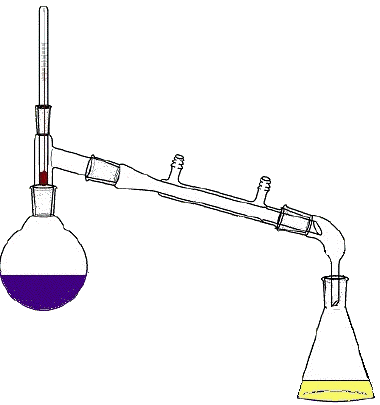
Which of the following pairs of substances may best be separated through distillation
a)
 sand and soil
b)
water and soil
c)
salt and sand
d)
 water and alcohol
74.
Which one of the following techniques would best be used to separate soil and water?
a)
Decanting
b)
distillation
c)
Filtration
d)
Chromatography
75.
Name the separation technique shown in the diagram.
a)
evaporation
b)
distillation
c)
 filtration
d)
decanting
76.
Sodium chloride can be separated from rock salt by first adding water to the mixture to dissolve the sodium chloride. The separation then takes place in two stages:
a)
evaporation followed by filtration
b)
 distillation followed by decanting
c)
filtration followed by evaporation
d)
filtration followed by decanting
77.
Which one of the following would you use to separate sand from iron filings?
a)
a bar magnet
b)
filter paper
c)
chromatography paper
d)
alum
78.
Water and alcohol are easily separated by distillation because of their
a)
 different melting points
b)
different colours
c)
different densities
d)
different boiling points
79.
Liquids that do not mix may be separated by using..
a)
an evaporating dish
b)
a separating funnel
c)
a loading
d)
a sedimentation
80.
Making a mixture results in ___________________ only.
a)
chemical reactions
b)
separate parts
c)
physical changes
d)
two subtances
81.
To separate iron filings and sulfur what method should you use?
a)
filtration 
b)
sorting
c)
magnet
d)
boiling
82.
How would you separate the ingredients of mixture Z?
a)
Water
b)
A magnet
c)
A sieve
d)
My hands
83.
How would you separate a mixture of sand and salt? 
a)
Mix them with water and let the water evaporate
b)
Mix them with water, pour the mixture through a sieve, then let the water evaporate
c)
Heat the sand and salt mixture for 5 minutes, then let it cool
d)
I would not do any of these because none of these options would work
84.
Which one of the following is NOT a mixture?
a)
Sugar
b)
Paint
c)
Crude oil
d)
Air
85.
Which mixture could you separate by adding water and then pouring through a coffee filter?
a)
sand and salt, because the salt would dissolve and the sand would not
b)
baking soda and salt, because they both dissolve
c)
sugar and salt, because they both dissolve
d)
iron fillings and sand, because neither one dissolves
86.
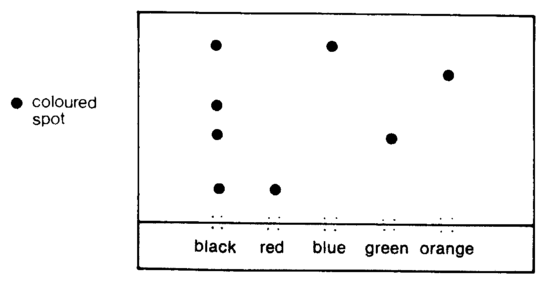
On the chromatogram given -------------- is mixture.
a)
red
b)
orange
c)
green
d)
black
87.

A pure substance shows ------------------ spot on chromatogram

a)

0

b)

1

c)

2

d)

3

88.
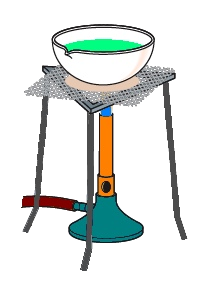
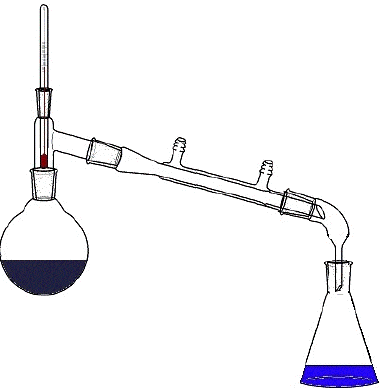
Look at the apparatus setup. It cannot be used to separate which of the following mixtures? 
a)
Marble chips from oil 
b)
Alcohol and water
c)
Chalk from sugar solution
d)
Sand and sea water
89.
Alpha particles.....
a)
a) are positively charged.
b)
b) consist of two protons and four neutrons.
c)
c) can penetrate any thickness of matter
d)
d) All of the above 
90.
The process of nuclear change in an atom of radioactive material is called... 
a)
nuclear decay
b)
nuclear mass
c)
isotopes
d)
radon
91.
During beta decay, a nucleus .... 
a)
gives up two protons and two neutrons.
b)
  maintains the same number of protons and neutrons.
c)
  loses a proton and gains a neutron.
d)
gains a proton and loses a neutron. 
92.
Radioactive materials have unstable...
a)
electrons
b)
protons
c)
nuclei
d)
neutrons
93.
A helium nucleus with two protons and two neutrons is called a(n) ____.  
a)
alpha particle
b)
electroscope
c)
beta particle
d)
gamma ray
94.
Negatively charged particles emitted from a nucleus at a high speed are ____.  
a)
alpha particle
b)
gamma rays
c)
beta particles
d)
X rays
95.
The three types of nuclear radiation in increasing order of penetrating power are ____.  
a)
  alpha, beta, gamma 
b)
X ray, beta, gamma
c)
alpha, gamma, beta 
d)
X ray, gamma, beta 
96.

What type of decay is shown here

23892U ---> 23490Th + 42He.

a)

alpha

b)

beta

c)

gamma

97.

Finish this equation

20983Bi--> _______ + 20581Tl

a)

42He

b)

0-1e

c)

y

98.

finish the equation


18173Ta --> ____ + 18174W

a)

42He

b)

0-1e

c)

y

99.
Has the symbol
a)
Alpha
b)
Beta 
c)
Gamma
d)
electron
100.
If we start off with element 5024X after an beta decay we get another element Y that looks like
a)
5023Y
b)
4622Y
c)
5025Y
d)
5024Y
101.
If we start off with element 5024X after an alpha decay we get another element Y that looks like
a)
5022Y
b)
 4622Y
c)
4820Y
d)
5426Y
102.
What is emitted during Alpha Radiation?
a)
A helium nuclei.
b)
A helium atom
c)
Gamma Rays.
d)
Positrons
103.

Gamma rays _________.

a)

have no mass and no charge

b)

have mass but no charge

c)

have no mass but have charge

d)

have mass and charge

104.

Solve this equation.

85209At = ___ + 24He

a)

83205Bi

b)

86209Rn

c)

81207Tl

d)

85208At

105.

Who arranged the known elements into horizontal rows of increasing atomic mass leaving gaps for as yet undiscovered elements?

a)

Mendeleev

b)

Meyer

c)

Newlands

d)

Moseley

106.

Who suggested that the physical and chemical properties were related to the atomic number, rather than atomic mass?

a)

Meyer

b)

Mendeleev

c)

Moseley

d)

Newlands

107.

Whose Periodic Table of Elements was the most accurate?

a)

Newlands'

b)

Mendeleev's

c)

Meyer's

d)

Moseley's

108.
What was Dmitri Mendeleev's greatest contribution to the history of the periodic table?
a)
He arranged all of the known elements by their atomic number
b)
He realised that there was a pattern of reactivity which repeated every 8 elements
c)
He predicted the existence (and properties) of new elements
d)
He identified the "law of triads" which became the groups
109.
The periodic table is organized by the number of ______ in each element's nucleus
a)
neutrons
b)
protons
c)
electrons
d)
atoms
110.

Who is known as the "Father of the Periodic Table" and given credit for the very first Periodic Table?

a)

Mosely

b)

Meyer

c)

Mendeleev

d)

Newlands

111.
Why were there blank spaces left in Mendeleev's periodic table?                                              
a)
He didn't know what to put there.
b)
 Undiscovered elements not yet known.
c)
Multiple elements could have fit
d)
He forgot to add the elements in.
112.

In the modern periodic table elements are arranged by:

a)

atomic mass

b)

atomic number

c)

valence electrons

d)

number of isotopes

113.
Mendeleev classified elements based on not only atomic mass but what else?                                                   
a)
reactivity
b)
boiling points
c)
physical properties only 
d)
 chemical & physical properties
114.

Who proposed the Law of Octaves?

a)

Lothar Meyer

b)

Henry Moseley

c)

John Newlands

d)

Dmitri Mendeleev

115.

Who was the first to arrange the elements by increasing atomic mass?

a)

Henry Moseley

b)

Dmitri Mendeleev

c)

John Newlands

d)

Antoine Lavoisier

116.

What are the rows in the periodic table called?

a)

Families

b)

Groups

c)

Periods

d)

Orbitals

117.

Which of following elements is a halogen?

a)

F

b)

Hg

c)

Mn

d)

Nd

118.

The chemical and physical properties of the elements repeat themselves when arranged by increasing atomic number is called

a)

Periodic Theory

b)

Periodic Hypothesis

c)

Periodic Law

d)

Law of Octaves

119.
Most of the elements on the periodic table are classified as _____.
a)
Metals
b)
Nonmetals
c)
Metalloids
d)
Periods
120.

Elements in the same group or family have the same number of

a)

neutrons

b)

valence electrons

c)

electrons

d)

energy levels

121.
Which is an alkali metal?
a)
Magnesium
b)
Iron
c)
Sodium
d)
Europium
122.

In Mendeleev's periodic table, elements in each column had similar

a)

atomic masses.

b)

properties.

c)

atomic numbers.

d)

symbols.

123.

What do the horizontal rows on the periodic table tell us?

a)

The number of orbitals

b)

The number of valence electrons (the electrons on the outer most shell)

124.

What does the number of proton tell us?

a)

electrons

b)

atomic number

c)

atomic mass

d)

neutrons

125.

The order of elements in the periodic table is based on

a)

the number of protons in the nucleus.

b)

the electric charge of the nucleus.

c)

the number of neutrons in the nucleus.

d)

atomic mass.

126.

Atoms of elements that are in the same group have the same number of

a)

protons.

b)

neutrons.

c)

valence electrons.

d)

protons and neutrons.

127.

Which of the following elements is an alkali metal?

a)

calcium

b)

magnesium

c)

mercury

d)

sodium

128.

In Mendeleev's periodic table, elements in each column had similar

a)

atomic masses.

b)

properties.

c)

atomic numbers.

d)

symbols.

129.

How was Mendeleev's periodic table arranged?

a)

by increasing atomic mass

b)

by decreasing atomic mass

c)

by increasing atomic number

d)

by decreasing atomic number

130.

Mendeleev left gaps in his periodic table because

a)

the table was too small.

b)

protons belonged there.

c)

the table was too full.

d)

no known elements fit there.

131.

Each column of the periodic table is

a)

an element.

b)

a group.

c)

an isotope.

d)

a period.

132.

The three main groups of elements are metals, nonmetals, and

a)

inert gases.

b)

alkali metals.

c)

radioactive isotopes.

d)

semiconductors/metalloids.

133.

Most elements are

a)

metals.

b)

nonmetals.

c)

metalloids.

d)

semiconductors.

134.

Elements in an elemental family have similar

a)

atomic symbols.

b)

atomic sizes.

c)

atomic weights.

d)

chemical properties.

135.

The order of elements in the modern periodic table is based on an element's

a)

atomic number.

b)

name.

c)

chemical symbol.

d)

atomic mass.

136.

Which statement about the alkali metals is correct?

a)

They are located in the left-most column of the periodic table.

b)

They are extremely nonreactive.

c)

They are usually gases.

d)

They form negative ions with a 1- charge.

137.

Metals tend to be

a)

gases.

b)

dull.

c)

brittle.

d)

good conductors.

138.

Which group is very stable due to the fact that they have a full outermost energy level?

a)

alkali metals

b)

halogens

c)

alkaline-earth metals

d)

noble gases

139.

Which of the following is a property of group 18 elements?

a)

malleable

b)

brittleness

c)

high electrical conductivity

d)

unlikely to react with other elements

140.

Based on its location on the periodic table, which of these elements most likely has physical and chemical properties most similar to boron (B)?

a)

magnesium (Mg)

b)

aluminum (Al)

c)

neon (Ne)

d)

chlorine (Cl)

141.

Which of the following groups on the Periodic Table is likely to form positively charged ions (or cations)?

a)

group 1

b)

group 13

c)

group 17

d)

group 18

142.

Which of the following elements would most likely be a shiny, gray-colored solid at room temperature, conduct electricity, and dent when hit with a hammer?

a)

argon (Ar)

b)

chlorine (Cl)

c)

sulfur (S)

d)

aluminum (Al)

143.

Alkali metals are extremely reactive because they

a)

have every small atomic masses.

b)

are not solid at room temperature.

c)

have one valence electron that is easily removed to form a positive ion.

d)

have two valence electrons that form compounds with calcium and magnesium.

144.

Most elements are

a)

metals.

b)

nonmetals.

c)

metalloids.

d)

semiconductors.

145.

Elements in an elemental family have similar

a)

atomic symbols.

b)

atomic sizes.

c)

atomic weights.

d)

chemical properties.

146.

Which statement about the alkali metals is correct?

a)

They are located in the left-most column of the periodic table.

b)

They are extremely nonreactive.

c)

They are usually gases.

d)

They form negative ions with a 1- charge.

147.

Which of the following is a property of group 18 elements?

a)

malleable

b)

brittleness

c)

high electrical conductivity

d)

unlikely to react with other elements

148.

What are the rows on the periodic table called?

a)

Groups

b)

Rows

c)

Periods

d)

Families

149.

Name group 2 on the periodic table:

a)

Alkali Metals

b)

Alkaline Earth Metals

c)

Noble Gases

d)

Transition Metals

150.

Name group 18 on the periodic table:

a)

Alkali Metals

b)

Alkaline Earth Metals

c)

Transition Metals

d)

Noble Gases

151.

What do we call groups 3-12 on the periodic table:

a)

Noble Gases

b)

Halogens

c)

Alkaline Earth Metals

d)

Transition Metals

152.

Name group 17 on the periodic table.

a)

Transition Metals

b)

Noble Gases

c)

Halogens

d)

Alkali Metals

153.

What is a valence electron?

a)

Electrons in the first energy shell

b)

Electrons in the second energy shell

c)

Electrons in the outer shell

d)

Total number of electrons