wayground logo

Free Printable Worksheets

Font size

S
M
L
XL
Worksheets

Super Ginormous Honors Final Review

Total questions: 155

Worksheet time: 6hrs 20mins

Name
Class
Date
1.
All of the following are physical properties of matter EXCEPT
a)
Mass
b)
Color
c)
Melting Point
d)
Ability to rust
2.
A vapor is which state of matter?
a)
Solid
b)
Liquid 
c)
Gas
d)
Plasma
3.
Which of the following is NOT an example of matter?
a)
Air
b)
Heat
c)
Smoke
d)
Water Vapor
4.
Which state of matter expands when heated and is easy to compress?
a)
Gas
b)
Liquid
c)
Solid
d)
Solids, Liquids, and Gases
5.
Which state of matter takes both the shape and volume of its container?
a)
Solid
b)
Liquid
c)
Gas
d)
Both Liquid and Gas
6.
A chemical change occurs when a piece of wood
a)
is split
b)
is painted
c)
decays
d)
is cut
7.
In Bohr's model of the atom, where are the electrons and protons located?
a)
The electrons move around the protons, which are at the center of the atom.
b)
The electrons and protons move throughout the atom
c)
The electrons occupy fixed positions around the protons, w hich are at the center of the atom
d)
The electrons and protons are located throughout the atom, but they are not free to move
8.
Stable electron configurations are likely to contain
a)
filled energy sublevels
b)
fewer electrons than unstable configurations
c)
unfilled s orbitals
d)
electrons with a clockwise spin
9.
The modern periodic table is arranged in order of increasing atomic
a)
mass
b)
charge
c)
number
d)
radius
10.
Of the elements, Pt, V, Li, and Kr, which is a nonmetal?
a)
Pt
b)
V
c)
Li
d)
Kr
11.
The atomic number of an element is the total number of which particles in the nucleus?
a)
neutrons
b)
protons
c)
electrons
d)
protons and electrons
12.
A description of how close a measurement is to its true value
a)
accuracy
b)
precision
c)
significant figures
d)
explanation
13.
An atom's ability to undergo chemical reactions is determined by its
a)
protons.
b)
innermost electrons.
c)
neutrons.
d)
outermost electrons.
14.
Aluminum has _ valence electrons. 
a)
7
b)
1
c)
6
d)
3
15.
Postive ions are called
a)
anions
b)
positrons
c)
alpha 
d)
cations
16.
A description of how close measurements are to each other is
a)
accuracy
b)
closeness
c)
precision
d)
target location
17.
The "s" orbital can hold 
a)
2 electrons
b)
4 electrons
c)
6 electrons
d)
10 electrons
18.
An atom has 12 protons, 12 electrons and 14 neutrons.  What is the mass number?
a)
12
b)
24
c)
26
d)
38
19.
a copper penny turning greenish after a few years.
a)
Chemical Change
b)
Physical Change
20.
Mendeleev arranged the periodic table by...?
a)
color
b)
increasing atomic mass
c)
increasing atomic number
d)
density
21.
What does it mean when an element is happy?
a)
They have 8 protons
b)
They have 8 valence electrons (a full octet)
c)
They have 8 protons
d)
They have 8 neutrons
22.
What element is represented in this Bohr Model? 
a)
Carbon
b)
Hydrogen
c)
Aluminum
d)
Lithium
23.
How are covalent bonds explained?
a)
When one atom takes the other atom's electron
b)
When the atom shares an electron with an another atom
c)
When the two nucleus merge
d)
When the neutrons leave the nucleus
24.
States that it is not possible to know precisely both the velocity and the position of a particle at the same time.
a)
Hund's rule
b)
Pauli exclusion principle
c)
Heisenberg uncertainty principle
d)
Aufbau principle
25.
Which subatomic particle is negatively charged?
a)
proton
b)
atom
c)
neutron
d)
electron
26.
Which atomic particle has a positive charge?
a)
Proton
b)
Neutron
c)
Electron
27.
The smallest particle of an element that retains the properties of that element is a(n)
a)
atom
b)
electron
c)
proton
d)
neutron
28.
Which subatomic particle has a neutral charge?
a)
Proton
b)
Neutron
c)
Electron
29.
The particles that are found in the nucleus of an atom are
a)
neutrons and electrons
b)
electrons only
c)
protons and neutrons
d)
protons and electrons
30.
All atoms of the same element have the same
a)
number of neutrons 
b)
number of protons
c)
mass number
d)
mass
31.
Isotopes of the same element have different
a)
number of neutrons 
b)
number of protons
c)
number of electrons
d)
atomic number 
32.
A mixture that does not look the same throughout:
a)
heterogeneous mixture
b)
homogeneous mixture
c)
the periodic table
d)
water
33.
A negative ion is called
a)
cation
b)
anion
c)
cathode
d)
electro
34.
When naming an ionic compound, you
a)
name the non-metal first
b)
use prefixes to show the number of atoms
c)
name the cation (metal) first
d)
there is no set rule
35.
The formula for copper (I) chloride is 
a)
CoCl2
b)
CoCl
c)
CuCl
d)
CuCl2
36.
In the picture shown, element x is likely __________.
a)
Carbon
b)
Oxygen
c)
Nitrogen
d)
Fluorine
37.
What is the FORMULA for
magnesium carbonate
a)
Mg(CO3)2
b)
MgHCO3
c)
MgCO2
d)
MgCO3
38.
Which of the following represents values that are precise, but not accurate?  Assume that the desired value is a bullseye.
a)
A
b)
B
c)
C
d)
D
39.
Which of the following represents values that are neither accurate nor precise?  Assume that the desired value is a bullseye.
a)
A
b)
B
c)
C
d)
D
40.
How many total atoms are in the formula below?
2Pb(SO4)2
a)
10
b)
11
c)
22
d)
18
41.
In the notation given, which variable represents the mass number?
a)
A
b)
Z
c)
X
d)
A - Z
42.
Which wave has the highest energy?
a)
A
b)
B
c)
D
d)
E
43.
Which orbital is pictured here?
a)
s
b)
p
c)
d
d)
f
44.
Which orbital is pictured here?
a)
s
b)
p
c)
d
d)
f
45.
Which of the following elements would require the most energy to remove a valence electron?
a)
Lithium
b)
Boron
c)
Nitrogen
d)
Fluorine
46.
Which of the following elements has the lowest first ionization energy?
a)
Lithium
b)
Boron
c)
Nitrogen
d)
Fluorine
47.
Which of the following elements has the largest atomic radius?
a)
Sodium
b)
Potassium
c)
Chlorine
d)
Bromine
48.
Which of the following elements has the largest electronegativity value?
a)
Sodium
b)
Potassium
c)
Chlorine
d)
Bromine
49.

How many significant digits does the following measurement have: 0.002040 m?

a)

6

b)

4

c)

3

d)

2

50.

Round 0.010229 min to four sig digs

a)

1022 min

b)

1023 min

c)

0.01023 min

d)

0.01022 min

51.

What is the measurement 1042 Liters rounded to 2 significant digits?

a)

1040 L

b)

1.1 x 10³ L

c)

1.0 x 10³ L

d)

1050 L

52.

Solve and round to the correct number of significant digits:

1.3562-mL / 14.32 g

a)

0.09-mL/g

b)

0.097-mL/g

c)

0.0973-mL/g

d)

0.09471-mL/g

53.
How would you write 4.3756 x 10in standard form?
a)
437,560,000
b)
0.00043756
c)
43,756
d)
4.3756
54.
Which of the following is correct scientific notation?
a)
20.35 x 10⁴
b)
.2035 x 104
c)
2035 4
d)
2.035 x10⁴
55.

Mg is best described as...

a)

Element

b)

Compound

c)

Mixture

d)

Colloid

56.

Water, H2O, is best described as...

a)

Element

b)

Compound

c)

Homogeneous Mixture

d)

Heterogeneous Mixture

57.

Sugar is best described as...

a)

Element

b)

Compound

c)

Homogeneous Mixture

d)

Heterogeneous Mixture

58.

Gold is best described as...

a)

Element

b)

Compound

c)

Homogeneous Mixture

d)

Heterogeneous Mixture

59.

Pure Air is best described as...

a)

Element

b)

Compound

c)

Homogeneous Mixture

d)

Heterogeneous Mixture

60.
Is melting butter for popcorn a chemical or physical change?
a)
chemical
b)
physical
61.
Is burning wood a chemical or physical change?
a)
chemical
b)
physical
62.
Which of the following is an example of a CHEMICAL change?
a)
Burning a marshmallow
b)
Melting a marshmallow
63.
When you put peroxide on a cut, it bubbles up. This is an example of a ______.
a)
chemical reaction
b)
physical change
64.

leaves changing color

a)

chemical change

b)

physical change

65.
What is the atomic number?
a)
the number of protons
b)
the number of protons and neutrons
c)
the number of neutrons
d)
the number of protons and electrons
66.
What is the mass number?
a)
the number of protons
b)
the number of protons and neutrons
c)
the number of neutrons
d)
the number of protons and electrons
67.
How many neutrons does the isotope of lithium have?
a)
8
b)
3
c)
4
d)
5
68.
How many protons does this isotope of titanium have?
a)
48
b)
22
c)
26
d)
70
69.
Do the following atoms belong to the same element? Explain
       Aluminum-27
       An atom with 14 protons and 13 neutrons
a)
Yes because they have the same number of protons
b)
Yes because they have the same mass
c)
No because they have different number of protons
d)
No because they have different number of neutrons
70.
J.J. Thomson provided evidence that an atom...
a)
is the smallest particle of matter
b)
contains negatively charged particles
c)
has an overall negative charge
d)
has an overall positive charge
71.
Rutherford's gold foil experiment provided evidence that...
a)
negative and positive charges are spread evenly throughout the atom.
b)
alpha particles have a positive charge.
c)
gold is not a dense as previously thought.
d)
there is a dense positively charged nucleus at the center of an atom.
72.
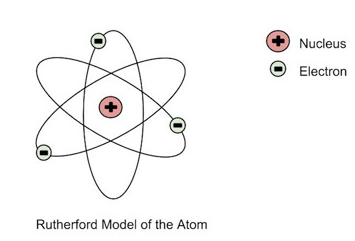
Who came up with this model of an atom?
a)
J.J. Thompson
b)
Ernest Rutherford
c)
Neils Bohr
d)
James Chadwick
73.
True or False: The majority of an atom is made up of empty space
a)
True
b)
False
74.
The majority of an atom's mass exists where?
a)
In the nucleus
b)
In the electron cloud
c)
In the space between the nucleus and the electrons
d)
In the neutrons
75.
An alpha particle consists of 
a)
A proton and a neutron 
b)
2 protons and 2 neutrons 
c)
3 protons and 3 neutrons 
d)
One proton 
76.

How many atomic orbitals exist in a d orbtial?

a)

1

b)

7

c)

3

d)

5

77.
If electrons in an atom have the lowest possible energies, the atom is in the
a)
ground state.
b)
inert state.
c)
excited state.
d)
radiation-emitting state.
78.

An atomic emission spectrum is produced when an electron moves from one energy level

a)

into the nucleus.

b)

to another position in the same sublevel.

c)

to a higher energy level.

d)

to a lower energy level.

79.

An atomic orbital can at most hold how many electrons, according to the Pauli Exclusion Principle?

a)

1 electron

b)

2 electrons

c)

3 electrons

d)

4 electrons

80.

A three-dimensional region around a nucleus where an electron may be found is called a(n)

a)

orbit

b)

mitochondria

c)

atomic orbital

d)

nucleus

81.
All orbitals of equal energy are occupied by one electron before any single orbital is occupied by a second electron.
a)
Aufbau principle
b)
Pauli exclusion principle
c)
Hund’s rule
d)
Core Notation
82.
Identify the element for
[Xe] 6s2 4f14 5d4
a)
Cobalt
b)
Iron
c)
Tungstun
83.

What element has the electron configuration 1s2 2s2?

a)

Li

b)

Be

c)

He

d)

Mg

84.

Valence electrons are defined a the ...........

a)

Electrons farthest away from the nucleus

b)

Electrons closest to the nucleus

c)

Electrons that just come and go - they don't stay with the atom

85.
Each column in the periodic table is called a 
a)
period
b)
group
c)
cluster
d)
unit
86.
Which group of the periodic table is composed of inert (not reactive)  gases?
a)
alkali metals
b)
alkaline earth metals
c)
halogens
d)
noble gases
87.
Elements which are shiny, conduct electricity and heat are called
a)
metal
b)
nonmetal
c)
metalloid
d)
nonexistent
88.
A horizontal row of elements in the periodic table.
a)
column
b)
group
c)
period
89.
Which is an alkali metal?
a)
Magnesium
b)
Iron
c)
Sodium
d)
Europium
90.
Elements in a ..................have similar chemical properties.  
a)
period
b)
group
c)
row
91.
The atoms along the staircase are called 
a)
metals
b)
nonmetals
c)
metalloids
d)
noble gases
92.
Which is a halogen?
a)
Helium
b)
Chlorine
c)
Oxygen
d)
Neptune
93.
As you move left to right across a period, the atomic radius will ....
a)
decrease
b)
increase
c)
stay the same
94.
Why did Mendeleev leave blanks in his periodic table?
a)
forgot elements
b)
left room for elements not yet discovered
c)
placed elements in wrong positions leaving gaps
95.
As you move across the periodic table atoms tend to get smaller because, ______________.
a)
the atoms have more mass.
b)
the atoms have less mass
c)
the atoms have more protons.
d)
the atoms have less electrons.
96.
Atoms that have a high electronegativity, _______________.
a)
give up their electrons more easily.
b)
hold on to their electrons more tightly.
c)
have more electron shells.
97.
An atom becomes _________ when it gains electrons.
a)
Positive
b)
Negative
c)
Neutral
d)
Invinsible
98.
An atom becomes _______ when it loses electrons.
a)
Positive
b)
Negative
c)
Neutral
d)
Invinsible
99.
What is the formula for magnesium phosphide?
a)
Mg3P2
b)
Mg2P3
c)
Mg2(PO4)3
d)
Mg3(PO4)2
100.
The chemical formula of potassium iodide is
a)
KI
b)
PI
c)
KI₂
d)
K₂I
101.
How do the following two elements bond together?
Al3+  O2-         
a)
AlO
b)
Al2O3
c)
Al3O6
d)
Al3O2
102.

What is the formula for iron(III) chloride?

a)

FeCl

b)

Fe3Cl

c)

FeCl2

d)

FeCl3

103.

What is the formula for aluminium hydroxide?

a)

AlOH

b)

AlOH3

c)

Al(OH)3

d)

(Al)3OH

104.

What is the correct formula for ammonium fluoride?

a)

NH4F

b)

FNH4

c)

(NH4)7F

d)

NHF

105.

What is the correct formula for nickel (II) phosphate?

a)

NiPO4

b)

Ni3(PO4)2

c)

Ni2(PO4)2

d)

Ni3P2

106.

What is the correct formula for magnesium oxide?

a)

MgO

b)

Mg2O2

c)

Mg(OH)2

d)

Mg2OH

107.
What two types of atoms make a covalent bond?
a)
2 Nonmetals
b)
1 Nonmetal and 1 Metal
c)
2 Metals
d)
2 Noble Gases
108.

Which of the following is NOT formed by a covalent bond?

a)

K2S

b)

H2O

c)

I2

d)

CO2

109.
What do we call a covalent bond where electrons are shared UNEVENLY or UNEQUALLY?
a)
Ionic
b)
Polar Covalent
c)
Nonpolar Covalent
d)
Van der Waals Force
110.
A _________ has two or more different types of matter that are near one another, but the matter does NOT chemically combine. 
a)
mixture
b)
compound
c)
property
d)
atom
111.
A _________ is a substance made of two or more DIFFERENT elements chemically combined. 
a)
mixture
b)
compound
c)
substance 
112.
This group typically gains or shares one electron.
a)
Halogens
b)
Noble Gases
c)
Alkaline Earth Metals
d)
Alkali Metals
113.
The formula for dinitrogen pentoxide is:
a)
NO
b)
N5O
c)
2NO
d)
N2O5
114.
SnS2
a)
Tin (I) sulfide
b)
Tin (II) sulfide
c)
Tin (III) sulfide
d)
Tin (IV) sulfide
115.
Covalent bonds...
a)
are normally between 2 nonmetals
b)
share electrons
c)
form molecules
d)
all of the above
116.
What is released in a combustion reaction?
a)
Oxygen and water
b)
Oxygen and carbon dioxide
c)
Carbon dioxide and water
d)
Water and hydrogen
117.
Which of these is a double displacement reaction?
a)
2Mg  +  O2  >  2MgO
b)
Mg  +  2HCl  >  H2  +  MgCl2
c)
MgI2  +  K2CO3  >  MgCO3  +  2Kl
d)
MgCO3  >  MgO  +  CO2
118.
This picture represents
a)
Synthesis
b)
Double Replacement
c)
Single Replacement
d)
Decomposition
119.
This image represents
a)
a double replacement reaction
b)
a decomposition reaction
c)
a single replacement reaction
d)
a complex compound reaction
120.
Compounds break down into simpler substances in this type of reaction.....
a)
Double Replacement
b)
Single Replacement
c)
Synthesis
d)
Decomposition
121.
Calculate 12.34 × 1.234 × 0.1234
a)
1.87908
b)
1.879
c)
1.9
d)
1.8790809
122.
Why are noble gases virtually nonreactive?
a)
They are all gases
b)
8 Valence electrons
c)
Last element in each period
d)
Because they are nonmetals
123.

This could be the dot diagram of

a)

Ne

b)

H

c)

C

d)

F

124.
CxHy +O--> H2O + CO2
a)
Decomposition
b)
Double replacement
c)
Combustion
d)
Single Replacement
125.
One element replaces another in a compound.
a)
Synthesis
b)
Combustion
c)
Single Replacement
d)
Double Replacement
126.
The following reaction is an example of what reaction type? 
CoCO3 → CoO + CO2
a)
Synthesis
b)
Decomposition
c)
Single Replacement
d)
Double Replacement
127.
Si + S8 --> Si2S4
a)
Synthesis (combination)
b)
Decomposition
c)
Single replacement
d)
Double replacement
128.
KOH + H3PO4 --> K3PO4 + H2O
a)
Synthesis (combination)
b)
Decomposition
c)
Single replacement
d)
Double replacement
129.
Pb(NO3)2 --> PbO + NO2 + O2
a)
Synthesis (combination)
b)
Decomposition
c)
Single replacement
d)
Combustion
130.
What are the products in the following chemical equation? 
2H2 + O2   -->   2H2O
a)
H2
b)
O2
c)
2H2 + O2
d)
2H2O
131.
What are always the product(s) for the combustion of a hydrocarbon?
a)
O2
b)
Acids and Bases
c)
H2O and CO2
d)
H2 and C
132.
What is the left part of a chemical equation called?
H2 + O → H2O
a)
Reactants
b)
Products 
c)
Yields 
d)
Chemical Equation 
133.
Breaking down a substance into simpler substances
a)
Displacement
b)
Synthesis
c)
Decomposition
d)
Oxidation
134.
Combining substances to form a new substance
a)
Displacement
b)
Synthesis
c)
Decomposition
d)
Oxidation
135.
_AgNO3 + _Cu _Cu(NO3)2 + _Ag
a)
2 AgNO3 + 2 Cu → 3 Cu(NO3)2 + 1 Ag
b)
2 AgNO3 + 1 Cu → 1 Cu(NO3)2 + 2 Ag
c)
1 AgNO3 + 2 Cu → 2 Cu(NO3)2 + 1 Ag
d)
3 AgNO3 + 2 Cu → 3 Cu(NO3)2 + 2 Ag
136.
_BaS + _PtF2  _BaF2 + _PtS
a)
1 BaS + 1 PtF2 → 1 BaF2 + 1 PtS
b)
4 BaS + 2 PtF2 → 1 BaF2 +  1 PtS
c)
1 BaS + 2 PtF2→ 2 BaF2 +  2 PtS
d)
1 BaS + 3 PtF2 →1 BaF2 +  2 PtS
137.
_K + _Cl2 _KCl
a)
2 K + 16 Cl2 → 8 KCl
b)
2 K + 1 Cl2 → 2 KCl
c)
3 K + 4 Cl2 → 3 KCl
d)
1 K + 1 Cl2 →1 KCl
138.
Balance this equation,            Al2O3 ---> Al + O2 
a)
Cannot be balanced
b)
2Al2O3 ---> 2Al + 3O2 
c)
2Al2O3 ---> 4Al + 3O2 
d)
3Al2O3 ---> 2Al + O2 
139.
In every balanced chemical equation, each side of the equation has the same number of ____.  
a)
coefficients
b)
moles
c)
molecules
d)
atoms of each element
140.
_AlBr3 + _K2SO _KBr + _Al2(SO4)3
a)
6 AlBr3 + 1 K2SO4 → 6 KBr + 1 Al2(SO4)3
b)
2 AlBr3 + 3 K2SO→ 6 KBr + 1 Al2(SO4)3
c)
1 AlBr3 + 1 K2SO→ 2 KBr + 3 Al2(SO4)3
d)
2 AlBr3 + 3 K2SO→ 1 KBr + 2 Al2(SO4)3
141.

How is the alpha particle written in a nuclear equation?

a)

42He

b)

24He

c)

0-1e

d)

00γ

142.
A helium nucleus with two protons and two neutrons is called a(n) ____.  
a)
alpha particle
b)
electroscope
c)
beta particle
d)
gamma ray
143.
A helium nucleus with two protons and two neutrons is called a(n) ____.  
a)
alpha particle
b)
electroscope
c)
beta particle
d)
gamma ray
144.
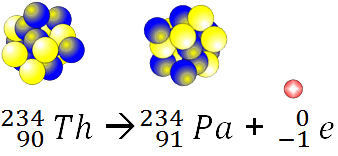
Which type of nuclear radiation is being emitted here?
a)
Alpha
b)
beta
c)
gamma 
d)
none
145.
Solve this equation for alpha decay.
85209At = ___ + 24He
a)
83205Bi
b)
86209Rn
c)
81207Tl
d)
85208At
146.

Gamma rays have

a)

no mass

b)

a huge mass

c)

a small mass

d)

an average mass

147.
Solve this equation for beta decay.
614C = ___ + -10e
a)
410Be
b)
714N
c)
210He
d)
613C
148.

The nucleus is held together by the ___________________________force.

a)

The Strong Nuclear Force

b)

The Weak Nuclear Force

c)

Electromagnetism

d)

Gravity

149.

During beta-particle emission, a neutron splits into a____________________.

a)

proton and electron

b)

neutron and electron

c)

neutron and proton

150.
Has the highest penetrating power.  Can penetrate our body.  Even several cm thick of lead or several meters thick of concrete cannot stop all of it.
a)
Alpha
b)
Beta
c)
Gamma
151.
Has the lowest penetrating power.  Can only penetrate 0.05 mm into the body and can be stopped by a piece of paper or clothing.
a)
Alpha
b)
Beta
c)
Gamma
152.
Uranium-238  decays into  Thorium-234  by emitting .........
a)
an alpha particle
b)
a beta particle
c)
gamma rays
d)
visible light
153.
Radioactive materials have unstable...
a)
electrons
b)
protons
c)
nuclei
d)
neutrons
154.
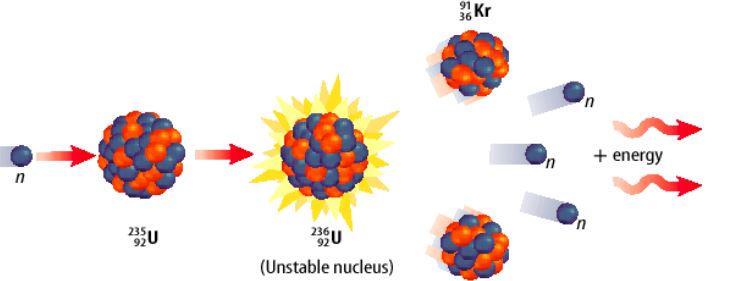
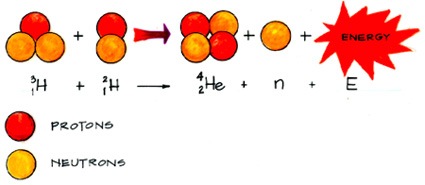
This is an example of...
a)
Fission  reaction
b)
Fusion reaction
c)
Decomposition reaction
d)
Decay
155.
Which process involves the joining of small nuclei?
a)
Beta decay
b)
Alpha decay
c)
Nuclear fission
d)
Nuclear fusion