wayground logo

Free Printable Worksheets

Font size

S
M
L
XL
Worksheets

6-12 Physical Science

Total questions: 153

Worksheet time: 3hrs 42mins

Name
Class
Date
1.

How many moles are in 74 g of KCl

a)

0.99 mole

b)

0.014 mole

c)

11.4 mole

d)

0.14 mole

2.

What is the molar mass of NaOH?

a)

123 g/mol

b)

41.1 g/mol

c)

650 g/mol

d)

250 g/mol

3.

How many grams are in 12.3 x 10 -4 moles of calcium phosphate Ca3(PO3)2

a)

0.34 g

b)

3.35 g

c)

6.78 g

d)

8.46 g

4.
N2 + 3H2 --> 2NH3
How many moles of N2 is needed to react with 6 moles of H2?
a)
6.7
b)
2.0
c)
3.0
d)
15.0
5.
4NH+ 5O2-->4NO + 6H2O
What is the total number of moles of NO produced when 1 mole of O2 is completely consumed?
a)
1
b)
1.2
c)
0.8
d)
4
6.

Determine the mass of calcium hydroxide produced when calcium carbide reacts with 0.64g of water according ot the following equation

CaC2 + 2H2O --> Ca(OH)2 + C2H2

a)

10.31 g Ca(OH)2

b)

41.31 g Ca(OH)2

c)

1.31 g Ca(OH)2

d)

31 g Ca(OH)2

7.
The amount of force pushing on an area is the definition of....
a)
Fluid
b)
Viscosity
c)
Barometer
d)
Pressure
8.
Where is pressure the greatest on the dam?
a)
D
b)
C
c)
B
d)
A
9.
Pressure is measured in what units
a)
Newtons
b)
m/s
c)
Pascals
d)
Moles
10.
A force is applied in a closed container, the pressure increases the same amount. EX: squeezing a water bottle or toothpaste
a)
Archimede's Principle
b)
Pascal's Principle
c)
Bernoulli's Principle 
11.
What principle is this hydraulic press showing?
a)
Archimedes' Principle
b)
Bernoulli's Principle
c)
Pascal's Principle
d)
Principle Testa
12.

Which statement correctly describes pressure?

a)

the applied force that acts on an object

b)

force per unit area

c)

the area to which a force is applied

d)

force times surface area

13.
What is the pressure in the hydraulic fluid?
a)
1210 N
b)
484 N/m2
c)
8000 N
d)
3025 N/m2
14.
The faster a fluid moves, the lower the pressure is in the moving fluid compared to the fluid not moving as fast. This is called
a)
Archimedes' Principle
b)
Bernoulli's Principle
c)
Pascal's Principle
d)
Vice Principle Snyder
15.
The design of a wing:
a)
causes the air above a wing to move faster than the air below the wing
b)
helps create lift
c)
creates a low pressure area above the wing
d)
all of these answers are correct
16.
According to Bernoulli's Principle, when the wind speed is high, wind pressure is ________
a)
high
b)
low
c)
not enough information
d)
None of the above
17.

Which intermolecular force is present in all molecules and atoms?

a)

London dispersion forces

b)

dipole-dipole forces

c)

hydrogen bonding

d)

none of the above

18.

Which noble gas has the highest boiling point?

a)

Ne

b)

Ar

c)

Kr

d)

Xe

19.

Which molecule below has hydrogen bonding?

a)

CH4

b)

HCl

c)

H2

d)

CH3CH2OH

20.

Which intermolecular force found in CCl2H2 is the strongest?

a)

dispersion forces

b)

dipole-dipole forces

c)

hydrogen bonding

d)

none of the above

21.
Which is the second strongest intermolecular force, after hydrogen bonding?
a)
dipole-dipole attraction
b)
London forces
22.
London forces are stronger in heavier atoms or molecules, and weaker in lighter atoms or molecules.  Which of these has the strongest London forces?
a)
F2
b)
Br2
c)
I2
d)
Cl2
23.

Intermolecular forces for: NH3

a)

Dispersion Force

b)

Dipole dipole

c)

Hydrogen bonding

24.
Ionic Bonding involves...
a)
The transfer of protons
b)
The transfer of nuetrons 
c)
The transfer of electrons
d)
None Of the above
25.
Define electronegativity
a)
ability to donate electron
b)
tendency to lose electron
c)
tendency to lose electron to its neighbor
d)
tendency of atom to attract shared electron to itself
26.
Covalent bond is equal sharing of electron. Polar covelent bond is
a)
unequal sharing of electrons
b)
different distribution of electrons
c)
presence of hydrogen bonding
d)
presence of polar atoms
27.

If fluorine has a larger electronegativity value than carbon, what charge will the fluorine receive if these two atoms bond?

a)

negative

b)

slight negative

c)

positive

d)

slight positive

28.

Water has an unusually high boiling point for a molecular compound because it has

a)

hydrogen bonding

b)

ion-ion attractions

c)

a high density

d)

a large gram formula mass

29.
Hydrogen bonding occurs when hydrogen is bonded to N, O, or F.  Which of the following has hydrogen bonding?
a)
CBr4
b)
NO2
c)
H2S
d)
NH3
30.
Intermolecular force present in Cl2?
a)
dipole dipole
b)
H-bond
c)
dispersion
d)
metallic
31.

Which one has higher melting point? CO2 or H2O

a)

CO2

b)

H2O

32.
Intermolecular force present in HCl?
a)
dipole dipole
b)
dispersion
c)
H-bond
d)
ionic
33.
How will the following molecule bond with itself?
a)
Dispersion
b)
Dipole
c)
Hydrogen bond
34.
What geometry will this molecular structure have?: CH4
a)
bent
b)
tetrahedral
c)
linear
d)
trigonal pyramidal
35.
What geometry will this molecular structure have?: PH3
a)
bent
b)
tetrahedral
c)
linear
d)
trigonal pyramidal
36.
Will this molecule be polar or nonpolar? H2S
a)
polar
b)
nonpolar
37.
Will this molecule be polar or nonpolar? CH4
a)
polar
b)
nonpolar
38.
What is the VSEPR theory used to predict?
a)
Bond Strength
b)
Polarity
c)
Molecular Shape
d)
Electronegativity
39.
According to VSEPR, molecules adjust their shapes to keep which of the following as far away as possible?
a)
Pairs of valence electrons
b)
Inner shell electrons
c)
Mobile Electrons
d)
Electrons closest to the nucleus
40.
What is the charge on an Aluminium ion?
a)
3
b)
+3
c)
+2
d)
+1
41.
What is the charge on a chloride ion?
a)
-1
b)
1
c)
+2
d)
+1
42.
When an atom loses an electron, it becomes a:
a)
positive ion
b)
negative ion
c)
neutral ion
d)
neutral atom
43.
Elements in Group 1 lose one electron to form ions with a _________________ charge.
a)
1+
b)
2+
c)
0
d)
1-
44.
Ionic bonds form between metals and ____.
a)
metalloids
b)
metals
c)
nonmetals
45.
which types of elements become cations?
a)
nonmetals
b)
all metals
c)
only transition metals
d)
some metals and some metalloids
46.
What is the formula of calcium oxide?
a)
CaO2
b)
CaO
c)
Ca2O
d)
CO
47.
How do covalent bonds form?
a)
Donating & receiving valence e- between atoms.
b)
Opposite slight charges attract each other between compounds.
c)
Scientists are still not sure how they form.
d)
Sharing valence e- between atoms.
48.
What two types of atoms make a covalent bond?
a)
2 Nonmetals
b)
1 Nonmetal and 1 Metal
c)
2 Metals
d)
2 Noble Gases
49.
What do we call a covalent bond where electrons are shared UNEVENLY or UNEQUALLY?
a)
Ionic
b)
Polar Covalent
c)
Nonpolar Covalent
d)
Van der Waals Force
50.
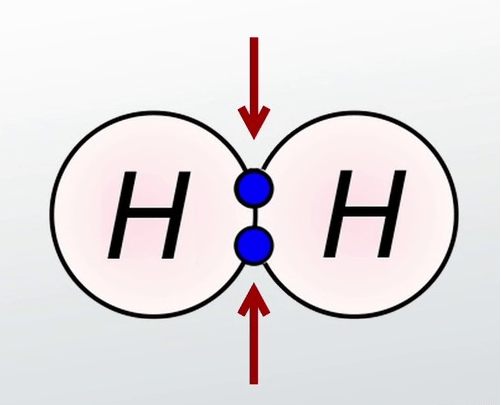
What type of bond is shown in this image?
a)
Ionic
b)
Polar Covalent
c)
Nonpolar Covalent
d)
Van der Waals Force
51.

The bond that holds together water molecules weakly is what type of bond?

a)

Ionic

b)

Covalent

c)

Metallic

d)

Hydrogen

52.

What are Van der Waals forces?

a)

The attraction of two surfaces at the surface level

b)

The attraction of two surfaces at the molecular level

c)

The attraction of two substances due to adhesive tape

d)

None of the above

53.

What is an isotope?

a)

An atom with varying numbers of protons

b)

An atom with varying numbers of electrons

c)

An atom with varying numbers of neutrons

d)

An atom with varying numbers of particles

54.

Which of the following describes a hydrogen bond?

a)

Strong attractions between a cation and anion

b)

Weak attraction between two substances with opposite charges

c)

Strong attraction due to sharing electrons

d)

None of the above

55.

What is polarity?

a)

An uneven distribution of protons causing charges on each element in the molecule.

b)

An uneven distribution of neutrons causing charges on each element in the molecule.

c)

An uneven distribution of electrons causing charges on each element in the molecule.

d)

All of the above

56.

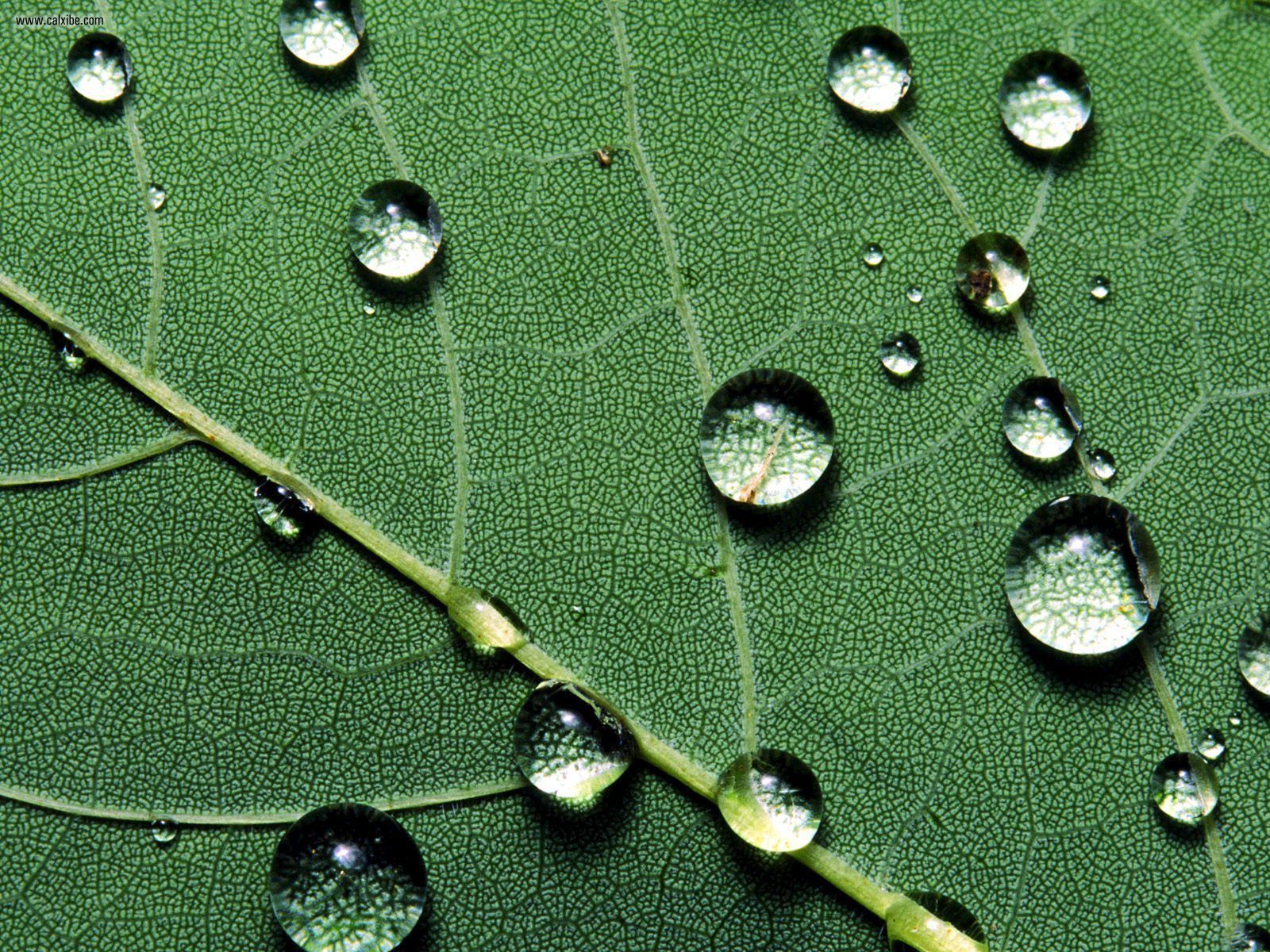
Refer to the picture of water sticking to a leaf; this is occurring because of:

a)

Adhesion

b)

Cohesion

57.

Describe COHESION.

a)

Water molecules attracted to other substances.

b)

Water molecules climbing upwards against the force of gravity.

c)

Water molecules dissolving many substances because of its polarity.

d)

Water molecules attracted to other water molecules.

58.
tendency of molecules of the same kind to stick to one another
a)
cohesion
b)
adhesion
c)
solution
d)
polar molecule
59.
What is the definition of sublimation?
a)
a chemical process where a solid turns into a gas without going through a liquid stage
b)
the process of a liquid changing into a gas
60.
When the temperature of matter increases the particles...
a)
speed up and move closer
b)
speed up and move farther apart
c)
slow down and move closer together
d)
slow down and move farther apart
61.
No definite shape, but has a definite volume
a)
Gas
b)
Liquid
c)
Solid
62.
Phase change from a liquid to a gas that only happens at the surface.
a)
evaporation
b)
boiling
c)
sublimation
d)
melting
63.
When the temperature of matter decreases the particles ...
a)
speed up and move farther apart
b)
speed up and move closer together
c)
slow down and move farther apart
d)
slow down and move closer together
64.
Phase change from a gas to a liquid.
a)
condensation
b)
evaporation
c)
melting
d)
deposition
65.
The phase change from water vapor to liquid water is known as...
a)
evaporation
b)
precipitation
c)
condensation
d)
sublimation
66.
What is deposition?
a)
Phase change from gas to solid
b)
phase change from liquid to solid
c)
Phase change from solid to gas
d)
Phase change from liquid to gas
67.
What is essential for a combustion reaction to begin?
a)
Carbon dioxide
b)
Fuel 
c)
Fuel, oxygen and heat
d)
Water and oxygen
68.
What kind of energy conversion does a combustion reaction involve?
a)
Kinetic to Potential Energy
b)
Chemical Potential Energy to Kinetic or Thermal Energy
c)
Potential Energy to Nuclear Energy
d)
Mass to Energy
69.
The initial energy required to start a combustion reaction is called
a)
Potential Energy
b)
Kinetic Energy
c)
Chemical Potential Energy
d)
Activation Energy
70.
The word equation for combustion is:
fuel + oxygen -->
 water + ________ __________
a)
Carbon dioxide
b)
Limewater
71.
All combustion reactions are 
a)
endothermic
b)
exothermic
c)
neutral
d)
fast
72.
How many atoms of iodine are in a mole of iodine?
a)
53
b)
63.55g
c)
126.9
d)
6.02 x 10²³
73.
The number 6.02 x 10²³ is called...
a)
Obama's number
b)
Bohr's number
c)
Trump's number
d)
Avogadro's number
74.
We use the periodic table to calculate...
a)
mass
b)
molar mass
c)
moles
75.
What is the molar mass of NaCl?
a)
58.45g/mol
b)
28g/mol
c)
12g/mol
d)
6.02 x 10²³
76.
How many molecules are in 32.4 grams of phosphorous pentoxide?
a)
1.76 x 10²³ molecules
b)
0.29 moles
c)
1.76 x 10²² molecules
d)
0.29 molecules
77.

Which compound below has the smallest molar mass?

a)

CO

b)

CO2

c)

H2O

d)

H2O2

78.

What is the molar mass of AgF?

a)

514.9 g/mol

b)

99.7 g/mol

c)

126.87 g/mol

d)

198.8 g/mol

79.

What is the electron configuration for gold (Fe) element 26?

a)

1s2 2s2 2p6 3s2 3p6 4s2 3d6

b)

1s1

c)

1s2 2s1

d)

1s2 2s2 2p6 3s2 3p6 4s2 3d10 4p5

80.
What atom matches this electron configuration?
1s22s22p63s23p64s23d10
a)
Zinc
b)
Copper
c)
Nickel
d)
Germanium
81.
What electron configuration matches an oxygen atom?
a)
1s22s22p63s2, 3p64s23d104p5
b)
1s22s22p4
c)
1s22s22p6
d)
1s22s22p63s23p64s23d1
82.

Electrons always flow from

a)

cathode to anode

b)

anode to cathode

83.

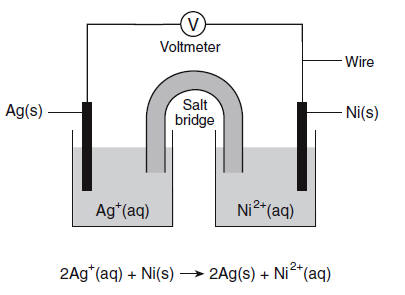
What would be the theoretical cell potential of the previous electrochemical cell?

Ag+/Ag = 0.80V

Ni2+/Ni = -0.25V

a)

1.05V

b)

-1.05V

c)

0.55V

d)

-0.55V

84.

What reaction occurs at the anode?

Ag+/Ag = 0.80V

Ni2+/Ni = -0.25V

a)

Ag+ + e- →Ag

b)

Ag → Ag+ + e-

c)

Ni2+ + 2e- → Ni

d)

Ni → Ni2+ + 2e-

85.
This variable in an experiment is the one being changed by the scientist. 
a)
dependent variable
b)
independent variable
c)
data
d)
control group
86.
If I ride my bike to school instead of walking, then I will get to school faster. What is the dependent variable?
a)
True
b)
How fast you get to school
c)
Riding a bike or walking
d)
False
87.
Which of the following would be considered quantitative data?
a)
Color
b)
Smell
c)
6.84 cm
d)
texture
88.
What is a factor that changes because of what the experimenter does?
a)
Dependent Variable
b)
Independent Variable
c)
Control Group
d)
Hypothesis
89.
How many significant digits does 1.008 have?
a)
1
b)
2
c)
3
d)
4
90.
How many significant digits does 0.0001 have?
a)
1
b)
3
c)
4
d)
5
91.
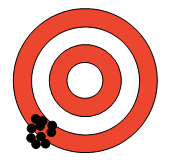
This bullseye demonstrates...
a)
High Accuracy & High Precision
b)
High Accuracy & Low Precision
c)
Low Accuracy & High Precision
d)
Low Accuracy & Low Precision
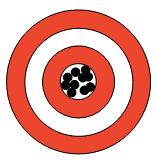
92.
?
a)
High Accuracy & High Precision
b)
High Accuracy & Low Precision
c)
Low Accuracy & High Precision
d)
Low Accuracy & Low Precision
93.
Write 7.113 x 10⁷ in standard form.
a)
71,130,00
b)
7,113,000
c)
0.0000007113
d)
7,113
94.
Write 0.00000707 in scientific notation.
a)
7.07 x 10⁻⁶
b)
7.07 x 10⁶
c)
707 x 108
d)
707 x 10-8
95.
Write 2.08 x 10²  in standard form.
a)
208
b)
0.0208
c)
20,800
d)
0.208
96.
Write 7.8 x 10⁻³  in standard form.
a)
0.0078
b)
7,800
c)
78
d)
0.078
97.
Which is the more precise measurement?
a)
2.4 oz
b)
2.37 oz
98.
How many significant figures does the following number have: 56.040
a)
2
b)
3
c)
4
d)
5
99.
Round 1009 to three sig figs
a)
100
b)
101
c)
1010
d)
1000
100.
Calculate 345.009 g - 23.009 g and give your answer with the appropriate number of significant figures.
a)
322.00 g
b)
322 g
c)
322.000 g
d)
322
101.
Calculate 12.34 + 1.234 + 0.1234 and give your answer with the appropriate number of significant figures.
a)
13.6974
b)
13.697
c)
13.70
d)
13.7
102.
Calculate 1.23 m x 0.89 m and give your answer with the appropriate number of significant figures.
a)
1.0 m2
b)
1.1 m2
c)
1.0947 m2
d)
1.09 m2
103.
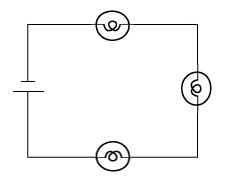
This is an example of a _______ circuit
a)
open
b)
series
c)
parallel
d)
square
104.
This is an example of a ______ circuit
a)
Series
b)
Parallel
c)
Open
d)
Dihexihedral
105.
The picture shows an electrical circuit. This circuit is a series circuit because: 
a)
It has 3 light bulbs.
b)
The same current flows through all three light bulbs.
c)
It uses a single battery.
d)
The electrical current is divided between the three light bulbs.
106.
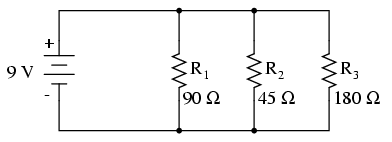
The equivalent resistance in this circuit is 
a)
100 ohms
b)
450 ohms
c)
400 ohms
d)
30 ohms
107.
The current through the battery of this circuit is
a)
0.02 amps
b)
0.09 amps
c)
50 amps
d)
9 amps
108.
What is the unit of power?
a)
Amps
b)
Watts
c)
Volts
d)
Joules
109.
Resistance is measured in ___. 
a)
watts. 
b)
amps.
c)
ohms.
110.
A correct statement of Ohm’s Law is:
a)
I= V R
b)
V ∝ I
c)
V = IR
d)
both b and c
111.
A Charging system producing 14.5 Volts with a current flow of 43.5 Amps, what is the circuit resistance
a)
58 Amps
b)
0.33 Amps
c)
13 Amps
d)
1 Amp
112.
How many Volts would we need to produce a current flow of 8 Amps through a 6 Ohm resistor
a)
12 volts
b)
24 volts
c)
1.3333
d)
48 volts
113.
What size resistor would produce a current flow of 5 Amps with a battery voltage of 12.6 volts
a)
60 Ohms
b)
2.52 Ohms
c)
1.71 ohms
d)
5.04 Ohms
114.

A force of repulsion is best defined as

a)

a force that pulls things together

b)

a force that pushes things apart

c)

a balanced force

d)

an imbalanced force

115.

The force found between water and water is a

a)

force of attraction

b)

force of repulsion

c)

imbalanced force

d)

magnetic force

116.

Coulomb's law says that the force between any two charges depends

a)

directly on the size of the charges

b)

inversely on the square of the distance between the charges

c)

both are correct

117.
Calculate the amount of centripetal force it takes for a softball pitcher to rotate a ball with a velocity of 3 m/s if the ball weighs .12 kg and her arm is .65 meters long.
a)
.38
b)
1.23
c)
.55
d)
1.66 N
118.

moving or tending to move toward a center...

a)

centripetal force

b)

centrifugal force

c)

Tangent

d)

Curvature

119.
What is the momentum of a charging rhino?
a)
2 × 10² kg⋅m/s
b)
3 × 10² kg⋅m/s
c)
2 × 10⁴ kg⋅m/s
d)
3 × 10⁴ kg⋅m/s
120.
Which object has the greatest momentum?
a)
Object A
b)
Object B
c)
Object C
d)
cannot be determined
121.

A 0.5 kg baseball flies through the air at 8 m/s. A baseball bat hits the ball with three times the momentum. Find the new velocity of the baseball.

a)

8 m/s

b)

16 m/s

c)

4 m/s

d)

24 m/s

122.
The equation to calculate momentum is
a)
p=mv
b)
p=1/2mv2
c)
p=mgh
d)
p=mg
123.
What is the unit for momentum?
a)
m/sec
b)
kg/sec
c)
kg/m
d)
kg m/sec
124.
When is momentum conserved in a collision?
a)
When the collision is inelastic.
b)
When the collision is elastic.
c)
When the collision is inelastic OR elastic but never an explosion.
d)
All collisions.
125.

Michelle runs and jumps off of a diving board and lands on a tube (she stays in the tube). The collision between Michelle and the tube is

a)

Elastic

b)

Inelastic

c)

Kind of Inelastic

d)

Completely absurd

126.

In a(n) ___________ collision, objects change shape or stick together.

a)

elastic

b)

inelastic

c)

both

d)

neither

127.
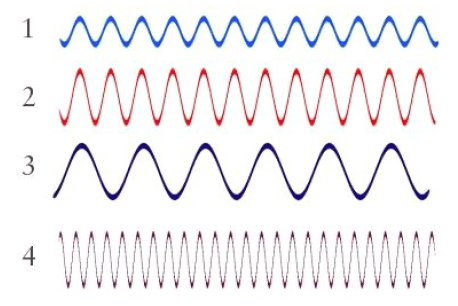
Which wave in the diagram has the greatest frequency?
a)
1
b)
2
c)
3
d)
4
128.
Which wave in the diagram has the greatest wavelength?
a)
1
b)
2
c)
3
d)
4
129.
A wave vibrating in the direction of propogation
a)
Longitudinal wave
b)
transverse wave
c)
wave propogation
130.
Any of the ways in which waves travel
a)
electromagnetic radiation
b)
wave propagation 
c)
magnetic fields
d)
electric field
131.
A wave vibrating at right angles to the direction of its propagation 
a)
transverse wave
b)
longitudinal wave 
132.
Bending of waves around an object (such as through a doorway)
a)
sound
b)
diffract
c)
pitch
d)
volume
133.
A wave in which the vibration is in the same direction as that in which the wave is traveling; sound waves
a)
longitudinal wave
b)
ocean wave
c)
transverse wave
d)
mechanical wave
134.
The part of a longitudinal wave where the particles of the medium are close together.
a)
rarefaction
b)
compression
c)
crest
d)
trough
135.
What is the formula for Resonance?
a)
Fr = 1/2TT /LC
b)
Fr = 6.28 x L x C
c)
Resonance = 3.14 x 2 x Fr
d)
Freq = 1/2 TT FC
136.
What components are in an Series RCL circuit?
a)
Resistor, Capacitor and LED.
b)
Capacitor and Transformer.
c)
A coil and a rectifier.
A coil and a diode.
A coil and a diode.
d)
Resistor, Capacitor and a Inductor.
137.
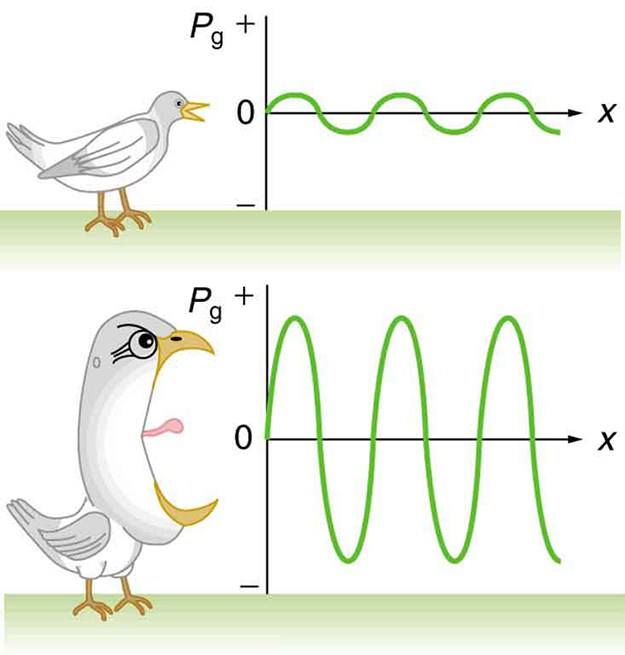
When a sound is louder what measurement gets bigger?
a)
Frequency 
b)
Amplitude 
c)
Wavelength 
d)
Crest
138.

a reflection that occurs when parallel rays of light hit a smooth, shiny surface

a)

regular reflection

b)

diffuse reflection

c)

real image

d)

virtual image

139.

a reflection that occurs when parallel rays of light hit a rough surface

a)

regular reflection

b)

diffuse reflection

c)

real image

d)

virtual image

140.

_____?_____ materials allow almost all the light waves to pass through easily, forming a clear image.

a)

Opaque

b)

Transparent

c)

Translucent

141.
An object that does not allow light to pass through
a)
transparent 
b)
clear
c)
opaque
d)
translucent
142.

This type of object lets most of the light that strikes it pass through, but it is blurry.

a)

transparent

b)

translucent

c)

co-parent

d)

opaque

143.

Light travels through an object during

a)

absorption

b)

reflection

c)

transmission

d)

diffraction

144.

curves outward, like the back of a spoon

a)

concave mirror

b)

absorption

c)

reflection

d)

convex mirror

145.

The angle of incidence is equal to the angle of reflection

a)

law of light

b)

law of reflection

c)

law of refraction

d)

law of incidence

146.

transfer of energy by a wave to the medium through which it travels

a)

radiant energy

b)

potential energy

c)

absorption

d)

refraction

147.

Who is responsible for the photoelectric effect?

a)

Planck

b)

Einstein

c)

Compton

d)

de Broglie

e)

Heisenberg

148.

Who is responsible for the uncertainty principle?

a)

Planck

b)

Einstein

c)

Compton

d)

de Broglie

e)

Heisenberg

149.

When light of specific frequencies is shined on a surface, electrons are ejected from the surface. This is the idea behind...

a)

Quantization of Energy

b)

Photoelectric Effect

c)

Compton Effect

d)

deBroglie Waves

e)

Uncertainty Principle

150.

A person cannot measure the location and the speed (momentum) of an object at the same time. This is the idea behind...

a)

Quantization of Energy

b)

Photoelectric Effect

c)

Compton Effect

d)

deBroglie Waves

e)

Uncertainty Principle

151.
Who was the first person to mention atoms in his research?
a)
Avogadro
b)
Democritus
c)
Dalton
d)
Rutherford
152.
Who developed the wave theory?
a)
DeBrogile
b)
Heisenberg
c)
Thompson
d)
Dalton
153.
Who discovered that electrons orbit on rings?
a)
Thompson
b)
Democritus
c)
Bohr
d)
Dalton