wayground logo

Free Printable Worksheets

Font size

S
M
L
XL
Worksheets

Chemistry Final

Total questions: 148

Worksheet time: 3hrs 8mins

Name
Class
Date
1.

Circling the atom, these parts of an atom hold a negative charge.

a)

Neutron

b)

Electron

c)

Proton

d)

Compound

2.
What does the nucleus of an atom contain?
a)
Electrons and neutrons
b)
Protons and neutrons
c)
Neutrinos and positrons
d)
DNA and RN
3.
Max is hungry and he prepares cereal with milk. This is an example of a: 
a)
Homogeneous mixture
b)
Heterogeneous mixture
4.

Which of these is a compound?

a)

Aluminium (Al)

b)

Carbon Dioxide (CO2)

c)

Nitrogen (N)

d)

Sand

5.

True or False: elements AND compounds are pure substances.

a)

True

b)

False

6.

This is

a)

a compound.

b)

an element.

c)

an atom.

d)

a mixture.

7.

In which mixture can you see all of the parts?

a)

homogeneous

b)

heterogeneous

8.

In which mixture can you not see all of the parts?

a)

homogeneous

b)

heterogeneous

9.

Which state of matter has both definite shape and definite volume?

a)

Gas

b)

Liquid

c)

Solid

10.

Volume is _______________________.

a)

the amount of matter an object has.

b)

the amount of space an object occupies.

c)

anything that mass and volume.

11.

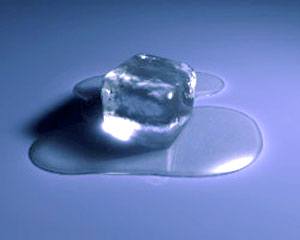
What state of matter does the picture below represent?

a)

solid

b)

liquid

c)

gas

d)

plasma

12.

How does thermal energy play a role in particle motion and changes of state?

a)

Thermal energy is a term that refers to temperature

b)

Increasing an object's thermal energy increases particle motion and can cause a change of state.

c)

Decreasing an object's thermal energy increases particle motion and can cause a change of state.

d)

Thermal energy is the energy added from a heat source.

13.

What happens to particles during changes of state between solid and liquid.

a)

Particles move so fast they break from their fixed position.

b)

Particles melt and become a liquid.

c)

Particles find a circular orbit around an atom's nucleus.

d)

Particles stop vibrating and change into their liquid form.

14.

The temperature at which a liquid turns to a gas is called the _____ point.

a)

boiling

b)

freezing

c)

amorphous

d)

crystalline

15.

How many oxygen atoms are in this chemical formula?

a)

6 oxygen atoms

b)

2 oxygen atoms

c)

3 oxygen atoms

d)

4 oxygen atoms

16.

Which Chemical Equation is Balanced?

a)

Fe4+O2------4FeO2+O2

b)

2H2+O2-----2H2O

c)

3Cr+4O₂-----2Cr₂O₃

17.
How many atoms of aluminum are on each side of the following equation: 4Al + 3O--> 2AlO3
a)
2
b)
6
c)
1
d)
4
18.
In a reaction A + B ----> C,  reactant A has 5g and product  C has 9g. How many grams does reactant B should have? 
a)
4g
b)
5g
c)
9g
d)
14g
19.

32 g of Oxygen completely reacts with 8 g of Hydrogen to produce _____ g Water

a)

8

b)

12

c)

24

d)

40

20.
Is this equation balanced or unbalanced? 
H2 + O2 --> H2O
a)
balanced
b)
unbalanced
21.
12g of Carbon react with 16g of Oxygen, how much carbon monoxide (CO) is formed? 
a)
28 g
b)
4g
c)
30g
d)
12g
22.

The vertical (up and down) columns in the Periodic Table are called

a)

groups

b)

towers

c)

periods

d)

atomic numbers

23.
Which group of the periodic table is composed of inert (not reactive)  gases?
a)
alkali metals
b)
alkaline earth metals
c)
halogens
d)
noble gases
24.

Name this group: These metals are the most reactive.

a)
b)
c)
d)
25.

Name this group: These metals are the second most reactive.

a)
b)
c)
d)
26.
The horizontal row on the periodic table is called a
a)
group
b)
family
c)
period
d)
atomic number
27.

As you move left to right on a row or period what happens?

a)

Atomic number increases by 1

b)

Electrons decrease

c)

Number of shells decrease

d)

Nothing

28.

Elements in the same group or column have the same ...

a)

# of valence electrons

b)

# of shells

c)

# of protons

d)

Mass Number

29.

Rows on the periodic table are called ___________.

a)

Periods

b)

Sentences

c)

Fences

30.

Elements in the same group have __________

a)

Similar Properties

b)

Same number of shells

c)

Similar Mass

31.
The atoms along the staircase are called 
a)
metals
b)
nonmetals
c)
metalloids
d)
noble gases
32.
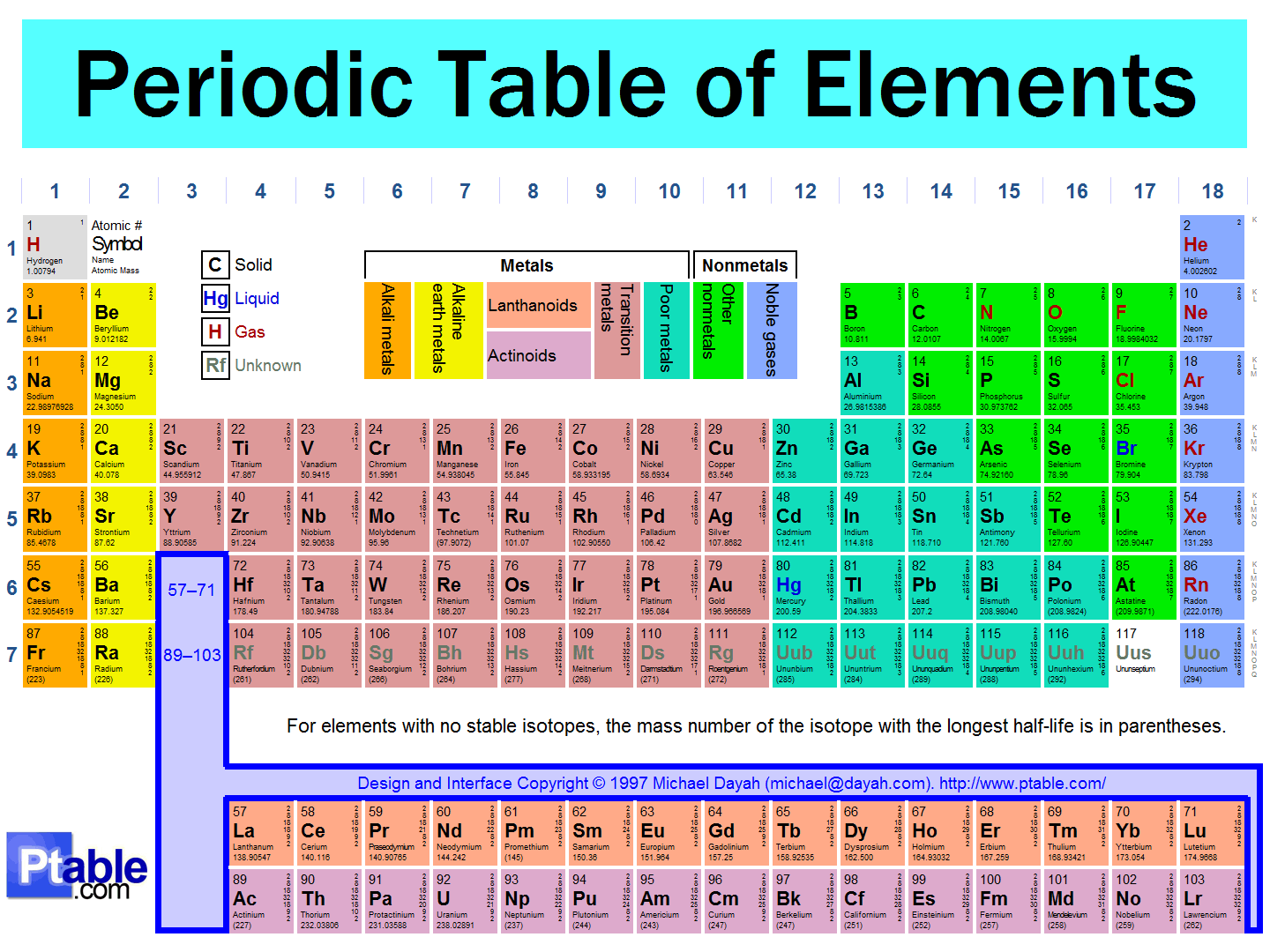
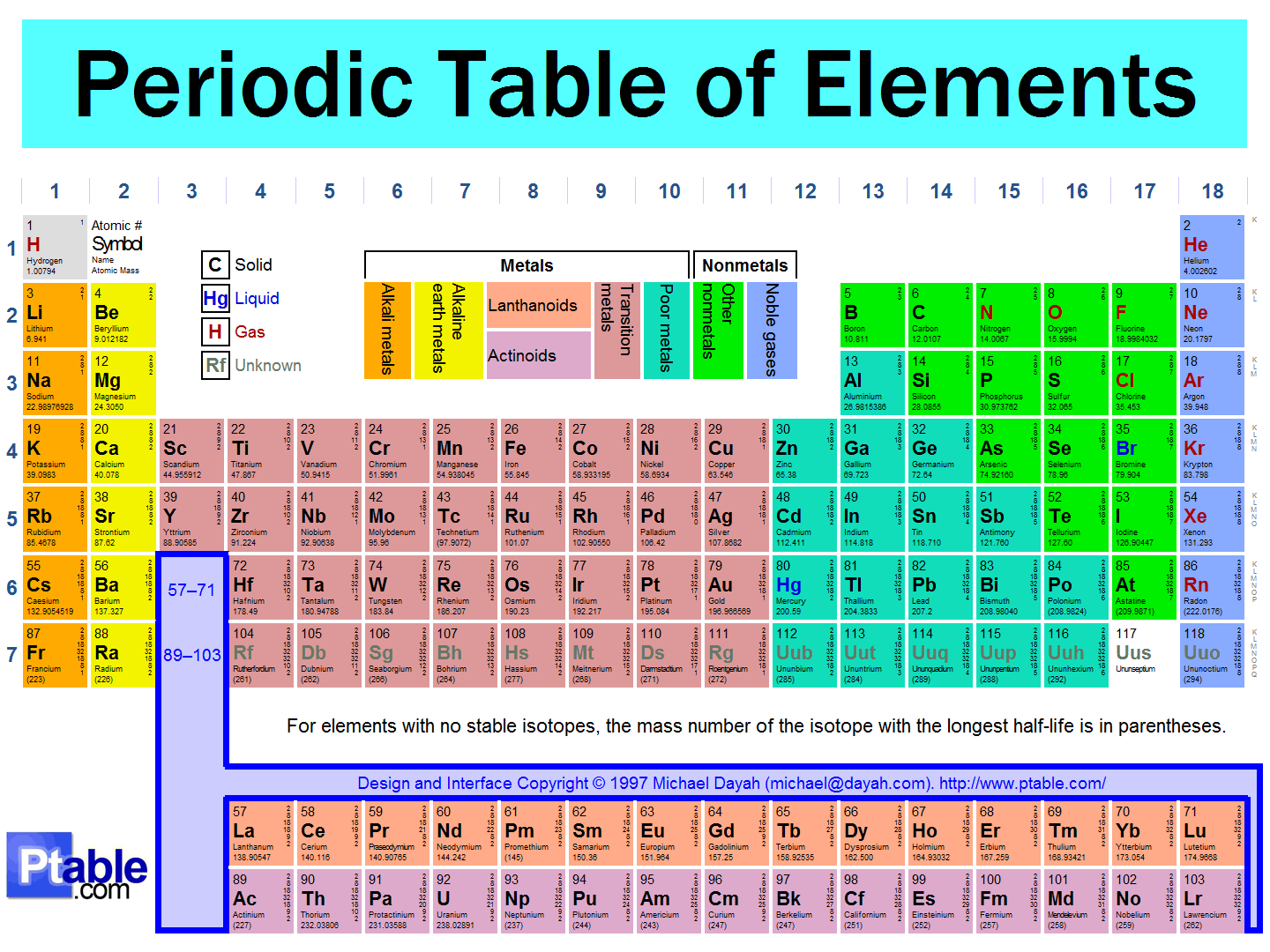
How many protons are in this element?
a)
79
b)
196
c)
117
d)
Cannot be determined
33.

Which elements are colored red?

a)

nonmetals

b)

metals

c)

metalloids

34.

Which elements are to the LEFT of the zigzag?

a)

metals

b)

nonmetals

c)

metalloids

35.

True or False: The reactivity of metals tends to decrease as you move from left to right across the periodic table.

a)

True

b)

False

36.
What reaction type is characterized by the reactant breaking down as the reaction progresses?
a)
Synthesis
b)
Decomposition
c)
Combustion
d)
Double Replacement
37.
What two molecules are produced in a combustion reaction?
a)
CO+ NH4
b)
SiO2 + H2O
c)
H2O + CO2
d)
CO+ H2O2
38.
Which set of coefficients properly balances the reaction below?
_Cu + _H2→_ CuO3 + _H2
a)
1,3,1,5
b)
2,6,2,6
c)
1,3,1,3
d)
1,2,3,4
39.
Which of the following can be categorized as a synthesis reaction?
a)
Ba + NaCl →BaCl2 + Na
b)
KNO3→K+ + NO3-
c)
2Li + F→ 2LiF
d)
HCl + LiNO HNO3 + LiCl
40.
What type of reaction is displayed below?
2Al + Fe2O3 → 2Fe + Al2O3
a)
Single Replacement
b)
Double Replacement
c)
Synthesis
d)
Combustion
41.
What type of reaction is characterized by two compounds switching bonding partners?
a)
Single Replacement
b)
Combustion
c)
Synthesis
d)
Double Replacement
42.
What are the correct coefficients to balance the reaction below?
_BaO + _K3N → _Ba3N2 + _K2O
a)
3,2,1,2
b)
3,3,1,3
c)
3,2,1,3
d)
3,1,2,3
43.
The Law of Conservation of Mass states
a)
that matter exists in all states and reacts the same
b)
that matter can only be changed into new substances by introducing a catalyst
c)
that matter exists in the same state throughout any chemical change
d)
that matter cannot be created or destroyed and that the mass of the products must equal the mass of the reactants
44.
What are the reactants in the chemical equation pictured?
a)
CH4 and CO2
b)
CH4 and O2
c)
CO2 and H2O
d)
O2 and H2O
45.
Is this balanced?...
Al + O2 --> 2Al2O3
a)
Yes!
b)
NO!
46.
Is this balanced?...
Fe + S --> FeS
a)
YES!
b)
NO!
47.
The red numbers in the image below represent ________
a)
subscripts
b)
coefficients
c)
I don't know, and don't want to try
d)
None of the answers are correct
48.
A formula with the lowest whole # ratio of elements in a compound is called
a)
Molecular Formula
b)
Chemical Formula
c)
Empirical Formula 
d)
Distance Formula
49.

What is the empirical formula for C4H6?

a)

CH

b)

CH3

c)

C2H3

d)

C4H6

50.

You are given the following percentages: 40.05% S and 59.95% O. Find the empirical formula for these elements.

a)

SO

b)

SO2

c)

SO3

d)

SO4

51.
Which pair has the same empirical formula?
a)
NaCrO4 and Na2Cr2O7
b)
C2H4O2 and C6H12O6
c)
C3H6Oand C2H6O2
d)
CH4 and C2H6
52.

Which of the following combinations would need roman numerals in the name?

a)

potassium + fluorine

b)

beryllium + oxygen

c)

boron + iodine

d)

lead + oxygen

53.

What is the name of the compound Na2(SO4)?

a)

Sodium sulfate

b)

Sodium sulfide

c)

Sodium sulfite

d)

Sodium sulfuroxide

54.

Which of these combinations is an ionic compound made of?

a)

Metal and Metal

b)

Nonmetal and Nonmetal

c)

Metal and Nonmetal

d)

Cation and Cation

55.

When naming ionic compounds with transition metals you need to include roman numerals to show the _____ of the metal..

a)

atomic number

b)

mass number

c)

charge

d)

ionization energy

56.
How do the following two elements bond together?
Cr3+  O2-         
a)
CrO
b)
Cr3O2
c)
Cr2O3
d)
CrO3
57.
In most cases, when naming you change the ending of the second element to ________.
a)
-ate.
b)
-ite.
c)
-ide.
d)
-ine.
58.
What is the FORMULA for....
beryllium iodide
a)
Be2I
b)
BeI
c)
BeI2
d)
BI2
59.

Name this compound:

(NH4)F

a)

Ammonia fluoride

b)

Ammonium fluorite

c)

Ammonia fluorate

d)

Ammonium fluoride

60.
How many sig figs are there?
100.00
a)
1
b)
3
c)
4
d)
5
61.
How many sig figs are there?
100000000
a)
1
b)
9
c)
10
62.
How many sig figs are there?
4004
a)
1
b)
2
c)
3
d)
4
63.
How many sig figs are there?
9009.00
a)
2
b)
4
c)
5
d)
6
64.
How many sig figs are there?
0.00400
a)
1
b)
3
c)
5
d)
6
65.
How many sig figs are there?
27000000
a)
2
b)
5
c)
8
66.
All of the following have one significant figure except:
a)
100 cm
b)
0.0001 cm
c)
2 cm
d)
2.00 cm
67.

All matter consists of particles called

a)

Units

b)

Atoms

c)

Cubes

d)

Pints

68.

Each protons has a _______________ electrical charge

a)

Positive

b)

Negative

c)

Neutral

d)

Shocking

69.

Each electron has a _________________ electrical charge

a)

Positive

b)

Negative

c)

Neutral

d)

Shocking

70.
An element has an atomic number of 76.  The number of protons and electrons in a neutral atom of the element are
a)
152 p+, 76 e-
b)
76 p+, 0 e-
c)
38 p+, 38 e-
d)
76 p+, 76 e-
71.
An atom has 5 protons, 7 neutrons and 5 electrons. What is the mass number of the atom?
a)
5
b)
7
c)
2
d)
12
72.
How many of these substances are elements?
a)
2
b)
3
c)
4
d)
5
73.
How are elements and compounds different?
a)
A compound is a combination of two or more types of matter, an element is one type.
b)
Compounds are represented by chemical symbols of one letter, elements by two.
c)
There are an infinite number of elements, but a limited number of compounds.
d)
Elements are always larger units of matter, and compounds are smaller.
74.

What element is this?

a)

Sodium (Na)

b)

Phosphorous (P)

c)

Nitrogen (N)

d)

Sulfer (S)

75.

Which orbital notation represents oxygen?

a)
b)
c)
d)
76.

How many electrons can an orbital hold?

a)

1 electron

b)

2 electrons

c)

3 electrons

d)

4 electrons

77.

What element matches this electron configuration?

1s22s22p63s2

a)

Neon

b)

Magnesium

c)

Aluminum

d)

Potassium

78.
What is this element? 
[Ar]4s2
a)
Calcium
b)
Sodium
c)
Scandium
d)
Titanium
79.

What is the electron configuration for the first two electrons?

a)

1d2

b)

1s2

c)

1f2

d)

1p2

e)

2s2

80.

How many valence does phosphorous have?

a)

2

b)

3

c)

5

d)

10

81.

If aluminum loses an electron, it will have a ________ charge and become a(n) ___________.

a)

positive, anion

b)

negatie, anion

c)

positive, cation

d)

negative, anion

82.

If fluorine gains an electron, it will have a _______ charge and become a(n) ____________.

a)

positive, anion

b)

negative, anion

c)

positive, cation

d)

negative cation

83.
What kind of change is a phase change?
a)
Physical - it's still the same substance
b)
chemical - it's made of chemicals 
84.
What is the formula for iron(III) oxide?
a)
FeO
b)
Fe3O
c)
Fe3O2
d)
Fe2O3
85.
What is the empirical formula of a compound if the molecular formula is W18O9?
a)
W18O9
b)
W2O
c)
W6O3
d)
none of the above
86.
What is the mass of one mole of aluminum?
a)
27 g
b)
13 g
c)
54 g
d)
14 g
87.
What is the molar mass of CO2?
a)
12
b)
16
c)
32
d)
44
88.
What is the mass percentage of Carbon in carbon dioxide (CO2)?
a)
27.3%
b)
42.9%
c)
57.1%
d)
72.7%
89.
Formula mass of KBr
a)
119
b)
117g
c)
54
d)
62g
90.
Formula mass of CaCO3
a)
100
b)
100g
c)
50
d)
50g
91.
Formula mass of HF
a)
20g
b)
10g
c)
11
d)
20
92.

How many bonds does a carbon atom need?

a)

2

b)

4

c)

6

d)

8

93.
What is the volume of Object X?
a)
10.0 cm3
b)
15.0 cm3
c)
20.0 cm3
d)
25.0 cm3
94.
Measure to the nearest milliliter.
a)
73 mL
b)
73.1 mL
c)
76 mL
d)
76.1 mL
95.
What is measured with a graduated cylinder?
a)
Passage of time
b)
Distance from one thing to another
c)
Weight of an object
d)
Volume of liquid
96.
Which piece of equipment is shown in the picture?
a)
Graduated Cylinder
b)
Meter Stick
c)
Triple-Beam Balance
d)
Beaker
97.
What is the volume of Object X?
a)
10.0 cm3
b)
15.0 cm3
c)
20.0 cm3
d)
25.0 cm3
98.
Measure to the nearest milliliter.
a)
73 mL
b)
73.1 mL
c)
76 mL
d)
76.1 mL
99.
What is measured with a graduated cylinder?
a)
Passage of time
b)
Distance from one thing to another
c)
Weight of an object
d)
Volume of liquid
100.
Which piece of equipment is shown in the picture?
a)
Graduated Cylinder
b)
Meter Stick
c)
Triple-Beam Balance
d)
Beaker
101.
What is the measurement using the correct number of sig. figs.?
a)
8.5mL
b)
8.50mL
c)
8.45mL
d)
8.4mL
102.
What is the measurement using the correct number of sig. figs.?
a)
89cm
b)
88.9cm
c)
88.90cm
d)
88cm
103.

What is the reading of the meniscus?

a)

36mL

b)

45mL

c)

35.0mL

d)

30.5mL

104.

What is the temperature shown?

a)

12 ⁰F

b)

15 ⁰F

c)

-12 ⁰F

d)

14 ⁰F

105.

How long is line segment K?

a)

3 mm

b)

3 cm

c)

4 cm

d)

6 mm

106.

What is the volume of the glue stick (in the picture)?

a)

15 mL

b)

23 mL

c)

8 mL

d)

7 mL

107.
The smallest unit of matter that retains the properties of that matter is
a)
a molecule
b)
a compound
c)
a mixture
d)
an atom
108.
Which statement best describes an element?
a)
any combination of two or more atoms of different types
b)
a pure substance made up of only one kind of atom
c)
a substance containing only carbon atoms
d)
any kind of crystal
109.
Which of the following changes is a physical change of matter?
a)
water evaporating
b)
paper burning
c)
a nail rusting
d)
a silver spoon tarnishing
110.
Which of the following changes is a chemical change of matter?
a)
ice melting to produce water
b)
vinegar combining with baking soda to produce carbon dioxide
c)
water boiling to produce water vapor
d)
liquid silica solidifying to form glass
111.
Which of the following is an example of a heterogeneous mixture?
a)
tap water
b)
chunky peanut butter
c)
orange-colored sugar water
d)
gold ring
112.
Which of these recorded observations is qualitative, rather than quantitative?
a)
A chemical reaction is complete in 2.3 s.
b)
The solid has a mass of 23.4 g.
c)
The compound melts at 87.5C.
d)
Iron is denser than aluminum.
113.
Which of these shows SI unit prefixes arranged in order from smallest to largest?
a)
centi, milli, kilo
b)
milli, centi, kilo
c)
kilo, milli, centi
d)
kilo, centi, milli
114.
A sample of bismuth has a mass of 343 g and a volume of 35.0 cm3.What is the density of bismuth?
a)
0.102 g/cm3
b)
9.80 g/cm3
c)
378 g/cm3
d)
1.20 104 g/cm3
115.
The number of significant figures in the measurement 170.040 km is
a)
Three
b)
Four
c)
Five
d)
Six
116.
Expressed in scientific notation, 0.0930 m is
a)
93  X  10-3 m
b)
9.3  X 10-3 m.
c)
9.30 X  10-2 m.
d)
9.30 X 10⁻⁴ m.
117.

An atom of carbon has 6 protons and 7 neutrons in its nucleus. If the atom is neutral, how many electrons does it have?

a)

0

b)

7

c)

6

d)

13

118.

A certain atom of oxygen contains 8 protons, 8 neutrons, & 8 electrons. Another atom of unknown identity contains 9 protons. Which of the following MUST be true about this unidentified atom?

a)

It has 9 neutrons in its nucleus.

b)

It is an isotope of oxygen.

c)

Its atomic mass is a decimal number.

d)

It cannot be an atom of oxygen.

119.

An atom of neon has 8 valence electrons. What will an atom of neon MOST likely do to be stable?

a)

Gain 1 electron

b)

Lose 2 electrons

c)

Lose 8 electrons

d)

Neither gain nor lose any valence electrons

120.

What type of bond is formed when atoms share electrons?

a)

Covalent

b)

Ionic

c)

Hydrogen

d)

Polyatomic

121.

How are ionic and covalent bonds alike?

a)

They both form organic molecules.

b)

They both fill outer electron shells.

c)

They both transfer electrons from one atom to another.

d)

They both transfer protons from one atom to another.

122.

A substance with a pH of 8 is a

a)

acid

b)

base

c)

neutral

123.

Carbon has 4 valence electrons which means

a)

it can only form bonds with carbon

b)

it is stable

c)

it can make ionic bonds

d)

it wants to make 4 covalent bonds

124.

The electrons in the outermost energy level are called

a)

valence

b)

ions

c)

covalent

d)

farthest out

125.

If salt is dissolved in water, water is the ____________

a)

Solution

b)

Solute

c)

Solvent

d)

Suspension

126.

Which of the following would be considered most acidic?

a)

1

b)

3

c)

7

d)

13

127.

The image shows the periodic grid for SODIUM. What is Sodium's atomic mass?

a)

11

b)

12

c)

23

d)

Impossible to tell

128.

The formula for density is...

a)

mass divided by volume

b)

volume divided by mass

c)

mass times volume

d)

mass2 times volume 

129.

How many meters are in a Kilometer?

a)

150

b)

100

c)

1000

d)

15

130.

The picture of the salad is an example of what type of mixture.

a)

Heterogenous

b)

Homogenous

131.

NaCl is a ....

a)

Element

b)

Compound

c)

Mixture

d)

Liquid

132.
Is this equation balanced?
a)
yes
b)
no
c)
Not enough information
133.
Is this equation balanced?
a)
yes
b)
no
c)
Not enough information
134.
Is the equation balanced?: 2H2O + O2 --> 4MgO + 3Fe
a)
Yes
b)
No
135.
Balance this equation
_N+ _H--> _NH3
a)
1,2,3
b)
1,3,2
c)
1,1,2
d)
2,1,1
136.
How many electrons can each p orbital hold?
a)
6
b)
3
c)
2
d)
4
137.
What is the electron configuration for F?
a)
1s2 2s2 3p5
b)
1s2 2s2 3d5
c)
1s2 2s2 2p5
d)
1s2 2p5
138.
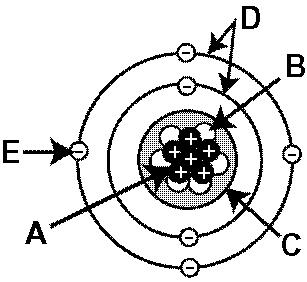
In the atom diagram shown, E is pointing to
a)
An electron
b)
a proton
c)
a neutron
d)
the nucleus
139.
An ionic bond forms when 
a)
Valence electrons are shared
b)
a sea of mobile electrons surround the cations
c)
valence electrons are transferred between atoms
d)
none of the above
140.
In chemical compounds, covalent bonds form when
a)
the electronegativity difference between two atoms is very large.
b)
electrons are completely transferred between two atoms.
c)
pairs of electrons are shared between two atoms.
d)
ions are held together by opposite charges.
141.
Most elements are can be classified as:
a)
metals
b)
nonmetals
c)
metalloids
142.
When electrons are transfered from cations to anions a ________ bond is formed
a)
Polar covalent
b)
Nonpolar covalent
c)
Ionic
d)
Metallic
143.
The oxidation number for the noble gases is 
a)
1+
b)
1-
c)
3+
d)
0
144.
According to the octet rule most elements need _______ valence electrons.
a)
2
b)
8
c)
6
d)
18
145.

How many protons does this isotope of titanium have?

a)

22

b)

26

c)

48

d)

70

146.
An atom becomes _________ when it gains electrons.
a)
Positive
b)
Negative
c)
Neutral
d)
Invinsible
147.

CH4   +   4 Cl2   →   CCl4  +  4 HCl

If we have 12 moles of HCl come out of the reaction, how many moles of CH4 had to go in to the reaction?

a)

1

b)

3

c)

4

d)

12

148.

How many atoms or compounds are in a mole?

a)

62 x 10^23

b)

6 x 10^23

c)

6 x 10^21

d)

8 x 10^23