wayground logo

Free Printable Worksheets

Font size

S
M
L
XL
Worksheets

Specific Heat Practice

Total questions: 152

Worksheet time: 10hrs 54mins

Name
Class
Date
1.
The specific heat of aluminum is 0.21 cal/g°C.  How much heat(Q) is released when a 10 g piece of aluminum foil is taken out of the oven and cools from 100° to 50°?
a)
105 J
b)
10.5 J
c)
1.05 J
2.
The specific heat of aluminum is 0.21 cal/g°C.  How much heat(Q) is released when a 10 g piece of aluminum foil is taken out of the oven and cools from 100° to 50°?
a)
105 J
b)
10.5 J
c)
1.05 J
3.
20 g of water. specific heat of water is 4.18 J/x°C.  temperature changes from 25° C to 20° Chow much heat energy (Q) moves from the water to the surroundings?
a)
418 Joules
b)
209 J
c)
83 J
d)
4.18 J
4.
A material was cooled from 100ºC to 40ºC.  What is the temperature change?
a)
60ºC
b)
40ºC
c)
-60ºC
d)
-40ºC
5.
The specific heat of aluminum is 0.21 cal/g°C.  How much heat(Q) is released when a 10 g piece of aluminum foil is taken out of the oven and cools from 100° to 50°?
a)
105 J
b)
10.5 J
c)
1.05 J
6.
The specific heat(c) of copper is 0.39 J/g °C. What is the temperature change(∆t) when 100 Joules of heat(Q) is added to 20 grams?
a)
12.82 °C
b)
24.12°C
c)
351 °C
7.
The specific heat is the amount of energy needed to raise the temperature one degree Celsius of a substance.
a)
True
b)
False
8.
Calculate the heat needed to raise the temperature of 0.25 kg of aluminum 7°C (c=900 J/kg°C)
a)
1575 J
b)
-1575 J
c)
514 J
d)
-514 J
9.
The amount of energy required to raise the temperature 1ºC for every kilogram is called____?
a)
Thermal Energy
b)
Specific Heat
c)
Temperature
d)
Kinetic Energy
10.
Water has a specific heat of 4184 J/KgºC.  Wood has a specific heat of 1760 J/KgºC.  What material needs more energy to raise the temperature 1ºC
a)
Wood
b)
Water
c)
Both are the same
11.
How does heat flow?
a)
Always from cold to warm
b)
Always from warm to cold
c)
Both warm to cold & cold to warm
d)
It depends on the temperature
12.
When a  piece of aluminum foil is taken out of the oven and cools from 100° to 50°, What is the change in temperature?
a)
50°
b)
c)
100°
d)
150°
13.
A pot of 2400g of water at a temperature of 25˚C is heated on a stove until the water boils (100˚C).  The specific heat of water is 4.18 J/(g˚C).
Determine the heat energy needed to heat the water in the pot to boiling.
a)
133.76J
b)
43,062.2J
c)
752,400J
d)
1,003,200J
14.
The temperature of an unknown piece of metal with a mass of 30.00 g changes from 25.0 °C to 35.0 °C when the metal absorbs 350.0 J of energy. What is the specific heat of the metal?
a)
1.17 J/g°C
b)
-1.17 J/g°C
c)
0.857 J/g°C
d)
-0.857 J/g°C
15.
How many Joules of energy are required to change 10 gram of water from 20 C to 90 C?
a)
1476 J
b)
2926 J
c)
210,050 J
d)
1,404,500 J
16.

The amount of energy required to raise the temperature 1ºC for every gram is called____?

a)

Thermal Energy

b)

Specific Heat

c)

Temperature

d)

Kinetic Energy

17.

What unit do you use to measure Thermal Energy?

a)

J/g ºC

b)

g

c)

ºC

d)

J

18.
What is the equation to measure change in Thermal Energy?
a)
Q=mc∆t
b)
Q=mc
c)
Q= ∆mct
d)
m=QC
19.

Water has a specific heat of 4184 J/gºC. Wood has a specific heat of 1760 J/gºC. What material needs more energy to raise the temperature 1ºC

a)

Wood

b)

Water

c)

Both are the same

20.
Copper, Stainless Steel, Carbon Steel, and Zinc were all heated using the same thermal energy.  What material would be the coolest after being heated?
a)
Copper
b)
Carbon Steel
c)
Zinc
d)
Stainless Steel
21.
How does heat flow?
a)
Always from cold to warm
b)
Always from warm to cold
c)
Both warm to cold & cold to warm
d)
It depends on the temperature
22.
When a  piece of aluminum foil is taken out of the oven and cools from 100° to 50°, What is the change in temperature?
a)
50°
b)
c)
100°
d)
150°
23.

How many Joules of energy are required to change 10 gram of liquid water from 20 C to 90 C?

a)

1400 J

b)

2800 J

c)

210,000 J

d)

1,400,000 J

24.
The specific heat of aluminum is 0.21 J/g°C.  How much heat(Q) is released when a 10 g piece of aluminum foil is taken out of the oven and cools from 100° to 50°?
a)
105 J
b)
10.5 J
c)
1.05 J
25.

For a skillet, used for cooking, do you want a high or low specific heat? and why?

a)

High, so that it will need more energy to heat up

b)

Low, so that it will change temperature quickly

26.
20 g of water. specific heat of water is 4.18 J/x°C.  temperature changes from 25° C to 20° Chow much heat energy (Q) moves from the water to the surroundings?
a)
418 Joules
b)
209 J
c)
83 J
d)
4.18 J
27.

There are four cups of hot cocoa. The cup sizes are shown. The temperature of the cocoa in each cup is 25 degrees celsius. Which cup has the MOST thermal energy?

a)

Largest cup (Trenta)

b)

Small cup (Tall)

c)

Venti

d)

All three are the same temperature so they have same thermal energy

28.
What would be the effect on the particles if more heat is supplied to the system?
a)
They would slow down
b)
They would stop moving
c)
They would speed up
d)
There would be no effect
29.

If the specific heat of water is 4,184 J/g∙°C, how much heat is required to increase the temperature of 1200 g of water from 23 °C to 39 °C?

a)

-80,371.2 J

b)

44,938.6 J

c)

80,371.2 J

d)

112,575.9 K

30.

Joules and calories are units of measurement for __________________.

a)

heat

b)

insulators

c)

conductors

d)

thermometers

31.

The amount of energy required to raise the temperature 1ºC for every gram is called____?

a)

Thermal Energy

b)

Specific Heat

c)

Temperature

d)

Kinetic Energy

32.

What unit do you use to measure Thermal Energy?

a)

J/g ºC

b)

g

c)

ºC

d)

J

33.
What is the equation to measure change in Thermal Energy?
a)
Q=mc∆t
b)
Q=mc
c)
Q= ∆mct
d)
m=QC
34.

Water has a specific heat of 4184 J/gºC. Wood has a specific heat of 1760 J/gºC. What material needs more energy to raise the temperature 1ºC

a)

Wood

b)

Water

c)

Both are the same

35.

If the specific heat of water is 4,184 J/g∙°C, how much heat is required to increase the temperature of 1200 g of water from 23 °C to 39 °C?

a)

-80,371.2 J

b)

44,938.6 J

c)

80,371.2 J

d)

112,575.9 K

36.
The specific heat of aluminum is 0.21 cal/g°C.  How much heat(Q) is released when a 10 g piece of aluminum foil is taken out of the oven and cools from 100° to 50°?
a)
105 J
b)
10.5 J
c)
1.05 J
d)
50 J
37.

How much heat (Q) is needed to raise the temperature of 8.00 g of lead by 15.0C?

a)

15.6J

b)

16J

c)

10.4J

d)

-15.6J

38.

The temperature of a 100.0-g block of ice increases by 5.00C. How much heat does the ice receive

a)

100J

b)

-1,045J

c)

104J

d)

1,045J

39.

The temperature of a 10g Gold nugget decreases from 100C to 70C. How much heat did the Gold nugget lose?

a)

-20J

b)

28.7J

c)

-28.7J

d)

47.8J

40.

The temperature of a 50g Copper wire changes by -5C. How much heat did the Copper wire lose?

a)

95J

b)

-95J

c)

-950J

d)

9.5J

41.

How much heat is gained in 20g of Lead if it goes from 70C to 80C?

a)

26J

b)

2.6J

c)

-26J

d)

-80J

42.

How much heat is lost if 100g of steam goes from 500C to 100C?

a)

700J

b)

-400J

c)

-74,800J

d)

74,800J

43.

Is heat gained or lost if Gold goes from 5C to 10C?

a)

gained

b)

lost

c)

neither

44.

Is heat gained or lost if Lead goes from 60C to 10C?

a)

gained

b)

lost

c)

neither

45.

Is heat gained or lost if a substance goes from 70C to 100C?

a)

gained

b)

lost

c)

neither

46.

Is heat gained or lost if water goes from 5C to -3C?

a)

gained

b)

lost

c)

neither

47.

Is heat gained or lost if a substance goes form -50C to -50C?

a)

gained

b)

lost

c)

neither

48.

How much heat is gained if 200g Copper goes from 16C to 26C?

a)

76J

b)

760J

c)

-760J

d)

-200J

49.

How much heat is lost if 20g of Aluminum goes from 15C to -10C?

a)

450

b)

45

c)

-45

d)

-450

50.

If 50g of water goes from 70C to 85C, how much heat is gained?

a)

15J

b)

3135J

c)

-3135J

d)

-15J

51.

The amount of energy required to raise the temperature 1ºC for every gram is called____?

a)

Thermal Energy

b)

Specific Heat

c)

Temperature

d)

Kinetic Energy

52.

What unit do you use to measure Thermal Energy?

a)

J/g ºC

b)

g

c)

ºC

d)

J

53.
What is the equation to measure change in Thermal Energy?
a)
Q=mc∆t
b)
Q=mc
c)
Q= ∆mct
d)
m=QC
54.

Water has a specific heat of 4184 J/gºC. Wood has a specific heat of 1760 J/gºC. What material needs more energy to raise the temperature 1ºC

a)

Wood

b)

Water

c)

Both are the same

55.
Copper, Stainless Steel, Carbon Steel, and Zinc were all heated using the same thermal energy.  What material would be the coolest after being heated?
a)
Copper
b)
Carbon Steel
c)
Zinc
d)
Stainless Steel
56.
How does heat flow?
a)
Always from cold to warm
b)
Always from warm to cold
c)
Both warm to cold & cold to warm
d)
It depends on the temperature
57.
When a  piece of aluminum foil is taken out of the oven and cools from 100° to 50°, What is the change in temperature?
a)
50°
b)
c)
100°
d)
150°
58.

How many Joules of energy are required to change 10 gram of liquid water from 20 C to 90 C?

a)

1400 J

b)

2800 J

c)

210,000 J

d)

1,400,000 J

59.
The specific heat of aluminum is 0.21 J/g°C.  How much heat(Q) is released when a 10 g piece of aluminum foil is taken out of the oven and cools from 100° to 50°?
a)
105 J
b)
10.5 J
c)
1.05 J
60.

For a skillet, used for cooking, do you want a high or low specific heat? and why?

a)

High, so that it will need more energy to heat up

b)

Low, so that it will change temperature quickly

61.
20 g of water. specific heat of water is 4.18 J/x°C.  temperature changes from 25° C to 20° Chow much heat energy (Q) moves from the water to the surroundings?
a)
418 Joules
b)
209 J
c)
83 J
d)
4.18 J
62.

There are four cups of hot cocoa. The cup sizes are shown. The temperature of the cocoa in each cup is 25 degrees celsius. Which cup has the MOST thermal energy?

a)

Largest cup (Trenta)

b)

Small cup (Tall)

c)

Venti

d)

All three are the same temperature so they have same thermal energy

63.
What would be the effect on the particles if more heat is supplied to the system?
a)
They would slow down
b)
They would stop moving
c)
They would speed up
d)
There would be no effect
64.

If the specific heat of water is 4,184 J/g∙°C, how much heat is required to increase the temperature of 1200 g of water from 23 °C to 39 °C?

a)

-80,371.2 J

b)

44,938.6 J

c)

80,371.2 J

d)

112,575.9 K

65.

Joules and calories are units of measurement for __________________.

a)

heat

b)

insulators

c)

conductors

d)

thermometers

66.
The temperature of an unknown piece of metal with a mass of 30.00 g changes from 25.0 °C to 35.0 °C when the metal absorbs 350.0 J of energy. What is the specific heat of the metal?
a)
1.17 J/g°C
b)
-1.17 J/g°C
c)
0.857 J/g°C
d)
-0.857 J/g°C
67.
Water has a specific heat of 4184 J/KgºC.  Wood has a specific heat of 1760 J/KgºC.  What material needs more energy to raise the temperature 1ºC
a)
Wood
b)
Water
c)
Both are the same
68.
The specific heat(c) of copper is 0.39 J/g °C. What is the temperature change(∆t) when 100 Joules of heat(Q) is added to 20 grams?
a)
12.82 °C
b)
24.12°C
c)
351 °C
69.
Energy is transferred as heat between two objects of ___________ temperatures. 
a)
differing
b)
same
70.
The symbol for specific heat is .......
a)
c
b)
Q
c)
m
d)
t
71.
What  is the formula to calculate heat energy required to raise the temperature of any substance?
a)
Q=mc∆t
b)
Q=mc
c)
Q= ½mv
d)
m=QC
72.

A 300.0 g piece of copper is heated and fashioned into a bracelet. The amount of energy transferred by heat to the copper is 66,300 J. If the specific heat of copper is 0.3845 J/g 0C, what is the change of the copper's temperature?

a)

641 °C

b)

7,650,000 Joules

73.

The specific heat of aluminum is 0.9025 J/g°C. How much heat(Q) is released when a 10.0 g piece of aluminum foil is taken out of the oven and cools from 100.0° to 50.0°?

a)

451 J

b)

45.1 J

c)

400 J

74.
For a skillet, used for cooking, do you want a high or low specific heat
a)
High, so that it will need more energy to heat up
b)
Low, so that it will change temperature quickly
75.
Using the heat equation, what would the formula look like if we were solving for change in temperature?
a)
Q m = ∆T Cp
b)
Q / (m Cp)  =  ∆T
c)
Q m / Cp  =  ∆T
d)
m c Q  =  ∆T
76.
The temperature of an unknown piece of metal with a mass of 30.00 g changes from 25.0 °C to 35.0 °C when the metal absorbs 350.0 J of energy. What is the specific heat of the metal?
a)
1.17 J/g°C
b)
-1.17 J/g°C
c)
0.857 J/g°C
d)
-0.857 J/g°C
77.

The SI units J/g°C measures

a)

Specific heat

b)

mass

c)

temperature

d)

heat energy

78.
The specific heat of aluminum is 0.21 cal/g°C.  How much heat(Q) is released when a 10 g piece of aluminum foil is taken out of the oven and cools from 100° to 50°?
a)
105 J
b)
10.5 J
c)
1.05 J
d)
50 J
79.
20 g of water. specific heat of water is 4.18 J/g°C.  temperature changes from 25° C to 20° Chow much heat energy (Q) moves from the water to the surroundings?
a)
418 Joules
b)
209 J
c)
83 J
d)
4.18 J
80.

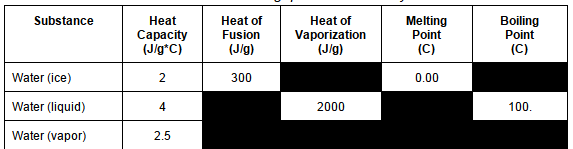
How many Joules of energy are required to change 10 gram of water from 20 C to 90 C with a a specific heat of 4 J/g.C?

a)
1400 J
b)
2800 J
c)
210,000 J
d)
1,400,000 J
81.

The specific heat of platinum is 0.133 J/g°C. How much heat(Q) is released when a 10 g piece of platinum cools from 100°C to 50°C?

a)

66.5 J

b)

665 J

c)

0.0266 J

d)

0.665 J

82.

210 g of water is heated from 10 ˚C until its temperature is 37C. If the specific heat of water is 4.18 J/g˚C, calculate the amount of heat energy needed to cause this rise in temperature.

a)

23,700.6 J

b)

23,700.6 g

c)

50.24 J

d)

50.24 g

83.

Heat lost or gains = ?

C = 4.18 J/g.c

M = 508 g

Change in Temp = 100 c and 120 c

a)

42,468.8 J/g.c

b)

42,468.8 J

c)

11,000 J

d)

12,456.3 J

84.
What is the equation to measure change in Thermal Energy?
a)
Q=mc∆t
b)
Q=mc
c)
Q= ∆mct
d)
m=QC
85.
A high specific heat means...
a)
It requires less energy to change temperature
b)
It requires more energy to change temperature
c)
It heats up very quickly
86.
A pot of 2400g of water at a temperature of 25˚C is heated on a stove until the water boils (100˚C).  The specific heat of water is 4.18 J/(g˚C).
Determine the heat energy needed to heat the water in the pot to boiling.
a)
133.76J
b)
43,062.2J
c)
752,400J
d)
1,003,200J
87.
Copper, Stainless Steel, Carbon Steel, and Zinc were all heated using the same thermal energy.  What material would be the coolest after being heated?
a)
Copper
b)
Carbon Steel
c)
Zinc
d)
Stainless Steel
88.

The specific heat(c) of copper is 0.39 J/g °C. What is the temperature change(∆t) when 100 Joules of heat(Q) is added to 20 grams?

a)

12.82 °C

b)

24.12°C

c)

1.95 °C

d)

5128 °C

89.

20 g of water. specific heat of water is 4.18 J/g°C. temperature changes from 25° C to 20° C, how much heat energy (Q) moves from the water to the surroundings?

a)

418 J

b)

209 J

c)

83 J

d)

4.18 J

90.

Observe the diagram. Which statement is true about the kinetic energy of the molecules in the containers?

a)

The molecules are moving faster in Diagram A

b)

The molecules are moving slower in Diagram A

c)

The molecules are moving at the same rate in both diagrams

91.
The measure of average kinetic energy of all the particles within an object is called ____________. 
a)
temperature
b)
conduction
c)
radiation
d)
heat 
92.
As the kinetic energy of the molecules in a substance increases, the temperature of the substance __________.
a)
increases
b)
decreases
93.
A high specific heat means...
a)
It heats up quickly with energy added
b)
It requires more energy to change temperature
94.
The symbol for specific heat is .......
a)
c
b)
Q
c)
m
d)
t
95.

A 15.75-g piece of iron absorbs 1086.75 joules of heat energy, and its temperature changes from 25°C to 175°C. Calculate the specific heat capacity of iron.

a)

0.46 J/goC

b)

1.654 J/goC

c)

2,567,446.875 J/goC

96.

How many joules of heat are needed to raise the temperature of 10.0 g of aluminum from 22.0°C to 55.0°C, if the specific heat of aluminum is 0.903 J/g°C?

a)

298 Joules

b)

0.003 Joules

c)

297 J/g°C

d)

0.003 J/g°C

97.

A 300.0 g piece of copper is heated and fashioned into a bracelet. The amount of energy transferred by heat to the copper is 66,300 J. If the specific heat of copper is 0.3845 J/g 0C, what is the change of the copper's temperature?

a)

641 °C

b)

756 °C

c)

756 J

d)

641 J

98.
For a skillet, used for cooking, do you want a high or low specific heat
a)
High, so that it will need more energy to heat up
b)
Low, so that it will change temperature quickly
99.
What would be the effect on the particles if more heat is supplied to the system?
a)
They would slow down
b)
They would stop moving
c)
They would speed up
d)
There would be no effect
100.

These units measure what variable in the specific heat equation? J/g°C

a)

Specific heat

b)

mass

c)

temperature

d)

heat energy

101.
The specific heat(c) of copper is 0.39 J/g °C. What is the temperature change(∆t) when 100 Joules of heat(Q) is added to 20 grams of copper?
a)
12.82 °C
b)
24.12°C
c)

351.99 °C

d)

12.82 g

102.

What is the change in temperature when 50,000 Joules of energy is added to 200 grams of water if the specific heat is 4.18 J/g * C?

a)
0.016 C
b)
1,500 C
c)

63.90 C

d)

59.81 C

103.

Which will heat up faster?

a)

copper

b)

granite

c)

iron

d)

basalt

104.

How many Joules of energy are required to change 10 gram of water from 20 C to 90 C? (specific heat of water is 4.18 J/g * C)

a)
1400 J
b)

2,926 g

c)
210,000 J
d)

2,926 J

105.

Which of the following best explains why the sand at the beach is hotter than the water?

a)

Sand has a higher specific heat than water.

b)

Sand has a lower specific heat than water.

c)

There is more water than sand at the beach.

d)

There is more sand than water at the beach.

106.

The specific heat of platinum is 0.133 J/g°C. How much heat(Q) is released when a 10 g piece of platinum cools from 100°C to 50°C?

a)

66.5 J

b)

-66.50 J

c)

-0.0266 J

d)

0.665 J

107.

What is the unit for the variable "q" in the specific heat equation?

a)

q

b)

J

c)

C

d)

K

108.

Water has a specific heat of 4.184 J/gºC. Wood has a specific heat of 1.760 J/gºC. What material needs more energy to raise the temperature 1ºC

a)

Wood

b)

Water

c)

Both are the same

109.
What has particularly high specific heat? 
a)
Water
b)
Gases 
c)
Metals 
d)
Poptarts
110.

Calculate the specific heat of a metal if 35 grams of the metal at 100.0 Celsius , is placed into 40. grams of water at 17.0 Celsius, produces a final temperature of 20.0 Celsius. What is the specific heat of the metal?

a)

5.6 J/g C

b)

0.18 J/g C

c)

1.5 J/g C

d)

0.32 J/g C

111.

Calculate the specific heat of a substance if 140 grams of the it at 85.0 Celsius , is placed into 50. grams of water at 22.0 Celsius, produces a final temperature of 24.0 Celsius. What is the specific heat of the substance?

a)

0.17 J/g C

b)

20 J/g C

c)

0.005 J/g C

d)

0.049 J/g C

112.

Calculate the specific heat of a substance if 55 grams of the it at 65 Celsius , is placed into 30. grams of water at 27.0 Celsius, produces a final temperature of 28.0 Celsius. What is the specific heat of the substance?

a)

0.060 J/g C

b)

17 J/g C

c)

0.05 J/g C

d)

0.39 J/g C

113.

Calculate the specific heat of a substance if 55 grams of the it at 65 Celsius , is placed into 30. grams of water at 27.0 Celsius, produces a final temperature of 28.0 Celsius. What is the specific heat of the substance?

a)

0.060 J/g C

b)

17 J/g C

c)

0.05 J/g C

d)

0.39 J/g C

114.

Calculate the specific heat of a substance if 55 grams of the it at 65 Celsius , is placed into 30. grams of water at 27.0 Celsius, produces a final temperature of 28.0 Celsius. What is the specific heat of the substance?

a)

0.060 J/g C

b)

17 J/g C

c)

0.05 J/g C

d)

0.39 J/g C

115.

Calculate the specific heat of a substance if 55 grams of the it at 65 Celsius , is placed into 30. grams of water at 27.0 Celsius, produces a final temperature of 28.0 Celsius. What is the specific heat of the substance?

a)

0.060 J/g C

b)

17 J/g C

c)

0.05 J/g C

d)

0.39 J/g C

116.

Calculate the specific heat of a substance if 55 grams of the it at 65.0 Celsius , is placed into 30. grams of water at 27.0 Celsius, produces a final temperature of 28.0 Celsius. What is the specific heat of the substance?

a)

0.060 J/g C

b)

17 J/g C

c)

0.05 J/g C

d)

0.39 J/g C

117.

Calculate the specific heat of a substance if 105 grams of the it at 95 Celsius , is placed into 1300. grams of water at 21.0 Celsius, produces a final temperature of 22.0 Celsius. What is the specific heat of the substance?

a)

01.4 J/g C

b)

0.14 J/g C

c)

0.71 J/g C

d)

0.59 J/g C

118.
Copper, Stainless Steel, Carbon Steel, and Zinc were all heated using the same thermal energy.  What material would be the coolest after being heated?
a)
Copper
b)
Carbon Steel
c)
Zinc
d)
Stainless Steel
119.
A material was cooled from 100ºC to 40ºC.  What is the temperature change?
a)
60ºC
b)
40ºC
c)
-60ºC
d)
-40ºC
120.
How many Joules of energy are required to change 10 gram of water from 20 C to 90 C?
a)
1400 J
b)
2800 J
c)
210,000 J
d)
1,400,000 J
121.
A high specific heat means...
a)
It heats up quickly with energy added
b)
It requires more energy to change temperature
122.
How much heat is gained by 125 grams of water that heats from 25.60C to 29.30C? The specific heat of water is 4.184 J/(g 0C). 
a)
1900J
b)
-1935J
c)
462.5J
d)
-462.5J
123.
A sample of silver with a mass of 26.5 g is heated to a temperature of 72.3 °C and placed in a container of water at 40.0 °C.  The final temperature of the silver and water is 52.4 °C.  What mass of water was in the container?  (The specific heat of silver is 0.240 J/g°C)
a)
2.44 g H2O
b)
2.74 g H2O
c)
0.41 g Ag
d)
1.41 g Ag
124.

The amount of energy required to raise the temperature 1ºC for every gram is called____.

a)
Thermal Energy
b)
Specific Heat
c)
Temperature
d)
Kinetic Energy
125.
What is the symbol for Thermal Energy?
a)
Q
b)
t
c)
m
d)
C
126.

What unit do you use to measure Thermal (Heat) Energy?

a)
J/Kg ºC
b)
Kg
c)
ºC
d)
J
127.

What is the symbol for Specific Heat?

a)
Q
b)
t
c)
m
d)

c

128.

Water has a specific heat of 4.184 J/gºC.  Wood has a specific heat of 1.760 J/gºC.  What material needs more energy to raise the temperature 1ºC

a)
Wood
b)
Water
c)
Both are the same
129.
Copper, Stainless Steel, Carbon Steel, and Zinc were all heated using the same thermal energy.  What material would be the coolest after being heated?
a)
Copper
b)
Carbon Steel
c)
Zinc
d)
Stainless Steel
130.
What does temperature measure?
a)
Heat
b)
ºC
c)
Kinetic Energy
d)
Thermal Energy
131.
How many Joules of energy are required to change 10 gram of water from 20 C to 90 C?
a)
1400 J
b)

2929 J

c)
210,000 J
d)
1,400,000 J
132.
A high specific heat means...
a)
It requires less energy to change temperature
b)
It requires more energy to change temperature
c)
It heats up very quickly
133.

The specific heat of aluminum is 0.21 J/g°C.  How much heat(Q) is absorbed when a 10 g piece of aluminum foil is put in the oven and changes temp from 50° to 100°?

a)
105 J
b)
10.5 J
c)
1.05 J
d)
50 J
134.
The specific heat(c) of copper is 0.39 J/g °C. What is the temperature change(∆t) when 100 Joules of heat(Q) is added to 20 grams of copper?
a)
12.82 °C
b)
24.12°C
c)
351 °C
135.

If two objects have different temperatures when they come in contact, heat will flow from the warmer object to the cooler one UNTIL ____________

a)

one reaches a temperature of zero

b)

they both have an equal temperature

c)

one runs out of energy

136.

What is the specific heat of an unknown substance if 100.0 g of it at 200.0 °C reaches an equilibrium temperature of 27.1 °C when it comes in contact with a calorimeter of water. The water weighs 75. g and had an initial temperature of 20.00 °C? (Specific heat of water is 4.18 J/g°C)

a)

0.111 J/g°C

b)

1.29 J/g°C

c)

0.129 J/g°C

d)

22225.85 J

137.

For a skillet, used for cooking, do you want a high or low specific heat

a)

High, so that it will need more energy to heat up

b)

Low, so that it will change temperature quickly

138.

Calorimetry Question:

A piece of metal with a mass of 32.8 g is heated to 100.5°C and dropped into 138.2 g of water at 20.0°C. The final temperature of the system is 30.2°C. What is the specific heat capacity of the metal?

a)

2.56 J/g°C

b)

0.391 J/g°C

c)

5.29 J/g°C

d)

3.50 J/g°C

139.

A metal cube at temperature of 70°C is immersed in water at temperature of 20°C. The metal _______ heat while the water __________ heat.

a)

gains, loses

b)

loses, gains

140.
A sample of iron receives 50.J of heat energy that raises the temperature of the iron by 25.0°C. If iron has a specific heat of 0.10 J/g°C, what is the mass of the iron sample?  (show your work)
a)
25g
b)
30g
c)
20g
d)
50g
141.

What does "ΔT" mean?

a)

A change in health

b)

A change in heat

c)

A change in height

d)

A change in temperature

142.
The temperature of an unknown piece of metal with a mass of 30.00 g changes from 25.0 °C to 35.0 °C when the metal absorbs 350.0 J of energy. What is the specific heat of the metal?
a)
1.17 J/g°C
b)
-1.17 J/g°C
c)
0.857 J/g°C
d)
-0.857 J/g°C
143.
Water has a specific heat of 4184 J/KgºC.  Wood has a specific heat of 1760 J/KgºC.  What material needs more energy to raise the temperature 1ºC
a)
Wood
b)
Water
c)
Both are the same
144.
The specific heat(c) of copper is 0.39 J/g °C. What is the temperature change(∆t) when 100 Joules of heat(Q) is added to 20 grams?
a)
12.82 °C
b)
24.12°C
c)
351 °C
145.
Energy is transferred as heat between two objects of ___________ temperatures. 
a)
differing
b)
same
146.
The symbol for specific heat is .......
a)
c
b)
Q
c)
m
d)
t
147.
What  is the formula to calculate heat energy required to raise the temperature of any substance?
a)
Q=mc∆t
b)
Q=mc
c)
Q= ½mv
d)
m=QC
148.

A 300.0 g piece of copper is heated and fashioned into a bracelet. The amount of energy transferred by heat to the copper is 66,300 J. If the specific heat of copper is 0.3845 J/g 0C, what is the change of the copper's temperature?

a)

641 °C

b)

7,650,000 Joules

149.

The specific heat of aluminum is 0.9025 J/g°C. How much heat(Q) is released when a 10.0 g piece of aluminum foil is taken out of the oven and cools from 100.0° to 50.0°?

a)

451 J

b)

45.1 J

c)

400 J

150.
For a skillet, used for cooking, do you want a high or low specific heat
a)
High, so that it will need more energy to heat up
b)
Low, so that it will change temperature quickly
151.
Using the heat equation, what would the formula look like if we were solving for change in temperature?
a)
Q m = ∆T Cp
b)
Q / (m Cp)  =  ∆T
c)
Q m / Cp  =  ∆T
d)
m c Q  =  ∆T
152.
The temperature of an unknown piece of metal with a mass of 30.00 g changes from 25.0 °C to 35.0 °C when the metal absorbs 350.0 J of energy. What is the specific heat of the metal?
a)
1.17 J/g°C
b)
-1.17 J/g°C
c)
0.857 J/g°C
d)
-0.857 J/g°C