wayground logo

Free Printable Worksheets

Font size

S
M
L
XL
Worksheets

Chemistry final review

Total questions: 156

Worksheet time: 5hrs 32mins

Name
Class
Date
1.
Which particle has a positive charge?
a)
electron
b)
orbital
c)
proton
d)
neutron
2.
Choose the particle that has no charge.
a)
nucleus
b)
neutron
c)
proton
d)
electron
3.
This particle determines what element you have - the elements identity.
a)
electron
b)
proton
c)
neutron
d)
valence shell
4.
An electron has a _____ charge.
a)
negative
b)
positive
c)
neutral
5.
What are the maximum number of electrons that go on the first 3 energy levels?
a)
2,4,16
b)
2,8,18
c)
4,8,12
d)
3,4,6
6.
What are valence electrons?
a)
electrons on the first orbital always
b)
nucleus
c)
the outermost shell
d)
the number of electrons on the outermost orbital
7.
Which particles make up the nucleus of an atom?
a)
protons and neutrons
b)
electrons and protons
c)
electrons, protons, and neutrons
d)
electrons and neutrons
8.
The particles of the atom you can find by knowing the atomic number.
a)
neutrons
b)
protons and electrons
c)
protons and neutrons
d)
atomic mass
9.
The subatomic particle that determines the identity of an element.
a)
neutron
b)
proton
c)
electron
d)
outer shell
10.
What charge does the nucleus have and why?
a)
positive - the neutrons do not have a charge
b)
positive - the neutrons and protons are positively charged particles
c)
neutral - the neutral charge dominates the positive charge
d)
neutral - electrons cancel out the positive charge of the atom
11.
What is the mass number and name of an element with 8 protons and 8 neutrons?
a)
16 - Carbon
b)
16 - Oxygen
c)
24 - Oxygen
d)
8 - Neon
12.
An element with a mass number of 10 and an atomic number of 6 has how many protons?
a)
5
b)
8
c)
6
d)
10
13.
An element with a mass number of 11 and an atomic number of 5 has how many neutrons?
a)
11
b)
5
c)
6
d)
16
14.
An atom has 10 protons, 15 neutrons and 10 electrons what is its mass number.
a)
20
b)
10
c)
5
d)
25
15.
Elements on the periodic table increase by...
a)
atomic mass
b)
size
c)
mass number
d)
atomic #
16.
Most of the mass of an atom is contained here.
a)
electron orbitals 
b)
nucleus
c)
shells
d)
atomic #
17.
What is the number that gives you the element and the number of protons contained in each elemental atom?
a)
atomic mass
b)
mass number
c)
symbol
d)
atomic #
18.
What do the following properties describe? : shiny, ductile, good conductor, high melting point
a)
metal
b)
nonmetal
c)
metalloid
19.
Which is an example of a nonmetal?
a)
Platinum
b)
Carbon
c)
Silver
d)
Lead
20.
Which is an example of a metalloid?
a)
Boron
b)
Lead
c)
Radon
d)
Gold
21.
How many proton are in this element?
a)
238
b)
92
c)
146
22.
How many electrons are in this element?
a)
238
b)
92
c)
146
23.
How many neutrons are in this element?
a)
238
b)
92
c)
146
24.
Which has the greater EN: 
Cl or Al?
a)
Cl
b)
Al
25.
Which of the following will have a larger radius than Zinc?
a)
Gallium
b)
Aluminum
c)
Magnesium
d)
Strontium
26.
Which of the following will have a higher electronegativity than arsenic (As)?
a)
Carbon (C)
b)
Neon (Ne)
c)
Antimony (Sb)
d)
Germanium (Ge)
27.
Which atom has the largest atomic radius?
a)
potassium
b)
rubidium 
c)
francium
d)
cesium
28.
As you move down the periodic table atoms get bigger.  This is because ____________.
a)
The atoms have more mass.
b)
The atoms have more protons.
c)
The atoms have more energy levels
d)
The atoms have more nuetrons
29.
As you move across the periodic table atoms tend to get smaller because, ______________.
a)
the atoms have more mass.
b)
the atoms have less mass
c)
the atoms have more protons.
d)
the atoms have less electrons.
30.
Atoms that have a high electronegativity, _______________.
a)
give up their electrons more easily.
b)
hold on to their electrons more tightly.
c)
have more electron shells.
31.
Electronegativity is...
a)
how good an atom is at attracting electrons
b)
the ability of an atom to lose electrons
c)
the energy required to remove an electron from a specific atom
d)
how easy it is to make friends. 
32.
The element with the largest electronegativity in the halogens is - 
a)
At
b)
F
c)
Cl
d)
Br
33.
Atomic radius generally increases as we move __________.  
a)
down a group and from right to left across a period 
b)
up a group and from left to right across a period 
c)
down a group and from left to right across a period 
d)
up a group and from right to left across a period 
34.
How many neutrons in C-14?
a)
6
b)
7
c)
14
d)
8
35.
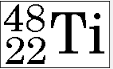
How many protons does this isotope of titanium have?
a)
48
b)
22
c)
26
d)
70
36.
What is the number of protons that the element in this image contain?
a)
14
b)
7
c)
15
d)
18
37.

The rows on the periodic table are referred to as

a)

Groups

b)

Periods

38.

The columns on a periodic table are referred to as

a)

Groups

b)

Periods

39.
All Matter is made up of
a)
compounds
b)
mixtures
c)
atoms
d)
pure substances
40.
Two or more different atoms joined together chemically is a(n)
a)
element
b)
compound
c)
pure substance
d)
mixture
41.
Ice melting into water is an example of a(n)
a)
physical change
b)
chemical change
42.
The color of the statue of liberty is due to a 
a)
physical change
b)
chemical change
43.
The phase change from gas to liquid is called
a)
melting
b)
freezing
c)
boiling
d)
condensing
44.
The phase change from solid to liquid is called
a)
melting
b)
freezing
c)
boiling
d)
condensing
45.
Which of the following is NOT an example of matter?
a)
air
b)
heat
c)
smoke
d)
water vapor
46.
Which of the following is a physical change?
a)
corrosion
b)
explosion
c)
evaporation
d)
rotting of food
47.
What atom matches this electron configuration?
1s22s22p63s23p64s23d10
a)
Zinc
b)
Copper
c)
Nickel
d)
Germanium
48.
How many electrons can the first energy level hold?
a)
1
b)
2
c)
8
d)
0
49.
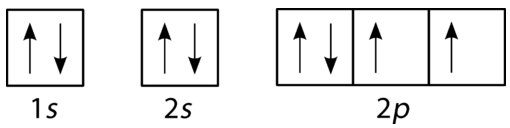
This orbital diagram represents:  
a)
C
b)
B
c)
N
d)
O
50.
How many electrons can the d sublevel hold?
a)
14
b)
10
c)
2
d)
6
51.
How many electrons can the s sublevel hold?
a)
14
b)
10
c)
2
d)
6
52.
How many electrons can the p sublevel hold?
a)
14
b)
10
c)
2
d)
6
53.
Nonmetals tend to 
a)
gain electrons
b)
lose electrons
54.
Metals tend to 
a)
gain electrons
b)
lose electrons
55.
When metals bond with non-metals they form what type of bonds
a)
covalent
b)
ionic
c)
cooperative
d)
lewis
56.
How do the following two elements bond together?
Cr3+  O2-         
a)
CrO
b)
Cr3O2
c)
Cr2O3
d)
CrO3
57.
PbS2
a)
lead sulfide
b)
lead sulfur
c)
lead II sulfide
d)
lead IV sulfide
58.
When a nonmetal gains electrons, it becomes this type of ion.
a)
Anion
b)
Cation
59.
When a metal loses electrons, it becomes this type of ion.
a)
anion
b)
cation
60.
An ion with a positive charge is a/an 
a)
anion
b)
cation
61.
An ion with a negative charge is a/an
a)
anion
b)
cation
62.
When an ionic compound is formed, its charge is 
a)
negative
b)
neutral (no charge)
c)
positive
63.
What is the formula for iron(II) carbonate?
a)
Fe2CO3
b)
FeCO3
c)
Fe2CO2
d)
FeCO4
64.
What is the formula for copper(I) sulfate?
a)
CuSO3
b)
CuSO4
c)
Cu2SO3
d)
Cu2SO4
65.
Name this compound:
NiPO4
a)
Nickel (I) phosphate
b)
Nickel (II) phosphate
c)
Nickel (IV) phosphate
d)
Nickel (III) phosphate
66.
How many valence electrons does the following atom have?
a)
3
b)
13
c)
5
d)
14
67.
When naming an ionic compound with a ______ metal needs a Roman Numeral after its name.
a)
Alkali
b)
Alkaline-Earth
c)
Transition 
d)
Metalloid
68.
the ions in metals are ________ together and arranged in _______ layers
a)
loosely arranged , irregular
b)
tightly packed, three
c)

closely packed, thick

d)
closely packed, regular
69.
How many valence electrons does aluminum have?
a)
13
b)
14
c)
3
d)
4
70.
Look at the following electron configuration: 1s22s22p63s23p3
What charge will the ion of this element likely form?
a)
+3
b)
-3
c)
+5
d)
-2
71.
Look at the following electron configuration: 1s22s22p63s1
What charge will the ion of this element likely form?
a)
+2
b)
-2
c)
+1
d)
-1
72.
If an element has 3 valence electrons, what charge will likely form on its ion form?
a)
+3
b)
+5
c)
-3
d)
-5
73.
An element forms an ion with a 2- charge. This means that 2 electrons were __________.
a)
Gained
b)
Lost
c)
Shared
d)
Destroyed
74.
When magnesium and chlorine react, they form an ionic compound. What is the charge of the ionic compound?
a)
+1
b)
+2
c)
-3
d)
0
75.
What salt forms when calcium and chlorine react? 
a)
CaCl
b)
Ca2Cl
c)
CaCl2
d)
CaCl3
76.
In metals, the _______ electrons form a shared sea of electrons.
a)
Metallic
b)
Inner
c)
Outer
d)
Ionic
77.
I can hit a metal with a hammer without the metal shattering because of its __________.
a)
Ductility
b)
Malleability
c)
Conductivity
d)
Lustrousness
78.
Metals like to ________ electrons.
a)
Gain
b)
Lose
c)
Anhilate
d)
Juggle
79.
What is the basis of a metallic bond?
a)
the attraction of neutral metal atoms.
b)
the attraction between protons and neutrons.
c)
the attraction between positive metal ions and interlocking electrons.
d)
the attraction between positive metal ions and free floating electrons.
80.
At room temperature, most metals are
a)
liquid
b)
solid
c)
gas
d)
an alloy
81.
What is the ability of a substance to be pulled into a thin strand?
a)
Malleability
b)
Ductility 
c)
Conductivity
d)
Solubility
82.
What is the ability of a substance to allow heat, sound, or electricity to flow through it?
a)
Malleability
b)
Ductility
c)
Solubility
d)
Conductivity
83.

What characteristic of metallic bonds allows metals to be malleable and ductile?

a)

The tightly held valence electrons in metallic bonds allow the atoms in a metal to move freely.

b)

The strong connection between atoms in metallic bonds allow the bonds to bend without breaking.

c)

The sea of free electrons in metallic bonds allow the atoms to move when stressed without changing the properties of the substance.

d)

The crystal structure of atoms in metallic bonds allows the metal to maintain a constant pattern when force is applied.

84.
Which of the following molecular shapes would have a bond angle of 180 Degrees?
a)
Bent
b)
Trigonal Planar
c)
Tetrahedral
d)
Linear
85.
What is the measure of a tetrahedral bond angle?
a)
90 Degrees
b)
109.5 Degrees
c)
120 Degrees
d)
180 Degrees
86.
Which molecule would have this shape?
a)
BF3
b)
CH4
c)
PCl5
d)
CO2
87.
The bond angle for a trigonal planar molecule is 
a)
90 Degrees
b)
109.5 Degrees
c)
120 Degrees
d)
180 Degrees
88.
Who could this molecule be?
a)
CH4
b)
CO2
c)
PCl5
d)
BF3
89.
One can predict the shape of a molecule by drawing its Lewis structure and
a)
balancing the oxidation numbers.
b)
accounting for nonbonded pairs of valence electrons.
c)
determining the empirical formula.
d)
identifying the presence of polyatomic ions.
90.
According to the VESPR theory four electron pairs give a
a)
linear shape
b)
bent shape
c)
trigonal planar shape
d)
tetrahedral shape
91.
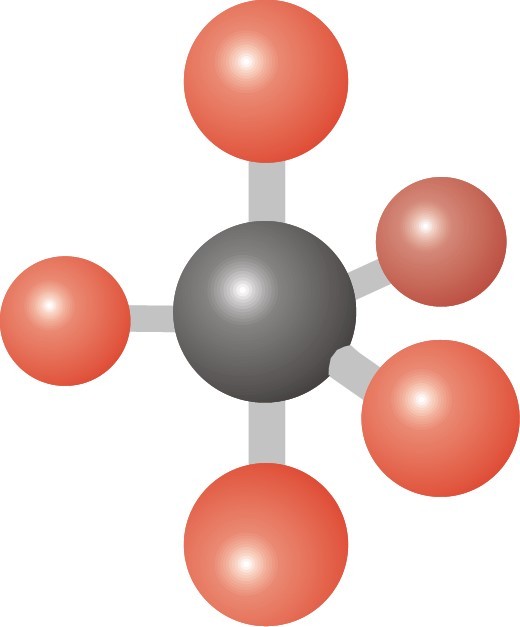
What molecule could this be? 
a)
H2O
b)
CCl4
c)
PCl5
d)
NaCl
92.

Use the electron dot formula of sulfur difluoride to predict its molecular shape

a)

Bent

b)

linear

c)

trigonal planar

d)

terahedral

93.
 A lone pair is defined as
a)
A pair of bonding electrons
b)
One non-bonding electron
c)
A pair of non-bonding electrons
d)
A pair of electrons on the central atom
94.
a)
17
b)
18
c)
7
d)
3
95.
What is the structure of an ammonia (NH3) molecule?
a)
Tetrahedral
b)
Trigonal planar
c)
Trigonal pyramidal
d)
Octahedral
96.

What is the correct Lewis Dot Structure for ammonia NH3

a)
b)
c)
d)
97.

Which is the correct molecular structure for carbon dioxide?

a)
b)
c)
d)
98.

CO2 has how many lone pairs?

a)

0

b)

1

c)

2

d)

3

e)

4

99.

This is a correct dot diagram for nitrogen (N)

a)

true

b)

false

100.
How many chemical bonds will be formed by the atom in the picture?
a)
4
b)
2
c)
3
d)
no way to know
101.
Which naming pattern is unique to polyatomic ionic compounds?
a)
they can have prefixes
b)
they can end in -ide
c)
they can end in -ate
d)
they use Roman Numerals
102.
What does the Roman Numeral in the name of a multivalent compound represent?
a)
the charge on the anion
b)
the charge on the cation
c)
the number of cations
d)
the number of metal ions
103.
What type of compound is Ca3N2?
a)
covalent
b)
simple ionic
c)
polyatomic ionic
d)
multivalent ionic
104.
What is the name of Ca3N2?
a)
calcium nitrogen
b)
carbon nitrogen
c)
calcium nitride
d)
carbon nitrate
105.
Carbon monoxide is a deadly gas produced from incomplete combustion. What type of compound is it?
a)
covalent
b)
simple ionic
c)
polyatomic ionic
d)
multivalent ionic
106.
What type of compound is KNO3?
a)
covalent
b)
simple ionic
c)
polyatomic ionic
d)
multivalent ionic
107.
KNO3 is used in fertilizers as a source of potassium and nitrogen. If you want to buy fertilizer with this compound, what chemical name should you look for?
a)
potassium nitrate
b)
potassium nitrite
c)
potassium nitride
d)
potassium nitrogen
108.
What type of compound is NH4Cl?
a)
covalent
b)
simple ionic
c)
polyatomic ionic
d)
multivalent ionic
109.
What is the name of Si2Cl6?
a)
disilicon hexachlorine
b)
disilicon hexachloride
c)
silicon hexachloride
d)
silicon chloride
110.

Formula for barium sulfide

a)

B2S3

b)

BaS

c)

Ba2S

d)

BaS2

111.

Name for PBr2

a)

phosphorus bromide

b)

phosphorus dibromide

c)

phosphorus dibromine

d)

phosphorus bromine

112.

Formula for lead (II) chloride

a)

PbCl2

b)

Pb2Cl

c)

Pb2Cl3

d)

Pb3Cl2

113.

Formula for Disilicon Heptasulfide

a)

SiS6

b)

SiS7

c)

Si2S6

d)

Si2S7

114.

Formula for iron (II) carbonate

a)

FeCO3

b)

Fe2CO3

c)

FeCO2

d)

Fe2CO2

115.

Name for SrBr2

a)

strontium bromine

b)

strontium bromide

c)

strontium dibromide

d)

strontium dibromine

116.

Formula for Cobalt (II) bromide

a)

CoBr

b)

Co2Br2

c)

Co2Br

d)

CoBr2

117.
What is the correct term for "bond that forms when electrons are shared unequally"?
a)
ionic bond
b)
metallic bond
c)
nonpolar covalent bond
d)
polar covalent bond
118.
What is the correct term for "bond that forms when electrons are shared equally"?
a)
ionic bond
b)
metallic bond
c)
nonpolar covalent bond
d)
polar covalent bond
119.
What is the correct term for "atom with more protons than electrons"?
a)
positive ion (cation)
b)
negative ion (anion)
c)
neutral atom
d)
stable atom
120.
What is the correct term for "atom with more electrons than protons"?
a)
positive ion (cation)
b)
negative ion (anion)
c)
neutral atom
d)
stable atom
121.
The correct formula for the diagram is _________.
a)
K2O
b)
2KO
c)
KOK2
d)
KO2
122.
What is the name for Fe(OH)2?
a)
Iron Dihydroxide
b)
Iron Hydroxide
c)
Iron (I) Hydroxide
d)
Iron (II) Hydroxide
123.
What is the name for NF3?
a)
Mononitrogen Triflouride
b)
Nitrogen Flouride
c)
Nitrogen (III) Flouride
d)
Nitrogen Triflouride
124.
What is the name for Al2(CO3)3
a)
Dialuminum Tricarbonate
b)
Aluminum Carbonate
c)
Aluminum (II) Carbonate
d)
Aluminum (III) Carbonate
125.
What is the name for WI5?
a)
Tungsten Iodide
b)
Tungsten Hexiodide
c)
Tungsten (V) Iodide
d)
Tungsten (IV) Iodide
126.
What is the formula for Silver (I) Chromate
a)
AgCrO
b)
AgCrO2
c)
Ag2CrO4
d)
Ag(CrO4)2
127.
Find the percent composition of Cu2S?
a)
%Cu= 67.987 %S= 32.013
b)
%Cu= 79.854   %S= 20.145
c)
%Cu= 35.946   %S= 64.054
128.
A compound consists of 72.2% magnesium(Mg) and 27.8% nitrogen(N) by mass. What is the empirical formula?
a)
Mg4N3
b)
MgN2
c)
Mg3N
d)
MgN
129.
What is the percentage of oxygen in carbon dioxide? (CO2)
a)
27.3%
b)
72.7%
c)
30%
d)
70%
130.
A formula with the lowest whole # ratio of elements in a compound is called
a)
Molecular Formula
b)
Chemical Formula
c)
Empirical Formula 
d)
Distance Formula
131.
Given the following: 42.07% Na, 18.89% P, and 39.04% O, determine the empirical formula.
a)
 NaPO2
b)
Na2PO3
c)
Na3PO4
d)
NaPO4
132.

How many significant digits are there in the measurement of 60 s (seconds)?

a)
b)
c)
d)
133.

How many significant digits are in the measurement of 3.40 m (meters)?

a)
b)
c)
d)
134.

How many significant digits are in the measurement 0.0029 g (grams)?

a)
b)
c)
d)
135.

How many significant digits are in the measurement 6.02 x 10²³ atoms/mol (atoms in every mole)?

a)
b)
c)
d)
136.

How many significant digits are in the measurement 20.1 mL (milliliters)?

a)
b)
c)
d)
137.

How many significant digits are in the measurement 1,000 yrs (years)?

a)
b)
c)
d)
138.
Solve and round accordingly.
10 x .5540 = ?
a)
5.540
b)
5.54
c)
6
d)
6.0
139.
Solve and round accordingly.
25.0 x 17 = ?
a)
430
b)
425
c)
425.0
d)
430.0
140.
How many significant figures are in 5.050?
a)
3
b)
4
c)
5
d)
2
141.
How many significant figures are in 2001?
a)
2
b)
4
c)
3
d)
1
142.
Solve and round accordingly.
2.34 + 0.00523 - 0.310
a)
2.03523
b)
2.0352
c)
2.035
d)
2.04
143.
Solve and round accordingly.
230/13.3 = 
a)
17.3
b)
17
c)
17.2
d)
17.2932
144.
Solve and round accordingly.
700 x 234 = ?
a)
373,800
b)
400,000
c)
4 x 10⁶
d)
370,000
145.
Round to two significant figures - 125,001
a)
130,000
b)
125,000
c)
100,000
d)
126,000
146.
Round to three significant figures - 0.056260
a)
0.06
b)
0.056
c)
0.0563
d)
0.05626
147.
How would you write 4.3756 x 10in standard form?
a)
437,560,000
b)
0.00043756
c)
43,756
d)
4,3756
148.

How would you write 0.0005 in scientific notation?

a)

50 x 10-5

b)

5 x 10⁻⁴

c)

5 x 10³

d)

.5 x 103

149.
How would you write -5.6 x 10⁻³ in standard form?
a)
0.0056
b)
-5,600
c)
0.00056
d)
-0.0056
150.

Scientific Notation is made up of two number parts. The second part is a power 10.

a)

True

b)

False

151.

How do you write

8.317 x 10⁶

in standard form?

a)

8,371,000

b)

83,170,000

c)

837,100

d)

8,317,000

152.
Which of the following is correct scientific notation?
a)
20.35 x 10⁴
b)
.2035 x 104
c)
2035 4
d)
2.035 x10⁴
153.
Express the following in scientific notation:
.000457
a)
457 x 106
b)
457 x 10-6
c)
4.57 x10⁴
d)
4.57 x 10⁻⁴
154.

What is scientific notation?

a)

A long way to write really short numbers

b)

A short way to write really large or really small numbers

c)

I don't know...

d)

None of the above

155.

If the exponent is a positive number the original number was...

a)

a really big number.

b)

a really small number.

156.

If the exponent is a negative number the original number was...

a)

a really large number.

b)

a really small number.