
 Worksheets
Chem 2 Q1
Total questions: 154
Worksheet time: 2hrs 13mins
Which of the following is an assumption of the kinetic-molecular theory of gases?
Collisions between gas particles are inelastic.
Gases consist of closely spaced particles.
Gas particles move around in an orderly manner.
The temperature of a gas depends on the average kinetic energy of the gas particles.
Which states of matter are fluid?
gases and liquids
liquids and solids
gases only
liquids only
The kinetic theory states
Particles won't move if you don't apply energy to it.
Particles only move in liquids and gases.
Particles are always in motion.
At the same temperature the object that has the most mass heats quicker.
If you spray air freshener on side of the room, why is there a delay for the smell to reach the other side of the room?

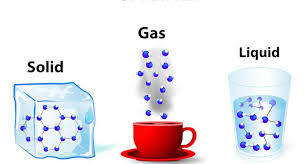
What intermolecular force present in a sample of pure HCl?
dipole-dipole attraction
H-bonds
London dispersion forces
molecule-ion attraction
Intermolecular forces are the forces that exist
within molecules
between molecules
Which of these is not an intermolecular force?
covalent bonding
London dispersion forces
hydrogen bonding
dipole-dipole forces
Which are the strongest intermolecular forces?
hydrogen bonds
London dispersion forces
dipole-dipole forces
molecule-ion attractions
Hydrogen bonding is a special type of what force?
London dispersion forces
ion-dipole forces
dipole-dipole forces
covalent force
What type of intermolecular force is present in all substances, regardless of polarity?
London dispersion forces
ion-dipole forces
dipole-dipole forces
hydrogen bonding
What explains the very high melting and boiling point of water?
Dipole-dipole forces between water molecules
London dispersion forces between water molecules
Hydrogen bonds between water molecules
Molecule-ion attractions between water molecules
In general, substances with stronger intermolecular forces have ________ boiling points than those with weaker forces
Higher
The same
Lower
Which is the second strongest intermolecular force, after hydrogen bonding?
dipole-dipole attraction
London forces
What are intermolecular forces?
forces of attraction or repulsion which act between neighboring particles
forces which keep a molecule together.
Which is NOT an intramolecular force?
Polar Covalent Bond
Nonpolar Covalent Bond
London Dispersion Force
Ionic Bond
Electrons that are free to move in metals are
delocalized electrons
oxidation number
chemical bond
salts
Which has the strongest forces between particles (usually)?
ionic bonding
metallic bonding
covalent bonding
Which has the weakest forces between particles (usually)?
ionic bonding
metallic bonding
covalent bonding
Which structure consists of a giant lattice of cations and anions held together by strong electrostatic forces of attraction?
ionic bonding
metallic bonding
covalent bonding
Which occurs between metal and non-metals?
ionic bonding
metallic bonding
covalent bonding
Which structure consists of a giant lattice of regularly arranged cations surrounded by a sea of delocalized electrons.
ionic bonding
metallic bonding
covalent bonding
Which of the following types of bonding results in materials which are malleable and ductile?
ionic bonding
metallic bonding
covalent bonding
Which of the following types of bonding results in materials which are generally insoluble in water?
ionic bonding
metallic bonding
covalent bonding
Which of the following types of bonding results in materials which have the highest melting and boiling points?
ionic bonding
metallic bonding
covalent bonding
Which of the following types of bonding results in materials which have the lowest melting and boiling points?
ionic bonding
metallic bonding
covalent bonding
In the case of metallic bonding, the greater the number of delocalized electrons, the ________ the metallic bond strength.
weaker
stronger
Which occurs between metals and metals?
ionic bonding
metallic bonding
covalent bonding
Which of the following is an intramolecular force?
hydrogen bonding
covalent bonding
Which intermolecular force is characterized by partially oppositely charged ions?
Dipole-dipole
Hydrogen bonding
London dispersion forces
Which substance would have the weakest intermolecular forces of attraction?
CH4
NaCl
H2O
MgF2
________________________ have the strongest intermolecular forces of attraction.
Dipole- Dipole
Dispersion
Hydrogen Bonds

Intermolecular forces for: CO2
Dispersion Force
Dipole dipole
Hydrogen bonding
the interactive force that exist between water molecules and sides of a graduated cylinder is______.
adhesion
capillarity
cohesion
IMF
The temperature at which its vapor pressure equals atmospheric pressure.
specific heat
vapor pressure
molar heat of fusion
boiling point
The ascension of liquids through slim tube, cylinder or permeable substance due to adhesive and cohesive forces interacting between the liquid and the surface is called_____.
surface tension
cohesion
capillarity
adhesion
Cohesive forces
Are the attraction of molecules within a liquid
Are only present when the liquid is exposed to glue
Are the attraction of molecules to the container walls
Are important for upward movement in capillary action
Capillary action is
Caused by cohesive and adhesive forces
Not observed in liquid mercury
Allows some liquids to 'flow' vertically up a thin tube
All of the above
A substance with a high vapor pressure have _______ intermolecular forces?
strong
weak
A substance with a high amount of intermolecular forces will have a ______ vapour pressure.
high
low
Water droplets are mainly formed by what force?
Viscosity
Van der Waals forces
Hydrogen Bonding
Dipole-Dipole interactions
As the temperature of a liquid increases, the viscosity
Increases
Decreases
Doesn't change
Not enough information
Which of the following is NOT a property of a liquid
surface tension
capillary action
viscosity
polar
This type of solid forms a regular repeating
three-dimensional structure called a crystal lattice. What type of solid is this?
amorphous
crystalline
glass
diamond
In amorphous solids, the atoms or molecules are held together in a completely random formation.
true
false
Which of the following is not true about crystalline solids?
Have a sharp melting point
Crystalline solids are anisotropic in nature
Cannot be cleaved along a definite plane
They are considered as true solids
Which of the following is true of solids?
Solids maintain a defined shape and size under all conditions.
All solids have a crystalline structure.
All solids maintain a defined shape and size if conditions remain constant.
All solids have a lattice structure at the atomic level.
One major difference between crystalline and amorphous solids is that
crystalline solids have a precise melting point.
amorphous solids have a lattice structure.
amorphous solids always behave consistently and uniformly.
crystalline solids break unpredictably and can produce curved fragments.
Which type of solid has mobile electrons in the crystal (sea of electrons)?
Ionic
Molecular
Metallic
Covalent Network
Which type of solid typically has the lowest melting point of the four types of crystals?
Ionic
Molecular
Metallic
Covalent Network
Which is an example of an ionic crystal?
Quartz
NaCl
Ammonia
Iron
Which is an example of a metallic crystal?
Quartz
NaCl
Ammonia
Iron
A friend in your chemistry class is struggling to understand why crystalline solids are grouped into four main types: network, molecular, ionic, and metallic. Which explanation below will BEST help him begin to understand why chemists might have these groups?
Crystalline solids all share a lattice structure, but have different densities. Chemists use the groups to organize the solids by density.
Crystalline solids all share a lattice structure and the same types of bonds, but are composed of different elements. These elements affect the way the solid conducts heat and electricity.
Crystalline solids all share a lattice structure, but behave differently under similar conditions.
Crystalline solids all share a lattice structure, but the bonds that hold them together at the atomic level differ. The elements that make up the solids also differ. These differences affect how a solid conducts heat and electricity.
Solids have many different properties. ___________ solids are known for their ability to be flattened into a sheet, stretched into a wire, and to conduct energy well.
Molecular
Metallic
Covalent Network
Ionic
It is possible to tell the difference between a solid with a crystalline structure and one with an amorphous structure just by looking at it.
True
False
An engineer is designing an electrical system and is looking for a material to transmit energy. She has four solids available, each made with different materials. To conduct energy most efficiently and effectively, she should use material
whose electron are held with ionic bonds.
whose electron are held with covalent bonds.
whose electrons are held with metallic bonds.
that is an electrical insulator.
Which statement is true about the properties of solids?
Metallic solids have a high melting point.
Network solids are generally not soluble in water.
Molecular solids do not dissolve easily in water.
All ionic solids are similar in density.

Which one of the following diagrams best represents a sematic A liquid crystal phase?
A
B
C
D
E

Which letter on the diagram represents a gas?
A
B
C
D
Which letter on the diagram represents a liquid?
A
B
C
D

What does point B represent?
Triple point
Critical point
Equilibrium point
Normal melting point
Which letter on the diagram represents a solid?
A
B
C
D
The temperature and pressure conditions at which the solid, liquid, and gas phases of a substance exist at the same time is called the
Critical point
Triple point
Melting point
Boiling point
What is the normal melting point of this substance?
150°C
100°C
-50°C
0°C
Which letter on the diagram represents the triple point?
A
B
C
D

What is true regarding CO2 for temperatures above 31°C?
It does not exist
It decomposes
It cannot be condensed back into a liquid
It is a plasma
What is the normal melting point of this substance?
40°C
60°C
100°C
110°C
What phase change occurs from F to E?
Sublimation
Deposition
Melting
Condensation
The temperature and pressure at which the gas and liquid states of a substance become identical and form one phase is called the
Critical point
Triple point
Melting point
Boiling point
What is the normal boiling point of this substance?
40°C
60°C
100°C
110°C
What phase change occurs from C to D?
Condensation
Vaporization
Melting
Sublimation
What phase would this substance be in at 0.5 atm of pressure and 100°C?
Solid
Liquid
Gas
What phase change occurs from E to C?
Sublimation
Freezing
Melting
Vaporization
What phase would this substance be in at 1 atm of pressure and 80°C?
Solid
Liquid
Gas
Normal freezing/melting and boiling points occur at standard pressure, which is
1 atm
5 atm
10 atm
15 atm
What is the normal boiling point of this substance?
0°C
100 °C
-50°C
150°C

Which state of matter is shown?
solid
liquid
gas

What phase change is happening? (hint: solid to liquid)
freezing
condensation
melting
sublimation

What phase change happens when dew forms on leaves? (hint: gas to liquid)
freezing
melting
deposition
condensation

The phase change from liquid to gas is _________
Melting
Evaporation
Deposition
Condensation

Phase change from liquid to solid is ___________.
Freezing
Melting
Sublimation
Condensation
All phase changes need energy added or taken away.
True
False
What happens to particles when they are heated?
They stop moving
They move closer together and compress
They speed up and spread around
They slow down and get closer

Which points are the phase changes?
A,C and E
B and D
A and C
B and E

At what point is the substance liquid?
B
A
C
D

Which point shows evaporation or condensation driving a phase change?
B
E
D
A

What does point B show?
Melting and Freezing
Condensation and Evaporation
Sublimation
Deposition
The particles that make up a solid move _________________ than particle that make up a gas.
More quickly
More slowly
Farther away
In the same way
During a phase change the temperature of a substance __________
Stays constant
Increases
Decreases
Vanishes
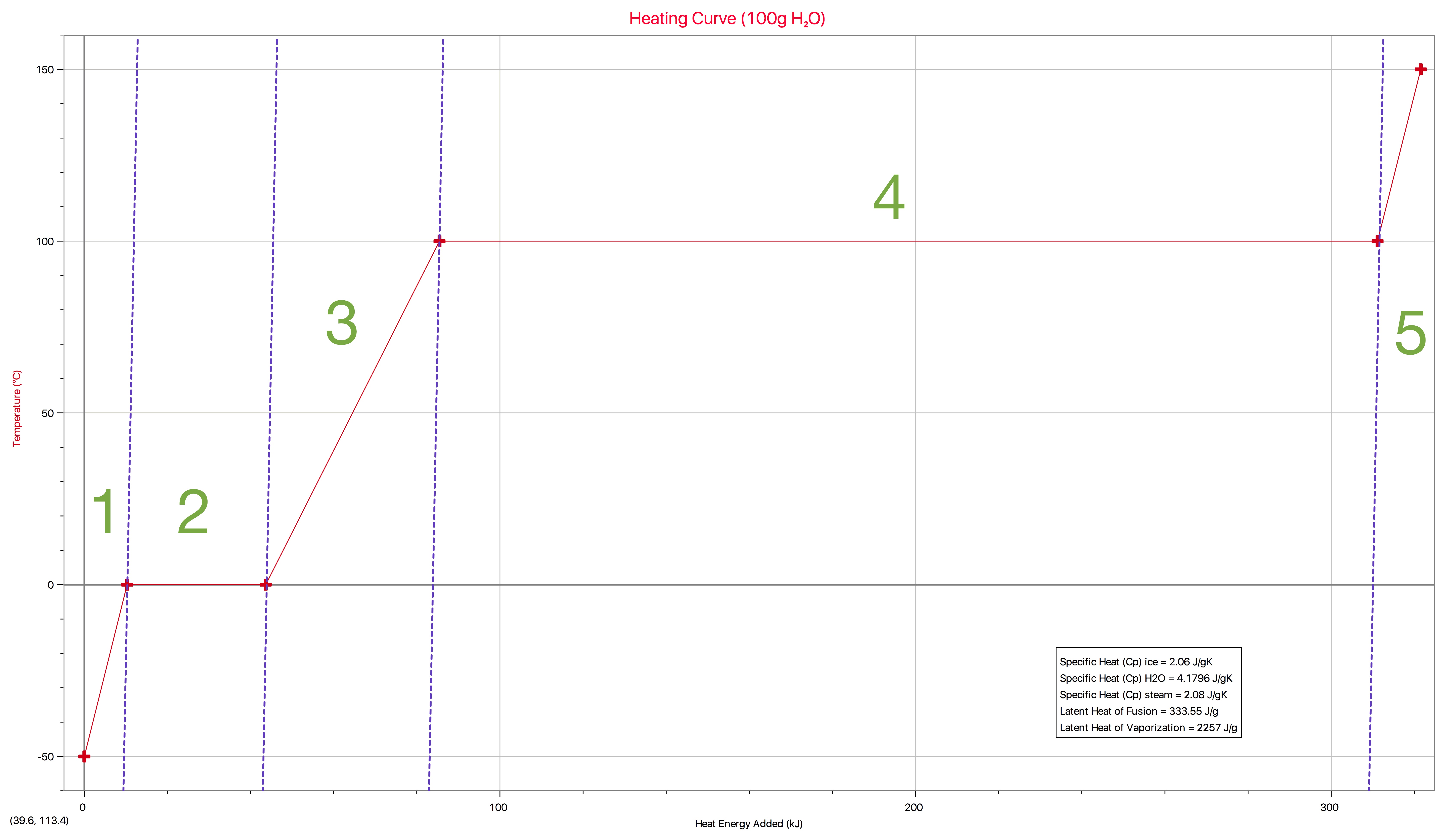
Thermal energy always moves:
From a high temperature object to a lower temperature object.
From a lower temperature object to a higher temperature object.
From an object with lower kinetic energy to an object with higher kinetic energy.
From an object of higher mass to an object of lower mass.

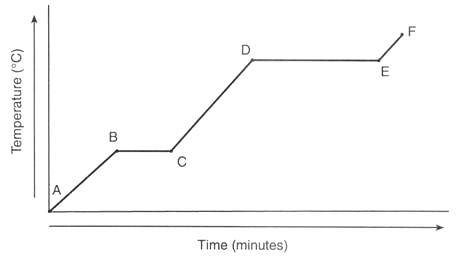
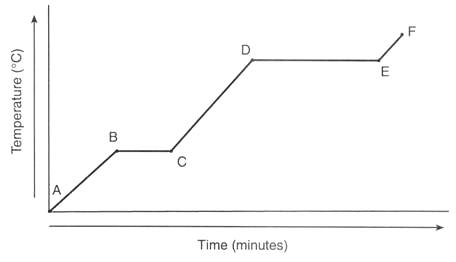
Given the heating curve of a solid being heated at a constant rate, what is the boiling point of this substance?
20°C
50°C
110°C
170°C

The melting point of the sample is
-60 ºC
-100 ºC
60 ºC
100 ºC

NaCl(s) was heated up starting at an initial temperature of 0°C. The heating curve is shown in the picture. What is the melting point of this substance?
0°C
801°C
1000°C
1465°C

Given the heating curve of water, what is happening to potential and kinetic energy during segment CD?
the potential energy and kinetic energy both increase
the potential energy increases while the kinetic energy decreases
the potential energy is constant while the kinetic energy increases
the potential energy increases while the kinetic energy is constant
It is a type of homogeneous mixture that is made up of two or more substances.
Solution
Emulsion
Suspension
Colloid
A __________mixture is a type of mixture with a uniform composition.
homogenous
heterogenous
hypotonic
hypertonic
This is the substance that makes up the minority of the solution, or this is the part that is dissolved.
SOLUTION
SOLUTE
SOLVENT
SUSPENSION
This is the substance that makes up the majority of the solution. This is the part where the solute is dissolved.
SOLUTION
SOLUTE
SOLVENT
SUSPENSION
It is a type of solution into which gases can spontaneously mix in any proportion.
SOLID SOLUTION
LIQUID SOLUTION
GASEOUS SOLUTION
AQUEOUS SOLUTION
It is a type of solution which are generally called alloys, where two or more metals are present.
SOLID SOLUTION
LIQUID SOLUTION
GASEOUS SOLUTION
AQUEOUS SOLUTION
It is the most common and it can be obtained by the dissolution of a gaseous, liquid, or solid solute.
SOLID SOLUTION
LIQUID SOLUTION
GASEOUS SOLUTION
AQUEOUS SOLUTION
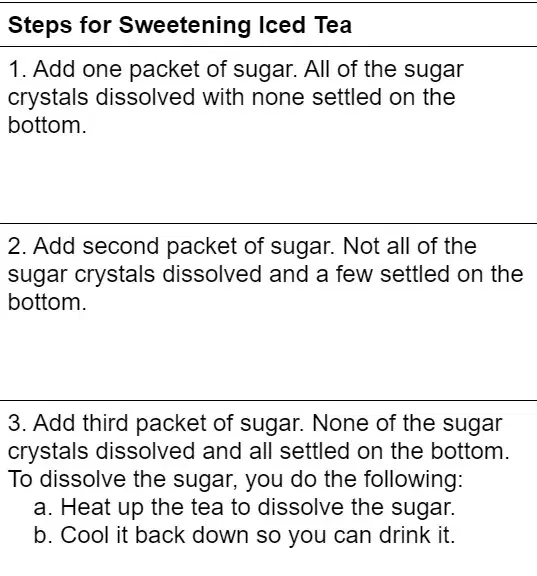
#1
Unsaturated
Saturated
Supersaturated
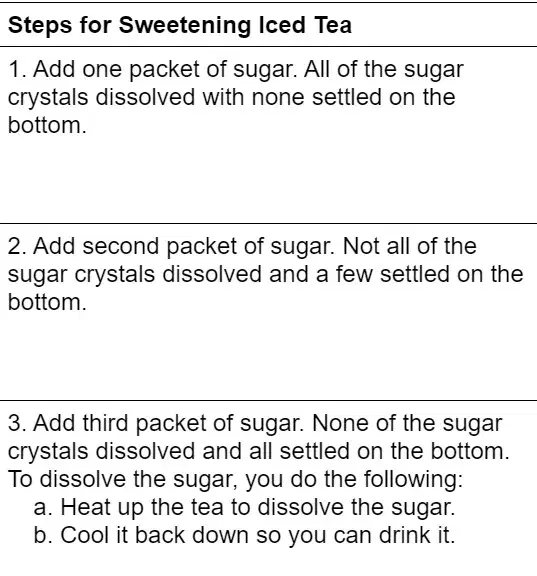
#2
Unsaturated
Saturated
Supersaturated
#3
Unsaturated
Saturated
Supersaturated
When CH3OH is dissolved in water, how many particles are in solution for each unit?
1
3
4
5
6
When KCl (potassium chloride) is dissolved in water, how many particles are in solution for each unit?
1
2
3
4
6
The weaker the intermolecular forces of a substance the _____________ the boiling point
higher
lower
A substance has a melting point of -125 oC and a boiling point of -35 oC. What state is it at 15oC?
Solid
Liquid
Gas
Freezing point
The classification of matter as a solid, a liquid, or a gas
Physical change in matter from a gas to a liquid
The temperature at which a substance changes states from a solid to a liquid
The temperature at which a substance changes from a liquid to a solid
The freezing point of water is...
100oC
0oC
-10oC
150oC

