wayground logo

Free Printable Worksheets

Font size

S
M
L
XL
Worksheets

Semeter 1 review CHEMISTRY

Total questions: 151

Worksheet time: 13hrs 35mins

Name
Class
Date
1.
A student conducting an investigation to determine the effect of temperature on the metabolism of yeast. Yeast and sugar are added to water, the gas produced is captured, and its volume is recorded. Which variables should be held constant during this investigation?
a)
Mass of sugar and water temperature
b)
Mass of yeast and mass of sugar
c)
Volume of gas and water temperature
d)
Volume of gas and mass of yeast
2.
When experimenting with the growth of a plant, a scientist uses three (of the same type of) plants, two different fertilizers, equal light, and equal water. What type of variable is the fertilizer?
a)
Dependent
b)
Independent
c)
Control
d)
Constant
3.
Should experiments be repeated over and over to see if the results are the same each time?
a)
yes
b)
no
4.
What is the general order of the steps of the scientific methods:
a)
question, experiment, hypothesis, analyze, results, conclusion, communicate results.
b)
question, hypothesis, experiment, analyze results, conclusion, communicate results
c)
question, hypothesis, experiment, analyze results, communicate results, conclusion
d)
all of the above
5.

In 1897, Joseph Thomson discovered that atoms contained electrons. He proposed a change in the atomic theory of that time, and the theory was modified because of his discovery. Since Thomson’s discovery, atomic theory has been further modified. What is the best explanation for why scientific theories are modified?

a)

Theories more than ten years old are usually out of date.

b)

Scientists want to prove that the work of other scientists is wrong.

c)

New evidence that supports a change prompts scientists to modify earlier theories.

d)

So much information is available today that it is harder to focus research and disprove theories.

6.
Sal is studying the solar system. He makes a physical model using different-sized foam balls to represent the planets. Which best describes why a physical model is a useful tool for studying the solar system?
a)
Solar system models can be used to study a system that is too big to study directly.
b)
A model of the solar system eliminates the need for scientists to study the solar system directly.
c)
A model of the solar system provides an exact replica of the actual solar system, so scientists can experience what each planet is like.
d)
A model of the solar system can provide more data about the solar system than direct observations.
7.

The theory of Plate Tectonics is the idea that the Earth's crust has many plates that move because of changes in temperature deep below the Earth's surface. It has changed over time. What would cause the theory to change?

a)

The addition of new empirical evidence.

b)

It was a bad theory to begin with.

c)

If the news ran a story about why it should be changed.

d)

If a famous scientist said it should be changed.
8.
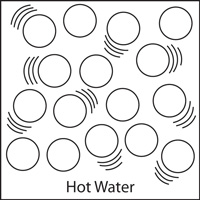
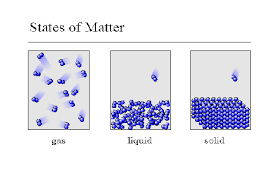
At higher temperatures
a)
particles in an object have less energy
b)
particles in an object move faster
c)
a gas contracts
9.
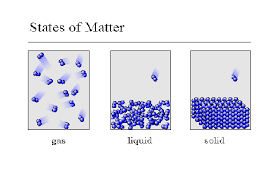
A gas
a)
has a definite shape but no definite volume
b)
has a definite volume but no definite shape
c)
has fast-moving particles
10.
Particles (molecules) in a ______________________ have more energy than the other states of matter.
a)
gas
b)
solid
c)
liquid
11.
The speed of the molecules determines the _____.
a)
volume
b)
density
c)
pressure
d)
temperature
12.
The speed of the molecules determines the _____.
a)
volume
b)
density
c)
pressure
d)
temperature
13.

Particles of a liquid

a)

are tightly packed together and stay in a fixed position.

b)

are free to move around one another but still touch.

14.

Solid to Gas

a)

Deposition

b)

Sublimation

c)

Evaporation

15.
What is matter?
a)
Anything that has mass and volume
b)
The shape of an object
c)
How much an object weighs
d)
The pull of objects on one another
16.
Volume is.....
a)
the weight of an object
b)
the gravity of an object
c)
how much space an object takes up
d)
measured with a balance scale
17.
Which state of matter has a definite shape?
a)
Gas
b)
Solid
c)
Liquid
d)
Plasma
18.

Sally placed a thermometer in a cup of water. She recorded the temperature every five minutes.

What is the best claim based on this data?

a)

A. The water gained heat.

b)

B. The water lost heat.

c)

C. The water lost mass.

d)

D. The water gained cold.

19.
Which types of particles have the strongest attractive forces between them?
a)
solids
b)
liquids
c)
gases
20.

This explains the behavior of solids, liquids and gases and is based on the concept that particles of matter are always in motion.

a)

ideal gas law

b)

atomic theory

c)

kinetic molecular theory

d)

Newton's 1st Law of Motion

21.

Which contains only elements?

a)

A

b)

B

c)

C

d)

D

22.

Which contains a pure substance? (Choose all)

a)

A

b)

B

c)

C

d)

D

23.

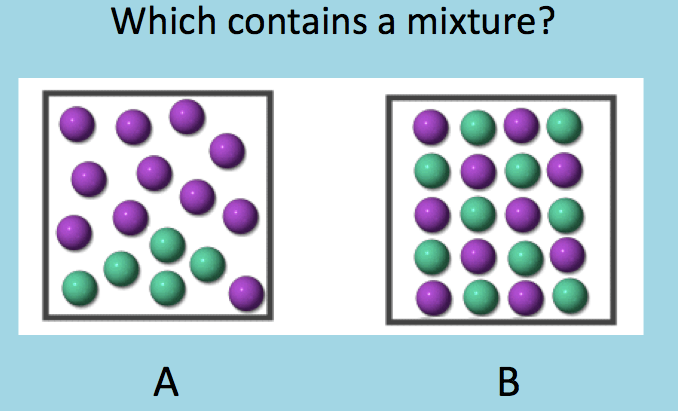
Which contains a mixture? (Choose all)

a)

A

b)

B

24.

Which contains a solution? (Choose all)

a)

A

b)

B

c)

None are solutions

25.

Which contains a pure substance? (Choose all)

a)

A

b)

B

c)

C

d)

D

26.

Which contains only elements (no compounds)? (Choose all)

a)

A

b)

B

c)

C

27.

What type of change?

a)

Chemical

b)

Evaporation

c)

Condensation

d)

Sublimation

e)

Melting

28.

Which is a heterogeneous mixture? (Choose all)

a)

1

b)

2

c)

3

d)

4

29.
A mixture that appears to be evenly mixed throughout:
a)
an atom
b)
a compound
c)
a homogeneous mixture
d)
a heterogeneous mixture
30.
A pure substance...
a)
is an element or a compound
b)
is an element or a mixture
c)
is a compound or a mixture
d)
is a mixture
31.
DIFFERENT kinds of atoms chemically combined to form a substance are
a)
Mixture
b)
Element
c)
Compound
d)
Substance
32.
You are eating a pizza. What type of mixture are you consuming?
a)
homogeneous
b)
heterogeneous
c)
pure substance
d)
The Periodic Table
33.
Salt is a(n)
a)
element
b)
compound
c)
mixture
34.
Which of the following is an element?
a)
Sugar
b)
Salt
c)
Water
d)
Oxygen
35.
Of these mixtures, which one is a solution?
a)
A
b)
B
c)
C
d)
D
36.
A combination of particles of one or more substance that are distributed uniformly throughout another substance is a/an
a)
Mixture 
b)
Substance
c)
Solution
37.
A pure substance that cannot be broken down into other substances by chemical or physical means. 
a)
compound          
b)
atom
c)
mixture 
d)
element
38.
Boron
a)
Bo
b)
B
c)
BO
d)
Bn
39.
Zinc
a)
Zc
b)
Zi
c)
Zk
d)
Zn
40.
Hydrogen
a)
H
b)
Hy
c)
Hi
d)
HH
41.

What are the horizontal rows on the periodic table called?

a)

periods

b)

groups

c)

metals

d)

nonmetals

e)

metalloids

42.

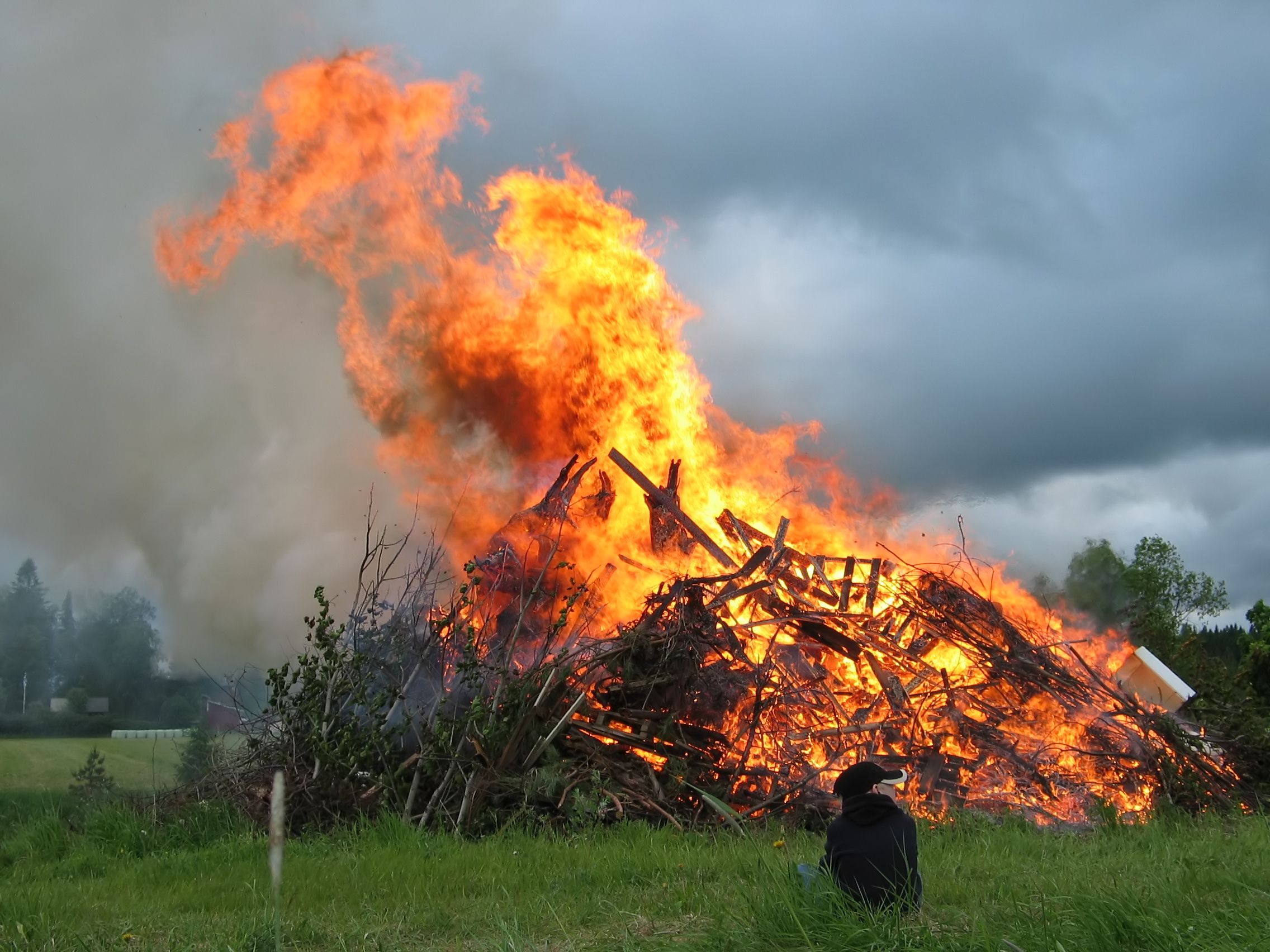
Wood that is burning in a brush pile has heat, and produces ashes.

a)

Physical

b)

Chemical

43.
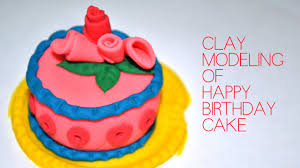
Why is this a physical change?
a)
The shape of the clay has been changed.
b)
The clay can be put back into a ball shape instead of a birthday cake.
c)
The clays has not changed chemically.
d)
All are true
44.
A __________ is a mixture that is formed when a solid is dissolved in a liquid.
a)
Chemical compound
b)
Solution
c)
Endothermic reaction
d)
Exothermic reaction
45.
What is a mixture?
a)
Pennies
b)
2 or more different things combined.
c)
Ice
d)
Marbles
46.

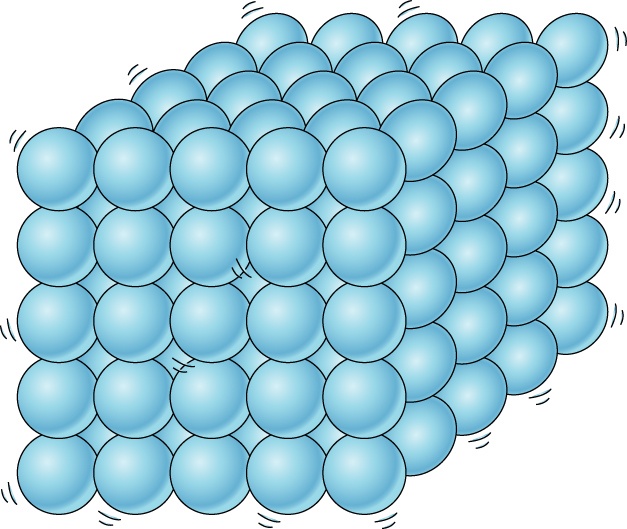
What state of matter?

a)

Solid

b)

Liquid

c)

Gas

d)

Plasma!!!

47.

If I add heat to a solid, how will the motion of the particles be affected?

a)

They will move slower

b)

They will stop moving

c)

They will move faster

d)

They will move to a different container

48.
How many significant figures does the following number have: 0.002040
a)
6
b)
4
c)
3
d)
2
49.
How many significant figures does the following number have: 0.998005
a)
9
b)
10
c)
6
d)
5
50.
Round 1047.78 to three sig figs
a)
104
b)
105
c)
1050
d)
1050.00
51.

What is the measurement 1042 Liters rounded to 2 significant figures?

a)

1040 L

b)

1.1 x 10³ L

c)

1.0 x 10³ L

d)

1050 L

52.
Determine the number of Significant Figures in 10-L.
a)
4
b)
3
c)
2
d)
1
53.
calculate the following to the correct number of sig figs.
0.00401  x  2.00  x  501
a)
4.02
b)
4
c)
4.0
d)
4.0180
54.
calculate the following to the correct number of sig figs.
13.2017/ 17.10
a)
.772
b)
.7720
c)
.772030
d)
.77
55.
Solve and round accordingly.
25.0 x 17 = ?
a)
430
b)
425
c)
425.0
d)
430.0
56.
Solve and round accordingly.
1.256 - 0.004 + 123.09 = ?
a)
100
b)
124.3
c)
124.34
d)
120
57.

The attendance for the basketball game was estimated to be 15,000 people but 12,500 people attended. What was the percent error?

a)

16.67%

b)

20%

c)

2500%

d)

80%

58.
Jessie estimates the weight of her cat to be 8 pounds.  The actual weight of the cat was 10 pounds.  Find the percent error.  
a)
15%
b)
20%
c)
25%
d)
30%
59.
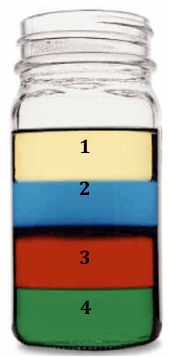
Put the liquids in order from most dense to least dense?
a)
4, 3, 2, 1
b)
1, 2, 3, 4
c)
3, 4, 2, 1, 
d)
4, 3, 1, 2
60.
What is the formula for density?
a)
density = mass x volume
b)
density = mass / volume
c)
density = mass + volume
d)
density = mass - volume
61.
True or False:  The density of a specific type of material never changes.  
a)
True
b)
False
62.
Which would be the most useful for identifying an unknown liquid?
a)
Weight
b)
volume
c)
mass
d)
density
63.

Convert

 100oC100^oC  to Kelvin

a)

 373 K373\ K  

b)

 273 K273\ K  

c)

 212 K212\ K  

d)

 0 K0\ K  

64.

Convert

 450 K450\ K  to Celsius

a)

 723oC723^oC  

b)

 277oC277^oC  

c)

 177 oC177\ ^oC  

d)

 623oC623^oC  

65.
How would you write 564,000,000 in scientific notation?
a)
5.64 x 10⁻⁷
b)
5.64 x 10⁶
c)
5.64 x 10⁸
d)
56.4 x 10⁷
66.
Write 3,450,000 in scientific notation.
a)
34.5 x 10⁶
b)
3.45 x 10⁶
c)
3.45 x 10⁷
d)
34.5 x 10⁵
67.
Write -4,500,000 in scientific notation.
a)
4.5 x 10⁶
b)
4.5 x 10⁻⁶
c)
-4.5 x 10⁶
d)
-4.5 x 10⁻⁷
68.
A container can hold 65 grams of water. Circle the conversion factor needed to find the mass of water that 5 identical containers can hold.
a)
5 containers / 65 grams
b)
1 container / 65 grams
c)
65 grams / 1 container
d)
65 grams / 5 containers
69.
Converting between units is easily done using ____________.
a)
conversion factors
b)
chemistry magic
c)
math magic
d)
just plain ol' magic
70.
Convert the following:
0.25 meters to centimeters
a)
25 cm
b)
0.25 cm
c)
2.5 cm
d)
250 cm
71.
Convert the following:
4.2 deciliters to liters
a)
0.42 Liters
b)
4.2 Liters
c)
42 Liters
d)
0.042 Liters
72.
How many conversion factors would you need to use to find the number of liters in a cubic decimeter? 
a)
one
b)
two
c)
three
d)
four
73.
Convert the following:
0.35 lb is how many grams? 
(conversion factor: 1 kg = 2.2 lb)
a)
1.6 x 10grams
b)
7.7 x 10⁻⁴ grams
c)
1.6 x 10⁻² grams
d)
7.7 x 10⁴ grams
74.
What technique can be used to convert complex units?
a)
dimensional analysis
b)
column merging
c)
pivot points
d)
Faraday flips
75.
What scientist is best known for his "Plum Pudding" model of the atom?
a)
J.J. Thomson
b)
Ernest Rutherford
c)
John Dalton
d)
Democritus
76.
The first person to propose a theory about an atom called the Atomos Theory was
a)
Democritus
b)
Rutherford
c)
Dalton
d)
Aristotle
77.
Who discovered the nucleus using the gold foil experiment?
a)
Democritus
b)
Robert Millikan
c)
James Chadwick
d)
Ernest Rutherford
78.
His atomic model was depicted similar to a planetary/solar system
a)
Niels Bohr
b)
Joseph Thomson
c)
Ernest Rutherford
d)
Democritus
79.
What is atomic number?
a)
Number of protons in an atoms 
b)
Number of neutrons in an atom
c)
Mass of an atom
d)
Charge on an atom
80.
What electrical charge does a proton have?
a)
+1
b)
0
c)
-1
d)
+2
81.
How many protons does an aluminium atom have? (Use the image to help you)
a)
27
b)
14
c)
40
d)
13
82.
Complete the missing label on the diagram.
a)
Neutron
b)
Centre
c)
Nucleus
d)
Sub atomic particle
83.

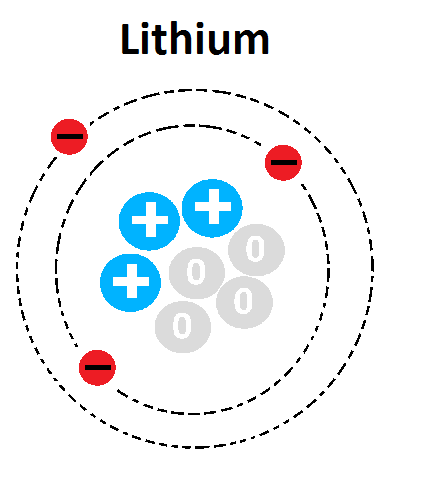
What is the atomic number of this atom?

a)

1

b)

3

c)

4

d)

7

84.
Jack has a rock. The rock has a mass of 14g and a volume of 2cm3. What is the density of the rock?
a)
7 mL
b)
7 g/cm3
c)
28 g/cm3
d)
1/7 g/cm3
85.
The positive particles of an atom are 
a)
electrons 
b)
positrons 
c)
neutrons 
d)
protons 
86.
all matter is made of what 
a)
energy 
b)
atoms 
c)
electrons 
d)
compounds 
87.
Particles in an atom that are neutral and have no charge are 
a)
negatrons 
b)
electrons 
c)
neutrons 
d)
protons 
88.
An atoms overall charge is 
a)
positive 
b)
depends on its mood 
c)
neutral 
d)
negative 
89.
True or False? Neutrons have a negative charge
a)
True
b)
False
90.
What is the atomic number for an element with three protons?
a)
2
b)
1
c)
3
d)
6
91.
An atom's mass number equals the number of...
a)
protons plus the number of electrons
b)
protons plus the number of neutrons
c)
protons
d)
neutrons
92.
Which statement about the atomic nucleus is correct?
a)
The nucleus is made of protons and neutrons and has a negative charge
b)
The nucleus is made of protons and neutrons and has a positive charge
c)
The nucleus is made of electrons and has a positive charge
d)
The nucleus is made of electrons and has a negative charge
93.
A particle that moves around the nucleus is a(n)...
a)
Proton
b)
Neutron
c)
Electron
d)
Quark
94.
Atoms have no electric charge because they...
a)
have an equal number of charged and non charged particles
b)
have neutrons in their nuclei
c)
have an equal number of electrons and protons
d)
have an equal number of neutrons and protons
95.
Which statement best describes an electron?
a)
Smaller mass than a proton and a negative charge
b)
Smaller mass than a proton and a positive charge
c)
Greater mass than a proton and a negative charge
d)
Greater mass than a proton and a positive charge
96.
Most of the mass in an atom is concentrated in the...
a)
electrons
b)
nucleus
c)
protons
d)
empty space
97.
What does the nucleus consist of?
a)
Protons + Electrons
b)
Neutrons + Electrons
c)
Atoms
d)
Protons + Neutrons
98.
How many neutrons does the isotope of lithium have?
a)
8
b)
3
c)
4
d)
5
99.
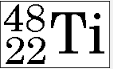
How many protons does this isotope of titanium have?
a)
48
b)
22
c)
26
d)
70
100.
How many neutrons in C-14?
a)
6
b)
7
c)
14
d)
8
101.
How many neutrons does the isotope below have?     89 36Kr
a)
53
b)
36
c)
89
d)
125
102.
How many neutrons does an atom of the isotope Neon-22 have?
a)
12
b)
10
c)
22
d)
20
103.
Four isotopes of lead include lead-204, lead-206, lead-207, and lead-208.  The average atomic mass of lead is 207.2.  Which isotope of lead is likely to be the most abundant.
a)
204
b)
206
c)
207
d)
208
104.
Which of the subatomic particles is the heaviest?
a)
electrons 
b)
protons 
c)
neutrons 
d)
protons and neutrons have equal mass
105.
In a stable atom the amount of electrons is electron is equal to
a)
neutrons
b)
protons
c)
atomic mass
d)
neutrons + protons
106.
Calculate the average atomic mass of silver.
a)
106.38649amu
b)
111.91896amu
c)
107.8677amu
d)
121
107.

The average atomic mass on the periodic table is found from...

a)

calculating the weighted average mass of all the isotopes of that element

b)

Calculating different types of elements together

c)

calculations the average of all elements in that period together.

d)

making a guess about how much all the isotopes might wiegh together.

108.
Which scientist developed the atomic theory?
a)
JJ Thomson
b)
Ernest Rutherford
c)
John Dalton
d)
James Chadwick
109.
1.  What is the shape of an s orbital?
a)
sphere
b)
dumbbell
c)
double dumbbell
d)
TOO COMPLEX TO KNOW IT.
110.
What is the shape of a p orbital?
a)
sphere
b)
it's just too complex to thing about it
c)
dumbbell
d)
I don't know this stuff.
111.
How many d orbitals are there in a given sublevel?
a)
1
b)
3
c)
5
d)
7
112.
How likely is it that an electron occupying a p or a d orbital would be found very near an atom’s nucleus? 
a)
likely...that's where you find it
b)
not likely
c)
not likely, but there is a f orbital near the nucleus
d)
what's near the orbital
113.
How many electrons can the d sublevel hold?
a)
8
b)
10
c)
2
d)
4
114.
Which is associated with more energy? 
a)
2p
b)
2s
c)
3p
d)
1s
115.
How many total electrons can the f orbitals in a sublevel hold?
a)
2
b)
14
c)
6
d)
10
116.
Which orbital has the least amount of energy? 
a)
p orbital
b)
d orbital
c)
s orbital 
d)
What is an orbital?
117.

How is a photon different from matter?

a)

A photon has no mass and travels at the speed of light.

b)

A photon has mass and travels at the speed of light.

c)

A proton has no mass and travels at the speed of light.

d)

A proton has mass and travels at the speed of light.

118.
The arrows pointing down represents...
a)
photon absorption
b)
proton emission
c)
electron absorption
d)
electron transition
119.
The parallel lines represents...
a)
energy levels of the atom
b)
energy levels of the electrons
c)
energy levels of the photons
d)
energy levels of the nucleus
120.
There is an emission spectrum and absoption spectrum shown here. What is the bottom spectrum?
a)
an emission spectrum
b)
an absoption spectrum
c)
neither
d)
both 
121.
Light is emitted when electrons ...
a)
jump from high to low 
b)
jump from low to high 
c)
either of these
d)
none of these
122.
As the energy level increases the difference in the energy level ...
a)
increases
b)
decreases
c)
stays the same
d)
none of these
123.

Each element produces its own pattern of emission spectra lines because each element has its own distinct

a)

Speed of light

b)

Electron configuration

c)

Number of neutrons

d)

None of these

124.

The color of emitted light with the SHORTEST wavelength is

a)

violet

b)

green

c)

red

d)

indigo

125.

The color of emitted light with the HIGHEST frequency is

a)

violet

b)

green

c)

red

d)

indigo

126.

The color of emitted light with the LOWEST frequency is

a)

violet

b)

green

c)

red

d)

indigo

127.
Every element has its own unique atomic spectra.
a)
True
b)
False
128.
The wavelength of light is related to which of the following properties?
a)
Color
b)
Frequency
c)
Color AND frequency
d)
Neither color NOR frequency
129.
Emission lines create _____ spectral lines on a visible light spectra due to the electrons moving into their _____ state.
a)
dark; excited
b)
dark; ground
c)
bright; excited
d)
bright; ground
130.
A wave with a large wavelength will have a ______ frequency and _____ energy
a)
high, low
b)
high, high
c)
low, high
d)
low, low
131.
All electromagnetic waves have the same...
a)
frequency
b)
speed
c)
wavelength
d)
energy
132.
Emission of light from an atom occurs when an electron
a)
drops from a higher to a lower energy level.
b)
   jumps from a lower to a higher energy level.   
c)
   moves within its atomic orbital.
d)
falls into the nucleus.
133.
What is the number of wave cycles that pass a given point per unit of time
a)
crest
b)
wavelength
c)
frequency
d)
amplitude
134.

What is the speed of light?

a)

3.0x10⁸ ms

b)

3.0x10⁸ m/s

c)

6.626x10⁻³⁴ Js

d)

6.626x10⁻³⁴ J/s

135.

The frequency of violet light is 7.5x10¹⁴ Hz. What is its wavelength?

a)

4.0x10⁻⁷ m

b)

4.0x10⁷ m

c)

2.25x10²³m

d)

2.25x10²³ Hz

136.
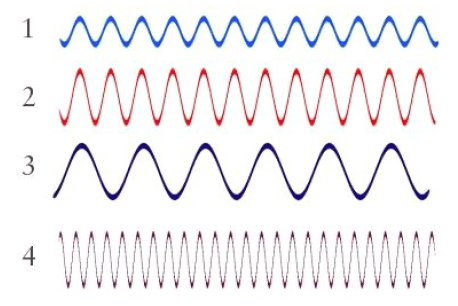
Which wave in the diagram has the greatest wavelength?
a)
1
b)
2
c)
3
d)
4
137.
Violet light has a wavelength of
4.10 x 10⁻¹²  m. What is the frequency?
a)
1.23 x 10^ -3 Hz
b)
7.31 x 10^ 19 Hz
c)
1.37 x 10^12 Hz
d)
3.0 x 10^ 8 Hz
138.

Red light has a wavelength of 675 x 10-9 m. What is its frequency?

a)

2.03x10¹¹ m

b)

4.44x10¹⁴ Hz

c)

4.44x10¹⁴ nm

d)

2.03x10¹¹ Hz

139.

What is Planck's Constant?

a)

6.63x10⁻³⁴ Js

b)

6.63x10⁻³⁴ J/s

c)

3.0x10⁸ ms

d)

3.0x10⁸ m/s

140.

Violet light has a wavelength of 4.10 x 10⁻¹² m. What is the frequency?

a)

1.23 x 10 -3 Hz

b)

7.31 x 10¹⁹ Hz

c)

1.37 x 10¹² Hz

d)

3.0 x 10⁸ Hz

141.

Solve this problems using the equation: C = λ x ν

A microwave oven emits radiation at a wavelength of 5.00 x 10⁻¹cm. What is the frequency of this radiation?

(Convert to m first).

a)

6.67 x 10⁻⁷ Hz

b)

2.00 Hz

c)

1.50 x 10⁶ Hz

d)

6.00 x 10¹⁰ Hz

142.

What atom matches this electron configuration?

1s2 2s2 2p6 3s2

a)

Neon

b)

Potassium

c)

Aluminum

d)

Magnesium

143.
What is the maximum number of electrons that an orbital can have?
a)
1 electron
b)
2 electrons
c)
3 electrons
d)
4 electrons
144.

How many d orbitals are there in the d sublevel?

a)

1

b)

3

c)

5

d)

7

145.

What is this element?

1s22s22p63s23p6

4s23d104p6

a)

Krypton

b)

Argon

c)

Selenium

d)

Bromide

146.
Which element is pictured?
a)
neon
b)
fluorine
c)
magnesium
d)
argon
147.

What noble gas should be used to write the shorthand configuration for Te?

a)

Ar

b)

Xe

c)

Kr

d)

Sb

148.

How many orbitals total can the principle energy level N= 4 have?

a)

18 orbitals

b)

32 orbitals

c)

8 orbitals

d)

16 orbitals

149.

How many electrons can a d orbital hold

a)

14

b)

6

c)

2

d)

10

150.

What does Pauli exclusion principle state ?

a)

states that each electron occupies the lowest energy orbital available

b)

states that a maximum of two electrons can occupy a single atomic orbital, but only if the electrons have opposite spins

c)

states that single electrons electrons with the same spin must occupy each-energy orbital before additional electrons with opposite spins can occupy the same orbitals

d)

States that a maximum of one electron can occupy a single atomic orbital

151.

How many electrons can a p orbital hold?

a)

2

b)

6

c)

8

d)

4