wayground logo

Free Printable Worksheets

Font size

S
M
L
XL
Worksheets

Chem 1 Honors Final Exam Review

Total questions: 147

Worksheet time: 3hrs 28mins

Name
Class
Date
1.
Which of the following best describes the particles in a gas?
a)
Vibrate, they do not move much at all and stay close together
b)
They break up and come together to form different types of particles. .
c)
They move fast and spread apart. 
d)
They can slide past one another, but stay close together.
2.
Which of the following best describes the particles in a liquid?
a)
Vibrate, they do not move much at all and stay close together
b)
They break up and come together to form different types of particles. .
c)
They move fast and spread apart. 
d)
They can slide past one another, but stay close together.
3.
Which of the following best describes the particles in a solid?
a)
Vibrate, they do not move much at all and stay close together
b)
They break up and come together to form different types of particles. .
c)
They move fast and spread apart. 
d)
They can slide past one another, but stay close together.
4.
Which of the following best describes sublimation?
a)
A liquid changing to a gas.
b)
A gas changing to a solid.
c)
A solid changing to a gas.
d)
A liquid changing to a solid.
5.
Which of the following best describes a liquid changing to a gas?
a)
Evaporation
b)
Condensation
c)
Sublimation
d)
Deposition
6.
Which of the following substances have an indefinite shape but a definite volume?
a)
Solid
b)
Liquid
c)
Gas
7.
Rotting fruit
a)
Chemical
b)
Physical
8.
Salt + water
a)
Chemical
b)
Physical
9.
Frying an egg.
a)
Chemical
b)
Physical
10.
A change in phase
a)
Chemical
b)
Physical
11.
How many significant figures does the following number have: 0.002040
a)
6
b)
4
c)
3
d)
2
12.
How many significant figures does the following number have: 0.998005
a)
9
b)
10
c)
6
d)
5
13.
Round 0.010229 to four sig figs
a)
1022
b)
1023
c)
0.01023
d)
0.01022
14.
What is the measurement 1042 Liters rounded to 2 significant figures? 
a)
1040 L
b)
1.1 x 10³ L
c)
1.0 x 10L
d)
1050 L
15.
This particle is found in the nucleus and has no charge
a)
Neutron
b)
Proton
c)
Electron
16.
This particle is found in the nucleus and has a positive charge
a)
Electron
b)
Proton
c)
Neutron
17.
The first person to ever talk about an atom was
a)
Democritus
b)
Rutherford
c)
Dalton
18.
All matter is made of what?
a)
energy 
b)
atoms 
c)
electrons 
d)
compounds 
19.
How did Rutherford discover the proton?
a)
Cathode tube ray experiment
b)
Gold Foil Experiment
c)
Planetary Model
d)
Plum Pudding Model
20.
What scientist is best known for his "Plum Pudding" model of the atom?
a)
J.J. Tomson
b)
Ernest Rutherford
c)
John Dalton
d)
Democritus
21.
What is the mass of a proton and a neutron?
a)
1amu
b)
2grams
c)
13amu
d)
10cm
22.
Elements on the periodic table increase by...
a)
atomic mass
b)
size
c)
mass number
d)
atomic #
23.
What is the difference between the atomic mass and the mass number?
a)
the atomic mass is always a whole number
b)
the atomic mass equals the atomic #
c)
mass number is the rounded atomic mass - always a whole number
d)
electrons
24.
Elements which are shiny, conduct electricity and heat are called
a)
metal
b)
nonmetal
c)
metalloid
d)
nonexistent
25.
What atom matches this electron configuration?
1s22s22p63s23p64s23d10
a)
Zinc
b)
Copper
c)
Nickel
d)
Germanium
26.
What electron configuration matches an oxygen atom?
a)
1s22s22p63s2, 3p64s23d104p5
b)
1s22s22p4
c)
1s22s22p6
d)
1s22s22p63s23p64s23d1
27.
How many electrons can the first energy level hold?
a)
1
b)
2
c)
8
d)
0
28.
Electrons occupy orbitals of lowest energy first is part of what electron configuration rule?
a)
Hund’s Rule
b)
Aufbau Principle
c)
Pauli Exclusion Principle
29.
What is the maximum number of electrons that an orbital can have?
a)
1 electron
b)
2 electrons
c)
3 electrons
d)
4 electrons
30.
How many p orbitals are there in a sublevel?
a)
2
b)
1
c)
4
d)
3
31.
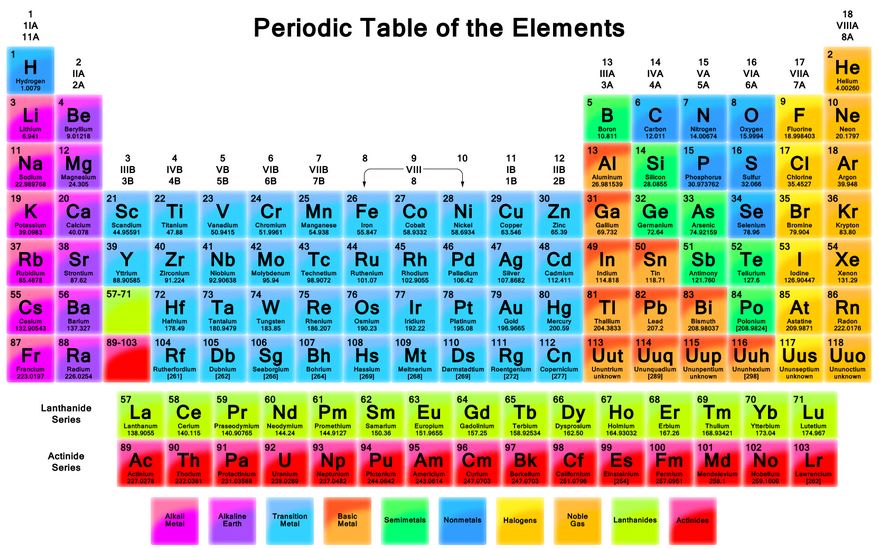
Which element is pictured?
a)
neon
b)
fluorine
c)
magnesium
d)
argon
32.
A possible explanation to a problem that has not yet been tested. 
a)
data
b)
theory
c)
hypothesis
d)
fact
33.
Mr. S. sets up an experiment to see how the mass of a ball affects the distance it rolls off a ramp.  Identify the independent variable.
a)
distance traveled by the ball
b)
height of the ramp
c)
mass of the ball
d)
weight of the ball
34.
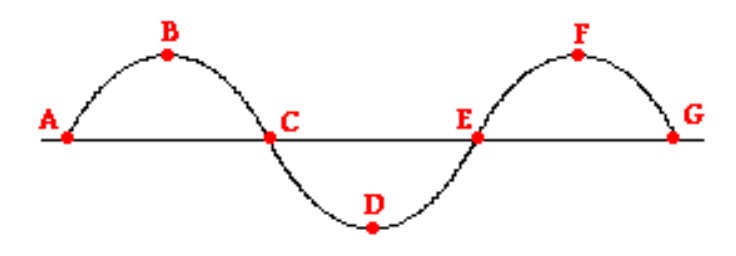
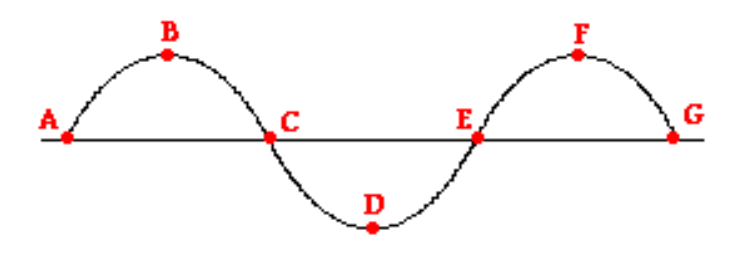
Which vocabulary term is used to identify the distance between points C & G?
a)
Amplitude
b)
Crest
c)
Frequency
d)
Wavelength
35.
Which letter(s) represent the trough of the wave?
a)
A
b)
c)
C
d)
D
D
36.
Which letter(s) represent the crest of the wave?
a)
A
b)
c)
C
d)
D
37.
What is this element? 
1s22s22p63s23p6
4s23d104p6
a)
Argon
b)
Krypton
c)
Selenium
d)
Bromide
38.
What is the shorthand electron configuration for Sulfur atom?
a)
[Ar] 3p4
b)
[He] 3s23p4
c)
[Ne] 3s23p4
d)
[Na] 3s23p3
39.
What atom matches this electron configuration?
[Xe] 6s2 4f14 5d9
a)
Mercury
b)
Gold
c)
Platinum
d)
Thallium
40.
A covalent bond is
a)
a bond that shares electrons metallicaly
b)
A bond that shares electrons with non metals
c)
Metalloids bonding
d)
metals and nonmetals bonding
41.
Hydrogen needs _____ electrons in its valence shell to be stable.
a)
4
b)
6
c)
8
d)
2
42.
Which element is not a metal?
a)
H
b)
Re
c)
Al
d)
B
43.
Which is a halogen?
a)
Helium
b)
Chlorine
c)
Oxygen
d)
Neptune
44.
Which is an alkali metal?
a)
Magnesium
b)
Iron
c)
Sodium
d)
Europium
45.
How did Mendeleev arrange the elements?
a)
alphabetical 
b)
density
c)
melting point
d)
atomic mass
46.
Why do ionic bonds form?
a)
so the number of protons equals the number of electrons
b)
to fill the outermost energy level
c)
so an atom can become unstable
47.
Ionic compounds are formed when one or more valence electrons are transferred from _____
a)
a nonmetal atom to a metal atom
b)
a nonmetal atom to a nonmetal atom
c)
a metal atom to a nonmetal atom
d)
a metal atom to a metal atom
48.
How do the following two elements bond together?
Cr3+  O2-         
a)
CrO
b)
Cr3O2
c)
Cr2O3
d)
CrO3
49.
Which of the following is an example of a COVALENT COMPOUND?
a)
H2S
b)
KI
c)
CaCl2
d)
MgO
50.
Which of the following is an example of an IONIC COMPOUND?
a)
NaCl
b)
H2O
c)
CO2
d)
NO
51.
Elements on the LEFT side of the periodic table will most likely form:
a)
Positive ions
b)
Negative ions
c)
Neutral Ions
d)
None of these
52.
As you move down the periodic table atoms get bigger.  This is because ____________.
a)
The atoms have more mass.
b)
The atoms have more protons.
c)
The atoms have more energy levels
d)
The atoms have more nuetrons
53.
Which atom has the largest atomic radius?
a)
potassium
b)
rubidium 
c)
francium
d)
cesium
54.
As you move across the periodic table atoms tend to get smaller because, ______________.
a)
the atoms have more mass.
b)
the atoms have less mass
c)
the atoms have more protons.
d)
the atoms have less electrons.
55.
Ionization energy is...
a)
the energy required to add an electron to a specific atom
b)
how much energy it takes to remove an electron from an atom
c)
the energy required to shield the outer electrons from the nucleus
d)
a measure of the ability of an atom to attract electrons
56.
Electronegativity is...
a)
how good an atom is at attracting electrons
b)
the ability of an atom to lose electrons
c)
the energy required to remove an electron from a specific atom
d)
how easy it is to make friends. 
57.
Which statement correctly and completely identifies a trend?
a)
Atomic radius decreases across a period and increases down a group.
b)
Electronegativity decreases across a period and decreases down a group.
c)
Ionization energy increases across a period and increases down a group.
d)
Ionic radius increases across a period and increases down a group.
58.
The element with the largest electronegativity in the halogens is - 
a)
At
b)
F
c)
Cl
d)
Br
59.
Density is an...
a)
Extensive Property
b)
Intensive Property
60.
Intensive property is dependent on the amount of a substance. 
a)
True
b)
False
61.
Ba+2, Br-1
a)
BrBa
b)
Br2Ba2
c)
BaBr2
d)
Br2Ba
62.
Ca+2P-3
a)
PCa
b)
P2Ca3
c)
CaP
d)
Ca3P2
63.
The name of FeCl₂ is
a)
iron chloride
b)
iron (II) chloride
c)
iron (I) chloride
d)
iron dichloride
64.
What is the correct formula for acetic acid?
a)
HA
b)
H₃C₂O₂
c)
HC₂H₃O₂
d)
H₂CO₃
65.
The correct name of Cu₃N₂ is
a)
copper (III) nitride
b)
copper (II) nitride
c)
copper nitride
d)
tricopper dinitride
66.
What is the correct name for HClO?
a)
Hypochlorous acid
b)
Hydrochloric acid
c)
Hydrogen Chlorate
d)
Hydrochloroxy acid
67.
When adding a subscript to a polyatomic ion, you should...
a)
multiply any subscripts on the polyatomic ion by the subscript you are adding
b)
put parentheses around the polyatomic ion before adding a subscript
c)
write the new subscript next to any subscripts on the polyatomic ion
d)
put the polyatomic ion in square brackets before adding the subscript
68.
What is the correct name for P₃Cl₆?
a)
Potassium chloride
b)
Phosphorous chloride
c)
Triphosphorous hexachloride
d)
Tetraphosphorous heptachloride
69.
What do atoms of metals tend to do with their valence electrons when bonding with non-metals?
a)
share them
b)
donate them
c)
keep them and accept others
d)
keep them and give others
70.
What is the correct formula for carbonic acid?
a)
H₂C
b)
H₂CO₃
c)
HCO₃
d)
HClO
71.
What is the correct name for SO₂?
a)
Sulfur oxide
b)
Sulfite
c)
Sulfur dioxide
d)
Sulfur II Oxide
72.
Which of the following is a covalent compound?
a)
CH4
b)
NaCl
c)
K3PO4
d)
Zn(OH)
73.
What is the name of " NO21- "?
a)
nitrogen dioxide
b)
nitrate
c)
nitrite
d)
nitrogen (II) oxide
74.
calcium phosphate
a)
CaPO4
b)
Ca2(PO4)3
c)
Ca3PO4
d)
Ca3(PO4)2
75.
H2SO4
a)
hydrosulfuric acid
b)
sulfuric acid
c)
sulfurous acid
d)
hydrosulfurous acid
76.
Name this compound: 
NH4F
a)
Ammonia fluoride
b)
Ammonium fluorite
c)
Ammonia fluorate
d)
Ammonium fluoride
77.
Is the equation balanced?: 2H2O + O2 --> 4MgO + 3Fe
a)
Yes
b)
No
78.
Balance this equation
_Al +_HCl --> _H+_AlCl3
a)
2, 6, 3, 2
b)
it is already balanced
c)
4, 12, 3, 4
d)
2, 1, 4, 5
79.
Balance this equation-
__P+ __O--> __P2O3
a)
it is already balanced
b)
2, 1, 3
c)
1, 2, 3
d)
1, 3, 2
80.
What kind of reaction is this:
2H2 + O2 --> 2H2O
a)
Synthesis
b)
Decomposition
c)
Single Replacement
d)
Double Replacement
81.
What type of reaction occurs between an element and a compound?
Zn + 2HCl --> ZnCl2 + H2
a)
Synthesis
b)
Decomposition
c)
Single Replacement
d)
Double Replacement
82.
What kind of reaction is this:
2H2O2 →2 H2+ O2
a)
Synthesis
b)
Decomposition
c)
Single Replacement 
d)
Combustion
83.
What kind of reaction is this:
2C3H7OH +9O2 -> 6CO2 + 8H2O
a)
Double Replacement
b)
Combustion
c)
Single Replacement
d)
Decomposition
84.
The reaction below is an example of?
AgNO3 + NaCl 
→ AgCl + NaNO3
a)
Single Replacement
b)
Double Replacement
c)
Decomposition
d)
Combustion
85.
What are the products of this reaction?
Cu+ AgNO3--> 
a)
Cu(NO3)2+Ag
b)
CuNO3 + Ag
c)
CuAg+NO3
d)
Cu+ AgNO3
86.
Write a balanced equation for this DR reactions
NaOH + Fe(NO3)3 -->
a)
NaFe + OH(NO3)3
b)
2NaNO3 + 3Fe(OH)3
c)
NaNO3 + FeOH
d)
3NaNO3 + Fe(OH)3
87.
Predict the products for the this reaction:
AgNO3 + KCl --> 
a)
AgCl + KNO3
b)
AgK + ClNO3
c)
AgNO3 + KCl
d)
KAg + NO3Cl
88.
Predict the products for the decomposition of calcium carbonate: CaCO3
a)
CaO + CO2
b)
Ca + CO3
c)
CaCO2 + O2
d)
CaO + CO3
89.
Write a balanced equation for this DR reaction
KOH(aq) + H3PO4(aq) --> 
a)
K3PO4 + 3HOH
b)
KH3 + OHPO4
c)
NR
d)
KPO4 + H3OH
90.
Write a Balanced Equation for this reaction:
C2H4 + 2 O2 -->
a)
C2O2 + H4
b)
CO2 + HOH
c)
NR
d)
2 CO2 + 2H2O
91.
What is the first thing you must do to solve a stoichiometry problem?
a)
Write a Balanced Equation
b)
Panic
c)
Write an Unbalanced Equation
d)
Ask for help
92.

For the Balanced Reaction: 3 Mg + 1 Fe2O3 → 3 MgO + 2 Fe; What is the Ratio of moles of MgO to moles Fe?

a)

3 mol Mg : 2 mol Fe

b)

2 mol Mg : 3 mol Fe

c)

1 mol Fe : 2 mol Fe

d)

3 mol MgO : 2 mol Fe

93.

Given the reaction: 4Al + 3O2 --> 2Al2O3

How many moles of Aluminum oxide can you produce if you have 2 moles of Al?

a)

3 mole

b)

2 mole

c)

1 mole

d)

0.5 mole

94.
N2 +  3H2 → 2NH3 
How many moles of hydrogen are needed to react with 2 moles of nitrogen?
a)
6
b)
2
c)
3
d)
1
95.

one mole is equal to

a)

6.02 x 10²² of anything

b)

6.02 x 10²³ of anything

c)

6.02 x 1024 of anything

d)

6.02 x 1025 of anything

96.

The numerical value of an atoms' molar mass and the value of its atomic mass are ________________.

a)

different

b)

the same

c)

varied

d)

large

97.

The molar mass of carbon is

a)

12.01 g/mol

b)

20.01 g/mol

c)

30.01 g/mol

d)

40.01 g/mol

98.

Find the molar mass of CH4

a)

12.00 g/mol

b)

10.00 g/mol

c)

16.04 g/mol

d)

25.00 g/mol

99.

Which are conversion factors that you can interchange

a)

22.4 L/mole and 1 mole/22.4 L

b)

6.02 x 10²³ molecules / 1 mole and 1 mole/6.02 x 1023 molecules

c)

6.02 x 10²³ atoms /1 mole and 1 mole/6.02 x 1023 mole

d)

all of them

100.

Pressure is caused by ______.

a)

gravity.

b)

gas molecules colliding with each other.

c)

gas molecules colliding with surfaces of the container.

d)

gas molecules reacting with each other.

101.
Movement of gas through a tiny opening
a)
Diffusion
b)
Effusion
102.
Gas molecules can easily be compressed  because ___________. 
a)
gas molecules are soft
b)
gas molecules are far apart
c)
gas molecules follow the shape of the container
103.
Change from gas to liquid...
a)
condensation
b)
evaporation
c)
expansion
d)
movement
104.
What phase of matter is shown in the diagram? (It is a regular pattern and the particles are locked in place.)
a)
solid
b)
liquid
c)
gas
d)
physical changes
105.
state of matter that has a fixed volume BUT changes it's shape to fit the container
a)
solid
b)
liquid
c)
gas
d)
phases of matter
106.

A hypothetical gas that perfectly fits all the assumptions of the kinetic molecular theory is a(n)________

a)

ideal gas

b)

combined gas

c)

technical gas

d)

chemical gas

107.

According to the kinetic molecular theory collisions between gas particles are perfectly elastic.

a)

True

b)

False

108.

Under what conditions do real gases behave as close to ideal as possible?

a)

Low pressure and High temperature

b)

Low temperature and Low pressure

c)

Low temperature and high pressure

d)

High temperature and high pressure

109.
Which is less compressible?
a)
Amorphous Solid
b)
Crystalline Solid
110.
Why are ionic solids more brittle than covalent molecular crystals?
a)
Ionic solids are held together by stronger binding forces.
b)
Ionic crystals are soft and easy to break.
c)
Covalent solids are held together by stronger binding forces.
d)
Covalent crystals contain a greater number of bonds.
111.
Which of the following is not a unit of measurement for Atmospheric pressure
a)
atm
b)
celcius
c)
kPa
d)
mmHg
112.
Atmospheric pressure is a measure of
a)
How many gas particles are in the air
b)
The pressure air particles exert on one another
c)
The pressure caused by air particles colliding with earth's surface
d)
How fast air particles are moving
113.
What will happen to the volume of a gas under constant temperature if the pressure increases?
a)
Increase
b)
Decrease
c)
Nothing
d)
Explosion!
114.
How are pressure and volume related?
a)
Directly
b)
Inversely
c)
They aren't related
115.
Which of the following would increase the pressure on a system?
a)
Increase the Temperature
b)
Pump in more gas
c)
Decrease the volume
d)
All of these
116.
Boyle's law :  The pressure and volume of a gas show a _____ relationship. 
a)
No relationship 
b)
Direct 
c)
Inverse 
d)
Equal
117.
What is the equation for Charles' Law?
a)
P1V1=P2V2
b)
V1/T1=V2/T2
c)
V1/n1=V2/n2
d)
P1/T1=P2/T2
118.
What type of relationship is Charles' Law?
a)
Inverse
b)
Direct
c)
Not enough information
d)
#goals
119.
When the temperature of matter increases the particles...
a)
speed up and move closer
b)
speed up and move farther apart
c)
slow down and move closer together
d)
slow down and move farther apart
120.
Collisions between gas particles are said to be "elastic" because _________________________.
a)
they have a stretchy waistband
b)
kinetic energy is lost between particles
c)
kinetic energy is not lost between particles and is instead transferred
d)
particles move in a straight line
121.

A gas occupies 3.5 L at standard pressure. Find the volume of the gas when the pressure is 1.5 atm.

a)

3.2L

b)

2.3mL

c)

6.4L

d)

2.3L

122.

At what temperature (in K) would the volume of a gas be 0.550 L if it had a volume of 0.432 L at –20.0oC?

a)

322K

b)

290K

c)

49K

d)

273K

123.
When dissolved in water, acids produce:
a)
bases
b)
salts
c)
hydrogen ions
d)
hydroxide ions
124.
Which type of ion does a base produce when it is dissolved in water?
a)
oxide
b)
oxygen
c)
hydrogen
d)
hydroxide
125.
How does a solution become supersaturated?
a)
dissolve lots of solute in it.
b)
dissolve a little solute in it. 
c)
dissolve more solute than you should be able to. 
d)
dissolve a super amount of solvent in it. 
126.
Solution where more solute can still be dissolved at the given temperature. 
a)
Saturated
b)
Unsaturated
c)
Supersaturated
d)
Homogeneous solution
127.
The ___ is the thing being dissolved.
a)
solute
b)
solvent
c)
mixture
d)
suspension
128.
Which solute is the most soluble at 10 ⁰C?
a)
KI
b)
KClO3
c)
NH4Cl
d)
NH3
129.
How many grams of SOcan dissolve at 50 ⁰C?
a)
5 g
b)
10 g
c)
20 g
d)
39 g
130.
When 20 grams of KNO3 is dissolved in 100 grams of water at 80 ºC, the solution can be correctly described as:
a)
supersaturated
b)
saturated
c)
unsaturated
131.
The amount of solute actually dissolved in a given amount of solvent.
a)
dilution
b)
concentration
c)
saturated solution
d)
supersaturated mixture
132.
When a solvent contains as much of the solute as it can hold, the solution is said to be
a)
supersaturated
b)
diluted
c)
saturated
d)
unsaturated
133.
Which is an example of a solute?
a)
Egg whites
b)
Sugar
c)
Water
d)
Acetone
134.
What does it mean to dilute a solution?
a)
lower the concentration of solute per solvent
b)
increase the concentration of solute per solvent
135.
You can make a solution more concentrated by adding __________.
a)
solute
b)
solvent
c)
water
136.
Solution where more solute can still be dissolved at the given temperature. 
a)
Saturated
b)
Unsaturated
c)
Supersaturated
d)
Homogeneous solution
137.
What will allow more solute to be dissolved in a solvent.
a)
adding more solute
b)
stiring
c)
cooling solution
d)
heat
138.
You and your friend have a contest to see who can make iced tea the fastest. Which of the following would NOT help you win?
a)
Cooling the water
b)
Using smaller crystals
c)
Heating the water
d)
Stirring quickly
139.
When you measure how fast a solute dissolves, you are measuring the
a)
amount of dissolving
b)
rate of particle movement
c)
amount of particle movement
d)
rate of dissolving
140.
How many moles of NaCl are present in a solution with a molarity of 8.59 M and a volume of 125 mL?
a)
1074 mol
b)
0.069 mol
c)
1.07 mol
d)
62.7 mol
141.
Which sweet tea would you expect to taste the sweetest?
a)
1M
b)
3M
c)
3.1M
d)
2.5M
142.
Calculate the molarity of the following solution:  1.0 mole of KCl in 750.0 mL of solution.
a)
0.750 M
b)
99 M
c)
1.3 M
d)
2.0 M
143.
How many moles are needed to make 2.5 L of a 3.8 M solution? 
a)
9.5 mol
b)
0.66 mol
c)
1.5 mol
d)
15 mol
144.
What does pH measure?
a)
Amount of Oxygen Ions
b)
Amount of Hydrogen Ions
c)
The amount of salt in a solution
d)
The density
145.
What is the endpoint of a titration
a)
Where the amount of acid and base are equal as shown by a colour change 
b)
Where there is no base
c)
When the volume of base in the burette is used up 
d)
When there is no acid
146.
What are the products of the neutralization shown below?
Ca(OH)2  +  H2CO3  -->  
a)
H2O  +  Ca2CO3
b)
CaO +  CO3
c)
H2O  +  CaCO3
147.
HCl + NaOH → 
a)
NaH + ClOH
b)
NaCl + H2
c)
NaCl + H2O
d)
NaCl + Cl2