wayground logo

Free Printable Worksheets

Font size

S
M
L
XL
Worksheets

Unit 1 Review

Total questions: 150

Worksheet time: 2hrs 29mins

Name
Class
Date
1.
What two types of measurements make up DENSITY
a)
Mass and Volume
b)
Temperature and Mass
c)
Grams and Centimeters
d)
Volume and Weight
2.
Look at this image.  Which object has the LOWEST density in water? How
a)
The Ping Pong Ball because it floats to the top 
b)
The bolt because it has sunk to the bottom
c)
The soda cap because it is not just full of air like the Ping Pong ball
3.
Jack has a rock. The rock has a mass of 14g and a volume of 2cm3. What is the density of the rock?
a)
7 mL
b)
7 g/cm3
c)
28 g/cm3
d)
1/7 g/cm3
4.
If an object has a density of .6 g/mL and you put it into water, will it sink or float?  
a)
sink
b)
float
5.
If an object has a density of 3.6 g/mL and you put it into water, will it sink or float?  
a)
sink
b)
float
6.
Frank has an eraser. It has a mass of 4g, and a volume of 2cm3. What is its density?
a)
8 g/cm3
b)
2 g/cm3
c)
1/2 g/cm3
d)
24 g/cm3
7.
What units are used to measure mass?
a)
g
b)
cm3
c)
g/cm3
d)
cm3/g
8.
What is the formula for density?
a)
density = mass x volume
b)
density = mass / volume
c)
density = mass + volume
d)
density = mass - volume
9.
Calculate the density of the cube.
a)
2 g/cm3
b)
4 g/cm3
c)
6 g/cm3
d)
8 g/cm3
10.
What is this tool to get mass?
a)
triple beam balance
b)
ruler
c)
thermometer
d)
graduate cylinder
11.
Which units of measurement are used for volume?
a)
grams
b)
centimeters
c)
grams/milliliter
d)
milliliter
12.
What units are used to measure Density?
a)
cm3/g
b)
g
c)
g/cm3
d)
cm3
13.
What is this tool to get volume?
a)
triple beam balance
b)
ruler
c)
thermometer
d)
graduate cylinder
14.
a)

15 cm3

b)

50 cm3

c)

150 cm3

d)

180 cm3

15.
a)

303.4 g

b)

370.4 g

c)

373.0 g

d)

373.4 g

16.

When you put an object in a graduated cylinder of water and measure how much the water level changed what is this process called?

a)

Relative Density

b)

Displacement

c)

Density

17.
What is the volume of Object X?
a)

10.0 ml

b)

15.0 ml

c)

20.0 ml

d)

25.0 ml

18.
What is the volume of the fish?
a)

18.0 ml

b)

6.0 ml

c)

38.0 ml

19.
An irregularly shaped piece of gold was lowered into a graduated cylinder holding a volume of water equal to 17 ml. The height of the water rose to 20 ml. If the mass of the gold was 27 g, what was its density?
a)
9 g/mL
b)
10.5 g/mL
c)
6.5 g/mL
d)
8 g/mL
20.
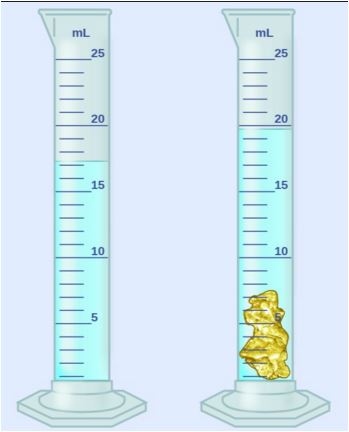
How much water has been displaced in the image shown?
a)
40 mL
b)
65 mL
c)
20 mL
d)
25 mL
21.

A measurement is something that has both a number and a ______

a)

Unit

b)

Symbol

c)

Number

22.

Mass is the amount of _______ an object has

a)

Matter

b)

weight

23.

The unit for mass is...

a)

Newton

b)

grams

c)

mililiters

d)

centimeters

24.

What is this tool called....

a)

Ruler

b)

Thermometer

c)

Beaker

d)

Graduated Cylinder

25.

A graduated cylinder is used to measure...

a)

Volume

b)

mass

c)

weight

d)

density

26.

The unit for volume is. (there is more than one right answer)

a)

grams

b)

milliliters (mL)

c)

Newton

d)

Centimeters Cubed

27.


What two types of measurements make up DENSITY

a)

Volume and Weight

b)

Temperature and Mass

c)

Mass and Volume

28.

What is the density of water?

a)

34 g/mL

b)

1 g/mL

c)

29 g/mL

d)

6 g/mL

29.

Measuring the volume of a block uses which equation

a)

Length ×Width×HeightLength\ \times Width\times Height  

b)

(radius)2×Length×π\left(radius\right)^2\times Length\times\pi  

30.

When measuring the volume of a cylinder , what equation would you use

a)

Width×Length×HeightWidth\times Length\times Height

b)

(radius)2×Length×π\left(radius\right)^2\times Length\times\pi

31.

What is the unit we use for mass?

Ex. The mass of a Pencil is 1.35 __?__

(a)  

32.

What is the unit for density ?

a)

g/ mL

b)

g

c)

gcm3\frac{g}{cm^3}  

d)

cm4cm^4  

33.
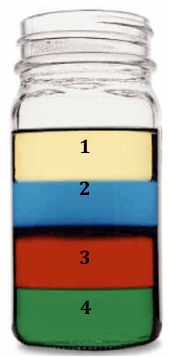
Put the liquids in order from most dense to least dense?
a)
4, 3, 2, 1
b)
1, 2, 3, 4
c)
3, 4, 2, 1, 
d)
4, 3, 1, 2
34.

Which box has a higher density?

a)

A

b)

B

c)

They are the same

35.
What is the formula for density?
a)
density = mass x volume
b)
density = mass / volume
c)
density = mass + volume
d)
density = mass - volume
36.
Frank has a paper clip. It has a mass of 9g and a volume of 3cm3. What is its density?
a)
3 g/cm3
b)
1/3 g/cm3
c)
27 g/cm3
d)
39 g/cm3
37.
A piece of copper has a mass of 89g and a volume of 10 cm3.  What would be the density of the copper?
a)
0.89 g/cm3
b)
89 g/cm3
c)
8.9 g/cm3
d)
890 g/cm3
38.

Calculate the density in the following question: A flower pot has a mass of 95 g and a volume of 92 mL.

a)

1.03 g/mL

b)

0.97 g/mL

c)

1.01 g/mL

d)

0.99 g/mL

39.

An object has a volume of 6 cm3 and a mass of 42 g. What's it's density?

a)

7 g/cm3

b)

48 g/cm3

c)

42 g/cm3

d)

6 g/cm3

40.
Jack has a rock. The rock has a mass of 14g and a volume of 2cm3. What is the density of the rock?
a)
7 mL
b)
7 g/cm3
c)
28 g/cm3
d)
1/7 g/cm3
41.
In the picture, the mass of the block is 200 g, the dimensions of the block are 6 cm by 4 cm by 5 cm.  What is its density?
a)
1.67g/cm3
b)
13.33 g/cm3
c)
0.60 g/cm3
d)
 24000 g/cm3
42.

The amount of water displaced is the same as the volume of the object. What is the VOLUME of the object?

a)
40 mL
b)
65 mL
c)
20 mL
d)
25 mL
43.

An object is is placed into 45 mL of water. The water rises to 48 mL. What is the volume of the object?

a)

3 mL

b)

93mL

c)

8 mL

d)

83 mL

44.
An irregularly shaped piece of gold was lowered into a graduated cylinder holding a volume of water equal to 17 ml. The height of the water rose to 20 ml. If the mass of the gold was 27 g, what was its density?
a)
9 g/mL
b)
10.5 g/mL
c)
6.5 g/mL
d)
8 g/mL
45.
An irregularly shaped rock was lowered into a graduated cylinder holding a volume of water equal to 50 ml. The height of the water rose to 75 ml. If the mass of the stone was 250 g, what was its density?
a)
15 g/mL
b)
5 g/mL
c)
10 g/mL
d)
20 g/mL
46.

The volume of the water is 40 mL. An object was placed inside the graduated cylinder and it now reads 65 mL. The mass of the object is 125 g. What is the DENSITY of the object?

a)
40 mL
b)
65 mL
c)

25 mL

d)

5 mL

47.
An object's volume was determined through water displacement.  The starting height of the water was 58 mL and the ending height was 65 mL.  What is the density of the object if it has a mass of 47.5 g?
a)
0.39 g/cm3
b)
6.79 g/cm3
c)
67.86 g/cm3
d)
0.15 g/cm3
48.
What is the volume of 150 grams of lead if it has a density of 11.3 g/cm3?
a)
13.3 g
b)
13.3 cm3
c)
.075 g
d)
1695 cm3
49.

The density of a material is 2 g/cm3. The volume is 24 cm3 . What is the mass?

a)
12 grams
b)
48 grams
c)
12 g/cm3
d)
48 g/cm3
50.
What is the mass of a substance with a volume of 72.5 cm3 and a density of 0.94 g/cm3?
a)
68.15 g
b)
77.13 g
c)
62 g
d)
100 g
51.

There are 4 objects listed with their densities. Which of the following will float on water? (SELECT 2)

a)

Object A:

0.7 g/cm3

b)

Object B:

1.2 g/cm3

c)

Object C:

0.25 g/cm3

d)

Object D:

11.4 g/cm3

52.

If an object has a density of 6 g/mL and you put it into water, will it sink or float?  
a)
sink
b)
float
53.
Put the liquids in order from most dense to least dense?
a)
4, 3, 2, 1
b)
1, 2, 3, 4
c)
3, 4, 2, 1, 
d)
4, 3, 1, 2
54.
What is the formula for density?
a)
density = mass x volume
b)
density = mass / volume
c)
density = mass + volume
d)
density = mass - volume
55.
Frank has an eraser. It has a mass of 4g, and a volume of 2cm3. What is its density?
a)
8 g/cm3
b)
2 g/cm3
c)
1/2 g/cm3
d)
24 g/cm3
56.
Jack has a rock. The rock has a mass of 14g and a volume of 2cm3. What is the density of the rock?
a)
7 mL
b)
7 g/cm3
c)
28 g/cm3
d)
1/7 g/cm3
57.
Why do some substances float on water?
a)
they are warmer than water
b)
they are cooler than water
c)
they are more dense than water
d)
they are less dense than water
58.
A crayon has a mass of 10g and volume of 5 mL. What is the density?
a)
30 g/mL
b)
15 g/mL
c)
1 g/mL
d)
2 g/mL
59.
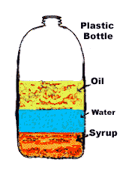
Which liquid is the least dense?
a)
oil
b)
water
c)
syrup 
d)
plastic bottle
60.
Look at this image.  Which object has the LOWEST density in water? How
a)
The Ping Pong Ball because it floats to the top 
b)
The bolt because it has sunk to the bottom
c)
The soda cap because it is not just full of air like the Ping Pong ball
61.
If an object has a density of .6 g/mL and you put it into water, will it sink or float?  
a)
sink
b)
float
62.
If an object has a density of 3.6 g/mL and you put it into water, will it sink or float?  
a)
sink
b)
float
63.
I have two objects with the same volume but different masses.  Which object will be more dense?
a)
The object with less weight.
b)
The object with more weight.
c)
The object with more mass.
d)
The object with less mass.
64.
Why did the balloon come back down to the ground?
a)
The air around it pushed it down.
b)
The air inside cooled and became more dense forcing the balloon to descend. 
c)
The air inside the balloon heated up and the air was too hot to rise. 
d)
The balloon may have had a hole in it.
65.

What happens to air molecules when they are heated?

a)

they come together

b)

they seperate

c)

they don't move

d)

they stay the same.

66.

What happens to air molecules when they are cooled?

a)

They spread apart

b)

they become compacted

c)

they stay the same

d)

they move quickly

67.

Warm air is _____ dense than cool air.

a)

more

b)

less

c)

the same

68.

Blue color: Chemical or Physical Property

a)
Chemical Property
b)
Physical Property
69.
Density: Chemical or Physical Property
a)
Chemical Property
b)
Physical Property
70.
Flammability (burns): Chemical or Physical Property
a)
Chemical Property
b)
Physical Property
71.

Reacts with acid: Chemical or Physical Property

a)
Chemical Property
b)
Physical Property
72.
Brittleness: Chemical or Physical Property
a)
Chemical Property
b)
Physical Property
73.

Sour taste: Chemical or Physical Property

a)
Chemical Property
b)
Physical Property
74.

Melting point: Chemical or Physical Property

a)
Chemical Property
b)
Physical Property
75.

Reacts with water: Chemical or Physical Property

a)
Chemical Property
b)
Physical Property
76.
Hardness: Chemical or Physical Property
a)
Chemical Property
b)
Physical Property
77.

Boiling point: Chemical or Physical Property

a)
Chemical Property
b)
Physical Property
78.
Luster: Chemical or Physical Property
a)
Chemical Property
b)
Physical Property
79.

Odour (smell): Chemical or Physical Property

a)
Chemical Property
b)
Physical Property
80.
Reacts with Air: Chemical or Physical Property
a)
Chemical Property
b)
Physical Property
81.

Which one of these is a chemical property?

a)

Melting point

b)

Boiling point

c)

Color

d)

Toxicity

82.
Physical properties are
a)

Properties that can be observed without changing the identity of the substance

b)

Properties that describe how a substance changes into a completely different substance

83.

is the ability of a substance to dissolve in a liquid

a)

malleability

b)

luster

c)

oxidation

d)

solubility

84.

the ability of a material to bend or be hammered into other shapes without breaking.

a)

Ductility

b)

Malleability

c)

Toxicity

d)

Solubility

85.

a resistance to being scratched or dented.

a)

Luster

b)

Flammability

c)

conductivity

d)

hardness

86.

 the ability to pass electricity or heat through a substance

a)

conductivity

b)

ductility

c)

oxidation

d)

malleability

87.

the ability of a substance to be drawn into thin wires

a)

Conductivity

b)

malleability

c)

ductility

d)

flammability

88.

The way something looks, feels, smells, and tastes are physical properties.

a)

True

b)

False

89.

Ability of substance to dissolve into another substance:

a)

magnetism

b)

malleability

c)

solubility

d)

appearance

90.

How a substance reacts to a magnet (attract or repel):

a)

solubility

b)

malleability

c)

state of matter

d)

magnetism

91.

The final product of any physical change is still composed of the same matter.

a)

True

b)

False

92.

The amount of matter(tiny particles) in an object?

a)

volume

b)

solubility

c)

magnetism

d)

mass

93.

Anything that has mass and takes up space.

(everything is made of this)

a)

mass

b)

matter

c)

volume

d)

reflectivity

94.

The amount of space and object takes up?

a)

mass

b)

volume

c)

reflectivity

d)

conductivity

95.

The amount of light that bounces off of an object

a)

solubility

b)

conductivity

c)

reflectivity

d)

magnetism

96.

ability for energy, such as electricity and heat, to move through an object.

a)

conductivity

b)

solubility

c)

mass

d)

volume

97.

A chemical property describes how matter __________.

a)

smells

b)

reacts with another type of matter

c)

looks under a microscope

d)

dissolves when made into a solution

98.

When matter reacts with fire?

a)

toxicity

b)

flammability

c)

oxidation

99.

color

a)

physical property

b)

chemical property

100.

flammable

a)

physical property

b)

chemical property

101.

hardness

a)

physical property

b)

chemical property

102.

odor/smell

a)

physical property

b)

chemical property

103.

tarnish/rust

a)

physical property

b)

chemical property

104.

taste

a)

physical property

b)

chemical property

105.

texture

a)

physical property

b)

chemical property

106.

reactivity

a)

physical property

b)

chemical property

107.
Is burning wood a chemical or physical change?
a)
chemical
b)
physical
108.

Is glass breaking a chemical or physical change?

a)
chemical
b)
physical
109.
Is a a rusting bicycle a chemical or physical change?
a)
chemcial
b)
physical
110.
Is melting ice a chemical or physical change?
a)
chemical
b)
physical
111.
Is spoiling food a physical or chemical change?
a)
phyiscal
b)
chemical
112.
Is frying an egg a physical or chemical change?
a)
chemical
b)
physical
113.
Salt dissolves in water
a)
physical Change
b)
chemical change
114.
Which is a chemical change?
a)
freezing fruit juice
b)
slicing a potato
c)
boiling water
d)
copper metal turning green
115.
what is the definition of physical change?
a)
any change that results in the formation of new chemical substances. 
b)
rusting
c)

changes affecting the form of a chemical substance, but not its chemical identity.

d)
any property that is measurable, whose value describes a state of a physical system
116.

What is a chemical change?

a)

How two chemicals react with one another when combined

b)

A property that we can measure or observe with our 5 senses or other tools

c)

When two chemicals react with one another to form a new substance

d)

When a change occurs but it does not result in the formation of a new substance

117.

A student mixes yellow powder with water. Which observation would prove a CHEMICAL change occurred?

a)

The powder DISSOLVED in the water

b)

The water turned the COLOR yellow

c)

The water's TEMPERATURE changed

d)

The STATE OF MATTER changed

118.

Which of the following examples provides evidence of a PHYSICAL change?

a)

Wood is burned and releases ash and smoke

b)

Iron rusts over time

c)

When mixed, baking soda and vinegar form gas bubbles

d)

Boiling water bubbles when heated

119.

Which of the following options provides evidence of a CHEMICAL change?

a)

Wood is burned releasing ash and smoke

b)

Rocks separate when soil is sifted

c)

Boiling water bubbles when heated

d)

Salt dissolves in water

120.

Which observations prove a chemical change occurred ?

a)

Dissolving and expected color change

b)

Mixing and dissolving

c)

State of matter change and boiling water bubbles

d)

Unexpected color change and temperature change

121.

When mixing milk and vinegar, a white, chunky, solid substance is formed. What has occurred?

a)

Physical change: state of matter

b)

Chemical change: precipitate

c)

Physical change: freezing

d)

Chemical change: new gas

122.

You mix two liquids together, bubbles form and the temperature decreases. This is a....

a)

Endothermic chemical change

b)

Exothermic chemical change

c)

Physical Change

123.

You mix a red liquid and a white solid together. They turn yellow and the temperature increases. This is a...

a)

Endothermic chemical change

b)

Exothermic chemical change

c)

Physical Change

124.

You mix a yellow powder and a clear liquid. The liquid turns light yellow and the powder seems to disappear. This is a...

a)

Endothermic Chemical Change

b)

Exothermic Chemical Change

c)

Physical Change

125.
a)
Element
b)
Compound
c)
Mixture
126.

Which if the following is described as being pure substances?

a)

elements

b)

compounds

c)

elements and compounds

d)

mixtures

127.

Which of the following describes a substance that has been physically combined and is NOT uniform throughout (you see the DIFFERENT parts that make it up)?

a)

Homogeneous Mixture

b)

Compound

c)

Heterogeneous mixture

d)

element

128.

What is the smallest part of a compound that retains the properties of that compound

a)

atom

b)

element

c)

Molecule

d)

mixture

129.

A student is observing a substance that contains multiple element that have been chemically combine C6H12O6(SUGAR). Which of the following best describes what the student is observing?

a)

Heterogeneous Mixture

b)

Homogeneous Mixture

c)

Element

d)

Compound

130.

What is the smallest part of an element that retains the properties of the element?

a)

atom

b)

molecule

c)

compound

d)

subatomic particles

131.

Which two compounds are Ionic bonds?

a)

water(H20)  and rust(Fe2O3)

b)

water(H2O) and carbon dioxide(CO2)

c)

rust(Fe2O3) and salt(NaCl)

d)

oxygen gas(O2) and nitrogen gas(N2)

132.
This picture represents which of the following?
a)
element
b)
compound
c)
mixture
d)

atom

133.
This picture represents which of the following?
a)
element
b)
compound
c)
mixture
d)

atom

134.
This picture represents which of the following?
a)
element
b)
compound
c)
mixture
d)

atom

135.
Covalent bonds are between...
a)
Metal and Non-metal
b)
Non-metal and Non-metal
c)
Metal and Metal
d)

Metalloids

136.
Ionic bonds are between...
a)
Metal and Non-metal
b)
Non-metal and Non-metal
c)
Metal and Metal
d)

Metalloids

137.
Atoms are most stable when their outer shell is complete.
a)
true
b)
false
138.

This substance can be separated by physical means such as filtering, sifting, and evaporating.

a)

Mixtures

b)

Pure Substances

c)

Elements

d)

Compounds

139.
How are ionic bonds formed?
a)
Transfer of electrons
b)
Sharing of electrons
140.
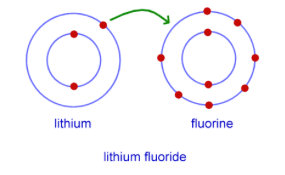
What type of bond is this?
a)
ionic
b)
covalent
141.

What type of bonding does this picture show?

a)

Ionic

b)

Covalent

142.
What type of mixture is this?
a)
homogenous mixture
b)
chemical
c)
heterogeneous mixture 
d)
solid mix
143.

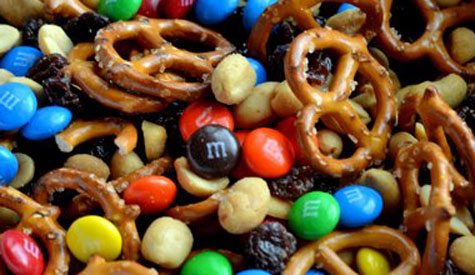
What kind of mixture is shown in the picture?

a)

Homogeneous Mixture

b)

Heterogeneous Mixture

144.

When one or more substance is combined CHEMICALLY it is called __________________.

a)

compound

b)

element

c)

mixture

d)

solution

145.
Contains only one kind of atom.
a)
Element
b)

Compound

c)
Mixture
146.
These contain only one kind of atom. 
a)
element 
b)
compound 
c)
mixture 
d)
water 
147.
A compound is made of ________ atoms. 
a)
big 
b)
similar 
c)
different 
148.
Carbon Dioxide is a ______ 
a)
compound 
b)
element 
c)
mixtures 
d)
Battle of Bunker Hill 
149.
This picture represents which of the following?
a)
element
b)
compound
c)
mixture of elements
d)
mixture of compounds
150.
Contains only one kind of atom.
a)
Element
b)
Compund
c)
Mixture