wayground logo

Free Printable Worksheets

Font size

S
M
L
XL
Worksheets

Spring 2023 - Semester 2 Final Review

Total questions: 150

Worksheet time: 1hrs 22mins

Name
Class
Date
1.

Groups run:

a)

up and down

b)

left to right

2.

Periods run:

a)

up and down

b)

left to right

3.

Which two elements share common characteristics based on the periodic table?

a)

Sodium and Magnesium

b)

Chlorine and Sulfur

c)

Argon and Neon

d)

Calcium and Bromine

4.

A student is studying a mystery substance. It breaks easily. It has a very dull luster. It doesn't conduct any electricity. What is the most likely substance this is?

a)

Metal

b)

Metalloid

c)

Nonmetal

5.

The third substance the student works with is a little brittle. It is just a little shiny. When he tries to conduct electricity through it at first, it doesn't conduct, but upon heating up, it does start to allow electrons to flow. What is the most likely substance type?

a)

Metal

b)

Metalloid

c)

Nonmetal

6.

What is the chart called that organizes all of the elements found on Earth?

a)

Element Chart

b)

Table of Elements

c)

Periodic Table of Elements

7.

Valence electrons are

a)

the electrons in the outer most energy level

b)

all the electrons in the atom

8.

The chemical symbol for an element is always represented by only 1 letter

a)

True

b)

False

9.

Which element would react similarly to Gold (Au)?

a)

Silver (Ag)

b)

Mercury (Hg)

c)

Iron (Fe)

10.

Chlorine, Cl, belongs to the ______ family.

a)

Noble gas

b)

alkaline earth metal

c)

Halogen

d)

Transition metal

11.

Sodium, Na, belongs to the ______ family.

a)

Halogen

b)

alkali metal

c)

Noble gas

d)

alkaline earth metal

12.

On the periodic table, elements with similar chemical characteristics are found in the same:

a)

period (row)

b)

group (column)

13.

The elements along zig zag line on the periodic table of elements are:

a)

metals

b)

nonmetals

c)

metalloids

14.

The majority (most) of the elements are:

a)

metals

b)

nonmetals

c)

metalloids

15.
The Modern Periodic Table of Elements is arranged by
a)
atomic mass
b)
atomic number
c)
valence electrons
d)
number of isotopes
16.
___________ is the only metal that is a liquid at room temperature.
a)
Platinum
b)
Water
c)
Tin
d)
Mercury
17.

Metals (select all that apply)

a)

are found on the right side of the periodic table.

b)

are found on the left side of the periodic table.

c)

are good conductors of heat and electricity.

d)

are brittle.

e)

are malleable and ductile.

18.
As you move down a group, atomic radius increases because - 
a)
you add more and more neutrons
b)
you add more and more protons
c)
you add more and more shells (energy levels)
d)
you add more atomic mass
19.
The atom with the largest atomic radius in Group 18 is - 
a)
Ar
b)
He
c)
Kr
d)
Rn
20.
As you move across the periodic table from left to right, the atomic radius decreases.  This is because - 
a)
the number of protons increases, so attraction to electrons increases
b)
the number of energy levels increases
c)
the number of electrons increases
d)
the atomic mass increases
21.
The atom with the largest atomic radius in Period 4 (row 4) is - 
a)
K
b)
Kr
c)
Fe
d)
Fe
22.
Francium (Fr) has the lowest ionization energy in Group 1 because - 
a)
it has the smallest number of valence electrons
b)
it has the greatest atomic mass
c)
it has the greatest number of protons, so it attracts its electrons the strongest
d)
its 1 valence electron is very far from the nucleus, so little energy is needed to remove it
23.
The element with the smallest ionization energy in Period 6 is - 
a)
Rn
b)
Cs
c)
Os
d)
Tm
24.
As you move across the periodic table atoms tend to get smaller because, ______________.
a)
the atoms have more mass.
b)
the atoms have less mass
c)
the atoms have more protons.
d)
the atoms have less electrons.
25.
The energy required to remove electrons is the definition of: 
a)
Electronegativity
b)
Atomic Number
c)
Atomic Radius
d)
Ionization
26.
Electronegativity is...
a)
the ability of an atom to attract/ accept electrons
b)
the ability of an atom to lose electrons
c)
the energy required to remove an electron from a specific atom
d)
how easy it is to make friends. 
27.
Which has the greater Electronegativity: 
N or C?
a)
C
b)
N
28.

Electronegativity __________ from left to right within a period and __________ from top to bottom within a group.

a)

decreases, increases 

b)

increases, increases

c)

increases, decreases 

d)

stays the same, increases

29.
Atomic Radius is...
a)
the relative size of the atom's nucleus
b)
the relative size of the atom's electron cloud
c)
the energy required to shield the outer electrons from the nucleus
d)
a measure of the ability of an atom to attract electrons
30.
Electronegativity is...
a)
how good an atom is at attracting electrons
b)
the ability of an atom to lose electrons
c)
the energy required to remove an electron from a specific atom
d)
how easy it is to make friends. 
31.
Atoms that have a high electronegativity, _______________.
a)
give up their electrons more easily.
b)
hold on to their electrons more tightly.
c)
have more electron shells.
32.
As atoms of elements in group 16 are considered in order from top to bottom, the electronegativity of each successive element....
a)
decreases
b)
increases
c)
remains the same
d)
none of the above
33.
The electronegativity of Cl is the highest in Period 2.  Why?
a)
Cl is the largest and has the greatest effective nuclear charge
b)
Cl is the smallest and has the lowest effective nuclear charge
c)
Cl is the largest and has the lowest effective nuclear charge
d)
Cl is the smallest and has the greatest effective nuclear charge
34.
An atom becomes _________ when it gains electrons.
a)
Positive
b)
Negative
c)
Neutral
d)
Invinsible
35.
An atom becomes _______ when it loses electrons.
a)
Positive
b)
Negative
c)
Neutral
d)
Invinsible
36.
Cations are...
a)
Positive
b)
Negative
c)
Neutral
d)
Purring
37.
Anions are...
a)
Positive
b)
Negative
c)
Neutral
d)
Crying
38.

What is the name of this ion?

a)

oxide

b)

oxygen

39.

Why are ions formed?

a)

To make our lives difficult

b)

Because atoms want to be stable with 8 valence electrons

c)

Because atoms have the same number of protons and electrons

d)

Because atoms gained neutrons

40.

An atom with 2 protons, 3 neutrons, and 4 electrons has a charge of ____.

a)

+2

b)

-2

c)

+3

d)

0

41.

How many protons, neutrons, and electrons?

a)

proton = 6, neutron = 4, electron = 1

b)

proton = 4, neutron = 4, electron = 5

c)

proton = 1, neutron = 6, electron = 10

d)

proton = 4, neutron = 2, electron = 3

42.

A Bromine ion gains 1 electron, which of the following is the correct symbol for a Bromine ion?

a)

Br-1

b)

Br+1

c)

Br+7

d)

Br-7

43.

What class of elements tends to lose electrons?

a)

metals

b)

nonmetals

c)

metalloids

d)

Noble Gas

44.

What class of elements tends to gain electrons?

a)

metals

b)

nonmetals

c)

metalloids

d)

Noble Gas

45.
Which of the following has a -3 charge?
a)
Boron
b)
Fluorine
c)
Nitrogen
d)
Neon
46.

How many electrons would a Calcium ion gain/lose?

a)

lose 1

b)

gain 1

c)

lose 2

d)

gain 2

47.

A Bromine ion gains 1 electron, which of the following is the correct symbol for a Bromine ion?

a)

Br-1

b)

Br+1

c)

Br+7

d)

Br-7

48.

True or False: Ionic Compounds shares valence electrons

a)

True

b)

False

49.

True or False: Covalent bonds are between a nonmetal and a nonmetal

a)

True

b)

False

50.

LiFLiF  

a)

Covalent

b)

Ionic

51.

SeBrSeBr   

a)

Covalent

b)

Ionic

52.

True or False: Ionic compounds do not have prefixes

a)

True

b)

False

c)

Sometimes they do

53.

True or False: Covalent compounds uses prefixes

a)

True

b)

False

54.

Ionic Bonds

a)

metal with nonmetal

b)

nonmetal with nonmetal

55.
How are ionic bonds formed?
a)
Transfer of electrons
b)
Sharing of electrons
56.
How many valence electrons does calcium have?
a)
2
b)
4
c)
6
d)
7
57.

If an atom has no charge, which of the following must be true?

a)

It has more neutrons than protons or electrons.

b)

There are only neutrons inside the atom.

c)

Its number of protons is equal to its number of electrons.

d)

The neutrons in the atom outnumber the electrons and protons.

58.
Atoms are most stable when their outer shell is complete.
a)
true
b)
false
59.
How are covalent bonds formed?
a)
Sharing of electrons
b)
Transfer of electrons
60.
This picture shows a...
a)
Ionic Bond
b)
Covalent Bond
c)
Both bonds
d)
Neither bond
61.
This picture shows a...
a)
Ionic Bond
b)
Covalent Bond
c)
Both bonds
d)
Neither bond
62.

Atoms in a water molecule are held together by what type of bond?

a)

Ionic

b)

hydrogen

c)

covalent

d)

none

63.

An atom with 1 valence electron 'needs' a full shell, so it can either gain 7 electrons or lose 1. Which is more likely to occur?

a)

nothing

b)

gain 7

c)

lose 1

64.

What two types of atoms make a covalent bond?

a)

2 nonmetals

b)

2 metals

c)

1 metal and 1 nonmetal`

65.
What is the correct formula for this molecule?
a)
NH
b)
N3H
c)
NH3
d)
NH4
66.

Elements in the same group have the same

a)

# of energy orbitals

b)

# of valence electrons

c)

# of protons

d)

# of neutrons

67.

dinitrogen pentoxide

a)

N2O5

b)

NO5

c)

N5O2

d)

N2O6

68.

What is the name of the compound Na2SO4?

a)

sodium sulfate

b)

sodium sulfide

c)

sodium sulfite

d)

Sodium sulfuroxide

69.

When naming binary ionic compounds, you change the ending of the second element to ___.

a)

-ate

b)

-ite

c)

-ide

d)

-ine

70.

Which of these is a distinguishing property for the noble gases?

a)

Soft - can cut with a plastic knife

b)

Unreactive - don't give or receive electrons

c)

Shiny - exhibits luster

d)

Poor conductors of electricity

71.

An unknown element is observed to be shiny, malleable, ductile, and is found to conduct heat and electricity very well. What group might this element fall into?

a)

Alkali metals

b)

Alkali earth metals

c)

Transition metals

d)

Non-metals

72.

Which of these are silvery-white?

a)

transition metals

b)

alkali earth metals

c)

halogens

d)

alkali metals

73.

Which of these are not good conductors of heat & electricity?

a)

noble gases

b)

alkali earth metals

c)

halogens

d)

non-metals

74.

Why is hydrogen, a non-metal, placed in the group that contains Alkali metals?

a)

Because it acts like a metal

b)

Because it also has only one valence electron

c)

Because it also has only one energy level

75.

Besides being very stable, what other characteristic does copper, gold, and silver share that made them a good choice for making coins?

a)

Ductile

b)

Conductivity

c)

Malleable

d)

Luster

76.
What part of an atom is involved in chemical bonding?
a)
protons
b)
neutrons
c)
electrons
d)
nucleus
77.
A ________ is a model of an atom in which each dot represents a valence electron.
a)
Valence electron
b)
Electron dot diagram/Lewis dot structure
c)
Lewis bond structure
78.
A __________ is a number written to the right of a chemical symbol and slightly below it.
a)
subscript
b)
coefficient
c)
chemical formula
d)
compound
79.

Name the following compound: CO

a)

Monocarbon monoxide

b)

Carbon monoxide

c)

Carbon oxide

d)

Monocarbon oxide

80.

Name the following compound: H2S

a)

Hydrogen disulfide

b)

Hydrogen sulfide

c)

Dihydrogen sulfide

d)

Dihydrogen monosulfide

81.

What is the prefix for the number 5 ?

a)

tetra-

b)

penta-

c)

hexa-

d)

hepta-

82.

What is the prefix for the number 8 ?

a)

hexa-

b)

hepta-

c)

octa-

d)

nona-

83.

What is the chemical formula for Dichlorine monoxide?

a)

ClO

b)

ClO2

c)

Cl2O2

d)

Cl2O

84.

What is the chemical formula for Dioxygen difluoride?

a)

O2F2

b)

OF

c)

O2F

d)

OF2

85.

Which is the correct Lewis structure for HCl ?

a)
b)
c)
d)
86.

What is the Lewis Structure for CH4 ?

a)
b)
c)
d)
87.
A bond with a partially negative end and a partially positive end is:
a)
ionic
b)
polar
c)
non-polar
d)
isometric
88.
A diatomic molecule like O2 is always_______ because electrons are shared ________.
a)
nonpolar; equally
b)
polar; equally
c)
nonpolar; unequally
d)
nonpolar; unequally
89.
When you are asked to find bond polarity, compare EN values of each bonding atom to the central atom
a)
true
b)
false
90.

When you have H-Cl, what is the polarity?

a)

nonpolar

b)

polar

c)

ionic

91.

When you have Li-O, what is the polarity?

a)

nonpolar

b)

polar

c)

ionic

92.
What formula results when Ca+2  and  Br- ions bond?
a)
Ca2Br2
b)
CaBr
c)
Ca(br)2
d)
CaBr2
93.
How do the following two elements bond together?
Cr3+  O2-         
a)
CrO
b)
Cr3O2
c)
Cr2O3
d)
CrO3
94.

Which is NOT an indication of a chemical change?

a)

Temperature Change

b)

Shape Change

c)

Formation of a precipitate

d)

Production of light

95.

What is the left part of a chemical equation called?

2H2 + O2 --> 2H2O

a)

Reactants

b)

Yields

c)

Products

d)

Chemical Equation

96.

What is the right part of a chemical equation called...

2H2 + O2 --> 2H2O

a)

Reactants

b)

Yields

c)

Products

d)

Chemical Equation

97.

True or False

In a chemical reaction, no new atoms are created, and no atoms are destroyed.

a)

TRUE

b)

FALSE

98.

(NH4)2Cr2O7 How many H are in this atom?

a)

2

b)

4

c)

6

d)

8

99.

Cu +HNO3 --> Cu(NO3)2 + H2O + NO. How many Oxygen in product?

a)

5

b)

6

c)

7

d)

8

100.

PCl5 +H2O --> POCl3 +HCl. How many chlorine (Cl) atoms?

a)

Reactants: 5; Products: 3

b)

Reactants 5; Products 5

c)

Reactants 5: Products 4

d)

Reactants 3; Products 5

101.

3 Ca(H2PO4)2. How many O atoms in this expression?

a)

4

b)

6

c)

8

d)

12

e)

24

102.
In an endothermic reaction, heat is ...
a)
taken in or absorbed
b)
given out or released 
103.
Which of the following shows the correct way to balance the chemical equation?
Fe + O2 -> Fe2O3
a)
4Fe + 3O2 -> 2Fe2O3
b)
2 Fe + 3O2 -> Fe2O6
c)
4 Fe + O6 -> 2Fe2O3
d)
None of the options are correctly balanced.
104.
Balance this equation...
HgO --> Hg + O2
a)
It is balanced 
b)
2HgO --> Hg + O2
c)
2HgO --> 2Hg + O2
d)
I don't know...Oh well!
105.
Ice melting
a)
Chemical Change
b)
Physical Change
106.
What happens in ALL chemical changes?
a)
Change in state of matter
b)
A new substance is formed
c)
Bubbles are produced
d)
An explosion
107.

According to the law of conservation of mass, how does the amount of each element on the product side compare to each element on the reactant side?

a)

The amount of atoms on each side is equal

b)

The amount of atoms on the product side is greater

c)

The amount of atoms on the reactant side is greater

d)

Depends on the reaction

108.
Which of the following describes a precipitate?
a)
a liquid forms when a block of metal is heated
b)
a solid forms when one liquid is poured into another
c)
a gas forms when a solid is placed in a liquid
d)
bubbles form when an acid is poured on a rock
109.

Which reaction type is the following:

C5H10 + O2 --> CO2 + H2O

a)

Decomposition

b)

Synthesis

c)

Combustion

d)

Double Replacement

110.
2 NH3+ 1 H2SO4 ----> 1 (NH4)2SO4
a)
Synthesis (or combination)
b)
Decomposition
c)
Single displacement
d)
Double displacement
111.
CaCO3 ----> CaO + CO2
a)
Synthesis (or combination)
b)
Decomposition
c)
Single displacement
d)
Double displacement
112.
Pb + FeSO4 ----> PbSO4 + Fe
a)
Synthesis (or combination)
b)
Decomposition
c)
Single displacement
d)
Double displacement
113.
Na3PO4 + 3 KOH ----> 3 NaOH + K3PO4
a)
Synthesis (or combination)
b)
Decomposition
c)
Single displacement
d)
Double displacement
114.
What is the term for the → sign in a reaction?
a)
makes
b)
produces
c)
yields
d)
all are correct
115.

Based on the activity series, will this reaction occur?

Au (s) + HCl (l) →

a)

AuCl + H

b)

No Reaction

c)

AuCl + H2

d)

Au2Cl + H2

116.

Predict the product(s) of this reaction (don't worry about balancing):

Mg + HCl →

a)

No Reaction

b)

MgCl2 + H2

c)

MgCl2 + H

d)

MgCl + H2

117.

Which element is higher in reactivity, Ag or Ca?

a)

Ag

b)

Ca

c)

Neither

d)

They're equal

118.
What do we look at to determine if an element is strong enough to replace another element in a single replacement reaction?
a)
Solubility Rules 
b)
Ionic Charges
c)
It must be insoluble!
d)
Activity Series
119.

Select 2 answers:

Geothermal Energy uses water heated deep in the Earth to heat things and generate electricity. The name comes from two Greek words, "Geo" which means_ and "Therm" which means_.

a)

Water

b)

Heat

c)

Earth

d)

Sun

e)

Rock

120.

Which of the following are renewable resources?

a)

coal and oil

b)

geothermal

c)

wind

d)

biomass: wood, scraps, corn stalks, animal waste, etc.

e)

solar

121.

Which of the following are nonrenewable resources?

a)

coal

b)

nuclear power

c)

oil

d)

natural gas

e)

biomass

122.

At what time is geothermal energy available?

a)

Day

b)

Night

c)

All day

d)

Never available

123.

Geothermal energy produces pollution: True or False?

a)

True

b)

False

124.

Where can geothermal energy be used best?

a)

Near a river

b)

Near a volcano

c)

In a mountain

d)

In the sea

125.

What spins the turbine?

a)

Hamster

b)

Steam

c)

Wind

d)

Water

126.
What is molten rock that has formed deep within the Earth?
a)
Hot Spot
b)
Magma
c)
Lava
d)
Volcano
127.
Volcanoes that have recently erupted are known as:
a)
Extinct Volcano
b)
Dormant Volcano
c)
Active Volcano
d)
What's a volcano?
128.
This plate is involved in all of the Ring of Fire Volcanoes.
a)
The Nazca Plate
b)
The North American Plate
c)
The Pacific Plate
d)
The Indian Plate
129.

The Earth's crust is broken into pieces called

a)

glass

b)

rocks

c)

plates

d)

lava

130.
What is molten rock that has reached the Earth's surface?
a)
Aa
b)
Lava
c)
Magma
d)
Pahoehoe
131.
Shield volcanoes have:
a)
gently sloping sides
b)
a steep cone shape
c)
moderately sized sides
d)
long cracks along plate boundaries
132.
Explosive eruption that hurls ash, gases, cinders, and bombs from the main vent.
a)
Volcano bomb
b)
Geyser
c)
Geothermal energy
d)
Pyroclastic flow
133.

Do two colliding continental plates always cause volcanoes?

a)

No, earthquakes always occur when two continental plates collide

b)

Yes, subduction always occurs when continental plates collide

c)

No, usually no subduction occurs when continental plates collide

d)

Yes, subduction always occurs when oceanic plates collide

134.

Where do most earthquakes and volcanoes happen?

a)

mid-ocean ridges

b)

plate boundaries

c)

in the mantle

d)

rift valley

135.

An area of volcanic activity far from a tectonic plate boundary is called a(n)

a)

hot spot

b)

cone

c)

island arc

d)

mantle plume

136.
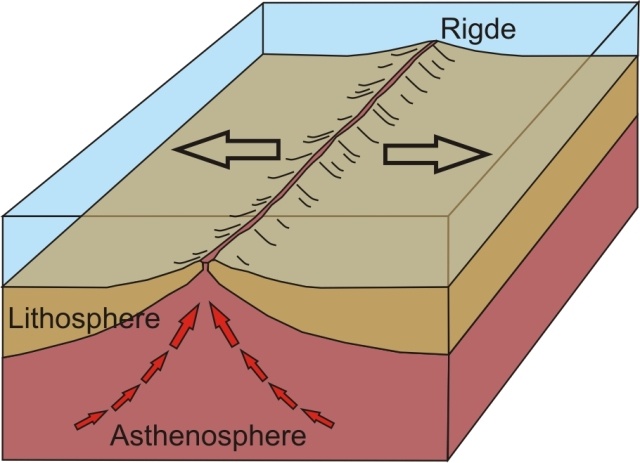
What kind of plate boundary is shown here?
a)

divergent

b)

convergent

c)

transform

137.
What kind of plate boundary is shown here?
a)

divergent

b)

convergent

c)

transform

138.

What is a volcano?

a)

A weak spot in Earth’s crust where magma can come to the surface.

b)

A mix of rocks, minerals, gases, and water from the mantle.

c)

Hot semifluid rock that becomes solid rock as it cools off.

d)

A special kind of mountain.

139.

What is a dormant volcano?

a)

A volcano that has erupted at least once in the last 10,000 years.

b)

A volcano that hasn’t erupted in the last 10,000 years, but could still erupt.

c)

A volcano that should never erupt again.

140.

What is an extinct volcano?

a)

A volcano that has erupted at least once in the last 10,000 years.

b)

A volcano that hasn’t erupted in the last 10,000 years, but could still erupt.

c)

A volcano that should never erupt again.

141.
Which layer of Earth is located above the outer core?
a)
crust
b)
inner core
c)
mantle
d)
lithosphere
142.
What is the top layer of the Earth's surface called? 
a)
Mantle
b)
Innercore
c)
Outercore
d)
Crust
143.
What part of the earth is a layer of rock that comprises 67% of Earth’s mass?
a)
mesosphere
b)
mantle
c)
asthenosphere
d)
lithosphere
144.
What layer is the hottest?
a)
Core
b)
Crust
c)
Mantle
145.
Which layer is made up of iron and nickel?
a)
Crust
b)
Mantle
c)
Inner Core
d)
Lithosphere
146.

Convection currents are found in which compositional layer?

a)

Crust

b)

Mantle

c)

Core

147.

What are the two types of crust?

a)

Asthenosphere and Mesosphere

b)

Lithosphere and Asthenosphere

c)

Oceanic and Continental

148.
You get sunburned due to __________ from the sun.
a)
conduction
b)
convection
c)
radiation
149.
John put a heat pack on his cold feet. What will most likely be the result?
a)
The cold from John’s feet will  be radiated into  the heat pack.
b)
The warmth of the heat pack will be radiated  onto John’s feet.
c)
The cold from John’s feet will be conducted  into the heat pack.
d)
The warmth of the heat pack will be conducted  onto John’s feet.
150.
Which best describes the process of convection?
a)
Convection is the primary way  heat travels  through rays.
b)
Convection is the primary way heat travels  through metals.
c)
Convection is the primary way heat travels  through appliances.
d)
Convection is the primary way heat travels  through liquids and gasses.