
 Worksheets
ES Fall Semester Exam 25-26
Total questions: 154
Worksheet time: 1hrs 19mins
Which scenario BEST demonstrates an environmentally sustainable society?
A community that overfishes local waters to maximize short-term profits
A city that invests in renewable energy, protects wetlands, and encourages recycling
A country that clears forests to expand farmland without replacement
A region that uses groundwater faster than it can be naturally replenished
Which of the following BEST explains why overconsumption is a threat to sustainability?
It leads to resource depletion faster than ecosystems can replenish them
It increases biodiversity
It promotes renewable energy use
It reduces pollution
A town is facing both water scarcity and air pollution. Which of the following strategies would MOST effectively address both problems while promoting sustainability?
Building more factories to boost the economy
Implementing water conservation programs and reducing industrial emissions
Importing water from other regions without regulating pollution
Expanding urban areas into surrounding forests
The 'Tragedy of the Commons' refers to:
Shared resources being overused because individuals act in self-interest
Renewable resources replenishing naturally
Private property being protected from overuse
Environmental policies that prioritize conservation
Which of the following is a renewable resource?
Coal
Oil
Solar energy
Natural gas
What does sustainability mean in environmental science?
Using resources at a rate faster than they can be replenished
Meeting the needs of the present without compromising the ability of future generations to meet their own needs
Ignoring environmental concerns for economic growth
Depleting natural resources for immediate benefits
George Perkins Marsh, Rachel Carson, and John Muir all influenced public awareness of environmental issues. Which statement BEST explains the connection between their work and modern sustainability practices?
Their work showed that humans have the power to degrade or conserve natural systems, forming the foundation of environmental policy.
They promoted industrial growth over natural preservation.
Their focus was primarily on economic development with minimal attention to ecosystems.
Their studies were unrelated to human impact on natural resources.
Which of the following scenarios BEST illustrates the concept of "natural capital" generating "natural income"?
A forest provides timber, clean water, and carbon sequestration without being permanently depleted
A coal mine produces energy while permanently destroying landscapes
A factory produces goods while emitting untreated pollutants
Overfishing a lake produces maximum yield for several years but collapses the ecosystem
Which of the following illustrates a challenge to achieving an environmentally sustainable society in a highly industrialized country?
High per capita resource consumption leading to ecological overshoot
Using renewable energy to meet most of the nation's electricity demand
Enforcing strict pollution controls and environmental regulations
Promoting urban green spaces and sustainable agriculture
Which of the following demonstrates the "Tragedy of the Commons" in modern environmental contexts?
Overfishing in international waters where no single nation regulates the catch
Planting trees in urban areas to reduce heat islands
Protecting endangered species in a national park
Using public transportation to reduce emissions
Which of the following BEST describes the difference between renewable and nonrenewable resources?
Renewable resources can be replenished naturally, while nonrenewable resources exist in finite amounts and take millions of years to form.
Renewable resources are always unlimited, while nonrenewable resources can never run out.
Renewable resources cannot be used by humans, while nonrenewable resources are human-made.
Renewable resources are always safer for the environment, while nonrenewable resources always cause pollution.
Which of the following best explains why population growth affects environmental sustainability?
Larger populations increase demand for resources and generate more waste, putting stress on natural systems
Population growth always decreases resource consumption
Population growth has no effect on ecosystems
Smaller populations consume more resources than larger ones
Which of the following demonstrates how humans can restore natural capital?
Reforestation, wetland restoration, and reducing emissions
Expanding urban sprawl into forests
Mining all remaining nonrenewable resources
Clear-cutting forests for farmland without replacement
A country is experiencing rapid economic growth, but most of its energy comes from burning coal. Citizens are demanding cleaner air, while industries warn that stricter regulations will slow growth. This conflict BEST illustrates which concept?
Environmental trade-offs between economic development and sustainability
Unlimited growth potential with renewable energy
The Tragedy of the Commons applied to private resources
Natural capital being replenished through industrialization
A region's ecological footprint is calculated to be twice the size of the land available within its borders. What does this reveal about the region's sustainability?
The region is living within its natural income
The region is in ecological overshoot, relying on resources beyond its biocapacity
The region is conserving biodiversity successfully
The region has achieved balance between natural capital and resource use
What is the definition of matter?
A substance that can be seen
Anything that moves quickly
Anything that has mass and takes up space
A solid object only
What is an example of matter?
A) A chair made of wood
B) Light from a lamp
C) Heat from the sun
D) A thought or an idea
Which of the following can be classified as a liquid?
Steam
Ice
Oxygen
Water.
Which of the following is a physical change?
Baking bread in an oven.
Rust forming on metal.
Burning wood in a fire.
Melting ice into water.
What happens during a chemical change?
New substances are formed with different properties.
No energy is involved at all.
State of matter always stays the same.
Only the appearance changes.
An example of a chemical change is:
Vinegar reacting with baking soda.
Sugar dissolving in water.
Cutting paper into strips.
Freezing water into ice.
Which process involves a physical change?
Tarnishing silver jewelry.
Crushing a can.
Mixing vinegar and baking soda.
Cooking an egg.
When a solid settles into a liquid, it is:
Breaking bonds in the molecules.
Causing an explosion of energy.
A physical change creating a different state.
A chemical reaction occurring rapidly.
In a chemical change, energy:
Only comes from the surrounding air.
Is absorbed or released during the reaction.
Is lost and cannot be recovered.
Remains constant throughout the process.
What is energy in scientific terms?
A) A force that pushes objects only.
B) A type of food for living things.
C) The ability to do work or cause change.
D) A source of heat in winter.
Which is an example of kinetic energy?
A drawn bow ready to shoot.
A moving bicycle down a hill.
A battery in a toy car.
A rock sitting on a cliff.
What is potential energy?
Energy caused by chemical reactions.
Energy due to motion of an object.
Energy stored in an object's position.
Energy from heat of an object.
What distinguishes a hypothesis from a theory in science?
Hypotheses are more accepted than theories.
A hypothesis is a proven fact.
A theory is a guess, not tested.
A hypothesis is testable; a theory is well supported.
How is a scientific hypothesis usually formulated?
Only from scientific experiments conducted.
Based on observations and prior knowledge.
From random guesses about the world.
Through personal beliefs and opinions.
Why can a theory evolve over time?
Once formed, it can't change at all.
Evolution contradicts established theories.
New evidence may lead to revisions or improvements.
A theory is always permanently fixed.
What role does evidence play in confirming theories?
Theories are confirmed without evidence.
Evidence supports or refutes theories over time.
Evidence is only for hypothesis testing.
Evidence has little effect on theories.
What is an example of a negative feedback loop?
Increased heart rate during exercise.
Body temperature regulation in humans.
Plant growth in high sunlight.
Water levels rising in a lake.
Which describes a positive feedback loop?
Creates stability in biological processes.
Prevents changes in system functioning.
Reduces a response to maintain balance.
Amplifies a response to a stimulus.
How do feedback loops influence ecosystems?
They ignore species interactions.
By controlling population dynamics and resources.
They lead to chaos in ecosystems.
They only apply to physical changes.
What is an example of a feedback loop in climate change?
Increase in oxygen levels due to plants.
Unused resources in urban areas.
Melting or reducing albedo effect.
Consistent weather patterns year-round.
What are the four major "spheres" of Earth?
Hydrosphere
Atmosphere
Biosphere
Cryosphere
Geosphere
The geosphere includes all of the living organisms on Earth.
True
False
Which of the following best describes "gross primary productivity" (GPP)?
The rate at which consumers convert biomass into energy
The total amount of chemical energy produced by photosynthesis in an ecosystem
The amount of biomass that remains after respiration by producers
The energy used by decomposers to break down organic matter
Which statement about energy flow in an ecosystem is correct?
Energy cycles through the ecosystem repeatedly, just like matter
Energy decreases at each successive trophic level due to losses (e.g., as heat)
Consumers produce energy by converting matter
Only producers can store energy in chemical form
Top predators are generally more abundant than primary consumers in an ecosystem.
True
False
Which cycle involves nitrogen fixation and denitrification?
Carbon Cycle
Water Cycle
Nitrogen Cycle
Phosphorus Cycle
Which is an example of an abiotic factor that can limit ecosystem productivity?
Decomposers
Herbivores
Secondary Consumers
Sunlight
What is the primary role of a producer in an ecosystem?
To decompose dead organic matter
To regulate the flow of water and nutrients
To consume other organisms for energy
To convert light energy into chemical energy
Write the letter of the answer to match each item in the first column with its correct match in the second column. Match each of the following words with their definitions below by clicking the word and dragging it to its correct place.
Precipitation
water falls from the sky in its liquid or solid form
Collection/Runoff
water travels downhill and gathers in ponds lakes and oceans
Condensation
gases cool down and change into liquids
Evaporation
liquids are heated and change into the gaseous state
Drag the steps of the water cycle to their correct placement in the picture.
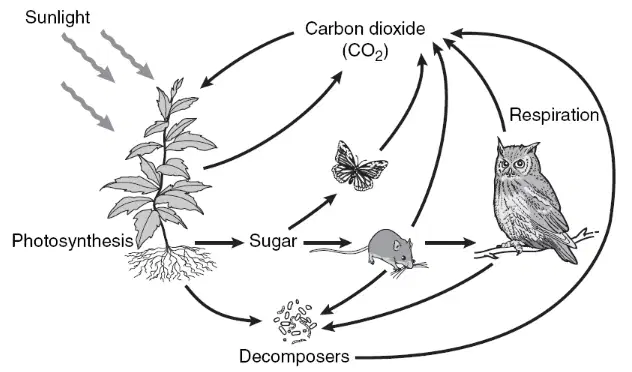
Which organism depicted in the diagram absorbs carbon dioxide from the atmosphere?
butterfly
owl
plant
moose
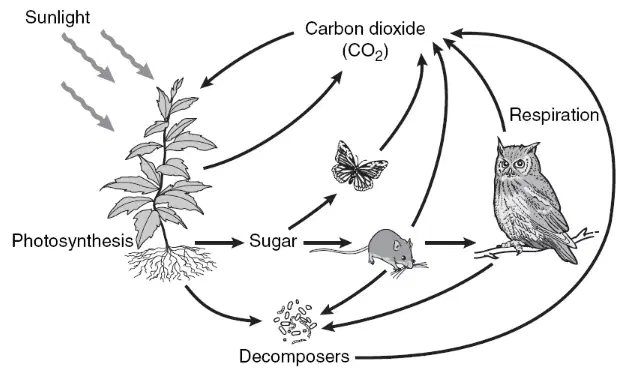
Which of the following changes to this ecosystem would directly cause the greatest amount of carbon dioxide to begin to build up in the atmosphere?
Hunters cause the owl population to rapidly decline.
Widespread herbicide use destroys the plant community.
Harsh weather causes a decline in the butterfly population.
A viral outbreak drastically reduces the mouse population.
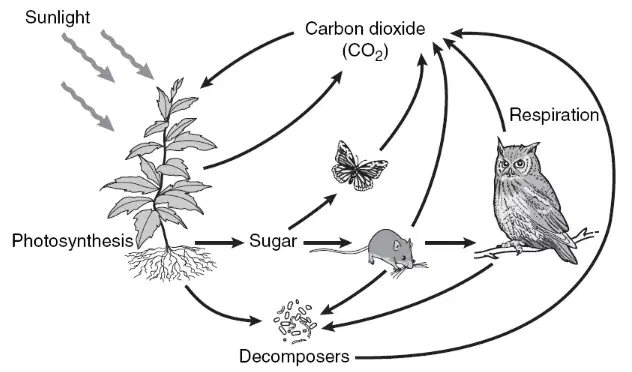
Which pair of organisms from the diagram above has a predator prey relationship?
Plants and Decomposers
Butterflies and Owls
Plants and Butterflies
Mice and Owls
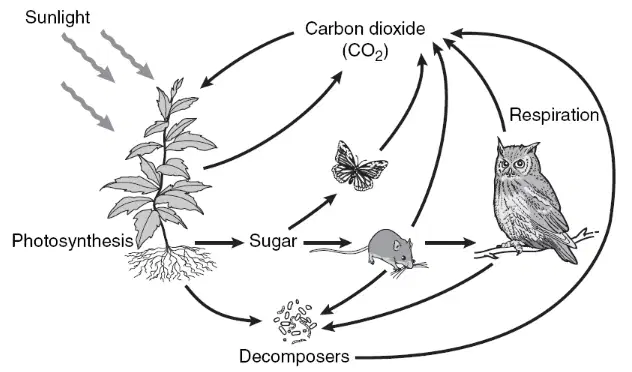
Sugar is a source of chemical energy, and the energy found in sugar was converted/made from -
kinetic energy
mechanical energy
gravitational potential energy
solar energy
What would be a consequence of removing the decomposers from an ecosystem?
Lightning would no longer convert nitrogen gas into ammonia
Plants would begin decomposing organisms instead of performing photosynthesis
Plants would not need to absorb nitrogen from the soil any longer
Nitrogen would remain trapped in the tissues of dead organisms
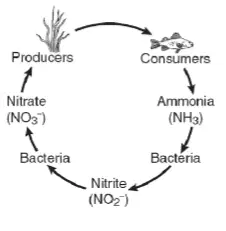
The diagram below depicts the nitrogen cycle in a classroom aquarium. Which of the following would occur if more fish were added to this ecosystem?
The amount of nitrates in the water would increase
The amount of ammonia in the water would decrease
The plants would reproduce more quickly to meet the growing needs of the fish
The bacteria community would decrease in response to the added fish
Identify why weathering is an important part of the phosphorus cycle.
weathering and erosion reverse phosphates into the soil
weathering and erosion convert phosphates into phosphorus gas
weathering and erosion are unimportant in the phosphorus cycle
weathering and erosion expose phosphates to be mined by humans
Which answer choice below lists the Levels of Organization in the correct order of smallest (simplest) to largest (most complex):
1. Atom 2. Molecule 3. Organelle 4. Cell 5. Tissue 6. Organ 7. Organ System 8. Organism 9. Population 10. Community 11. Ecosystem 12. Biosphere
1. Molecule 2. Atom 3. Organelle 4. Cell 5. Tissue 6. Organ 7. Organ System 8. Organism 9. Population 10. Community 11. Ecosystem 12. Biosphere
1. Atom 2. Organelle 3. Molecule 4. Cell 5. Tissue 6. Organ 7. Organ System 8. Organism 9. Population 10. Community 11. Ecosystem 12. Biosphere
1. Atom 2. Molecule 3. Cell 4. Organelle 5. Tissue 6. Organ 7. Organ System 8. Organism 9. Population 10. Community 11. Ecosystem 12. Biosphere
Match the different types of consumers to their definitions.
Herbivore
organisms that eat plants/producers
Carnivore
organisms that eat meat/consumers
Omnivore
organisms that eat both plants/producers & meat/consumers
Decomposer
Organisms that break down dead organisms and absorb nutrients from them.
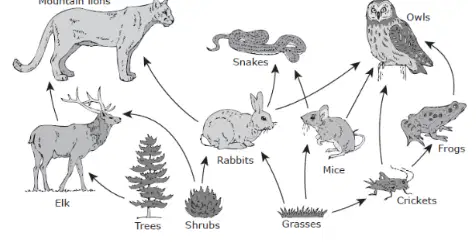
Which statement does NOT describe a relationship shown in the food web? A diagram of a terrestrial food web is shown with mountain lions, owls, snakes, rabbits, mice, frogs, crickets, elk, trees, shrubs, and wild grasses.
A. elk are prey for mountain lion
B. mice are herbivores that consume grasses and are preyed on by snakes
C. rabbits consume shrubs and are parasites of grasses
D. owls prey on rabbits and frogs
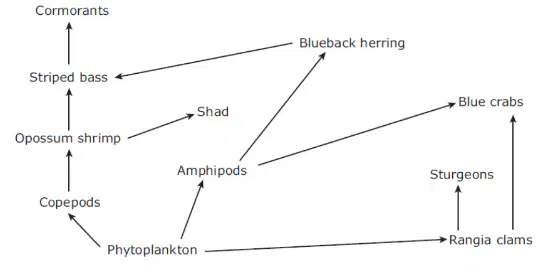
In the aquatic food web below, which two organisms have a predator-prey relationship?
blue crabs & rangia clams
sturgeons & blue crabs
copepods & amphipods
shad & sturgeons
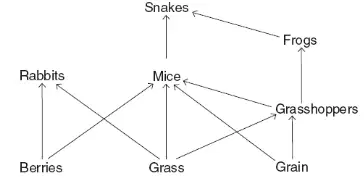
Insecticides are used by a farmer to decrease the grasshopper population in this area. This reduction in the grasshopper population would also cause which set of changes?
the grain population to increase and the frog population to decrease
the grain population to decrease and the frog population to increase
the grain population to decrease and the frog population to decrease
the grain population to increase and the frog population to increase
Match the sphere to its definition:
made up of the parts of Earth where life exists
Biosphere
made up of all the solid earth, including rocks, minerals and landforms
Geosphere
made up of all the gaseous, liquid, and solid water on or near Earth's surface
Hydrosphere
the layer/envelope of gases that surrounds the planet.
Atmosphere
Natural capital is best defined as:
The monetary value of Earth's resources
The total biomass of Earth's organisms
The amount of energy received from the sun
Earth's stock of renewable and non-renewable resources providing essential services
The primary function of Earth's spheres is to:
Generate energy
Create weather
Maintain life support systems
Produce natural resources
Human technological success, such as the development of antibiotics
, is a result of the complex brain which evolved through natural selection. However, the widespread use of antibiotics has led to the rapid evolution of antibiotic-resistant bacteria (genetic resistance).
Considering that humans are a slow-reproducing species, what is the most likely long-term evolutionary consequence of the rapid genetic resistance observed in bacteria?
The technological success of antibiotics completely halts the process of natural selection for both humans and bacteria.
Humans will spontaneously develop a new biological adaptation, such as an improved immune system, to counteract the antibiotic-resistant bacteria.
Human reliance on technology (antibiotics) creates an accelerated selective pressure on bacteria, but the slow rate of human reproduction limits our ability to evolve new biological defenses as quickly as the bacteria can evolve resistance, creating a long-term health crisis.
The rapid evolution of antibiotic-resistant bacteria will eventually slow down once they have evolved resistance to all current antibiotics.
If a sudden, catastrophic environmental change (like a rapid, extreme temperature shift) occurs, which of the following scenarios best predicts the outcome based on the "Pace of Reproduction Limitation" outlined in the slides?
A fast-reproducing species (e.g., bacteria) is less likely to survive because the sheer volume of their population makes them more susceptible to the catastrophic change.
A slow-reproducing species (e.g., elephants) is likely to face extinction because their long generation time means they cannot produce enough offspring with new, advantageous mutations quickly enough for the traits to spread through the population.
A slow-reproducing species (e.g., elephants) is more likely to survive because their long lifespan gives them more time to experience mutations that might lead to an advantageous trait.
A fast-reproducing species (e.g., bacteria) is likely to face extinction because their rapid reproduction means they will quickly deplete available resources before a beneficial trait can arise.
What is the scientific theory of evolution?
The study of ancient Greek and Roman philosophy.
The process by which species genetically change over time from generation to generation.
The rapid change of a single organism's traits over its lifetime.
The sudden appearance of new organisms after a major environmental disaster.
Match the species classifications to its definition...
A species whose decline or removal causes a major collapse in the entire food web and structure of an ecosystem, disproportionate to its own abundance, is known as a:
Indicator species
Keystone species
Foundation species
Native species
What is the main difference between native and nonnative species?
Native species always harm ecosystems, nonnative do not
Native species migrate frequently, nonnative do not
Native species originated in that ecosystem; nonnative were introduced
Native species are predators, nonnative are prey
What is an organism's ecological niche?
The role it plays in its community, including all factors that affect survival and reproduction
The place where it sleeps
The physical space it occupies in the ecosystem
The type of food it prefers
Wolves reintroduced to Yellowstone helped control elk populations, which allowed vegetation to recover. This demonstrates functional diversity because:
Wolves increased genetic variation in elk
Wolves directly improved soil regeneration
Wolves filled a crucial role in the food web that influenced energy flow
Wolves added to ecosystem diversity by creating new habitats
Two populations of frogs live in similar wetlands. Population A has high genetic diversity, while Population B has low genetic diversity. A new fungal disease spreads through both wetlands. Which outcome is most likely?
Population B is more likely to adapt quickly
Both populations will be equally vulnerable
Population B will survive because fewer genes means less mutation
Population A is more likely to have individuals resistant to the disease
Which of the following are the four components of biodiversity? (Select all that apply)
Functional diversity
Species diversity
Genetic diversity
Ecosystem diversity
Habitat diversity
Which of the following best defines biodiversity?
The number of endangered species in a given region
The total amount of biomass in an ecosystem
The variety of life on Earth, including species, genes, ecosystems, and processes
The number of plants in a forest
A region's ecological footprint is calculated to be twice the size of the land available within its borders. What does this reveal about the region's sustainability?
The region is living within its natural income
The region is in ecological overshoot, relying on resources beyond its biocapacity
The region is conserving biodiversity successfully
The region has achieved balance between natural capital and resource use
Which type of interspecific interaction is characterized by one species benefiting while the other species is neither harmed nor helped?
mutualism
predation
commensalism
parasitism
competition
The long-term evolutionary change in which bats develop advanced echolocation to find moths, and in response, some moths develop the ability to jam the bats' sonar, is an example of what process?
natural selection
speciation
resource partitioning
coevolution
Competition between two different species that share an overlapping niche for a limited resource is specifically known as:
intraspecific competition
competitive exclusion
interspecific competition
The process where different species evolve specialized traits that allow them to use the same scarce resources at different times or in different ways, thereby reducing competition, is called:
A) Interspecific competition
B) Competitive Exclusion
C) Resource partitioning
D) Coevolution
Which of the following best describes a difference between a mutualistic relationship and a parasitic relationship?
Parasitism continues for many generations, while mutualism is limited to one generation
Parasitism involves only two organisms, while mutualism involves many organisms
Parasitism benefits only one organism, while mutualism benefits both organisms
Parasitism harms both organisms, while mutualism harms only one organism
In a marine ecosystem, Southern Sea Otters prey on sea urchins, preventing the urchin population from destroying the kelp forests. In this system, the sea otter is considered a(n):
keystone species
parasite
pioneer species
restricted species
The key distinction between Primary Ecological Succession and Secondary Ecological Succession is:
The presence or absence of soil or bottom sediment at the start of the process.
The types and amount of organisms that function as pioneer species.
The complexity of the climax community.
The speed at which the succession occurs.
Which of the following would initiate Primary Ecological Succession?
A) A forest that was recently cleared by a wildfire
B) A heavily polluted stream that has been cleaned up
C) An abandoned agricultural field
D) Bare rock exposed by a retreating glacier
Which term describes the ability of an ecosystem to survive moderate disturbances, often associated with high species diversity?
Ecological Inertia
Limiting Factor
Ecological Resilience
Carrying Capacity
A tropical rain forest typically has high inertia but low resilience. This means it is:
Highly resistant to natural disasters but recovers slowly from a cleared tract.
Slow to establish a mature community but recovers quickly after a fire.
Prone to low-level disturbances but recovers quickly from severe damage.
Resistant to lower levels of change but may reach an ecological tipping point after a large clearing.
Why do grasslands typically have high ecological resilience?
They are able to restore themselves well without secondary succession.
Their vegetation is resistant to lower levels of change.
They have high species diversity, which promotes stability.
Most of their plant matter is stored in underground roots that can survive a fire.
In the traditional view of ecological succession, a community dominated by a few long lived plant species and representing the final stage of succession is called a:
Intermediate community
Pioneer community
Climax community
Sustainable community
Which of the following is an example of a pioneer species in terrestrial primary succession?
Shrubs and shade-tolerant trees like pines
Grasses and perennials
Lichens and small annual plants that can grow on bare rock
Shade-tolerant trees like oak and hickory
A population will increase in size if:
Deaths and emigration exceed births and immigration.
The death rate is greater than the birth rate.
Births plus immigration exceed deaths and emigration.
The carrying capacity is temporarily exceeded.
What term is defined as the maximum population of a given species that a particular habitat can sustain indefinitely?
Range of tolerance
Carrying capacity
Environmental resistance
Exponential growth
A factor that limits population growth regardless of the population's density, such as a large wildfire or a severe hurricane, is classified as a:
Logistic growth factor
Environmental resistance factor
Density dependent factor
Density independent factor
A population that temporarily exceeds the carrying capacity of its environment and then experiences a sharp decline in population size is undergoing a(n):
Population crash (or dieback)
Restricted boom
Logistic growth plateau
Exponential growth phase
Species that have a capacity for a high rate of population increase, a short life span, and produce many small offspring with little to no parental care are categorized as:
r-selected species
K-selected species
Type I survivorship species
Generalist species
Which curve best illustrates logistic growth as a population size is limited by factors like competition and disease?
J-shaped curve
S-shaped curve
Rapid growth pyramid
Negative growth curve
A population of fish, which typically produces a large number of offspring, most of which die at a young age, would be represented by which type of survivorship curve?
Type II (Constant loss)
Type III (Early loss)
Type I (Late loss)
Deserts are always hot places
True
False
Human population growth can lead to increases in species extinctions by reducing the habitat available for many species.
True
False
Nonnative species tend to thrive in new ecosystems because they lack natural predators.
True
False
Habitat fragmentation reduces the threat of extinction because it allows a species' populations to spread out over a wide area.
True
False
On average, San Diego, California, has milder winters and cooler summers than Dallas, Texas. This is an example of a difference in climate.
True
False
Many inland wetlands have been drained or filled to grow crops or have been covered with concrete, asphalt, and buildings.
True
False
The loss of orangutans from tropical rain forests would have few impacts on other species in those ecosystems.
True
False
The Endangered Species Act only offers protection for species located within United States boundaries.
True
False
Tropical regions normally receive more precipitation than other areas of Earth because the intense input of solar radiation leads to greatly increased evaporation of moisture.
true
false
In terms of biodiversity, coral reefs are the marine equivalents to tropical rain forests
true
false
How do commercial farms impact wild endangered species?
They help endangered species by reintroducing farm-raised individuals of such species to the wild.
They help wild endangered species by selling farm-raised individuals of such species to reduce overharvesting.
They hurt wild endangered species by overharvesting such species for commercial sale.
They help wild endangered species by raising alternative species that can be harvested instead.
They hurt wild endangered species by offering hunting experiences that encourage overexploitation.
Which of the following is a measure of climate?
the average amount of rainfall in Phoenix, Arizona, over the past month
the average amount of rainfall in Phoenix, Arizona, over the past 3 decades
the total amount of rainfall in Phoenix, Arizona, in the past year
the total amount of rainfall in Phoenix, Arizona, over the past month
the total amount of rainfall in Phoenix, Arizona, over the past 3 decades
Most photosynthesis in the open sea occurs in the ____.
bathyal zone
abyssal zone
coastal zone
benthic zone
euphotic zone
When the algae in coral reefs die off due to environmental stresses the coral subsequently dies because of lack of food. This process is referred to as ____.
parasitism
coral bleaching
algal blooming
erosion
ocean acidification
According to the IUCN, most of the endangered bird species on its Red List have declined primarily due to which human-related factor?
overhunting
pollution
exotic pet trade
invasive species
pesticide use
The greatest threat to most species is ____.
invasive species
loss of habitat
water pollution
climate change
overhunting
An endangered species is best described as any species that ____.
is in danger of becoming rare
has fewer than two individuals remaining
is considered economically important
may eventually become threatened
will soon become extinct in all or part of its range
The rain shadow effect refers to _____.
more sunlight on the windward side of mountain ranges
more sunlight on the leeward (facing away from the wind) side of mountain ranges
more sunlight on the windward side of cloud systems
drier conditions on the windward side of mountain ranges
drier conditions on the leeward (facing away from the wind) side of mountain ranges
The process whereby a chemical pollutant becomes more concentrated as it moves up each trophic level in a food chain or web is called _____.
fragmentation
biomagnification
overexploitation
speciation
bioaccumulation
Ocean acidification is occurring because _____.
of agricultural runoff into rivers
the ocean absorbs about 25% of the carbon dioxide emitted into the atmosphere by human activities
water changes pH as it warms
overfishing is changing the structure of ecosystems, harming the plankton that regulate the pH of ocean water
acid rain has worsened over the last two decades
Extinction rates began rising above the natural background rate after _____.
Earth’s first recorded ice age
the end of the last mass extinction
the appearance of modern humans
the global climate started to change
the end of the twentieth century
What does the term HIPPCO help describe?
an approach to increasing captive-bred populations
an international treaty meant to protect endangered species
human activities that threaten wild species
the impacts of a sixth mass extinction
the process by which nonnative species become invasive
The Convention on Biological Diversity is a landmark law because it focuses on ___
prosecution of indigenous peoples
enforcement of severe financial penalties
species of importance to the United States
protection of entire ecosystems
international cooperation
The main purpose of the Endangered Species Act is to ___
identify and protect lands important to endangered species in the United States
identify and protect endangered species in the United States and abroad
emphasize the protection of biological diversity and ecosystem functioning
develop more effective recovery plans for species that are endangered
prevent species in the United States from becoming endangered
How many mass extinctions has Earth experienced throughout its history?
six
five
none
one
hundreds
At least half of the known species of terrestrial plants and animals are found ____.
in both temperate and tropical rain forests
only in tropical rain forests
only in temperate grasslands
only in temperate rain forests
in both temperate and tropical grasslands
Aquatic life zones include ____.
A) saltwater and brackish bodies of water only
B) freshwater, saltwater, and brackish bodies of water
C) freshwater bodies of water only
D) saltwater bodies of water only
E) freshwater and brackish bodies of water only
Eutrophication involves the ____.
filtration of toxic wastes and pollutants by wetlands
organization of deep lakes into distinct zones of life
seasonal flooding of lowland areas
deposition of sediment at the mount of a river
natural process in which lakes gain nutrients over time
Scientists predict one-quarter to one-half of all land plants and animals could become extinct by the end of this century due to ____.
illegal trade
climate change
human population growth
overharvesting
habitat loss
Much of which biome has disappeared from Earth because it has been converted to farm land for growing crops and grazing cattle?
cold grassland
temperate grassland
temperate forest
tropical grassland
cold desert
Colony collapse disorder causes honeybees to ____.
stop living together in groups
stop reproducing
stop making honey
abandon their hives
become more aggressive
Bioaccumulation refers to the ____.
increase in species diversity in areas that have been protected
data collection about DNA in captive populations of endangered species
ability of a chemical to build up in an organism’s tissues
ability of an animal to adapt to pollutants in its environment
buildup of pesticides in soil and water supplies
A bioprospector is someone who ____.
collects animals from the wild for captive breeding programs
searches for plant and animal sources for medicinal drugs
studies the ways in which humans exploit plants and animals
works as a biologist and medical doctor for private industry
searches for plants that can be used as biofuels
When a region is identified as a wilderness area, it is off-limits to all human activities.
True
False
The first step in sustaining terrestrial biodiversity is to create an inventory of the species contained in an ecosystem, so scientists can get a baseline reading of which species the ecosystem contains.
True
False
Removing dams and allowing rivers to flow freely can help restore biodiversity.
True
False
A debt-for-nature swap can allow a country to better protect its forests and other ecosystems.
True
False
A tree plantation, also called a tree farm or commercial forest, is a managed forest that contains a large variety of tree species of different ages.
True
False
Overfishing is an example of the tragedy of the commons.
True
False
Grazing must always be kept to a minimum because rangeland grasses cannot be grazed again and again.
True
False
________________ can place stress on U.S. national parks, as was demonstrated by the case of gray wolves in Yellowstone National Park.
Introduction of nonnative species
Lack of species biodiversity
Overhunting of species
Exploding populations of certain species
Disturbance of wildlife by humans
The National Park Service reports that the effects of _____ ruin scenic views more than 90% of the time in many of its parks.
soil erosion
logging
air pollution
forest fires
recreational vehicle use
A certain lake in the arid west contains an endangered species of fish. The legal status of this fish required water diversions out of the river feeding the lake to be decreased substantially. About 10 years following this decree, the declining cottonwood forest and canopy along the riverbanks was noted to be recovering. This situation illustrates the potential effectiveness of ___________________.
the species approach to sustaining biodiversity
the ecosystem approach to sustaining biodiversity
identifying biodiversity hotspots for aquatic biodiversity
using reconciliation ecology to sustain biodiversity
identifying life raft ecosystems to sustain biodiversity
The National Wilderness Preservation System ____.
has the support of most resource extractors
mainly includes protected wilderness in Alaska
is a worldwide network of protected reserves
prohibits humans from entering wilderness areas
includes lands that are managed for forestry
Which of the following is an example of reconciliation ecology?
forgiving a country’s debt so it can invest in conservation
planting prairie grass along railroad tracks
allowing people to use national parks
setting aside land as a wilderness area
paying farmers for crops damaged by wildlife
One reason protecting marine biodiversity is difficult is that _____.
damage to oceans and other bodies of water is generally not visible
species in marine ecosystems can migrate beyond protected areas
marine ecosystems are basically inexhaustible resources
scientists find it difficult to identify which protections work best
most of the world’s ocean area lies within the legal jurisdiction of various countries
Ocean acidification leads to _____.
dead zones in areas where rivers flow into oceans
reduced levels of dissolved carbon dioxide in ocean waters
rising temperatures across the world’s oceans
overstimulation of coral reef production
poor shell formation in some aquatic species
A buffer zone is ____.
a strictly protected inner core of land
a protected zone reserved for endangered species
a protected area established between urban areas
an outer core where people can extract resources
an inner core where human activities are allowed
Which aquatic ecosystems have been identified as being most in need of restoration according to the ecosystem approach to sustaining aquatic biodiversity?
wetlands
lakes and rivers
coastal ocean waters
deep ocean waters
bays and estuaries
One characteristic of biodiversity hotspots is that they _____.
have not suffered ecological disruption
are rich in endangered species found nowhere else
have lost less than 30% of their original habitat
are remote enough to be protected from human activity
ed through government funding and laws
One change in land use that has negatively impacted grasslands in the southwestern United States is ____.
introduction of new species of livestock
expansion of riparian zones
increased rotational grazing
planting of tree farms
real estate development
Livestock graze on nearly _______________ of the world’s grasslands.
one-tenth
one-quarter
one-third
one-half
three-quarters
The establishment of tree farms _____.
has resulted in less forest cover in the United States
increases the amount of biodiversity in forest ecosystems
involves a single cycle of planting, growing, and harvesting trees
can help protect old-growth forests by providing trees for harvesting
creates protected forests that are managed to limit human impacts
____________ involves turning a degraded ecosystem into a functional or useful ecosystem without trying to restore it to its original condition.
replacement
restoration
reintroduction
rehabilitation
artificial construction
____________ involves turning a degraded ecosystem into a functional or useful ecosystem without trying to restore it to its original condition.
act as custodians of protected lands in return for foreign aid or debt relief
take out loans to finance the establishment of nature preserves
sell nature preserves to industries to pay off debts
invest in environmentally friendly companies
repay debts with raw natural resources rather than currency
A crown fire is _____.
most common in forests that frequently experience fires
a carefully planned and control fire set by forest managers
limited to the tree canopy and rarely becomes widespread
an extremely hot fire that burns whole trees and kills wildlife
usually limited to the ground and does not threaten human safety
In the United States, most tree-free paper is made from _____.
rice
kenaf
hemp
straw
corn
Focusing on establishing and maintaining new habitats to conserve species diversity in places where people live, work, or play in order to share such ecosystems with other species is called _____ ecology.
life raft
urban
reintroduction
reconciliation
terrestrial
Focusing on establishing and maintaining new habitats to conserve species diversity in places where people live, work, or play in order to share such ecosystems with other species is called _____ ecology.
primary forests
commercial forests
tree farms
plantations
second-growth forest
When strip cutting is used as a method to harvest timber, _____.
one tree is selected to be cut down at a time
tree harvest is limited to one narrow corridor at a time
it results in wholesale removal of trees from a given area
logging roads do not need to be constructed to access trees
it creates the most damage of all timber harvest methods
Studies have suggested humans degrade or overuse _____ of the ecosystem services provided by various ecosystems worldwide.
15%
30%
60%
75%
90%
Rangelands and pastures are both _____.
unfenced
fenced in
riparian zones
grasslands
seldom used

