Worksheets
Ch 18 & 19: Volcanoes and Earthquakes
Total questions: 152
Worksheet time: 1hrs 23mins
A quiet eruption produces what type of dangerous hazard?
lava flow
lahar
pyroclastic flows
lave domes

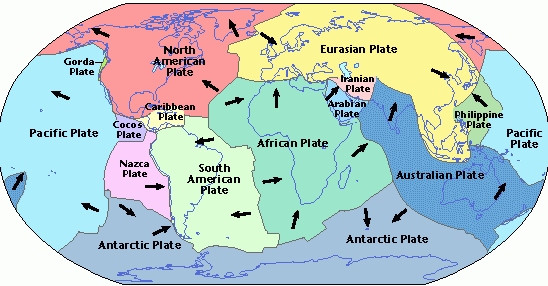
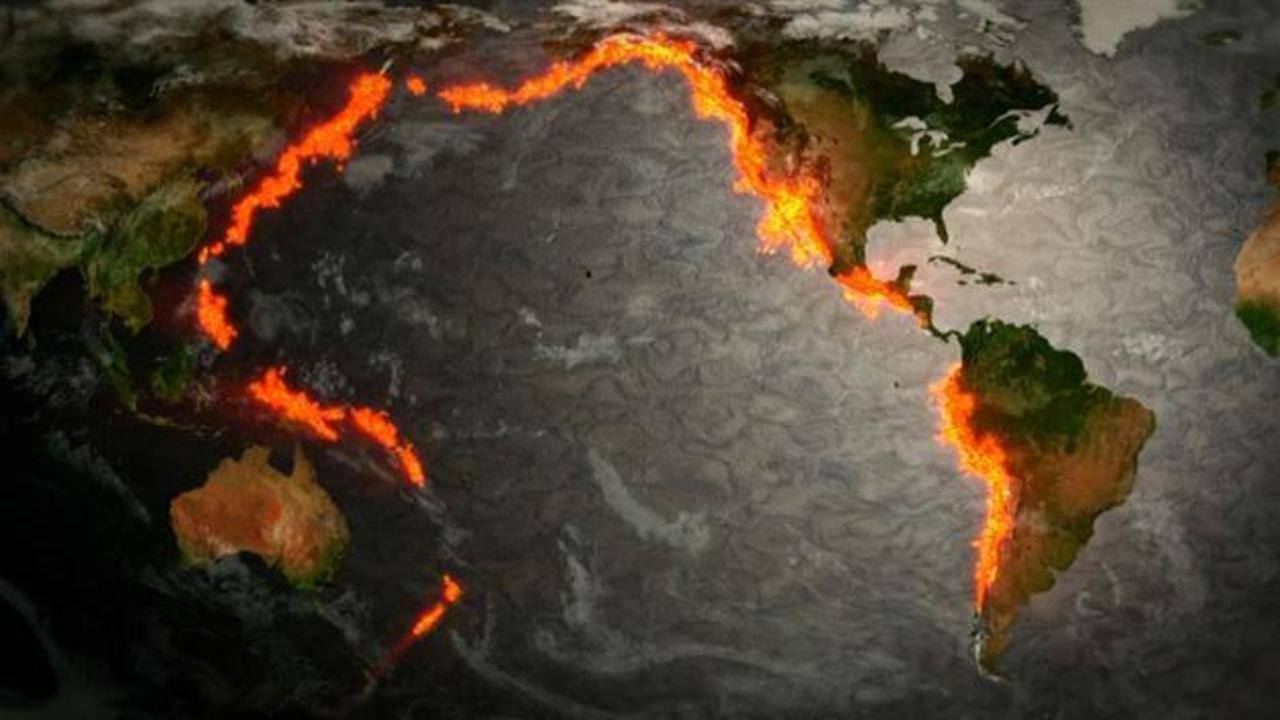
Where do most volcanoes form?
Middle of tectonic plates
Plate boundaries and along edges of continents
Antactica
Middle of continents

The Hawaiian islands are formed by
subduction
earthquakes
hot spots
divergent plates

Volcanoes that have both lava flows and pyroclastic flows are called
composite volcano
cinder cone volcano
shield volcano
that really big volcano over yonder

The opening of a volcano labeled "A" is called what?
Neck
Conduit
Vent
Magma
The connecting pipe between the magma chamber and the vent labeled "C" is called what?
Neck
pyroclastic flow
lava
side vent
The place where all the lava comes from labeled "D" is called the?
Neck
magma chamber
lava
side vent
The location where a volcano erupts but it is not its main exiting point labeled "F" is called
Neck
magma chamber
vent
side vent
A huge crater caused by the collapsing of a magma chamber is called a _______.
crater
vent
caldera
shield volcano

A large, flat volcano that produces quiet eruptions is called a
shield volcano
composite volcano
cinder cone volcano
super volcano

Nonviscous lava that is very runny but very hot is called
pahoehoe
AA
pyroclastic flows
lava

Viscous Lava that produces slowly moving blocks because it has a lot of silica is called
pahoehoe
AA
lava
pyroclastic flow
A stratovolcano is also known as a _______.
Composite volcano
cinder cone volcano
shield volcano
that small volcano over there

A volcano that produces large pyroclastic flows only is called a
cinder cone volcano
composite volcano
shield volcano

A large cloud of hot ash, cinders, blocks, etc. that travels very fast is called
pahoehoe
AA
pyroclastic flow
dust storm
Viscosity of magma is determined by
magma composition/silica
magma temperature
amount of dissolved gases
all of these
If the silica in the magma goes up, then the viscosity of the magma goes
up
down
stays the same
none of these
If the viscosity of magma goes up, then the eruption is
more violent
less violent
stays the same
none of these

This gas is responsible for the rotten egg smell that you smell around volcanoes and hot springs.
carbon dioxide
dihydrogen oxide
sulfur dioxide
carbon monoxide

What volcanic feature happens when magma cuts through rock vertically?
Sill
Laccolith
Volcanic Dike
Batholith

What volcanic feature happens when magma cuts across sedimentary rock horizontally?
Volcanic Dike
Sill
Pluton
batholith

This is most likely a__________volcano because it has gradual sloping sides.


What type of volcano is shown above?
Strato
Cinder Cone
Shield
Composite


Openings in the Earth's crust through which molten rock flows to the surface, usually forming mountains, are called __________.
volcanoes
earthquakes
faults
magma

The major belt of volcanoes and tectonic activity that surrounds much of the Pacific Ocean:
Ring of Fire
Ring of Asia
Ring o' earthquakes
Ring a ding ding

What is molten rock that has reached the Earth's surface called?
Aa
Lava
Magma
Pahoehoe

What factor(s) determine(s) whether an eruption will be explosive?
Only the amount of gases in the magma
Only the day of the week the eruption happens on
Both the amount of gas and silica in the magma
None of these affect the explosiveness of the volcano

Vocanoes are found...
on land
under water
on islands
all of the above
A live volcano is called a/an:
Dormant volcano
Active volcano
Extinct volcano
Shield volcano
What type of volcano has large, fairly steep slopes made of alternating layers of ash and silica rich lava?
Caldera
Cinder Cone
Composite Volcano
Shield Volcano

This city was destroyed in 79 A.D. by the eruption of Mt. Vesuvius.
Paris
Gagetown
Pompeii
Naples


Rank the volcanic stages from LEAST likely to MOST likely to erupt.
active, dormant, extinct
extinct, dormant, active
dormant, extinct, active
dormant, active, extinct
What tool helps a volocanologist to monitor seismic activity?
Radar
GPS
Thermometer
Seismograph

Lava that is very thin and runny, or has low viscosity, probably
has low silica content
is high in silica

A bowl shaped area that may form at the top of a volcano around the central vent
crater
vent
tube
leftovers
Volcanoes form in different ways and release different types of lava. There are two main types of volcanoes. Shield volcanoes form when thin, runny lava is released. This magma does not contain a lot of gas, so it has less energy. Because of this, it releases relatively gently and lava flows far down the sides of the volcano before cooling. Shield volcanoes are wide and flat, resembling a shield of armor. Composite volcanoes are formed by magma that contains a lot of gas. The thick magma builds up an enormous amount of pressure, causing an explosive eruption. Lava from a composite volcano cools quickly and doesn’t flow very far. As a result, lava piles up and creates mountainous slopes. A composite volcano is most likely what you imagine when you think of a volcano.
Which of the following best describes the relationship between gas and volcanic eruptions?
The more gas magma contains, the more explosive a volcanic eruption will be.
The presence of gas in magma decreases the likelihood of a volcanic eruption.
As gas builds up in magma, volcanic eruptions occur once in the magma chamber and once above ground.
Gas found in magma determines only the intensity of eruptions involving composite volcanoes and not shield volcanoes.
Volcanoes usually occur at fault lines. Fault lines are where tectonic plates push together, pull apart and slide past each other. The energy created here forms volcanoes and causes eruptions. This isn’t the only way volcanoes form though. Some volcanoes, like those found in Hawaii, occur over hot spots. Hot spots are portions of the mantle at which the temperature is abnormally high. These high temperatures cause magma to rise and break through Earth’s crust. This type of volcano often forms a seamount. A seamount is an undersea mountain that becomes an island if it surpasses sea level. While a seamount is over a hot spot, it remains volcanically active. But over the course of millions of years, as tectonic plates shift and the seamount moves, the volcano eventually becomes extinct.
When is a seamount volcanically active?
while it is over a hot spot
when it surpasses sea level
when it occurs at a fault line
when tectonic plates move it
Volcanoes can be categorized as active, dormant or extinct. Although definitions vary from scientist to scientist, a volcano is considered active if it has erupted recently or erupts regularly. A dormant volcano refers to a volcano that has not erupted recently, but will likely erupt again. An extinct volcano is a volcano that will never erupt again because its magma supply has been cut off. One point of disagreement between scientists is their definition of “recently.” For some, it means within the last 10,000 years. For others, much shorter. The line between active, dormant and extinct volcanoes can be blurry. In some rare cases, volcanoes long thought to be extinct have unexpectedly come back to “life.”
Which of the following would most likely be classified as an active volcano?
a mountain that shows no history of eruption
a volcano that has erupted twice in the past 350 years
a volcano that is now an island with a population of 200,000
a volcano that erupted 12,000 years ago and is still connected to its magma supply
Volcanic eruptions can happen quickly. When an eruption occurs, there isn’t much that can be done to slow its destructive force. Because of this, scientists are continuously working to improve their ability to predict eruptions. Better technology means evacuation warnings can be issued before it’s too late. Earthquakes caused by magma pushing up through the volcano are one indicator of an approaching eruption. Vibrations from these earthquakes can be detected by a device called a seismometer. Another sign a volcano may soon erupt is swelling of the volcano itself. As magma builds up, the magma chamber enlarges and changes the shape of the volcano. These changes can be identified by tilt meters, devices that measure the tilt of a structure. Gas release can also signal an eruption. Although changes in the atmosphere around a volcano tend to be small, scientists have developed devices to detect these minor changes. Predicting eruptions is all about safety. The sooner these indicators can be identified, the more time those who live near volcanoes will have to evacuate.
With which of the following statements would the author of this passage most likely agree?
Volcanic eruptions are impossible to predict and scientists are wasting their time.
Volcanic eruptions are no longer an issue as a result of technological advances.
Scientists have made important progress when it comes to predicting volcanic eruptions.
Scientists should focus only on earthquake detection when it comes to predicting volcanic eruptions.

What type of volcano is this?
Fissure
Shield
Dome
Stratovolcano/ Composite


Repeated floods of molten material can form high, level plateaus called...
prairie plateaus
magma plateaus
lava plateaus
dome plateaus

The destructive mudflow on the slopes of a volcano is called :
aa
Lahar
Lapilli
Pillow Lava

An instrument that simply detects earth waves is a ________________.
seismoscope
seismograph
seismometer
seismotracker
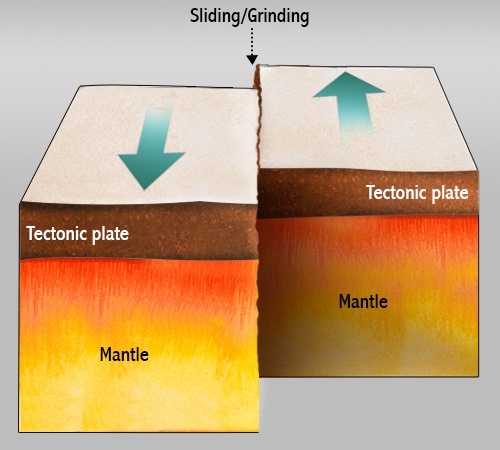
Subduction would most likely be occurring at a ____________ boundary.
convergent
divergent
normal
transform
What is a major difference between a fault and a joint?
Faults are always bigger than joints.
Faults occur on land while joints are found beneath the ocean.
Faults involve visible movement of rocks, but joints do not.
Faults cannot cause earthquakes, but joints can.
The horizontal direction of a fault is its ___________.
strike
stress
dip
slip
The angle that the face of a fault makes with the horizontal is its _________.
strike
stress
dip
slip
Most major faults in the United States are found in ________________.
coastal plains
inland prairies
mountain ranges
southwestern deserts
What is the name of the longest strike-slip fault in southern California?
Los Angeles Fault
New Madrid Fault
San Andreas Fault
San Mateo Fault
Rayleigh waves and Love waves are both examples of ___________.
P waves
S waves
surface waves
tremor waves
Which of the following in not related to locating an earthquake?
overthrust
focus
seismic wave
epicenter
Earthquakes are most common
in the center of continental plates.
in river valleys
at the North and South Poles.
near the edges of tectonic plates.
One quake measures 6.0 on the Richter scale and another measures 7.0. How does the second quake's energy compare with that of the first?
It has slightly more energy.
It does one times more the amount of damage
It is ten times more energetic
It has about thirty-two times more energy.
An impending earthquake
cannot be reliably predicted
can sometimes be sensed by animals
can alter water tables underground
all of the above
An ocean wave caused by an earthquake is called a(n) _____________.
breaker
L wave
tidal wave
tsunami
Waves that do not travel through the earth's interior
P waves
S waves
surface waves
Last waves to arrive at a seismic station
P waves
S waves
surface waves
Second waves to arrive at a seismic station
P waves
S waves
surface waves
Most destructive earth waves
P waves
S waves
surface waves
Strongest and slowest body waves
P waves
S waves
surface waves
First waves to arrive at a seismic station
P waves
S waves
surface waves
Not required to determine an earthquake's epicenter
P waves
S waves
surface waves
Love and Rayleigh waves
P waves
S waves
surface waves
Indicates the energy released during an earthquake
tsunami
landslide
building collapse and fire
Richter Scale
Modified Mercalli Intensity Scale
Earthquake hazard, especially in urban areas
tsunami
landslide
building collapse and fire
Richter Scale
Modified Mercalli Intensity Scale
Earthquake hazard, especially in mountainous areas
tsunami
landslide
building collapse and fire
Richter Scale
Modified Mercalli Intensity Scale
Identifies the destructiveness of an earthquake
tsunami
landslide
building collapse and fire
Richter Scale
Modified Mercalli Intensity Scale
Earthquake hazard, especially in coastal areas
tsunami
landslide
building collapse and fire
Richter Scale
Modified Mercalli Intensity Scale