wayground logo

Free Printable Worksheets

Font size

S
M
L
XL
Worksheets

Unit 2 - Fall 2022

Total questions: 150

Worksheet time: 1hrs 28mins

Name
Class
Date
1.
In physical changes, substances might change in __________ but not in __________.
a)
appearance, composition
b)
volume, state of matter
c)
texture, color
d)
weight, mass
2.
True or False: a physical change may produce a new substance.
a)
True
b)
False
3.
Which of the following is an example of a physical change?
a)
sugar and oxygen reacting to produce water and carbon dioxide
b)
honey dissolving in tea
c)
a raw egg being cooked
d)
metal rusting after being left out in the rain
4.
A physical change can sometimes result in a color change. Which of the following situations show this?
a)
Milk turns yellow when it spoils.
b)
Dough becomes darker when it is baked into cake.
c)
A red candy dissolves and turns water pink.
d)
A match turns black when it is burned.
5.
A copper penny turning greenish after a few years is an example of ...
a)
Chemical Change
b)
Physical Change
6.
A change in which NEW substances are formed.
a)
Chemical change
b)
Physical change
c)
Casual change
d)
Formal change
7.
Bubbles form when two or more substances are combined ...
a)
Chemical Change
b)
Physical Change
8.
An explosion occurs ...
a)
Chemical Change
b)
Physical Change
9.
A change in the size, shape, or state of matter.
a)

Chemical Change

b)

Physical Change

10.

Choose the best description below for the image

a)

Physical Change

b)

Chemical Change

11.

Choose the best description below for the image

a)

Physical Change

b)

Chemical Change

12.

Cooking an egg

a)

Chemical Change

b)

Physical Change

13.

Melting Chocolate

a)

Chemical Change

b)

Physical Change

14.

Evaporating Water

a)

Chemical Change

b)

Physical Change

15.

Breaking a glass

a)

Chemical Chang

b)

Physical Change

16.

Burning wood

a)

Chemical Change

b)

Physical Change

17.

Bike rusting

a)

Chemical Change

b)

Physical Change

18.

Crumpling tin foil

a)

Chemical Change

b)

Physical Change

19.

Baking a cake

a)

Chemical Change

b)

Physical Change

20.

Boiling water

a)

Chemical Change

b)

Physical Change

21.
Baking soda and vinegar combine to make carbon dioxide
a)
Chemical Change
b)
Physical Change
22.

Which of the following are examples of a Chemical Change?

a)

Iron Rusting

b)

Gas Burning

c)

Breaking a glass

d)

Boiling water

e)

Burning Wood

23.
Sugar dissolves in water
a)
Chemical Change
b)
Physical Change
24.

The change of one state of matter to another is called

a)

Osmosis

b)

Phase Change

c)

Matter

d)

Energy

25.

Transition from a solid to a liquid

a)

Condensation

b)

Melting

c)

Freezing

d)

Evaporation

26.

Transition from a liquid to a gas

a)

Condensation

b)

Freezing

c)

Evaporation

d)

Melting

27.

Transition from a liquid to a solid

a)

Freezing

b)

Sublimation

c)

Melting

d)

Evaporation

28.

Change of a solid directly into a gas

a)

Deposition

b)

Melting

c)

Sublimation

d)

Freezing

29.

Change of a gas directly into a solid

a)

Sublimation

b)

Condensation

c)

Evaporation

d)

Deposition

30.

The temperature at which a substance changes state from liquid to a solid...

a)

Density

b)

Freezing point

c)

Mass

d)

Melting point

31.

Anything that has mass and takes up space is

a)

mass

b)

matter

c)

volume

d)

physical property

32.

What are the three states of matter?

a)

color, shape and size

b)

magnetism, sink and float

c)

solid, liquid and gas

d)

volume, shape, color

33.

What did Bohr's atomic theory model look like?

a)

A ring with gold foil in the middle.

b)

Electrons orbiting the nucleus like the planets around the sun.

c)

A cloud of electrons floating around the nucleus.

d)

A scoop of chocolate chip ice cream. It had electrons scattered within a ball of positive charge.

34.

The cloud model is what we use for the atomic theory now. What does the cloud model look like?

a)

A ring with gold foil in the middle.

b)

Electrons orbiting the nucleus like the planets around the sun.

c)

A cloud of electrons floating around the nucleus.

d)

A scoop of chocolate chip ice cream. It had electrons scattered within a ball of positive charge.

35.

What is a positively charged particle?

a)

neutron

b)

electron

c)

proton

d)

atom

36.

What is a negatively charged particle?

a)

neutron

b)

electron

c)

proton

d)

atom

37.

What is a particle with no charge?

a)

neutron

b)

electron

c)

proton

d)

atom

38.

What is the mass of a proton?

a)

1840 amus

b)

1 amu

c)

1/1840 amus

d)

It has no mass.

39.

What is the mass of an electron?

a)

1840 amus

b)

1 amu

c)

1/1840 amus

d)

It has no mass.

40.

What is the mass of a neutron?

a)

1840 amus

b)

1 amu

c)

1/1840 amus

d)

It has no mass.

41.

The mass number is the sum of what two parts of an atom?

a)

proton and neutron

b)

proton and electron

c)

electron and netron

d)

none of the above

42.

The smallest particle which retains the properties of an element.

a)

molecule

b)

atom

c)

electron

d)

neutron

43.

The center of an atom is the

a)

proton

b)

neutron

c)

nucleus

d)

electron

44.

_________ is a way of listing the elements

a)

dictionary

b)

Google forms

c)

Periodic Table of Elements

d)

Elementary School

45.

If an element has 6 protons, how many electrons does it have if the atom is neutrally charged?

a)

6

b)

4

c)

2

d)

1

46.

Which element has the least amount of protons?

a)

Oxygen

b)

Hydrogen

c)

Boron

d)

Chromium

47.

How many neutrons does Nitrogen have?

a)

14

b)

7

c)

21

d)

2

48.

What is the atomic mass of an atom with 32 protons and 31 neutrons?

a)

31

b)

32

c)

62

d)

63

49.

How many neutrons are there for an atom with a mass of 20 and 11 protons?

a)

9

b)

11

c)

20

d)

31

50.

How many protons are there for an atom with 16 neutrons and atomic mass of 33?

a)

16

b)

17

c)

18

d)

33

51.

Element number 22 (atomic number 22) has how many protons?

a)

22

b)

25

c)

47

d)

69

52.

What is the atomic mass of element 5 if it has 6 neutrons?

a)

5

b)

6

c)

11

d)

30

53.

How many neutrons does element 11 have if it has an atomic mass of 21?

a)

10

b)

11

c)

12

d)

32

54.
An atom is electrically neutral when
a)
protons and neutrons are the same
b)
protons and electrons are the same
c)
neutrons and electrons are the same
55.

How many neutrons does this isotope of lithium have?
a)
8
b)
3
c)
5
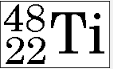
56.
How many protons does this isotope of titanium have?
a)
48
b)
22
c)
26
57.

Isotopes of an element have a different number of...

a)

Protons

b)

Neutrons

c)

Electrons

58.

Using the picture from a periodic table, what is the Atomic Number?

a)

26

b)

Fe

c)

55.845

d)

56

59.

Using the picture from a periodic table, what is the Mass Number?

a)

26

b)

Fe

c)

55.845

60.

Using the picture from a periodic table, how many NEUTRONS are in Iron?

a)

26

b)

30

c)

55.845

d)

82

61.

What is a positive ion called?

a)

anion

b)

cation

c)

isotope

d)

covalent

62.

What is a negative ion called?

a)

anion

b)

cation

c)

covalent

d)

isotope

63.

If an atom gains electrons, the charge will be positive.

a)

true

b)

false

64.

If an atom loses electrons, it becomes a negative ion.

a)

True

b)

False

65.

Which particles change the charge in atoms when ions are formed?

a)

Protons

b)

Electrons

c)

Neutrons

66.

An atom becomes _________ when it gains electrons.

a)

Positive

b)

Negative

c)

Neutral

67.

An atom becomes _______ when it loses electrons.

a)

Positive

b)

Negative

c)

Neutral

68.
What is the charge of an atom that has lost one electron?
a)
-1
b)
-2
c)
+1
d)
+2
69.
What is the charge of an atom that has gained one electron?
a)
-1
b)
-2
c)
+1
d)
+2
70.
Valence electrons are: 
a)
Electrons farthest away from the nucleus
b)
Electrons closest to the nucleus
c)
Electrons that just come and go - they don't stay with the atom
71.

Na ionizes to a charge of _______

a)

+1

b)

+2

c)

-1

d)

-2

72.

Be ionizes to a charge of ________.

a)

+1

b)

+2

c)

-1

d)

-2

73.

Ca ionizes to a charge of _______.

a)

+1

b)

+2

c)

-1

d)

-2

74.

Al ionizes to a charge of _______.

a)

+3

b)

-3

c)

+2

d)

-2

75.

N ionizes to a charge of _______.

a)

+3

b)

-3

c)

+2

d)

-2

76.

S ionizes to a charge of _______.

a)

-2

b)

-1

c)

+1

d)

+2

77.

F ionizes to a charge of ________.

a)

-2

b)

-1

c)

+1

d)

+2

78.

Cl ionizes to a charge of _________.

a)

-2

b)

-1

c)

+1

d)

+2

79.

What element has this orbital notation?

a)

lithium

b)

beryllium

c)

boron

d)

carbon

80.

What element has this electron configuration?

a)

helium

b)

lithium

c)

beryllium

d)

boron

81.

Which element is represented by this orbital notation?

a)

carbon

b)

nitrogen

c)

oxygen

d)

fluorine

82.

Which element is represented by this orbital notation?

a)

neon

b)

sodium

c)

magnesium

d)

aluminum

83.

Which of the following is the electron configuration for Fluorine

a)
b)
c)
d)
84.

Which of the following is the electron configuration for neon?

a)
b)
c)
d)
85.
How many electrons can the first energy level hold?
a)
1
b)
2
c)
8
d)
0
86.
 The diagram above represents two electrons with 
a)
a. opposite spins.
b)
 b. the same spin.
c)
c. different energies.
d)
d. different energy levels.
87.
What is the correct noble-gas notation for the electron configuration of an atom of chlorine? 
a)
a. [Ar]3s2 3p5
b)
 b. [Ne]3s2 3p4
c)
 c. [Ar]3s2 3p4
d)
 d. [Ne]3s2 3p5
88.
How many electrons can the d sublevel hold?
a)
14
b)
10
c)
2
d)
6
89.

How many electrons can the p sublevel hold?

a)

14

b)

10

c)

2

d)

6

90.
Identify this atom: 
a)
Lithium
b)
Chlorine
c)
Phosphorus 
d)
Fluorine
91.

Which are the four atomic orbitals?

a)

s,p,d,f

b)

a,b,c,d

c)

s,t,e,p

d)

d,r,o,f

92.

What is the electron configuration for gold (Fe) element 26?

a)

1s2 2s2 2p6 3s2 3p6 4s2 3d6

b)

1s1

c)

1s2 2s1

d)

1s2 2s2 2p6 3s2 3p6 4s2 3d10 4p5

93.

The electron configuration of an atom is 1s22s22p61s^22s^22p^6 The number of electrons in the atom is 

a)

3

b)

5

c)

6

d)

10

94.

The valence electron of elements in group 1 =

a)

11

b)

3

c)

5

d)

1

95.
Which periodic group has the smallest atomic radius?
a)
Alkali metals
b)
Halogens
c)
Noble Gases
d)
Transition metals
96.
Which statement correctly and completely identifies a trend?
a)
Atomic radius decreases across a period and increases down a group.
b)
Electronegativity decreases across a period and decreases down a group.
c)
Ionization energy increases across a period and increases down a group.
d)
Ionic radius increases across a period and increases down a group.
97.
Ionization energy is...
a)
the energy required to add an electron to a specific atom
b)
how much energy it takes to remove an electron from an atom
c)
the energy required to shield the outer electrons from the nucleus
d)
a measure of the ability of an atom to attract electrons
98.
Electronegativity is...
a)
how good an atom is at attracting electrons
b)
the ability of an atom to lose electrons
c)
the energy required to remove an electron from a specific atom
d)
how easy it is to make friends. 
99.
As you move across the periodic table atoms tend to get smaller because, ______________.
a)
the atoms have more mass.
b)
the atoms have less mass
c)
the atoms have more protons.
d)
the atoms have less electrons.
100.
Which has the greater EN: 
Cl or Al?
a)
Cl
b)
Al
101.
Which has the greater EN: 
N or C?
a)
C
b)
N
102.
Which of the following will have a larger radius than Zinc?
a)
Gallium
b)
Aluminum
c)
Magnesium
d)
Strontium
103.

What property is being measured in this diagram?

a)

Density

b)

Ionization Energy

c)

Atomic Radius

d)

Atomic Mass

104.
The atom with the largest atomic radius in Period 4 (row 4) is - 
a)
K
b)
Kr
c)
Fe
d)
Fe
105.
Francium (Fr) has the lowest ionization energy in Group 1 because - 
a)
it has the smallest number of valence electrons
b)
it has the greatest atomic mass
c)
it has the greatest number of protons, so it attracts its electrons the strongest
d)
its 1 valence electron is very far from the nucleus, so little energy is needed to remove it
106.
Families all have similar 
a)
Names
b)
atomic numbers
c)
atomic masses
d)
properties
107.
Each row in a periodic table is called a 
a)
Group
b)
Period
c)
Row
d)
Column
108.
Each column in the periodic table is called a 
a)

Period

b)

Group

c)

Cluster

d)

Unit

109.
In the modern periodic table elements are arranged by:
a)
atomic mass
b)
atomic number
c)
valence electrons
d)
number of isotopes
110.

_________________________ are the horizontal rows on the periodic table while _______________________ are the vertical columns.

a)

periods/ groups(families)

b)

groups(families)/periods

c)

metals/non-metals

d)

non-metals/metals

111.

Which of the following elements is in (period 4 , group 2)

a)

Carbon

b)

Potassium

c)

Calcium

d)

Sodium

112.

Which of the following has similar properties to potassium (K) because they are in the same group(family)

a)

Sodium (Na)

b)

Magnesium (Mg)

c)

Calcium (Ca)

d)

Gold (Au)

113.
Which group of the periodic table is composed of inert (not reactive)  gases?
a)
alkali metals
b)
alkaline earth metals
c)
halogens
d)
noble gases
114.
Elements which are shiny, conduct electricity and heat are called
a)
metal
b)
nonmetal
c)
metalloid
d)
nonexistent
115.
The atoms along the staircase are called 
a)
metals
b)
nonmetals
c)
metalloids
d)
noble gases
116.

Which group does Aluminum belong to?

a)

Group 3

b)

Group 13

c)

Group 6

d)

Group 26

117.

Which period is Oxygen found in?

a)

Period 1

b)

Period 2

c)

Period 3

d)

Group 16

118.

Which element is found in Period 4, Group 8?

a)

Iron

b)

Oxygen

c)

Nickel

d)

Silver

119.

What is the ATOMIC NUMBER of the element found in Period 4, Group 1?

a)

41

b)

4

c)

1

d)

19

120.

Element 1 is located on which section of the periodic table?

a)

Metal

b)

Nonmetal

c)

Metalloid

121.

Element 2 is located on which section of the periodic table?

a)

Metal

b)

Nonmetal

c)

Metalloid

122.

Element 4 is located on which section of the periodic table?

a)

Metal

b)

Nonmetal

c)

Metalloid

123.

Element 5 is located on which section of the periodic table?

a)

Metal

b)

Nonmetal

c)

Metalloid

124.

Element 6 is located on which section of the periodic table?

a)

Metal

b)

Nonmetal

c)

Metalloid

125.

Element 7 is located on which section of the periodic table?

a)

Metal

b)

Nonmetal

c)

Metalloid

126.

Element 8 is located on which section of the periodic table?

a)

Metal

b)

Nonmetal

c)

Metalloid

127.

a)

Metals

b)

Nonmetals

c)

Metalloids

128.

a)

Metals

b)

Nonmetals

c)

Metalloids

129.

a)

Metals

b)

Nonmetals

c)

Metalloids

130.

Which shaded region represents the nonmetals on the periodic table?

a)
b)
c)
131.

Which shaded region represents the metalloids on the periodic table?

a)
b)
c)
132.

Which shaded region represents the metals on the periodic table?

a)
b)
c)
133.

In which shaded area are all of the gases on the periodic table?

a)
b)
c)
134.
Groups on the periodic table are __________.
a)
Horizontal Rows
b)
Vertical Columns
135.
Periods on the periodic table are __________.
a)
Horizontal Rows
b)
Vertical Columns
136.

The first letter of a chemical symbol is always a

a)

Capital

b)

Lowercase

c)

Number

d)

Symbol

137.

The second letter of a chemical symbol is always a

a)

Capital

b)

Lowercase

c)

Number

d)

Symbol

138.

How many electrons do the alkali metals have in their outer shell?

a)

1

b)

2

c)

8

d)

7

139.

Which of the following is NOT an alkali metal?

a)

Li

b)

Mg

c)

K

d)

Cs

140.
What two types of measurements make up DENSITY
a)
Mass and Volume
b)
Temperature and Mass
c)
Grams and Centimeters
d)
Volume and Weight
141.
What units are used to measure mass?
a)
g
b)
cm3
c)
g/cm3
d)
cm3/g
142.
Which units of measurement are used for volume?
a)
grams
b)
centimeters
c)
grams/milliliter
d)
milliliter
143.
What is this tool to get volume?
a)

Triple Beam Balance

b)

Ruler

c)

Thermometer

d)

Graduated Cylinder

144.
A piece of copper has a mass of 89g and a volume of 10 cm3.  What would be the density of the copper?
a)
0.89 g/cm3
b)
89 g/cm3
c)
8.9 g/cm3
d)
890 g/cm3
145.
Frank has a paper clip. It has a mass of 9g and a volume of 3cm3. What is its density?
a)
3 g/cm3
b)
1/3 g/cm3
c)
27 g/cm3
d)
39 g/cm3
146.

How many minutes are in four hours?

a)

175 min

b)

280 min

c)

240 min

d)

325 min

147.

How many millimeters are in 65.4 centimeter

a)

254 mm

b)

654 mm

c)

365 mm

d)

456 mm

148.

Convert 40 ounces to pounds. (16oz = 1lb)

a)

2.5 pounds

b)

0.4 pounds

c)

2/5 pounds

d)

5 pounds

149.
Solve the proportion:
a)
4
b)
8
c)
14
d)
10
150.
Solve the proportion.
a)
1
b)
3
c)
6
d)
5