wayground logo

Free Printable Worksheets

Font size

S
M
L
XL
Worksheets

NS Quarter 4 Review 2020-2021

Total questions: 155

Worksheet time: 3hrs 51mins

Name
Class
Date
1.
Choose the correct shape for this molecule:
a)
Trigonal planar
b)
Trigonal pyramidal
c)
Tetrahedral
d)
Linear
2.
Choose the correct shape for this molecule:
a)
Trigonal planar
b)
Trigonal pyramidal
c)
Bent
d)
Linear
3.
Choose the correct shape for this molecule:
a)
Bent
b)
Trigonal pyramidal
c)
Trigonal planar
d)
Linear
4.
Choose the correct shape for this molecule:
a)
Trigonal planar
b)
Trigonal pyramidal
c)
Bent
d)
Tetrahedral
5.
Choose the correct shape for this molecule:
a)
linear
b)
Trigonal pyramidal
c)
Bent
d)
Tetrahedral
6.
In covalent bonds, electrons are ___________.
a)
transferred
b)
gained
c)
lost
d)
shared
7.
What two types of atoms make a covalent bond?
a)
2 Nonmetals
b)
1 Nonmetal and 1 Metal
c)
2 Metals
d)
2 Noble Gases
8.
How many electrons should Oxygen have around its Lewis dot model?
a)
5
b)
6
c)
7
d)
8
9.
*
a)
trigonal pyramid
b)
linear
c)
bent
d)
angular
10.
*
a)
linear
b)
trigonal planar
c)
trigonal pyramid
d)
bent of angular
11.
 A lone pair is defined as
a)
A pair of bonding electrons
b)
One non-bonding electron
c)
A pair of non-bonding electrons
d)
A pair of electrons on the central atom
12.
What is the VSEPR theory used to predict?
a)
Bond Strength
b)
Polarity
c)
Molecular Shape
d)
Electronegativity
13.
According to VSEPR, molecules adjust their shapes to keep which of the following as far away as possible?
a)
Pairs of valence electrons
b)
Inner shell electrons
c)
Mobile Electrons
d)
Electrons closest to the nucleus
14.
How many electrons can be used in the Lewis Structure for : NO3 -
a)
23
b)
20
c)
18
d)
24
15.
What is the measure of a tetrahedral bond angle?
a)
90 Degrees
b)
109.5 Degrees
c)
120 Degrees
d)
180 Degrees
16.
What geometry will this molecular structure have?: H2S
a)
bent
b)
tetrahedral
c)
linear
d)
trigonal pyramidal
17.
According to the octet rule most elements need _______ valence electrons.
a)
2
b)
8
c)
6
d)
18
18.
Choose the correct shape for this molecule:
a)
Bent
b)
Trigonal pyramidal
c)
Tetrahedral
d)
Trigonal planar
19.
Choose the correct shape for this molecule:
a)
Bent
b)
Linear
c)
Tetrahedral
d)
Trigonal pyramidal
20.

Which biomolecule is made of nucleotides?

a)

Carbohydrate

b)

Lipids

c)

Protein

d)

Nucleic Acid

21.
Which biomolecule has sugars and starches?
a)
Lipids
b)
Proteins
c)
Carbohydrates
d)
Nucleic Acid
22.
Which biomolecule functions include enzymes­ which speeds the rate of chemical reactions, structural components in cells, mechanical functions in muscles and cytoskeleton, cell signaling, and immune response; provides structure and helps with chemical reactions 
a)
Protein
b)
Lipids
c)
Carbohydrate
d)
Nucleic Acid
23.
Which biomolecule is important source of energy for humans; glucose for human cells, tissues, and organs; provides fiber, sugar, and starches; provides structural support, cell wall, and cell membrane maker?
a)
Nucleic Acid
b)
Lipid
c)
Carbohydrate
d)
Protein
24.
Which biomolecule includes fats, such as triglycerides, oils, waxes, and steroids (cholesterol); insoluble in water; provides energy storage, insulation, part of cell membrane, and hormones 
a)
Nucleic Acid
b)
Lipids
c)
Carbohydrate
d)
Protein
25.
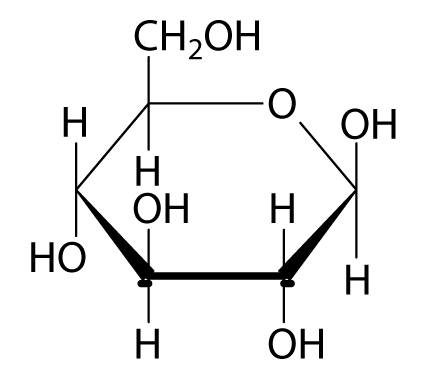
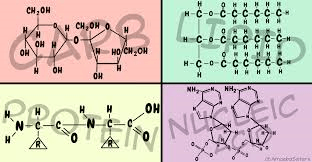
Identify the biomolecule
a)
Carbohydrate
b)
Lipid
c)
Protein
d)
Nucleic Acid
26.
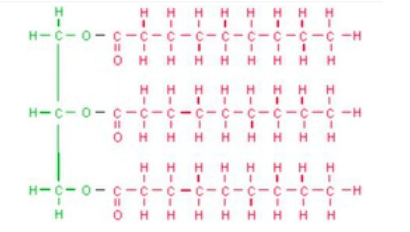
Identify the biomolecule
a)
Lipid
b)
Protein
c)
Carbohydrate
d)
Nucleic Acid
27.
What is the monomer for a protein?
a)
Monosaccharide
b)
Triglyceride
c)
Amino Acid
d)
Nucleotide
28.
Lipids are made up of which of the following?
a)
glycerol and fatty acids tails
b)
glycerol and monolipids
c)
fatty acids and phosolipids
d)
amino acids and nucleotides
29.
What is the monomer of nucleic acids?
a)
Glycerol
b)
Monosaccharides
c)
Amino Acids
d)
Nucleotides
30.
Which biomolecule is this a picture of?
a)
Protein
b)
Nucleic Acid
c)
Lipid
d)
Carbohydrate
31.
Which biomolecule is this a picture of?
a)
Protein
b)
Nucleic Acid
c)
Lipid
d)
Carbohydrate
32.
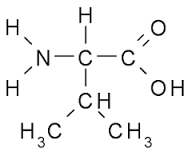
Which biomolecule is this a picture of? (Hint: it is made of amino acids)
a)
Proteins
b)
Nucleic Acids
c)
Lipids
d)
Carbohydrates
33.
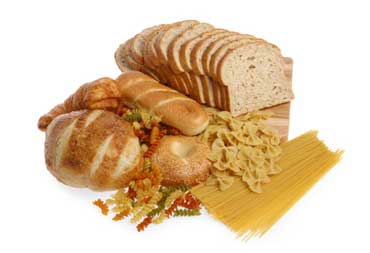
Which biomolecule is found in pastas and breads? (Hint: it is a polymer)
a)
Lipid
b)
Protein
c)
Simple Carbohydrate
d)
Complex Carbohydrate
34.
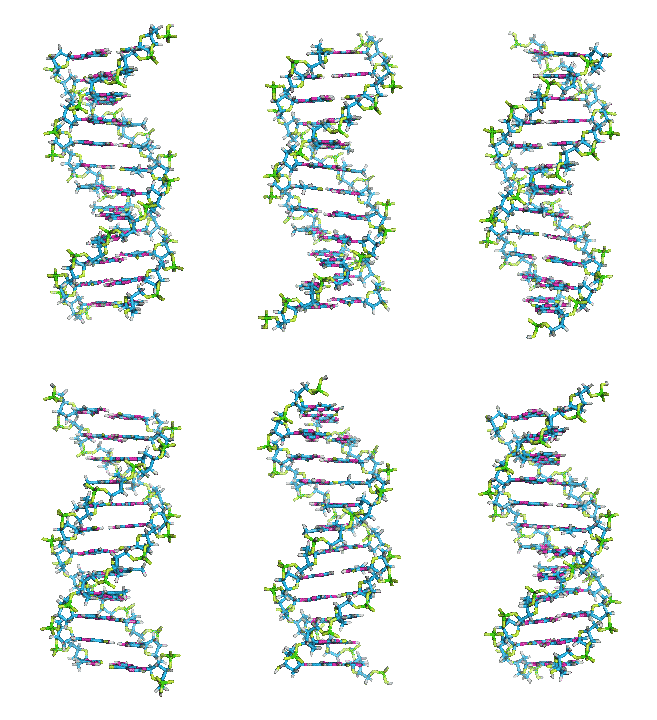
Which biomolecule is made of nucleotides and include your DNA? (Hint: they carry genetic information)
a)
Carbohydrate
b)
Lipids
c)
Protein
d)
Nucleic Acid
35.
The monomer (building block) of a nucleic acid is
a)
Monosaccharide
b)
Amino Acid
c)
Nucleotide
d)
Polysaccharide
36.
ALL polymers (large molecules) are made up of...
a)
monosaccharides
b)
monomers
c)
proteins
d)
None of these
37.
Monomers combine to form ________ through the process of ________.
a)
polymers; hydrolysis
b)
polymers; dehydration synthesis
c)
monomers; hydrolysis
d)
monomers; dehydration synthesis
38.
Which of the following is NOT a biomolecule?
a)
Water
b)
Nucleic Acid
c)
Protein
d)
Lipid
39.
Carbon, Hydrogen, Oxygen and Nitrogen are elements in what biomolecule?
a)
Carbohydrate
b)
Lipid
c)
Protein
d)
Nucleic acid
40.
What elements are common to all 4 biomolecules?
a)
Carbon, hydrogen, nitrogen
b)
Carbon, Nitrogen, Phosphorus
c)
Carbon, Hydrogen, Oxygen
d)
Carbon, Hydrogen, Phosphorus
41.
A monomer is ...
a)
a single atom
b)
a building block for polymers
c)
a single element
d)
is an inorganic molecule
42.
Enzymes are considered to be 
a)
Lipids
b)
Carbohydrate
c)
Protein
d)
Nucleic Acid
43.
What is the purpose  of an enzyme?
a)
give permission for the reaction
b)
raise activation energy
c)
speed up reactions
d)
control how many reactions occur
44.

There are three tenets of the Cell Theory. Which of the following is NOT a tenet?

a)

Cells are the basic structure and function of life.

b)

All living things are made of one or more cells.

c)

The cell is the basic unit of matter.

d)

All cells come from preexisting cells.

45.

____ is credited with being the first scientist to observe cork cells.

a)

Leewenhoek

b)

Shleidon

c)

Hooke

46.

Cells that are only made of (a)   cell are called unicellular.

47.

Check all the boxes for each organelle that plant and animal cells both have.

a)

lysosomes

b)

cell membrane

c)

mitochondria

d)

nucleus

e)

cell wall

48.

Sometimes called the “powerhouse” of the cell, this organelle is where respiration takes place.

a)

Mitochondria

b)

Nucleus

c)

Vacuole

49.

Bacteria is classified as a what?

a)

Prokaryote

b)

Eukaryote

50.

If it does not rain for a long period of time, plants’ leaves will begin to wilt or sag. They have used up the water that they stored in their ___________

a)

Vacuole

b)

Chloroplast

c)

Mitochondria

51.

Which scientist was credited as being the first in observing cells?

a)

Hooke

b)

Leewenhoek

c)

Virchow

52.

The _______ is the smallest structural and functional unit of a living thing. (this will be matching on the test)

a)

cell

b)

metabolism

c)

nutrition

d)

defense

53.

Which choice is NOT part of the cell theory.

a)

All organisms are composed of cells.

b)

Cells are the basic unit of life.

c)

All cells come from previous cells.

d)

Cells are always the same size and shape.

54.

What happened that allowed cells to be studied?

a)

Cells increased in size.

b)

Scientists began to work together.

c)

Scientists became smarter.

d)

The microscope was invented and improved.

55.
Which statement is a part of the cell theory?
a)
all cells come from preexisting cells
b)
bacteria are prokaryotic cells
c)
eukaryotic cells are complex
d)
humans are multicellular
56.
What tool do you use to view the cells?
a)
metric ruler
b)
centrifuge
c)
microscope
d)
pipette
57.
What kind of cell is this?
a)
Animal 
b)
Plant
58.
What kind of cell is this?
a)
Animal
b)
Plant
59.

Cell theory states that...

a)

cells are the basic building block of life

b)

cells are cool

c)

cells are microscopic

d)

cells cannot be destroyed

60.
A plant and an animal are both living things. According to the Cell Theory, what can you conclude about these two very different organisms?
a)
Plants have cells but animals do not.
b)
They are both made of one or more cells. 
c)
They both come from the same kind of cell.
d)
They both come from a non-living organism.
61.

What type of organisms does the cell theory apply to

a)

bacteria

b)

multicellular organisms

c)

plants and animals

d)

all of the above

62.
This scientist concluded that animals and, in fact, all living things are made of cells:
a)
Hooke
b)
Leeunwenhoek
c)
Schleiden
d)
Schwann
63.
This scientist was the first to identify cells and name them:
a)
Hooke
b)
Leeunwenhoek
c)
Schleiden
d)
Virchow
64.
This scientist proposed that all cells come from other cells:
a)
Leeunwenhoek
b)
Schleiden
c)
Schwann
d)
Virchow
65.
This scientist concluded that plants are made of cells:
a)
Virchow
b)
Schwann
c)
Schleiden
d)
Leeunwenhoek
66.
This scientist observed live cells and observed greater detail:
a)
Hooke
b)
Leeunwenhoek
c)
Virchow
d)
Schwann
67.
All organisms are made of:
a)
organelles
b)
cytoplasm
c)
DNA
d)
cells
68.
All existing cells are produced by other
a)
living cells
b)
dead cells
c)
atom cells
d)
animal cells
69.
What is the name of the structure labeled #4?
a)
stage
b)
course adjustment knob
c)
fine adjustment knob
d)
aperture
70.
what is the function of the structure labeled #4?
a)
used with meduim and high power objectives to bring an object into focus
b)
used with low power objective to bring an object into focus
c)
used with all objectives to brign an object into focus
d)
it is used to change the magnification of the object
71.
while focusing a microscope on high power a student crushed the cover slip. The student probably
a)
closed the diaphragm
b)
turned up the light intensity
c)
rotated the eyepiece
d)
used the course adjustment knob
72.
A microscope has an ocular magnification of 10 and a high power objective magnification of 50. What is the highest total magnification of the microscope?
a)
500x
b)
400x
c)
50x
d)
40x
73.

What piece supports the microscope and is used to transport the microscope from one place to another?

a)

Eyepiece

b)

Stage

c)

Base

d)

Light Source

74.

What piece is the platform that supports the microscope slide?

a)

Base

b)

Diaphragm

c)

Stage Clips

d)

Stage

75.

What piece holds the microscope slide in place ?

a)

Base

b)

Diaphragm

c)

Stage Clips

d)

Stage

76.

What piece controls the amount of light that enters the microscope ?

a)

Aperture

b)

Diaphragm

c)

Light Source

d)

Arm

77.

What piece is a larger knob usually found on either the body tube or the arm and it is used to focus the image under low power?

a)

Aperture

b)

Fine Adjustment Knob

c)

Diaphragm

d)

Course Adjustment Know

78.

What piece is the smaller knob, found near the course adjustment knob, and is used to focus the image under low and high power?

a)

Aperture

b)

Fine Adjustment Knob

c)

Diaphragm

d)

Course Adjustment Know

79.

What piece is found between the base and the stage and shines light through the object being viewed and into the microscope ?

a)

Aperture

b)

Fine Adjustment Knob

c)

Light Source

d)

Stage Clips

80.

What piece holds and turns the objective lenses into viewing position?

a)

Aperture

b)

Objective

c)

Nosepiece

d)

Stage Clips

81.

Passageway for light and maintains the correct distance between the lenses.

a)

Body Tube

b)

Diaphragm

c)

Mirror or light source

d)

Stag

82.
When you focus on a new specimen, always begin with
a)
low power and coarse adjustment.
b)
low power and fine adjustment
c)
high power and coarse adjustment
d)
high power and fine adjustment
83.

When is it okay to go to a higher magnification and use the fine focus?

a)

First thing when you get the slide.

b)

After you have located the cell using lower magnification and coarse focus.

c)

When you are done looking at the slide.

84.
What is number 2?
a)
Base
b)
Arm
c)
Stage
d)
Neck
85.
What is number 3?
a)
Course Adjustment Knob
b)
Fine Adjustment Knob
c)
Diaphragm
d)
Eyepiece
86.
What is number 1?
a)
Base
b)
Arm
c)
Stage
d)
Neck
87.
What is number 4?
a)
Course Adjustment Knob
b)
Fine Adjustment Knob
c)
Diaphragm
d)
Eyepiece
88.
What is number 5?
a)
Course Adjustment Knob
b)
Fine Adjustment Knob
c)
Diaphragm
d)
Eyepiece
89.
What is number 6?
a)
Course Adjustment Knob
b)
Fine Adjustment Knob
c)
Diaphragm
d)
Eyepiece
90.
What is number 7?
a)
On/Off Switch
b)
Nosepiece
c)
Light
d)
Objective Lens
91.
What is number 8?
a)
On/Off Switch
b)
Nosepiece
c)
Light
d)
Objective Lens
92.
What is number 9?
a)
On/Off Switch
b)
Nosepiece
c)
Light
d)
Objective Lens
93.
What is number 11?
a)
Aperture
b)
Stage
c)
Stage Clips
d)
Stand
94.
What is number 12?
a)
Aperture
b)
Stage
c)
Stage Clips
d)
Stand
95.
Which pieces raise and lower the stage or objective lense?
a)
Diaphragm and Light
b)
Aperture and Diaphragm
c)
Fine and Course Adjustment Knobs
d)
Eyepiece and Arm
96.
Rigid, outermost layer of the plant cell
a)
nucleus
b)
cell membrane
c)
cell wall
d)
cytoplasm
97.
Functions in energy production, known as the energy factory of the cell
a)
mitochondria
b)
chloroplast
c)
vacuole
d)
cytoplasm
98.
The control center that controls all the functions of the cell
a)
cytoplasm
b)
cell wall
c)
cell membrane
d)
nucleus
99.
Contains chlorophyll and is where photosynthesis takes place. Found in plant cells only.
a)
mitochondria
b)
chloroplast
c)
vacuole
d)
cytoplasm
100.
Semi-permeable layer around the cell that encloses the contents of the cell
a)
nucleus
b)
cell membrane
c)
cell wall
d)
chloroplast
101.
jelly-like substance that is located between the cell membrane and the nucleus
a)
mitochondria
b)
chloroplast
c)
vacuole
d)
cytoplasm
102.
I am the "power house" of the cell. I make most of the energy!
a)
mitochondria
b)
vacuole
c)
lysosome
d)
nuceus
103.
I store water in both plant and animal cells. What am I?
a)
cytoplasm
b)
ribosomes
c)
vacuole
d)
lysosomes
104.
I am the outer most layer of an animal cell. What am I?
a)
cell wall
b)
nucleus
c)
cell membrane 
d)
cell skin
105.
Which organelle uses energy from sunlight to make sugar?
a)
mitochondria
b)
nucleus
c)
chloroplasts
d)
vacuoles
106.

I make proteins for the cell. What am I?

a)

ribosome

b)

cell membrane

c)

nucleus

d)

chloroplast

107.
The two kinds of cells are Prokaryotes and Eukaryotes. How are they different?
a)
Prokaryotes have a nucleus.
b)
Eukaryotes have a nucleus.
c)
Prokaryotes are plant cells.
d)
There is no difference.
108.
What cell part is NOT found in all cells?
a)
Cell Wall
b)
Cell Membrane
c)
Cytoplasm
d)
Genetic Material
109.
Which of the following is found in eukaryotic cells but NOT prokaryotic cells?
a)
Cell membrane
b)
Mitochondria
c)
Ribosomes
d)
DNA
110.
Which of the following is directly involved in the transportation of materials inside/within the cell?
a)
Endoplasmic Reticulum
b)
Vacuole
c)
Lysosome
d)
Mitochondria
111.
I am a protein packaging and shipping machine! Who am I?
a)
vacuole
b)
ribosome
c)
endoplasmic reticulum
d)
golgi apparatus
112.
What makes the endoplasmic reticulum rough?
a)
Vessicles
b)
Vacuoles
c)
Ribosomes
d)
Chromosomes
113.
"Garbage collectors" of the cell that remove waste: 
a)
Cell Membrane
b)
Centrioles
c)
Lysosomes
d)
Nucleus
114.
"Envelopes" of the cell, used for transporting material: 
a)
Vesicles
b)
Centrioles
c)
ATP
d)
Mitochondria
115.

Ciąg instrukcji języka programowania wysokiego poziomu zrozumiały dla programisty to:

a)

kod wynikowy

b)

kod źródłowy

c)

kod wykonawczy

d)

kod translatoryjny

116.
The amount of particles in a given space.
a)
diffusion
b)
concentration
c)
permeable
d)
active transport
117.
The process where only water is allowed to pass through the cell membrane from a high to low concentration.
a)
meiosis
b)
respiration
c)
diffusion
d)
osmosis
118.
The movement of molecules from an area of high concentration to an area of low concentration.
a)
Osmosis
b)
Respiration
c)
Diffusion
d)
Active Transport
119.
Cells use energy to move materials across a membrane (low to high concentration).
a)
Active transport
b)
Passive transport
c)
Diffusion
d)
Osmosis
120.
Cells transport material across a cell membrane without using energy (high to low concentration)
a)
Passive transport
b)
Concentration
c)
Endocytosis
d)
Active Transport
121.
Cell membrane surrounds a particle and encloses it (for large particles)
a)
Endocytosis
b)
Exocytosis
c)
Permeable
d)
In high concentration
122.
Particles are removed from a cell (pushed out).
a)
Endocytosis
b)
Exocytosis
c)
Permeable
d)
In high concentration
123.
Which of the following is an example of osmosis?
a)
Oxygen exiting leaves after photosynthesis
b)
A raisin swelling in a cup of water
c)
Water changing from a liquid to a gas
d)
Oxygen moving into an animal cell
124.
Cells need to bring in molecules to carry out cellular processes. Often, this requires moving the molecules across the cell membrane against the concentration gradient. How do these molecules get into the cell?
a)
passive transport by diffusion
b)
active transport using ATP 
c)
passive transport by osmosis
d)
 osmosis
125.
 Look at the diagram of a cross-section of a cell membrane below. The cell membrane controls movement of materials into and out of the cell. The following particles are moving from high concentration to low concentration and are using a carrier protein. How would you describe this type of movement across the membrane? 
a)
simple osmosis
b)
active transport
c)
simple diffusion
d)
facilitated diffusion
126.
Look at the cross section of a cell membrane of a eukaryotic cell. H+ ions are being pumped from a low concentration to a high concentration. How do you describe this type of transport across the cell membrane?
a)
active transport
b)
passive transport
c)
facilitated diffusion
d)
co-transport
127.
 In pure water, a red blood cell from an animal will swell and burst, but a leaf cell from a plant will not. Which structure in the leaf cell is responsible for this difference?
a)
cell membrane
b)
cell wall
c)
 mitochondrion
d)
nucleus
128.
The diagram below represents a cell and some molecules in its environment. Which molecule would require the use of energy in order to be brought into the cell?
a)
1
b)
2
c)
3
d)
4
129.
During diffusion molecules tend to move 
a)
   up the concentration gradient
b)
 from an area of lower concentration to an area of higher concentration
c)
 in a direction that doesn’t depend on concentration
d)
 down the concentration gradient
130.
I am single stranded.
a)
DNA
b)
RNA
c)
Both DNA and RNA
131.
I am a nucleic acid.
a)
DNA
b)
RNA
c)
Both DNA and RNA
132.
I am arranged as a double helix or "twisted ladder."
a)
Both DNA and RNA
b)
DNA
c)
RNA
133.
I have the sugar ribose.
a)
RNA
b)
DNA
c)
Both DNA and RNA
134.
I have the sugar deoxyribose.
a)
RNA
b)
DNA
c)
Both DNA and RNA
135.
I include the bases guanine, cytosine, and adenine.
a)
DNA
b)
RNA
c)
Both DNA and RNA
136.
In eukaryotic cells, I travel out of the nucleus to a ribosome.
a)
Both DNA and RNA
b)
DNA
c)
RNA
137.
I have the base thymine.
a)
Both DNA and RNA
b)
RNA
c)
DNA
138.
I have the base uracil.
a)
RNA
b)
DNA
c)
Both DNA and RNA
139.

Which of following matches with Cytosine?

a)

Adenine

b)

Thymine

c)

Guanine

d)

Uracil

140.

Which of the following is NOT a base in RNA?

a)

Adenine

b)

Thymine

c)

Uracil

d)

Cytosine

141.

What does the "N" in RNA stand for?

a)

Nitrogen

b)

Nucleic

c)

Nucleus

d)

Nuclear

142.
Which sequence of DNA bases would pair with this partial strand
ATG TGA CAG
a)
ATG TGA CAG
b)
TAC ACT GTC
c)
GTA AGT GAC
d)
CAT TCA CTG
143.
Which of the following best describes a DNA molecule?
a)
double helix
b)
contains ribose
c)
made of amino acids
d)
contains Uracil
144.
Which of the following units are repeatedly joined together to form a strand of DNA?
a)
amino acids
b)
nucleotides
c)
fatty acids
d)
polysaccharides
145.
Why is DNA important?
a)
it is very small and very complicated
b)
it's in everything
c)
it serves as the blueprint for traits of all living things
d)
because we eat it every day for energy
146.
What determines the code, or information, of a DNA molecule?
a)
the shape (structure) of the nitrogen bases
b)
the order (sequence) of the nitrogen bases
c)
the color of the nitrogen bases
d)
the frequency (number) of nitrogen bases
147.
Which 2 molecules form the sides (backbone) of the DNA ladder?
a)
deoxyribose sugar and adenine
b)
deoxyribose sugar and a hydrogen bond
c)
deoxyribose sugar and the nucleus
d)
deoxyribose sugar and phosphate
148.
What are the three components of a nucleotide?
a)
sugar, hydrogen, nitrogen base
b)
sugar, oxygen, nitrogen base
c)
sugar, phosphate, nitrogen base
d)
sugar, phosphate, protein
149.
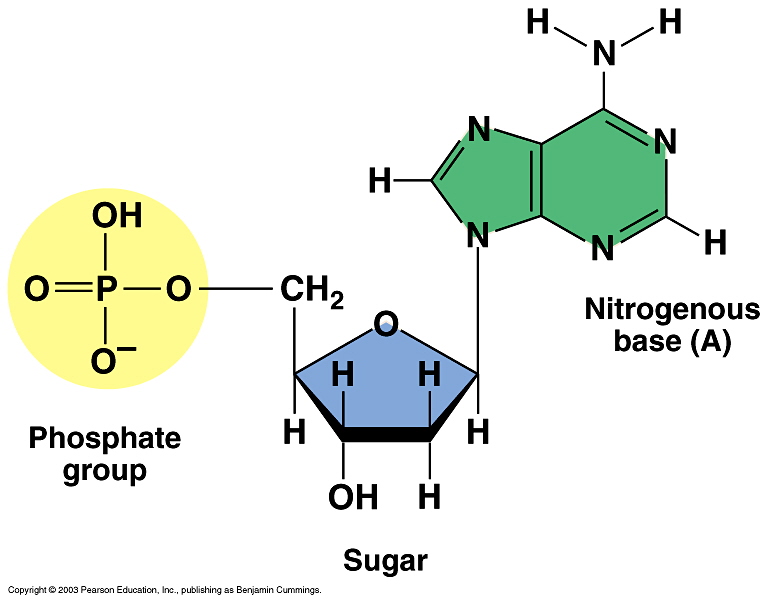
What does this picture represent?
a)
amino acid
b)
base pairing
c)
nucleotide
d)
the DNA molecule
150.
What is the correct complimentary strand for the following DNA?ATCGAG
a)
TACGAG
b)
ATCGAG
c)
TAGCTG
d)
TAGCTC
151.
How many nucleotides make a codon?
a)
1
b)
2
c)
3
d)
6
152.

In DNA, adenine goes with __________

a)

adenine

b)

cytosine

c)

guanine

d)

thymine

153.
In RNA, adenine goes with __________.
a)
adnine
b)
cytosine
c)
thymine
d)
uracil
154.

Which shows the correct complementary DNA strand of ATG?

a)

ATG

b)

TAC

c)

TAG

d)

CGC

155.
DNA codes for...
a)
cholesterol
b)
proteins
c)
fatty acids
d)
a sandwich