
 Worksheets
Chemical Reactions
Total questions: 155
Worksheet time: 5hrs 46mins
(a) C2H6 + (b) O2 --> (c) H2O + (d) CO2
7
6
2
4
(a) HClO4 + P4O10 --> (b) H3PO4 + (c) Cl2O7
12
4
6
(a) N2 + (b) O2 + 2H2O --> (c) HNO3
2
5
4
3
6
(a) CaCl2 + (b) Na3PO4 --> Ca3(PO4)2 + (c) NaCl
3
2
6
4
(a) FeS + (b) O2 --> (c) Fe2O3 + 4SO2
4
7
2
3
(a) C3H8 + (b) O2 --> (c) CO2 + (d) H2O
1
5
4
3
2
What is the missing coefficient?
__SeCl + 2O2 --> 2SeO2 + Cl2
1
2
3
4
15.6 grams of lead(II) nitrate is in a test tube. A 4.8-g sample of potassium iodide is an Erlenmeyer flask. The substance in the test tube is poured into the Erlenmeyer flask so that the two substances react. What is the mass of the combined products?
20.4 g
10.8 g
4.8 g
136 g
Pb(NO3)2 + 2KI --> PbI2 + __KNO3
1
2
3
4
HCl + NaOH --> NaCl + H2O
NaCl
H2O
HCl
NaOH
4P + 5O2 --> 2P2O5
P
O2
P2O5
2Fe(OH)3 --> Fe2O3 + 3H2O
Fe2O3
H2O
Fe(OH)3
4NH3 + 5O2 --> 4NO + 6H2O
NH3
O2
NO
H2O

In the reaction Pb(NO3)2 + 2KI --> PbI2 + 2KNO3, what is the role of KI?
Solvent
Catalyst
Product
Reactant
(a) AlCl3 + (b) K2SO4 --> Al2(SO4)3 + (c) KCl
How many oxygens?
Al2(SO4)3
How many aluminums?
Al2(SO4)3
How many sulfurs?
Al2(SO4)3
How many calciums?
Ca3(PO4)2
How many phosphorus atoms?
Ca3(PO4)2
How many oxygen atoms?
Ca3(PO4)2
Na2O + Ca(NO3)3 --> CaO + __NaNO3
1
2
3
4
2Na + __Cl2 --> 2NaCl
1
2
3
4
_K2SO4 + _Na2O --> _Na2SO4 + _K2O
1, 2, 1, 2
1, 2, 2, 1
1, 1, 1, 1
2, 1, 1, 2
_Ca(NO3)2 + _AlCl3 --> _CaCl2 + _Al(NO3)3
2, 3, 2, 3
3, 2, 3, 2
1, 3, 2, 3
3, 2, 2, 3
_NaCl + _H2SO4 --> _Na2SO4 + _HCl
2, 1, 1, 2
2, 1, 2, 1
1, 2, 1, 2
3, 1, 2, 1
_Cl2 + _Na2O --> _O2 + _NaCl
2, 2, 1, 4
2, 1, 2, 4
1, 2, 1, 4
2, 1, 1, 2
(a) Na + (b) K2SO4 --> Na2SO4 + 2K
Ca(NO3)2 + K2SO4 --> (a) CaSO4 + (b) KNO3

Is this equation balanced?
Yes
No

To balance an equation you should:
ONLY change subscripts.
ONLY change coefficients.
Change BOTH subscripts and coefficients.

Is this equation balanced?
Yes
No
_Fe + _O2 --> _Fe2O3
4, 3, 2
2, 1, 1
1, 1, 1
3, 2, 1
_C3H8 + _O2 --> _CO2 + _H2O
1, 5, 2, 4
2, 5, 3, 4
1, 4, 3, 4
1, 5, 3, 4
Which of the following is a balanced equation?
H2 + O2 --> H2O
H2 + 2O2 --> H2O
2H2 + O2 --> 2H2O
2H2 + 2O2 --> 2H2O
AlCl3 + (a) Na --> (b) Al + 3NaCl
(a) Ca(NO3)2 + (b) AlCl3 --> 3CaCl2 + 2Al(NO3)3
(a) H3PO4 + (b) Ca(OH)2 --> (c) Ca3(PO4)2 + (d) H2O
Which reactant is needed to balance this equation and follow the law of conservation of mass?
(a) + FeCl2 --> 2AgCl + Fe(NO3)2

In this chemical equation, if the coefficient in front of "Na" were changed to 4, what coefficient in front of NaCl would be needed to balance this equation?
What are the respective coefficients needed to balance this equation?
_N2(g) + H2(g) --> _NH3(g)
1, 1, 1
1, 2, 3
1, 3, 2
3, 3, 2
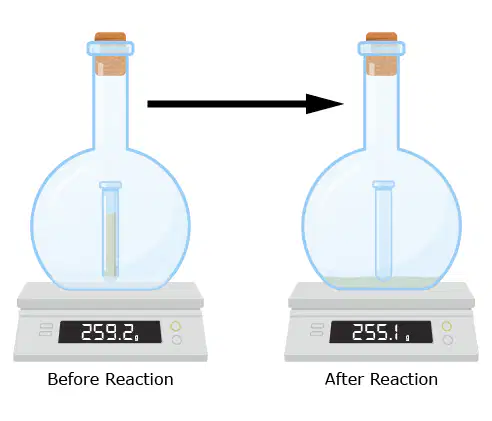
In a laboratory, students added some sodium hydrogen carbonate solution to the bottom of a flask. Then, a small test tube was filled with acetic acid and placed in the flask and massed. The students mixed the the test tube solution with the solution in the flask resulting in a reaction that produced sodium acetate, water, and carbon dioxide gas. The mass was taken again after the reaction. The reaction is illustrated here. The mass of the reactants does not equal the products in the reaction between sodium hydrogen carbonate and acetic acid pictured above. Given the law of conservation of mass, which states mass cannot be created or destroyed, why is there a difference in mass?
Student error in recording masses.
The acid used up the sodium hydrogen carbonate
The reaction was exothermic and warm glass has a lower mass than cool glass.
The carbon dioxide escaped because the flask was not stoppered.
Which statement of the following are true regarding the equation listed below?
Fe + CuCl2 → FeCl2 + Cu
The equation is balanced.
The equation is not balanced.
_NH3 + O2 → _N2 + _H2O
After correctly balancing this chemical equation, what coefficient will go before NH3?

(a) PbS(s) + (b) O2(g) --> 2PbO(s) + 2SO2(g)
(a) C2H4(g) + (b) O2(g) --> (c) CO2(g) + 2H2O(g)
_C2H6 + _O2 --> _CO2 + _H2O
2, 5, 3, 4
1, 5, 2, 4
2, 7, 4, 6
1, 3, 2, 3
_Al + _O2 --> _Al2O3
3, 2, 1
2, 1, 1
2, 3, 1
4, 3, 2
Matter can not be created nor destroyed: it can only be
Destroyed a little bit
Transformed, changed
Invisible
None of the above
The number to the lower side of an element is a
Subscript
Coefficient
Superscript
Charge
The number in front of a compound or element is a
(a)
A chemical reaction is balanced when
both sides have the same elements
Same subscripts
Both sides have the same number of atoms
Same coefficients
Which of these is not a chemical reaction?
Burning of wood
Mixing vinegar and baking soda
Milk going bad
Melting of ice
If a reaction starts with 20g of reactants it should produce
a total of 40g of products
a total of 80 g of products
a total of 10g of products
a total of 20g of products
What is the Law of Conservation of mass?
Mass is created in a chemical reaction
New chemicals formed from a chemical reaction have a larger overall mass than the original reactants
Mass is never created or destroyed
Mass is created in a physical change
When sodium and chlorine combine to form sodium chloride, sodium chloride is the:
product
reactant
Maria fills a bowl with 200 g of water. She puts the bowl of water in the freezer, and the water freezes. Which will most likely be the mass of the frozen water?
50 g
200 g
100 g
400 g
How many atoms do you have in the compound 2MgCl2?
2
6
4
8
How many atoms do you have in the chemical formula 2Mg(ClO3)2?
2
9
7
18
Law of conservation of mass states the amounts of atoms in the reactants and the products...
Increase
Stay the same
Decrease
No correct answer
Does the equation H2+O2 →H2O follow the Law of Conservation of Mass?
Yes, because the atoms are equal.
No, because there are more atoms in the product.
No, because more info is needed.
No, because there are more atoms in the reactant.
At the end of chemical reactions, what is the total mass of the reactants compared to the total mass of the products?
the product is doubled
the mass is the same
the product is half the mass of the reactants
the mass changes depending on the reaction
When balancing equations a ____ can be placed to the left of a formula of a substance to make the equations balanced
charge
random number
coefficient
subscript
PCl5 + (a) H2O --> (b) HCl + H3PO4
Which equation is balanced?
PbO2 + 2H2--> H2SO4
2Na + 2H2O --> 2NaOH + H2
SO2 + H20 --> H2SO4
2Na + 2H2O --> 2NaOH + H
What is a coefficient?
The small number on the right of the chemical symbol.
The large number to the left of a formula
_Zn + _HCl --> ZnCl2 + _H2
1, 1, 2, 1
1, 2, 1, 1
1, 1, 1, 2
2, 1, 1, 1
_Mg + _Cl2 --> _MgCl2
1, 2, 1
2, 1, 1
1, 1, 2
already balanced
How many atoms of aluminum are on each side of the following equation:
4Al + 3O2 --> 2Al2 O3
(a) P4 + (b) O2 --> (c) P2O3
(a) Mg(OH)2 + (b) HCl --> MgCl2 + 2H2O
2AgI + Na2S --> (a) Ag2S + (b) NaI
PCl5 + (a) H2O --> H3PO4 + (b) HCl
Single replacement
Double replacement
Single replacement
Double replacement
Single replacement
Double replacement
Single replacement
Single replacement
Single replacement
Single replacement
N2+O2--> _NO
__Li + __Cl2 -> __LiCl
What is the coefficient of O2 when the equation _C4H10 + _O2 --> _CO2 + _H2O is balanced?
5
6
10
8
Which of the following is a balanced chemical equation?
2H2 + O2 --> 2H2O
H2 + O2 --> H2O
2H2 + 2O2 --> 2H2O
H2 + 2O2 --> H2O2
Al(OH)3 → Al2O3 + H2O

What type of reaction is taking place in this picture?
Synthesis
Single Replacement
Double Replacement
Combustion
Classify each of these chemical reactions.
2MnI3 --> 2Mn + 3I2
2Al + 3CuSO4 --> Al2(SO4)3 + 3Cu
2Na + S --> Na2S
2KCl + F2 --> Cl2 + 2KF
2Mg + O2 -- 2MgO
HCl + NaOH --> NaCl + H2O
H2O --> H2 + O2
2FeBr3 + 3H2SO4 --> Fe2(SO4)3 + 6HBr
Classify each chemical reaction.
C3H8 + 5O2 --> 3CO2 + 4H2O
Al(NO3)3 + 3NaOH --> Al(OH)3 + 3NaNO3
4Al + 3O2 --> 2Al2O3
2HgO --> 2Hg + O2
6CO2 + (a) H2O + energy--> (b) C6H12O6 + 6O2
(a) Al + (b) O2 --> (c) Al2O3
Which of the following is a balanced equation?
CH4 + 3O2 --> CO2 + 2H2O
2CH4 + O2 --> CO2 + 2H2O
CH4 + O2 --> CO2 + H2O
CH4 + 2O2 --> CO2 + 2H2O
How many atoms are present in the compound 3CaCO3?
9
3
15
18
Fe + O2 -> Fe2O3
HgO --> Hg + O2
Fe + S --> FeS
In reactions, products must be equal to..
Products
Reactants
Starters
Enders
According to the law of conservation of mass, how does the amount of each element on the product side compare to each element on the reactant side?
The amount of atoms on each side is equal
The amount of atoms on the product side is greater
The amount of atoms on the reactant side is greater
Depends on the reaction
Balance the following chemical equation:
____KClO3 → ____KCl + ____O2
2KClO3 → 4KCl + O2
4KClO3 → 2KCl + 3O2
2KClO3 → 2KCl + 3O2
Which reaction type is the following:
C5H10 + O2 --> CO2 + H2O
Decomposition
Synthesis
Complete Combustion
Double Replacement

The law of conservation of mass can be demonstrated by a chemical reaction. Which of the following models of a chemical reaction best represents the law of conservation of mass?


N2+O2--> _NO
(Check ALL answers)
Mg + __HCl ---> MgCl2 + H2
Balance this equation
_Al +_HCl --> _H2 +_AlCl3
2,6,3,2
it's already balanced
4,12,3,4
2,1,4,5
Balance the following equation:
___ Mg+ ___ O2→___ MgO
1, 1, 3
2, 1, 2
1, 2, 1
2, 2, 2
Balance the following equation:
___ SeCl6+ ___ O2→___ SeO2+____Cl2
1, 1, 1, 3
2, 1, 2, 1
1, 2, 1, 2
2, 2, 2, 4
_Zn+_HCl-->_ZnCl2 +_H2
P4+O2 --> P2O3
H3PO4 + (a) KOH --> K3PO4 + 3H2O
(a) K + (b) B2O3 --> (c) K2O + (d) B
(a) Na + (b) NaNO3 --> (c) Na2O + (d) N2
(a) Na + (b) O2 --> (c) Na2O
(a) Al + (b) S8 --> (c) Al2S3
What type of reaction?
4C + S8 --> 4CS2
(a)
What type of reaction?
2H3PO4 + 3Mg(OH)2 --> Mg3(PO4)2 + 6H2O
(a)
What type of reaction?
KOH + HBr --> KBr + H2O
(a)
What type of reaction?
6Cs + N2 --> 2Cs3N
(a)
What type of reaction?
2C6H6 + 15O2 --> 12CO2 + 6H2O
(a)
What type of reaction?
2C10H22 + 31O2 --> 20CO2 + 22H2O
(a)
What type of reaction?
3Li + AlCl3 --> 3LiCl + Al
(a)
What type of reaction?
NH3 + HCl --> NH4Cl
(a)
What type of reaction?
2KNO3 --> 2KNO2 + O2
(a)
What type of reaction?
2Al + 3H2SO4 --> Al2(SO4)3 + 3H3
(a)
What type of reaction?
3BaF2 + 2K3PO4 --> Ba3(PO4)2 + 6KF
(a)
What type of reaction?
CaCO3 --> CaO + O2
(a)
What type of reaction?
2HgO (s) --> 2Hg (l) + O2 (g)
(a)
What type of reaction?
2NaOH (s) --> Na2O (s) + H2O (g)
(a)
What type of reaction?
CH4 + 2O2 --> CO2 + 2H2O
(a)

