wayground logo

Free Printable Worksheets

Font size

S
M
L
XL
Worksheets

✅Unit 1 Study Guide

Total questions: 150

Worksheet time: 38hrs 30mins

Name
Class
Date
1.
How would you write 4.3756 x 10in standard form?
a)
437,560,000
b)
0.00043756
c)
43,756
d)
4,3756
2.
How would you write 0.0005 in scientific notation?
a)
50 x 105
b)
5 x 10⁴
c)
5 x 10³
d)
.5 x 103
3.
How would you write -5.6 x 10⁻³ in standard form?
a)
0.0056
b)
-5,600
c)
0.00056
d)
-0.0056
4.
Scientific Notation is made up of two number parts. The second part is a power of base 10.
a)
True
b)
False
5.
Scientific Notation is made up of two number parts. The first part should be a number between 1 and 100.
a)
True
b)
False
6.
When writing a number in scientific notation, the first number must be greater than 1, but less than 10.
a)
False
b)
True
7.
The rule of scientific notation is to write all exponents with a base of ____.
a)
50
b)
5
c)
100
d)
10
8.
How do you write
1001
in scientific notation?
a)
1.0001 x 10⁴
b)
1.01 x 10⁵
c)
1.001 x 10³
d)
10.1 x 10³
9.
How do you write
8.317 x 10⁶
in standard form?
a)
8, 371, 000
b)
83, 170, 000
c)
837, 100
d)
8, 317, 000
10.
Which of the following is correct scientific notation?
a)
20.35 x 10⁴
b)
.2035 x 104
c)
2035 4
d)
2.035 x10⁴
11.
Express the following in scientific notation:
.000457
a)
457 x 106
b)
457 x 10-6
c)
4.57 x10⁴
d)
4.57 x 10⁻⁴
12.
Express the following in standard notation:
8.025 x 10⁻⁸
a)
.00000008025
b)
.000000008025
c)
802,500,000,000
d)
80,250,000,000
13.
Convert to standard notation:
3.05 x 10⁵ 
a)
305,000
b)
305
c)
3,050,000
d)
30,500
14.
What is scientific notation?
a)
A long way to write really short  numbers
b)
A short way to write really long numbers
c)
I don't know...
d)
None of the above
15.
Express the following in scientific notation:
0.0000002203
a)
.02203 x 107
b)
22.03 x 10⁻⁶
c)
2.203 x 10⁻⁷
d)
22.03 x 10⁶
16.

How many significant figures?

0.150

a)

1

b)

2

c)

3

d)

4

17.

How many significant figures?

7945

a)

1

b)

2

c)

3

d)

4

18.

How many significant figures?

7945

a)

1

b)

2

c)

3

d)

4

19.

How many significant figures?

0.150

a)

1

b)

2

c)

3

d)

4

20.

How many significant figures?

76400.0

a)

3

b)

4

c)

5

d)

6

21.

How many significant figures?

76490

a)

3

b)

4

c)

5

d)

6

22.

Which one is rounded correctly for the following equation?

1.987 - 0.48 = ?

a)

1.5

b)

1.51

c)

1.507

d)

2

23.

Which one is rounded to the correct number of significant figures for the following equation?

7520 x 0.021 = 157.92

a)

157.92

b)

157.9

c)

158

d)

160

24.

Which answer is rounded to the correct place for the equation below?

457.1 + 459.32 = 916.42

a)

916.42

b)

916.4

c)

916.0

d)

916

25.

Which answer is rounded to the correct place for the equation below?

487.0 / .0024 = 121750.0

a)

121750.0

b)

121800

c)

122000

d)

120000

26.
How many significant figures are in the measurement 48032 m?
a)
5
b)
4
c)
3
d)
2
27.

State the number of significant figures in the following measurement:

0.002040 moles

a)

6

b)

4

c)

3

d)

2

28.

State the number of significant figures in the following measurement:

27000000 cm/s

a)

2

b)

5

c)

8

29.

State the number of significant figures in the following measurement:

0.00400 m

a)

1

b)

3

c)

5

d)

6

30.

Solve and round to the correct number of significant figures.


1.678 / 0.42

a)

4.0

b)

3.99

c)

3.9

d)

4

31.

Solve and round to the correct number of significant figures.


23.7 x 3.8

a)

90.06

b)

90.1

c)

91

d)

90.

32.

Solve and round to the correct number of significant figures.

730 / 1.89

a)

390

b)

386.243

c)

386

d)

386.24

33.

Calculate 5.50 cm + 5.50 cm and give your answer with the appropriate number of significant figures.

a)

11 cm

b)

11.0 cm

c)

11.00 cm

d)

11.000 cm

34.

Calculate 12.34 + 1.234 + 0.1234 and give your answer with the appropriate number of significant figures.

a)

13.6974

b)

13.697

c)

13.70

d)

13.7

35.
Calculate 345.009 g - 23.009 g and give your answer with the appropriate number of significant figures.
a)
322.00 g
b)
322 g
c)
322.000 g
d)
322
36.
Calculate 7.987 m - 0.54 m and give your answer with the appropriate number of significant figures.
a)
7.45 m
b)
7.447 m
c)
7.4 m
d)
7.5 m
37.
Calculate 1.23 m x 0.89 m and give your answer with the appropriate number of significant figures.
a)
1.0 m2
b)
1.1 m2
c)
1.0947 m2
d)
1.09 m2
38.

Solve and round to the correct number of significant figures.

791.6 x 52

a)

41000

b)

41

c)

41160

d)

41200

39.

Solve and round to the correct number of significant figures.

730 / 1.89

a)

390

b)

386.243

c)

386

d)

386.24

40.

Solve and round to the correct number of significant figures.


23.7 x 3.8

a)

90.06

b)

90.1

c)

91

d)

90.

41.

Solve and round to the correct number of significant figures.


1.678 / 0.42

a)

4.0

b)

3.99

c)

3.9

d)

4

42.

Solve and round to the correct number of significant figures.


1.5 x 0.5

a)

.75

b)

.8

c)

.750

d)

.7

43.
Is glass breaking a chemical or phyiscal change?
a)
chemical
b)
physical
44.
Is burning wood a chemical or physical change?
a)
chemical
b)
physical
45.
Is burning wood a chemical or physical change?
a)
chemical
b)
physical
46.
Is glass breaking a chemical or phyiscal change?
a)
chemical
b)
physical
47.
Is hammering wood together to build a house a chemical or physical change?
a)
chemical
b)
physical
48.
Is a a rusting bicycle a chemical or physical change?
a)
chemcial
b)
physical
49.
Is melting butter for popcorn a chemical or physical change?
a)
chemical
b)
physical
50.
Is spoiling food a physical or chemical change?
a)
phyiscal
b)
chemical
51.
Is making salt water to gargle with a physical or chemical change?
a)
physical
b)
chemical
52.
Is moldy cheese a chemical or physical change?
a)
chemical
b)
physical
53.
a copper penny turning greenish after a few years.
a)
Chemical Change
b)
Physical Change
54.
Green bananas turning yellow on their own as they ripen.
a)
Chemical Change
b)
Physical Change
55.
A change in the size, shape, or state of matter.
a)
chemical change
b)
physical change
c)
chemical reaction
d)
electron change
56.
Baking a cake by mixing flour, sugar, chocolate powder, eggs, and milk, and then heating them in the oven.
a)
Chemical Change
b)
Physical Change
57.
Which of the following is NOT an example of a physical change?
a)
crumpled paper
b)
pencil sharpening
c)
shrunken clothing
d)
sour milk
58.
A change in which NEW substances are formed.
a)
Chemical change
b)
Physical change
c)
Casual change
d)
Formal change
59.
Which of the following is NOT an example of chemical change?
a)
sour milk
b)
burning wood
c)
breaking a pencil
d)
rust
60.
Which of the following IS a physical change?
a)
Getting a haircut
b)
Rusty metal
c)
sour milk
d)
A compound
61.
Which of the following IS a chemical change
a)
using chalk
b)
water freezing
c)
slicing cheese
d)
digestion
62.
Which type of property is the ability to conduct electricity?
a)
physical property
b)
chemical property
63.
What kind of properties can only be observed when a substance changes into a different substance?
a)
physical properties
b)
chemical properties
c)
liquid properties
d)
real properties
64.
Which of the following properties is a physical property?
a)
magnetism
b)
reactivity with oxygen
c)
flammability
d)
non-reactive
65.
What characteristic defines all chemical changes?
a)
There is a change of state.
b)
Electricity is produced.
c)
A new material is formed.
d)
Bubbles are produced. 
66.
A physical property can be observed with your
a)
Eyes
b)
Ears
c)
Tastes
d)
All of the above
67.
What is anything that has mass and takes up space?
a)
matter
b)
substance
c)
chemistry
d)
property
68.

On which celestial object (outer space) would your mass be the greatest?

a)

Earth

b)

Jupiter

c)

Sun

d)

Your mass doesn't change on different celestial objects
69.
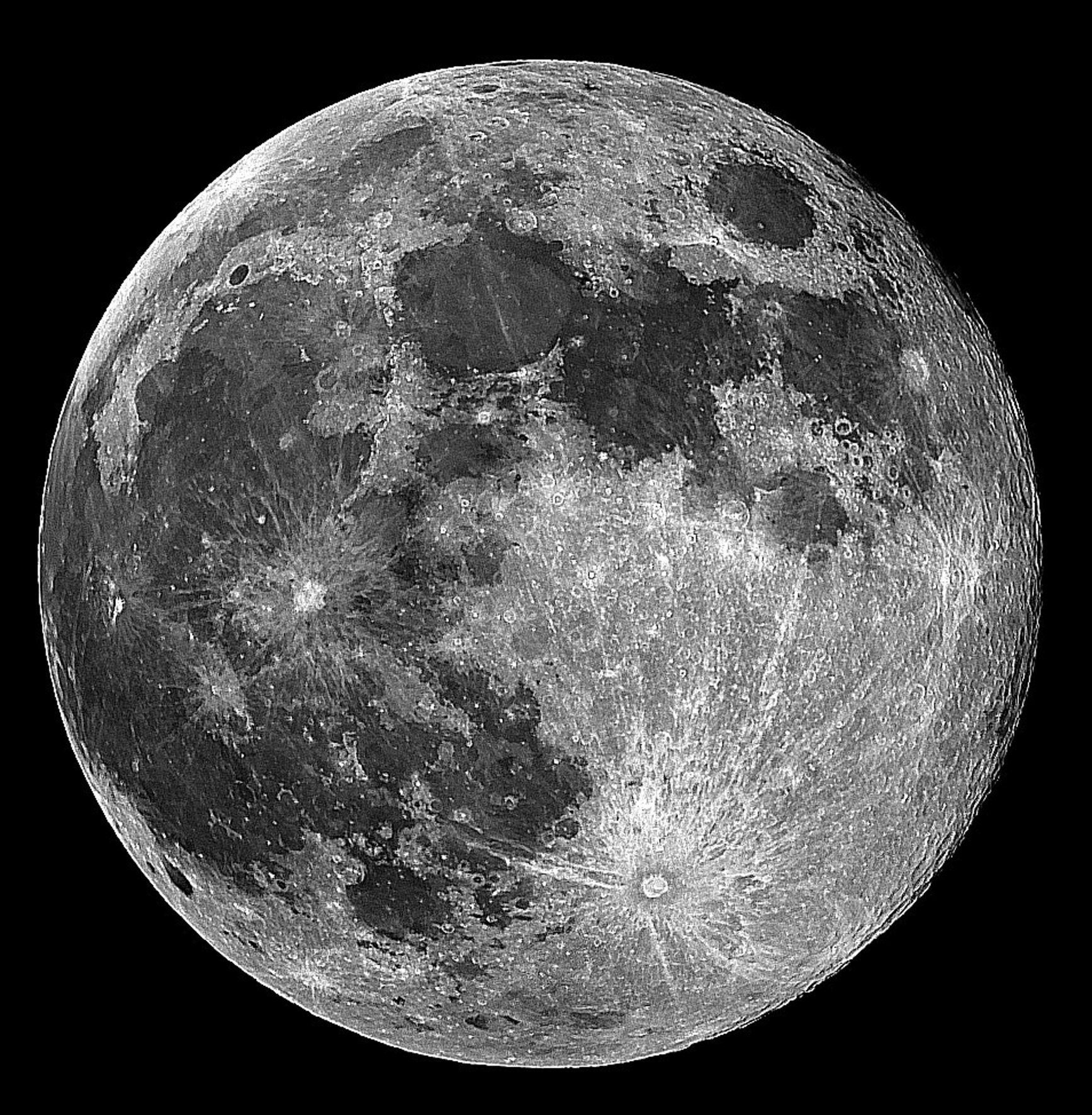
Why would you weigh less on the moon compared to Earth?
a)
less air
b)
less sunlight
c)
more gravitational pull
d)
less gravitational pull
70.

Protects the eyes from flying objects or chemical splashes

a)

goggles

b)

striker

c)

bunsen burner

d)

ring clamp

71.

A small glass container used to view chemical reactions or to heat small amounts of a substance

a)

test tube

b)

striker

c)

ring clamp

d)

funnel

72.

A wide-mouthed container used to transport, heat, or store substances

a)

beaker

b)

triple beam balance

c)

erlenmeyer flask

d)

eye dropper

73.

Used to light a Bunsen burner

a)

striker

b)

lab stand

c)

funnel

d)

goggles

74.

Attaches to a lab stand and used to hold a variety of lab equipment

a)

ring clamp

b)

lab stand

c)

erlenmeyer flask

d)

funnel

75.

Used to measure volume very precisely

a)

Graduated cylcinder

b)

lab stand

c)

Erlenmeyer flask

d)

Bunsen burner

76.

Used to pour liquids into containers with small openings or to hold filter paper

a)

funnel

b)

bunsen burner

c)

eye dropper

d)

ring clamp

77.

Used to heat objects

a)

Bunsen burner

b)

graduated cylinder

c)

ring clamp

d)

eye dropper

78.

cylindrical glass tube used for holding liquids or heating them over a Bunsen burner's flame

a)

graduated cylinder

b)

test tube

c)

beaker

79.
What is used to hold test tubes?
a)
Test tube rack
b)
Magnifying glass
c)
Petri dish
d)
Funnel
80.

Which of these activities is permitted during lab?

a)

running around

b)

eating

c)

drinking

d)

None of these

81.

Horseplay, practical jokes, or pranks in the lab are:

a)

always against the rules

b)

okay, as long as everybody laughs

c)

the fastest way to get an A in the class

d)

okay, as long as nobody loses an eye

82.

An observation made with your senses

a)

Qualitative observation

b)

Quantitative observation

c)

temperature

d)

conclusion

83.

What is an hypothesis?

a)

a guess

b)

a testable, tentative explanation

c)

a theory

d)

data

84.

Which of the following is an example of quantitative data?

a)

grey

b)

oily

c)

44.2oC

d)

Copper

85.

What is chemistry?

a)

the study of matter

b)

the study of the universe

c)

the study of science

d)

the study of numbers

86.

Substance formed by a chemical reaction

a)

reaction

b)

molecule

c)

product

d)

proton

87.

Substance that is changed by a chemical reaction

a)

reactant

b)

rotation

c)

restoration

d)

relaxation

88.

"Matter" is anything that...

a)

takes up space and has volume.

b)

takes up space and has mass.

c)

takes up air and has mass.

d)

takes up air and has volume.

89.

Weight is ...

a)

the force of gravity acting on your mass.

b)

how much matter you have in you.

c)

the same on every planet.

d)

how many cookies you ate over break.

90.

Mass is....

a)

how swoll you are.

b)

how heavy something is.

c)

how much volume something has.

d)

how much matter something has.

91.

A substance that is made up of only one (1) kind of atom is call an

(a)  

92.

Scientists have organized all the known elements in the ...

a)

Element Chart

b)

Periodic Table

c)

Element Table

d)

Periodic Chart

93.

Check all that apply: Physical Properties of a substance

a)

color

b)

dissolves

c)

texture

d)

hardness

e)

flammable

94.
The summary at the end of an experiment that explains the results is... 
a)
conclusion
b)
procedures
c)
materials
d)
responding variable
95.
A testable prediction about a scientific investigation is a(n)
a)
Question
b)
Observation
c)
Hypothesis
d)
Experiment
96.
A series of steps used by scientists to solve a problem or answer a question. 
a)
scientific method
b)
recipe
c)
data collection
d)
metric system
97.

The information you collect while doing your experiment is called

a)

conclusions

b)

data

c)

hypotheses

d)

procedures

98.

The process of obtaining information by using the senses is called a/an

a)

Conclusion

b)

Observation

c)

Inquiry

d)

Scientific method

99.

An explanation based on many repeated observations during experiments.

a)

conclusion

b)

scientific law

c)

theory

d)

hypothesis

100.

Performing a test or experiment allows you to test your ___________.

a)

Conclusions

b)

Hypothesis

c)

Data

d)

Question

101.
A series of steps used by scientists to solve a problem or answer a question. 
a)
scientific method
b)
recipe
c)
data collection
d)
metric system
102.

What state of matter is pictured above?

a)

solid

b)

liquid

c)

gas

103.

What state of matter is pictured above?

a)

solid

b)

liquid

c)

gas

104.

What state of matter is pictured above

a)

solid

b)

liquid

c)

gas

105.

Water is an example of what state of matter?

a)

solid

b)

liquid

c)

matter

d)

melting

106.

Helium is an example of what state of matter?

a)

solid

b)

liquid

c)

gas

d)

evaporation

107.

A desk is which of the following states of matter?

a)

solid

b)

liquid

c)

gas

d)

evaporation

108.
A combination of rocks and water is an example of
a)
A mixture
b)
A solution 
c)
Dissovling
109.
A mixture of aluminum and steel can best be separated by ________________.
a)
adding water
b)
using a sieve
c)
density
d)
a magnet
110.
Lemonade is a special mixture called a 
a)
substance
b)
solution
c)
plasma
d)
ingredient
111.

pebbles and rocks

a)

Homogeneous Mixture

b)

Heterogeneous Mixture

112.

pizza with toppings

a)

Homogeneous Mixture

b)

Heterogeneous Mixture

113.

gravel and sand

a)

Homogeneous Mixture

b)

Heterogeneous Mixture

114.

coffee and hot water

a)

Homogeneous Mixture

b)

Heterogeneous Mixture

115.

cocoa powder and milk

a)

Homogeneous Mixture

b)

Heterogeneous Mixture

116.

sand and seawater

a)

Homogeneous Mixture

b)

Heterogeneous Mixture

117.
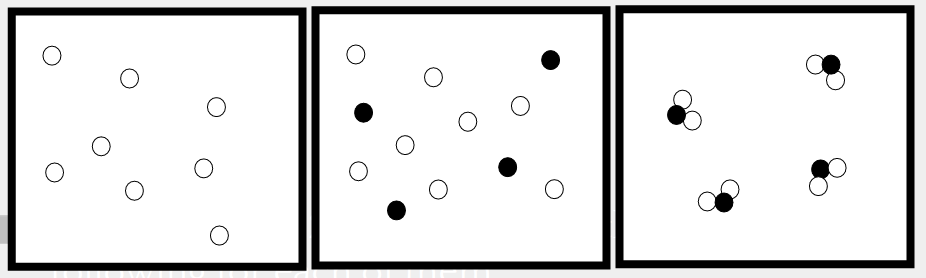
Which one of these pictures represents a mixture? 
a)
1
b)
2
c)
3
d)
1, 2 and 3
118.
Which one of these pictures represents a pure substance? 
a)
1 and 2
b)
1 and 3
c)
2 and 3
d)
1, 2 and 3
119.
NaCl
a)
Element
b)
Compound
c)
Homogeneous Mixture
d)
Heterogeneous Mixture
120.
Lucky Charms
a)
Element
b)
Compound
c)
Homogeneous Mixture
d)
Heterogeneous Mixture
121.
O2
a)
Element
b)
Compound
c)
Homogeneous Mixture
d)
Heterogeneous Mixture
122.
Co
a)
Element
b)
Compound
c)
Homogeneous Mixture
d)
Heterogeneous Mixture
123.
Aluminum
a)
Element
b)
Compound
c)
Homogeneous Mixture
d)
Heterogeneous Mixture
124.
Carbon
a)
Element
b)
Compound
c)
Homogeneous Mixture
d)
Heterogeneous Mixture
125.
Kool-Aid
a)
Element
b)
Compound
c)
Homogeneous Mixture
d)
Heterogeneous Mixture
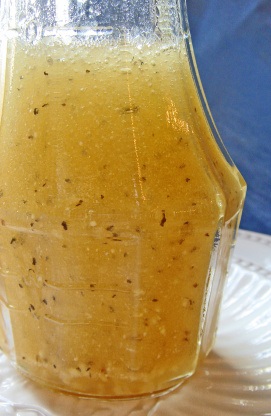
126.
Italian Salad Dressing is a . . .
a)
heterogeneous mixture
b)
homogeneous mixture
c)
Pure Substance
d)
Compound
127.
A mixture that is NOT evenly distributed is called ....
a)
Compounded
b)
Homogenous
c)
Heterogenous
d)
Salty
128.
What is a homogeneous mixture?
a)
a mixture that is the same throughout.
b)
a mixture that is made up of one type of atom.
c)
a mixture that is made up of one type of compound
d)
a mixture that cannot be separated through physical changes
129.
A combination that can be separated by physical processes is a .....
a)
Atom
b)
Compound
c)
Element
d)
Mixture
130.
Are made from a combination of 2 or more elements in a constant ratio...
a)
Atome
b)
Mixture
c)
Compounds
d)
Elements
131.
Sweet Tea
a)
Element
b)
Compound
c)
Homogeneous Mixture
d)
Heterogeneous Mixture
132.
What is the Law of Conservation of mass?
a)
Mass is created in a chemical reaction
b)
Mass is created in a physical change
c)
New chemicals formed from a chemical reaction have a larger overall mass than the original reactants
d)
Mass is never created or destroyed
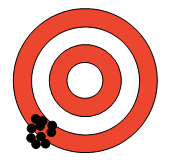
133.
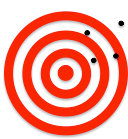
This bullseye demonstrates...
a)
High Accuracy & High Precision
b)
High Accuracy & Low Precision
c)
Low Accuracy & High Precision
d)
Low Accuracy & Low Precision
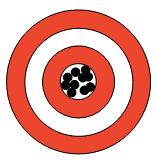
134.

This bullseye demonstrates...

a)

High Accuracy & High Precision

b)

High Accuracy & Low Precision

c)

Low Accuracy & High Precision

d)

Low Accuracy & Low Precision

135.

Describe the accuracy and precision of the image

a)

Very accurate and somewhat precise

b)

Very accurate but not precise at all

c)

Not accurate at all but very precise

d)

not accurate and not very precise

136.

A set of data are all close in value to each other, but they are not close to the actual value. This set of data can be described as _________________.

a)

precise

b)

accurate

137.

Which best describes the target?

a)

Precise, but not accurate

b)

Accurate but not precise

c)

Precise and accurate

d)

Neither accurate nor precise

138.

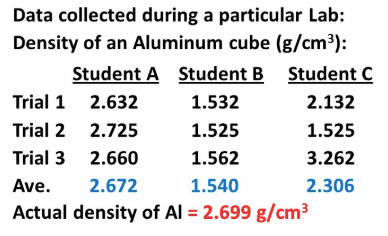
Which student is the most ACCURATE?

a)

A

b)

B

c)

C

139.

Which of the following weighing balance is more accurate?

a)

A

b)

B

c)

C

140.

Which of the following weighing balance is more precise?

a)

A

b)

B

c)

C

141.
What is the volume of the liquid in this graduated cylinder?
a)
19 mL 
b)
35 mL 
c)
24 mL 
d)
1.9 mL
142.
What is the scale on this graduated cylinder?
a)
.1 mL per line
b)
.2 mL per line
c)
.5 mL per line
d)
1 mL per line
143.
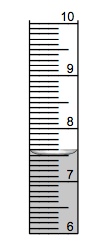
What is the volume of the liquid in this graduated cylinder?
a)
8.5 mL 
b)
7.5 mL 
c)
8 mL 
d)
.1 mL
144.
What is the volume of the liquid in this graduated cylinder?
a)
43 mL 
b)
30.7 mL 
c)
37 mL 
d)
38 mL
145.
What is the volume of the liquid in this graduated cylinder?
a)
44 mL 
b)
30.6 mL 
c)
37 mL 
d)
36 mL
146.
What is the volume of the liquid in this graduated cylinder?
a)
8.2 mL 
b)
8.02 mL 
c)
82 mL 
d)
9.8 mL
147.
What is the volume of the liquid in this graduated cylinder?
a)
21 mL 
b)
2.1 mL 
c)
.21 mL 
d)
2.01 mL
148.
What is the volume of the liquid in this graduated cylinder?
a)
43 mL 
b)
40.3 mL 
c)
4.3 mL 
d)
.43 mL
149.
Identify the equipment shown here:
a)
graduated cylinder
b)
Erlenmeyer flask
c)
beaker
d)
volumetric flask
150.
Identify the equipment shown here:
a)
pipette
b)
eye dropper
c)
tweezer
d)
forceps