wayground logo

Free Printable Worksheets

Font size

S
M
L
XL
Worksheets

UNIT 1: Chemistry FUNdamentals

Total questions: 130

Worksheet time: 4hrs 40mins

Name
Class
Date
1.

An object has a mass of 14.4 grams and a volume of 18.2 ml. Determine the density of the object.

a)

1.1 g/ml

b)

0.79 g/ml

c)

1.3 g/ml

d)

2.1 g/ml

2.

An object has a density of 3.6 g/ml. What volume will 51.3 grams of this object occupy?

a)

18.3 ml

b)

24,4 ml

c)

19.6 ml

d)

14.3 ml

3.

An object has a density of 5.5 g/ml. Determine the mass of the object if it has a volume of 24.4 ml.

a)

114.2 g

b)

36.6 g

c)

134.2 g

d)

4.6 g

4.

Is '25 meters' a qualitative or quantitative observation?

a)

Qualitative

b)

Quantitative

5.

Is 'Tall' a qualitative or quantitative observation?

a)

Qualitative

b)

Quantitative

6.
How many centimeters are in a meter?
a)
1.0
b)
10.0
c)
100.0
d)
1000.0
7.

How many grams are in a kilogram?

a)

1.0

b)

10.0

c)

100.0

d)

1000.0

8.

Convert 32,000 into scientific notation.

a)

32.0x10³

b)

3.20x10⁴

c)

320x102

d)

0.32x10⁻²

9.

Convert 6.02x10² to standard notation

a)

6.02

b)

60.2

c)

602.0

d)

0.602

10.

How many Sig Figs are in 6.023x10²³?

a)

1.0

b)

2.0

c)

3.0

d)

4.0

11.
How many Sig Figs are in 0.00025?
a)
1.0
b)
2.0
c)
3.0
d)
4.0
12.
How many Sig Figs are in 25.00?
a)
1.0
b)
2.0
c)
3.0
d)
4.0
13.
Round 5.235874 to 3 Sig Figs
a)
5.23
b)
5.235
c)
5.236
d)
5.24
14.
You know that 12 inches = 1 foot.  Convert 60 inches to feet.
a)
720 feet
b)
5 feet
c)
5 inches
d)
72 feet
15.

What unit should be in the denominator of the conversion factor?

a)

yards

b)

leagues

c)

feet

d)

fathoms

16.

What unit should be in the numerator of the conversion factor?

a)

yards

b)

leagues

c)

feet

d)

fathoms

17.

What conversion factor would be best for this problem?

a)

1 kg / 2.2 lbs

b)

1 lb / 2.2 kg

c)

1000 g / 1 kg

d)

1 kg / 1000 g

18.

Is 60.02x10²³ in correct scientific notation format?

a)

Yes

b)

No

19.
The length of a desk is 3.5 feet. How many centimeters is the length? 
(there are 2.54 cm in an inch)
a)
60
b)
120.23
c)
106.68
d)
117.12
20.
How many seconds are in a day?
a)
There are only seconds in a minute.
b)
1440sec
c)
86,400sec
d)
84,600sec
21.
convert 9 km to mm
a)
900,000
b)
9,000,000
c)
9,000
d)
90,000
22.
The length of a desk is 3.5 feet. How many centimeters is the length? 
(there are 2.54 cm in an inch)
a)
60
b)
120.23
c)
106.68
d)
117.12
23.
A bar of copper has a mass of 216g and a volume of 24cm3. What is the density of copper?  
a)
9g/cm3
b)
.11g/cm3
c)
5184g/cm3
d)
322mL
24.
What is the density of a plastic ball that has a volume of 6cm3 and a mass of 12g? 
a)
2g/cm3
b)
.5g/cm3
c)
72g/cm3
d)
4mL
25.
What is the unit of measurement for mass? 
a)
mL
b)
cm3
c)
g
d)
g/cm3
26.
To calculate density you would use the following equation
a)
D = M/V
b)
M = D x V
c)
V = M/ D
d)
NONE OF THESE
27.
Frank has a paper clip. It has a mass of 9g and a volume of 3cm3. What is its density?
a)
3 g/cm3
b)
1/3 g/cm3
c)
27 g/cm3
d)
39 g/cm3
28.
We start with 50 mL in a graduated cylinder and drop in an object.  The water rises to 64 mL.  What is the volume of this object?
a)
64 mL
b)
64
c)
14 mL
d)
14
29.
Frank has a paper clip. It has a mass of 9g and a volume of 3cm3. What is its density?
a)
3 g/cm3
b)
1/3 g/cm3
c)
27 g/cm3
d)
39 g/cm3
30.
Is melting butter for popcorn a chemical or physical change?
a)
chemical
b)
physical
31.
Is burning wood a chemical or physical change?
a)
chemical
b)
physical
32.
A change in the size, shape, or state of matter.
a)
chemical change
b)
physical change
c)
chemical reaction
d)
electron change
33.
Which of the following is NOT an example of a physical change?
a)
crumpled paper
b)
pencil sharpening
c)
shrunken clothing
d)
sour milk
34.
Kim puts an ice cube in a beaker and it melts. This is a good example of:
a)
a physical change.
b)
a chemical change.
c)
an experiment.
d)
an analysis.
35.
When you break a cracker into pieces it is a 
a)
Chemical change
b)
Physical change
c)
Chemical Weathering
d)
Physical Weathering
36.
Adding baking soda and vinegar together and it fizzes and creates carbon dioxide.
a)
Chemical
b)
Physical
37.
What is an example of a Chemical change?
a)
Ripped paper 
b)
boiled egg
c)
cracked egg
d)
sugar in water
38.
Jayden asked Gabe what she could do to an egg for a chemical change. Gabe answered correctly and said...
a)
You can drop the egg.
b)
You can cook the egg.
c)
You can crack the egg.
d)
You can paint the egg.
39.
what is the definition of chemical change?
a)
any change that results in the formation of new chemical substances. 
b)
changing clothes
c)
matter cannot be created or destroyed, only change form
d)
changes affecting the form of a chemical substance, but not its chemical composition.
40.
which one is a chemical property?
a)
odor
b)
combustibility
c)
solubility
d)
all of the above
41.
How many dimes equals 14 quarters?
a)
140 dimes
b)
35 dimes
c)
70 dimes
d)
20 dimes
42.
How many hours are in a year?
(Hint:  365 days = 1 year)
a)
8760 hrs
b)
8670 hrs
c)
525,600 hrs
43.
You know 16 cups = 1 gallon. Convert 3.5 gallons into cups.
a)
56 cups
b)
0.21875 cups
c)
19.5 cups
d)
48 cups
44.
How many gallons are in a pool that holds 758,000 Liters?
(1 gallon = 3.79 Liters)
a)
200
b)
20,000
c)
200,000
d)
2,000,000
45.
Gas costs $3.05 a gallon, and your car travels at 27 miles for each gallon of gas. How far can you travel in your car with $95 in your pocket?
a)
11 miles
b)
840 miles
c)
7800 miles
d)
870 miles
46.
The length of a desk is 3.5 feet. How many centimeters is the length? 
(there are 2.54 cm in an inch)
a)
60
b)
120.23
c)
106.68
d)
117.12
47.
Elijah earn $200 for 8 hours of work. What is the unit rate (in dollars per hour)?
a)
$50 per hour
b)
$12 per hour
c)
$192 per hour
d)
$25 per hour
48.
Convert 40 ounces to pounds
a)
2.5 pounds
b)
.4 pounds
c)
2/5 pounds
d)
5 pounds
49.
How many sig figs are there?
100.00
a)
1
b)
3
c)
4
d)
5
50.
How many sig figs are there?
0.000008
a)
1
b)
2
c)
6
d)
7
51.
How many sig figs are there?
0.0009009090000
a)
3
b)
10
c)
14
52.
How many significant figures does the following number have: 0.998005
a)
9
b)
10
c)
6
d)
5
53.
How many significant figures does the following number have: 100.00210
a)
7
b)
5
c)
10
d)
8
54.
Round 0.010229 to four sig figs
a)
1022
b)
1023
c)
0.01023
d)
0.01022
55.
Round 1047.78 to three sig figs
a)
104
b)
105
c)
1050
d)
1050.00
56.
What is 78.5 rounded to one significant figure?
a)
79
b)
78.5
c)
70
d)
80
57.
Determine the number of Significant Figures in 10-L.
a)
4
b)
3
c)
2
d)
1
58.
How many Significant Figures in the number below?
4.56 x 10³
a)
5
b)
4
c)
6
d)
3
59.
How many significant figures will be in the answer to the following question:
7.62 x 6.98 x 3.2645
a)
1
b)
2
c)
3
d)
4
60.
Calculate 5.50 cm + 5.50 cm and give your answer with the appropriate number of significant figures.
a)
11 cm
b)
11.0 cm
c)
11.00 cm
d)
11.000 cm
61.

Solve. Round using SigFig math rules.

98.7°C - 97.25°C

a)

1°C

b)

1.5°C

c)

1.45°C

d)

1.450°C

62.
Solve. Round using SigFig math rules.
103-cm x 11-cm
a)
11-cm2
b)
1100-cm2
c)
1130-cm2
d)
1133-cm2
63.
How many gallons are in 64 quarts?
(Hint:  4 qt = 1 gal)
a)
16 gal
b)
0.25 gal
c)
0.75 gal
d)
1.5 gal
64.
Mr. Jolly drove 90 km per hour on South Luzon Blvd. this morning. How many meters per second is this rounded to the nearest tenth of a second?
a)
125
b)
30
c)
25
d)
800
65.
My cup of coffee hold 350 mL (milliliters) how many kL (kiloliters) is my coffee cup
a)
350
b)
35
c)
.35
d)
.00035
66.

Convert 6 centigrams/day to kilograms/year

a)

2.19 kilograms/year

b)

21.9 kilograms/year

c)

.0219 kilograms/year

d)

219 kilograms/year

67.
An ______________ is the basic particle from which all elements are made. 
a)
chemical bond
b)
atom
c)
molecule
68.
A _________________ is a substance made of 2 or more elements that are chemically combined in a set ratio. 
a)
compound
b)
element
c)
atom
d)
chemical bond
69.
A _____________________ is made of 2 or more substances that are together in the same place, but their atoms are not chemically bonded. 
a)
chemical bond
b)
mixture
c)
molecule
d)
atom
70.
A ______________ mixture is when you can usually see the different parts and the can easily be separated. 
a)
heterogeneous 
b)
homogeneous
71.
A _______________ mixture is when the parts of the mixture are evenly mixed and you can't see the different parts. 
a)
heterogenous mixture
b)
homogeneous mixture
72.
An ______________ is a substance that cannot be broken down. 
a)
element
b)
molecule
c)
chemical bond
73.
This law states that energy cannot be created or destroyed, but it can change form.
a)
Endothermic reaction
b)
Law of Conservation of Energy
LOCOE
c)
Exothermic reaction
d)
Law of Conservation of Matter
LOCOM
74.
An element is made up of only one kind of _____.
a)
isotope
b)
plastic
c)
atom
d)
metal
75.
What is the left part of a chemical equation called?
H2 + O → H2O
a)
Reactants
b)
Products 
c)
Yields 
d)
Chemical Equation 
76.
An ice cube is put into a heated pan. What will most likely happen to the molecules in the ice as the ice is heated
a)
The molecules will begin to move slower.
b)
The molecules will begin to move faster
c)
The molecules will begin to increase in density
d)
The molecules will begin to condense in the air.
77.
Which among the following is an element?
a)
brass
b)
bronze
c)
silver
d)
stainless steel
78.
Physical or chemical change?
A solid is crushed into a powder?
a)
physical change 
b)
chemical change 
79.
Which of the following are pure substances?
a)
elements 
b)
colloids 
c)
heterogeneous mixture 
d)
solutions 
80.
Define a Chemical Property
a)
A property which depends on the objects size or matter.
b)
A property of matter not involving in its manifestation a chemical change
c)
A property or behavior of a substance which undergoes a chemical change or reaction.
d)
A property which makes the object smell or taste different.
81.
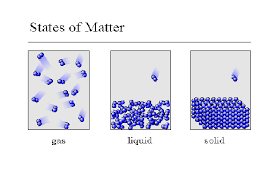
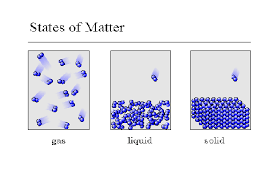
How is a gas defined?
a)
Indefinite shape, indefinite volume
b)
Definite shape, definite volume
c)
Found in stars
d)
Definite volume, indefinite shape
82.
How is a solid defined?
a)
Indefinite shape and indefinite volume
b)
Definite shape and definite volume
c)
Found in the stars
d)
Definite volume, indefinite shape
83.
Define a liquid.
a)
Indefinite shape, indefinite volume
b)
Definite shape, definite volume
c)
Found in stars
d)
Definite volume, indefinite shape
84.
At higher temperatures
a)
particles in an object have less energy
b)
particles in an object move faster
c)
a gas contracts
85.
What are the three states of matter?
a)
solid, volume, mass
b)
density, volume, mass
c)
solid, liquid, gas
d)
density, gas, volume
86.
Something that takes up space and has mass.
a)
volume
b)
matter
c)
mass
d)
density
87.
A state of matter that has a definite volume and shape.
a)
solid
b)
liquid
c)
gas
d)
matter
88.
A measure of how much mass is contained in a given unit of volume.
a)
mass
b)
density
c)
volume
d)
matter
89.
The amount of space something takes up
a)
density
b)
volume
c)
mass
d)
matter
90.
Shape is a ____ that helps identify an object.
a)
physical property
b)
chemical property
c)
mass
d)
matter
91.
A watermelon has more matter than a grape, so it has more
a)
mass
b)
eat
c)
solid
d)
greater
92.
You can measure ______ with grams.
a)
mass
b)
volume
c)
conductivity
d)
melting point
93.

The fact that baking soda and vinegar react to form sodium acetate, carbon dioxide and water is an example of what type of property?

a)

physical property

b)

chemical property

c)

intensive property

d)

extensive property

94.

The fact that iron rusts when exposed to oxygen is an example of what type of property?

a)

physical property

b)

chemical property

c)

extensive property

d)

intensive property

95.

What type of change is an apple rotting an example of?

a)

physical change

b)

extensive property

c)

chemical property

d)

chemical change

96.

What type of property is density an example of?

a)

chemical property

b)

physical change

c)

intensive property

d)

extensive property

97.

What type of change is shredding paper an example of?

a)

physical property

b)

intensive property

c)

chemical change

d)

physical change

98.

When calcium metal turnings are added to water, calcium oxide and hydrogen gas are produced. What type of property of calcium is this an example of?

a)

chemical property

b)

intensive property

c)

extensive property

d)

physical property

99.

What type of change is burning paper an example of?

a)

chemical change

b)

extensive property

c)

chemical property

d)

physical change

100.

What type of change is crushing a soda can an example of?

a)

chemical change

b)

extensive property

c)

physical change

d)

physical property

101.

What type of property is melting point an example of?

a)

chemical property

b)

chemical change

c)

physical property

d)

extensive property

102.
A copper penny turning greenish after a few years is an example of ...
a)
Chemical Change
b)
Physical Change
103.
Which of the following is NOT an example of chemical change?
a)
sour milk
b)
burning wood
c)
breaking a pencil
d)
rust
104.
A change in phase ...
a)
Chemical Change
b)
Physical Change
105.
Bubbles form when two or more substances are combined ...
a)
Chemical Change
b)
Physical Change
106.
To go back to the substances original states is not possible or you would need to use chemicals. 
a)
Chemical
b)
Physical
107.
Evidence of Chemical Change.
a)
New Substance 
b)
Size change
c)
State change
d)
Mixture 
108.
1. Sugar dissolves in warm water
 
 
a)
Physical change
b)
Chemical Change
109.
Which form of matter has a definite shape like this picture?
a)
liquid
b)
solid
c)
gas
d)
clay
110.
Which form of matter take the shape of a container like this juice?
a)
liquid
b)
solid
c)
glass
d)
gas
111.
What is happening when my water bottle in the freezer goes from a liquid state to a solid state?
a)
melting
b)
evaporating
c)
freezing
d)
cutting
112.
My glass of ice water is sitting in the sun and has droplets of water on the outside of the glass. What is happening?
a)
condensation
b)
evaporation
c)
melting
d)
freezing
113.
Which of the following terms identifies the change from a liquid to gas?
a)
Vaporization
b)
Condensation
c)
Deposition
d)
Sublimation
114.
Which of the following terms identifies the change from a liquid to solid?
a)
Melting
b)
Condensation
c)
Vaporization
d)
Freezing
115.
When the temperature of matter increases the particles...
a)
speed up and move closer
b)
speed up and move farther apart
c)
slow down and move closer together
d)
slow down and move farther apart
116.
No Definite Shape and No Definite Volume
a)
Gas
b)
Liquid
c)
Solid
117.
Definite shape and a definite volume.
a)
Gas
b)
Liquid
c)
Solid
118.
No definite shape, but has a definite volume
a)
Gas
b)
Liquid
c)
Solid
119.
Phase change from a solid to a gas.
a)
sublimation
b)
deposition
c)
condensation
d)
evaporation
120.
Phase change from a solid to a liquid.
a)
melting
b)
sublimation
c)
boiling
d)
condensation
121.
Phase change from a liquid to a gas that only happens at the surface.
a)
evaporation
b)
boiling
c)
sublimation
d)
melting
122.
How are solids different from liquids?
a)
particles in solids are moving freely around each other.
b)
particles in solids have no motion.
c)
particles in solids are vibrating in place.
d)
particles in solids have more motion than in liquids
123.
What can be determined by measuring the speed of molecules?
a)
volume
b)
density
c)
pressure
d)
temperature
124.
The drops of water that appear on the outside of a glass of cold juice on a warm day are an example of?
a)
sublimation
b)
condensation
c)
evaporation
125.
In a solid, the particles
a)
vibrate in place
b)
slide past one another
c)
overcome the strong attraction
126.
A gas
a)
has a definite shape but no definite volume
b)
has a definite volume but no definite shape
c)
has fast-moving particles
127.
At higher temperatures
a)
particles in an object have less energy
b)
particles in an object move faster
c)
a gas contracts
128.
Balloons can be twisted into shapes because
a)
the force exerted changes the number of particles
b)
the volume of a gas is constant
c)
particles of gas can be compressed
129.
The opposite phase of melting is 
a)
freezing 
b)
sublimation
c)
condensation 
d)
deposition 
130.
Which of the following terms identifies the change from a liquid to gas?
a)
Vaporization
b)
Condensation
c)
Deposition
d)
Sublimation