wayground logo

Free Printable Worksheets

Font size

S
M
L
XL
Worksheets

Chemistry Matter Check for Understanding

Total questions: 131

Worksheet time: 1hrs 11mins

Name
Class
Date
1.
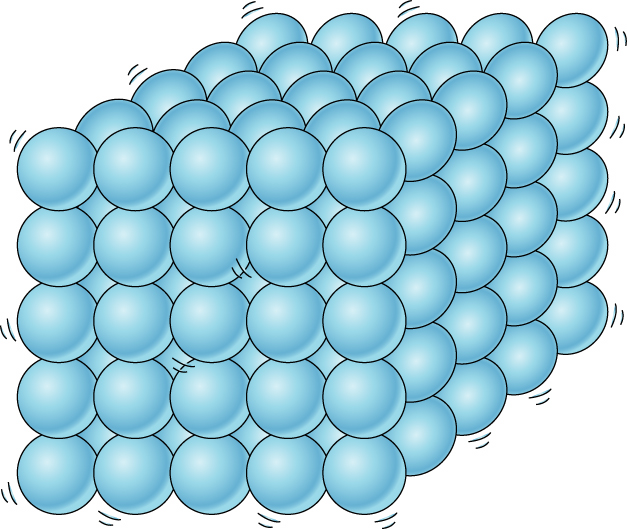
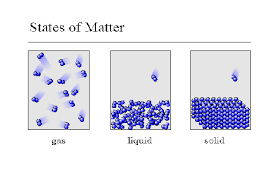
In a solid, the particles
a)
vibrate in place
b)
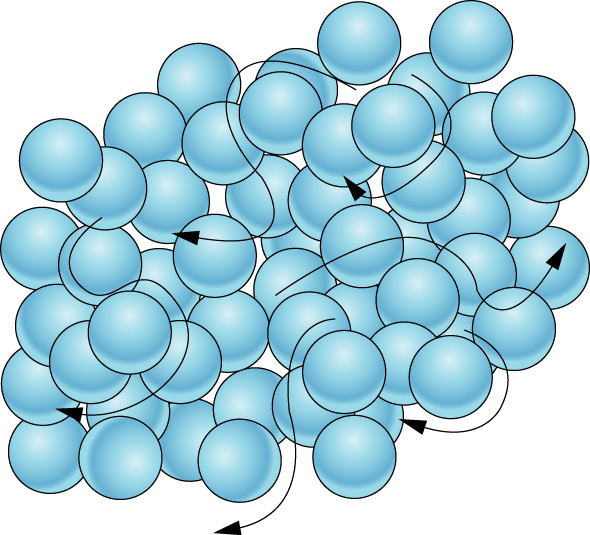
slide past one another
c)
overcome the strong attraction
2.
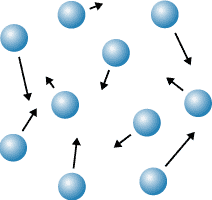
A gas
a)
has a definite shape but no definite volume
b)
has a definite volume but no definite shape
c)
has fast-moving particles
3.
Define a liquid.
a)
Indefinite shape, indefinite volume
b)
Definite shape, definite volume
c)
Found in stars
d)
Definite volume, indefinite shape
4.
The endothermic conversion in which a state of matter with definite volume and definite shape converts to a substance with indefinite volume, indefinite shape, but definite mass, without passing through the liquid state.
a)
melting
b)
freezing
c)
deposition
d)
sublimation
5.
An exothermic conversion that results in less kinetic molecular movement into a substance that has a definite volume, but indefinite shape.  
a)
condensation
b)
vaporization
c)
deionization
d)
ionization
6.
An exothermic conversion that results in less kinetic molecular movement into a substance that has definite shape and definite volume.
a)
condensation
b)
freezing
c)
melting
d)
vaporization
7.
The exothermic conversion from an indefinite volume and indefinite shape to a substance with a definite shape and definite volume. 
a)
deposition
b)
sublimation
c)
condensation
d)
freezing
8.
The exothermic change that takes a state of matter with charged particles with indefinite volume and shape to a state of matter without charged particles with indefinite volume and shape. 
a)
ionization
b)
deionization
c)
deposition
d)
sublimation
9.
The molecular friction within a fluid that produces a flow resistance. 
a)
surface tension
b)
viscosity
c)
malleability
d)
ductility
10.
The particles in a liquid are:
a)
moving faster than a solid
b)
mover slower than a solid
c)
moving faster than a gas
d)
moving faster than a plasma
11.
When vaporization takes place, particle motion:
a)
increases
b)
decreases
c)
becomes charged
d)
stops
12.
a)
solid
b)
liquid
c)
gas
d)
plasma
13.
a)
solid
b)
liquid
c)
gas
d)
plasma
14.
a)
solid
b)
liquid
c)
gas
d)
plasma
15.
One cup of water is left outside for two days when it was checked there was only half a cup left. What happened?
a)
evaporation; chemical change
b)
condensation; physical change 
c)
evaporation; physical change
d)
condensation; chemical change
16.
what happens when water freezes?
a)
ice is formed; chemical property
b)
cold water is formed; physical change
c)
ice is formed; physical change
d)
cold water is formed; chemical change
17.
At higher temperatures
a)
particles in an object have less energy
b)
particles in an object move faster
c)
a gas contracts
18.
Particles of a liquid
a)
are tightly packed together and stay in a fixed position.
b)
have no viscosity.
c)
decrease in volume with increasing temperature.
d)
are free to move around one another but still touch.
19.
Substance with NO definite volume or shape...
a)
solid
b)
liquid
c)
gas
20.
Substance with a DEFINITE volume, but NO definite shape...
a)
solid
b)
liquid
c)
gas
21.
Substance with a DEFINITE shape and DEFINITE volume...
a)
solid
b)
liquid
c)
gas
22.
Substance that fills its container and can "spill" out into more space...
a)
solid
b)
liquid
c)
gas
23.
Amount of matter in a solid, liquid, or gas...
a)
mass
b)
volume
24.
Amount of space an object takes up...
a)
Mass
b)
Volume
25.

Which of the following statements is NOT true of atoms and molecules?

a)

They are tiny particles.

b)

They are always in motion.

c)

They are found in all matter.

d)

They never bump into each other.

26.

What consists of free-moving ions and electrons?

a)

gas

b)

plasma

c)

solid

d)

liquid

27.

If the temperature increases, then the particle speed _____________?

a)

Increases

b)

Decreases

c)

Stays the same

28.

If the temperature decreases, then the particle speed ______________?

a)

Increases

b)

Decreases

c)

Stays the same

29.
Which is less compressible?
a)
Amorphous Solid
b)
Crystalline Solid
30.
Which has a more clearly defined shape?
a)
Amorphous Solid
b)
Crystalline Solid
31.
Why does it take less energy to melt methane than it does to melt ice (water)?
a)
Methane is held together by stronger intermolecular forces.
b)
Ice is held together by stronger intermolecular forces.
c)
Ice is colder than methane.
d)
Ice is affected by only dispersion forces.
32.
Solids with a random distribution of atoms ?
a)
Crystalline solid
b)
Amorphous solid
c)
Geometric solid
d)
Atomic Solid
33.
Solids where atoms are arranged in an orderly geometric pattern?
a)
Crystalline solid
b)
Amorphous solid
c)
Geometric solid
d)
Atomic Solid
34.
If a liquid has high viscosity, it probably has:
a)
strong resistance to flow
b)
weak resistance to flow
35.

The endothermic conversion in which a state of matter with definite volume and definite shape converts to a substance with definite volume, indefinite shape, but definite mass.

a)

melting

b)

freezing

c)

sublimation

d)

vaporization

e)

ionization

36.

The endothermic conversion in which a state of matter with definite volume and indefinite shape converts to a substance with indefinite volume, indefinite shape, but definite mass.

a)

melting

b)

freezing

c)

condensation

d)

vaporization

e)

ionization

37.

The endothermic conversion in which a state of matter with indefinite volume and indefinite shape, but with definite mass, converts to a substance that has no definite mass, is not a whole particle, but rather a charged particle known as an ion.

a)

melting

b)

vaporization

c)

deionization

d)

ionization

e)

deposition

38.

Which diagram represents an element?

a)

Diagram (a)

b)

Diagram (b)

c)

Diagram (c)

d)

None of the diagrams represent the parts of an element.

39.

Which of the following represents a compound?

a)

Diagram (a)

b)

Diagram (b)

c)

Diagram (c)

d)

All of the diagrams represent the parts of a compound.

40.

Which diagram represents a homogeneous mixture?

a)

Diagram (a)

b)

Diagram (b)

c)

Diagram (c)

d)

None of the diagrams represent the parts of a mixture.

41.

What type of material is pictured?

a)

Element

b)

Compound

c)

Homogeneous mixture

d)

Heterogeneous mixture

42.

What type of material is pictured?

a)

Element

b)

Compound

c)

Heterogeneous mixture

d)

Homogeneous mixture

43.

What type of matter is shown in this particle diagram?

a)

Element

b)

Compound

c)

Mixture of Elements

d)

Mixture of Compounds

e)

Mixture of Elements and Compounds

44.

What type of matter is shown in this particle diagram?

a)

Element

b)

Compound

c)

Mixture of Elements

d)

Mixture of Compounds

e)

Mixture of Elements and Compounds

45.

What type of matter is shown in this particle diagram?

a)

Element

b)

Compound

c)

Mixture of Elements

d)

Mixture of Compounds

e)

Mixture of Elements and Compounds

46.

What type of matter is shown in this particle diagram?

a)

Element

b)

Compound

c)

Mixture of Elements

d)

Mixture of Compounds

e)

Mixture of Elements and Compounds

47.

What type of matter is shown in this particle diagram?

a)

Element

b)

Compound

c)

Mixture of Elements

d)

Mixture of Compounds

e)

Mixture of Elements and Compounds

48.

This picture of oil and water is a(n)

a)

Element

b)

Compound

c)

Heterogeneous mixture

d)

Homogeneous mixture

49.

An even distribution of two or more different substances mixed together.

a)

Element

b)

Compound

c)

Heterogeneous mixture

d)

Homogeneous mixture

50.

The symbol "H" represents

a)

Element

b)

Compound

c)

Heterogeneous mixture

d)

Homogeneous mixture

51.

The formula C8H10N4O2 represents

a)

Element

b)

Compound

c)

Heterogeneous mixture

d)

Homogeneous mixture

52.

A chemical substances composed of atoms with the same number of protons in the atomic nucleus is a(n)

a)

Element

b)

Compound

c)

Heterogeneous mixture

d)

Homogeneous mixture

53.
The endothermic conversion in which a state of matter with definite volume and definite shape converts to a substance with indefinite volume, indefinite shape, but definite mass, without passing through the liquid state.
a)
melting
b)
freezing
c)
deposition
d)
sublimation
54.
The endothermic conversion in which a state of matter with definite volume and definite shape converts to a substance with indefinite volume, indefinite shape, but definite mass, without passing through the liquid state.
a)
melting
b)
freezing
c)
deposition
d)
sublimation
55.
An exothermic conversion that results in less kinetic molecular movement into a substance that has a definite volume, but indefinite shape.  
a)
condensation
b)
vaporization
c)
deionization
d)
ionization
56.
An exothermic conversion that results in less kinetic molecular movement into a substance that has definite shape and definite volume.
a)
condensation
b)
freezing
c)
melting
d)
vaporization
57.
The exothermic change that takes a state of matter with charged particles with indefinite volume and shape to a state of matter without charged particles with indefinite volume and shape. 
a)
ionization
b)
deionization
c)
deposition
d)
sublimation
58.
The molecular friction within a fluid that produces a flow resistance. 
a)
surface tension
b)
viscosity
c)
malleability
d)
ductility
59.
The particles in a liquid are:
a)
moving faster than a solid
b)
mover slower than a solid
c)
moving faster than a gas
d)
moving faster than a plasma
60.
When vaporization takes place, particle motion:
a)
increases
b)
decreases
c)
becomes charged
d)
stops
61.
Temperature is related to the 
a)
average potential energy
b)
average kinetic energy
c)
sum of the average and potential energy
d)
difference between the average kinetic and potential energy
62.
a)
solid
b)
liquid
c)
gas
d)
plasma
63.
a)
solid
b)
liquid
c)
gas
d)
plasma
64.
a)
solid
b)
liquid
c)
gas
d)
plasma
65.
what is the definition of chemical change?
a)
any change that results in the formation of new chemical substances. 
b)
changing clothes
c)
matter cannot be created or destroyed, only change form
d)
changes affecting the form of a chemical substance, but not its chemical composition.
66.
which one is the definition of chemical property?
a)
a property or characteristic of a substance that is observed during a reaction where the chemical composition of a substance is changed
b)
any change that results in the formation of new chemical substances
c)
combustibility
67.
what is the definition of physical change?
a)
any change that results in the formation of new chemical substances. 
b)
rusting
c)
changes affecting the form of a chemical substance, but not its chemical composition.
d)
any property that is measurable, whose value describes a state of a physical system
68.
what is burning?
a)
physical change
b)
physical property
c)
chemical change
d)
chemical property
69.
which one is a physical change?
a)
evaporation
b)
energy
c)
sublimation
d)
evaporation and sublimation
70.
One cup of water is left outside for two days when it was checked there was only half a cup left. What happened?
a)
evaporation; chemical change
b)
condensation; physical change 
c)
evaporation; physical change
d)
condensation; chemical change
71.
what happens when water freezes?
a)
ice is formed; chemical property
b)
cold water is formed; physical change
c)
ice is formed; physical change
d)
cold water is formed; chemical change
72.
Is burning wood a chemical or physical change?
a)
chemical
b)
physical
73.
Is glass breaking a chemical or phyiscal change?
a)
chemical
b)
physical
74.
Is hammering wood together to build a house a chemical or physical change?
a)
chemical
b)
physical
75.
Is a a rusting bicycle a chemical or physical change?
a)
chemcial
b)
physical
76.
Is melting butter for popcorn a chemical or physical change?
a)
chemical
b)
physical
77.
What is the quantity 7896 millimeters expressed in meters?
a)
7.896 m
b)
78.96 m
c)
789.6 m
d)
789,600 m
78.
What is the quantity 0.0075 meters expressed in centimeters?
a)
0.075 cm
b)
0.75 cm
c)
7.5 cm
d)
70.5 cm
79.
Jack has a rock. The rock has a mass of 14g and a volume of 2cm3. What is the density of the rock?
a)
7 mL
b)
7 g/cm3
c)
28 g/cm3
d)
1/7 g/cm3
80.
Which liquid is the least dense?
a)
oil
b)
water
c)
syrup 
d)
plastic bottle
81.
What type of mixture is this?
a)
homogenous mixture
b)
chemical
c)
heterogeneous mixture 
d)
solid mix
82.
Compounds are made from the atoms of two or more _______.
a)
solutions
b)
carbs
c)
mixtures
d)
elements
83.
Which of the following is not an element?
a)
water
b)
hydrogen
c)
carbon
d)
oxygen
84.
In a solid, the particles
a)
vibrate in place
b)
slide past one another
c)
overcome the strong attraction
85.
A gas
a)
has a definite shape but no definite volume
b)
has a definite volume but no definite shape
c)
has fast-moving particles
86.
Define a liquid.
a)
Indefinite shape, indefinite volume
b)
Definite shape, definite volume
c)
Found in stars
d)
Definite volume, indefinite shape
87.
Substance with NO definite volume or shape...
a)
solid
b)
liquid
c)
gas
88.
Amount of space an object takes up...
a)
Mass
b)
Volume
89.
Which liquid is the least dense?
a)
oil
b)
water
c)
syrup 
d)
plastic bottle
90.
Flammability is an example of what property?
a)
Chemical property
b)
Physical property
91.
This is an example of a
a)
physical change
b)
chemical change
92.
Which is an example of a physical property?
a)
ability to react with acid
b)
 color
c)
flammability
d)
ability to react with oxygen
93.
Physical properties are
a)
properties that can be observed without changing the identity of the substance
b)
properties that describe how a substance changes into a completely different substance
c)
properties that we can only observe with our eyes
d)
properties that we need special tools to observe
94.
Which is NOT a physical property?
a)
odor
b)
reacts with bleach
c)
sinks in water
d)
density
95.
Which is a physical change?
a)
burning match 
b)
vinegar in baking soda 
c)
melting butter
d)
cooking an egg
96.
Is making a cake physical or chemical
a)
physical
b)
chemical
c)
ducktile
d)
maluable
97.
Is burning wood a chemical or physical change?
a)
chemical
b)
physical
98.
Green bananas turning yellow on their own as they ripen.
a)
Chemical Change
b)
Physical Change
99.
An instant ice pack getting cold when the chemicals are able to touch.
a)
Chemical Change
b)
Physical Change
100.
Which of the following is not an element?
a)
water
b)
hydrogen
c)
carbon
d)
oxygen
101.
Matter is defined as anything that _____
a)
can be weighted
b)
contains kinetic energy
c)
has mass and takes up space
d)
many colors
102.
Compounds are made from the atoms of two or more _______.
a)
solutions
b)
carbs
c)
mixtures
d)
elements
103.
What type of mixture is this?
a)
homogenous mixture
b)
chemical
c)
heterogeneous mixture 
d)
solid mix
104.
In a solid, the particles
a)
vibrate in place
b)
slide past one another
c)
overcome the strong attraction
105.
A gas
a)
has a definite shape but no definite volume
b)
has a definite volume but no definite shape
c)
has fast-moving particles
106.
Define a liquid.
a)
Indefinite shape, indefinite volume
b)
Definite shape, definite volume
c)
Found in stars
d)
Definite volume, indefinite shape
107.
CO2 would be a .....
a)
Compound
b)
Molecule
c)
Compound AND Molecule
d)
Sandwich
108.
A combination that can be separated by physical processes is a .....
a)
Pure Substance
b)
Glucose
c)
Element
d)
Mixture
109.
Water exists as a _____________ at 3 mmHg and 50 °C.
a)
solid
b)
liquid
c)
gas
d)
supercritical fluid
110.
Water exists as a _____________ at 700 mmHg and 50 °C.
a)
solid
b)
liquid
c)
gas
d)
supercritical fluid
111.
What phase change(s) may occur at pressures below 4.58 mmHg?
a)
sublimation/deposition
b)
melting/freezing
c)
all phase changes are possible at these pressures
d)
vaporization/condensation
112.
Which statement is true for carbon dioxide at -60 °C?
a)
All three phases are possible.
b)
It can exist as a solid or a gas, depending on pressure.
c)
It is a solid.
d)
With enough pressure it can be melted.
113.
What is the normal boiling point of CO2?
a)
-78.5 °C
b)
-56.7 °C
c)
31 °C
d)
It doesn't have a normal boiling point.
114.

What letter on the diagram represents a gas?

a)

A

b)

B

c)

C

d)

D

115.

What letter on the diagram represents a liquid?

a)

A

b)

B

c)

C

d)

D

116.
Which statement is true for carbon dioxide at -60 °C?
a)
All three phases are possible.
b)
It can exist as a solid or a gas, depending on pressure.
c)
It is a solid.
d)
With enough pressure it can be melted.
117.
Water will boil at temperatures above 100 °C at pressures __________ 760 mmHg.
a)
below
b)
above
c)
equal to
d)
significantly below
118.
The pressure is increased on a sample of water at 0 °C from 0 mmHg to 800 mmHg.  In order, what changes occur?
a)
deposition, melting
b)
sublimation, melting
c)
condensation, freezing
d)
deposition, freezing
119.
What phase change(s) may occur at pressures below 4.58 mmHg?
a)
sublimation/deposition
b)
melting/freezing
c)
all phase changes are possible at these pressures
d)
vaporization/condensation
120.
Water exists as a _____________ at 3 mmHg and 50 °C.
a)
solid
b)
liquid
c)
gas
d)
supercritical fluid
121.
Water exists as a _____________ at 700 mmHg and 50 °C.
a)
solid
b)
liquid
c)
gas
d)
supercritical fluid
122.

Based on what you have learned... Is this substance likely water?

a)

Yes

b)

No

123.

The average atmospheric pressure in Michigan is close to 1 ATM. What state would this substance be in if it was a nice summer day with a temperature of 80 o F (27 o C)?

a)

Solid

b)

Liquid

c)

Gas

d)

Michigan

124.

What would the state of this substance be at 1 ATM of pressure at a 80 degrees Celsius?

a)

Solid

b)

Liquid

c)

Gas

d)

Michigan

125.

What would the state of this substance be at 0.5 ATM of pressure at a 100 degrees Celsius?

a)

Solid

b)

Liquid

c)

Gas

d)

Michigan

126.

What is the boiling point of this substance at 1 ATM of pressure?

a)

40

b)

60

c)

100

d)

110

127.

What is the melting point of this substance at 1 ATM of pressure?

a)

40

b)

60

c)

100

d)

110

128.

What letter on the diagram represents the triple point?

a)

A

b)

B

c)

C

d)

D

129.

What letter on the diagram represents a solid?

a)

A

b)

B

c)

C

d)

D

130.

What letter on the diagram represents a liquid?

a)

A

b)

B

c)

C

d)

D

131.

What letter on the diagram represents a gas?

a)

A

b)

B

c)

C

d)

D