wayground logo

Free Printable Worksheets

Font size

S
M
L
XL
Worksheets

Chem Semester 2 Final

Total questions: 130

Worksheet time: 3hrs 58mins

Name
Class
Date
1.
During equilibrium, the rates of the forward and the reverse reaction are ________
a)
the same 
b)
unequal
c)
unequal for exothermic reactions
d)
unequal for endothermic reactions
2.
If a reaction is reversible and has reached equilibrium, what can be said about the amounts of reactants and products?
a)
some reactant, some product
b)
no reactant, all product
c)
all reactant, no product
3.
Define chemical equilibrium.
a)
A reaction is reversible.
b)
The concentration of the reactants is equal to the concentration of the products.
c)
The rate of a forward reaction is equal to the rate of the reverse reaction.
d)
The reaction stops and no further change in concentration occurs.
4.
Which of the two graphs reaches equilibrium?
a)
The left one.
b)
The right one.
c)
Both of them.
d)
Neither.
5.
This symbol indicates that a reaction is ____________
a)
reversible
b)
irreversible
6.
For the reaction...
SO2(g) + O2(g) <−>  SO3(g)
If the concentration of 
SO2(g)  is increased, the equilibrium of the reaction will ___________.
a)
shift to the left
b)
shift to the right
c)
not shift
7.
For the reaction...
heat  +  N2  +  O2  <−>  2NO
If the heat is added to the chemical system, the equilibrium will shift _______.
a)
left
b)
right
c)
left and right
d)
neither left nor right
8.
For the reaction...
heat  +  N2  +  O2  <−>  2NO
If the heat is removed to the chemical system, the equilibrium will shift _______.
a)
left
b)
right
c)
both left and right
d)
neither left nor right
9.
For the reaction...
heat  +  N2  +  O2  <−>  2NO
If the heat is added to the chemical system, the concentration of O2 will _______.
a)
increase
b)
decrease
c)
remain the same
d)
triple
10.

For the following hypothetical equilibrium, what is the value of the equilibrium constant if the concentration are as shown?

A (g) + 2B (g) <-----> C (g)

[A] = 0.000045 M, [B] = 0.022 M, [C] = 0.0094 M

Calculate Keq:

a)

.22

b)

9.9

c)

4.3 x 10⁵

d)

2.3 x 10⁸

11.

What is the Keq expression for the following reaction?

2 NO(g) + O2(g) ⇌2 NO2(g)

a)

Keq = [NO2]2 / [NO]2[O2]

b)

Keq = [NO]2[O2] / [NO2]2

c)

Keq = [NO]2[O2][NO2]2

d)

Keq = 2[NO][O2] / 2[NO2]

12.
Le Chatelier's Principle states that.... 
If a (dynamic) equilibrium is disturbed by changing the conditions, the position of equilibrium................
a)
moves to increase the change
b)
moves to counteract the change
c)
does not change
13.
A substance that increases speed of chemical reaction without being being changed is called:
a)
Catalyst
b)
Acid
c)
Base
d)
pressure
14.
What was the equation for this reaction? All the substances were gases.
a)
A + B ⇌ 2C
b)
2A + B ⇌ 2C
c)
2C ⇌ 2A + B
d)
A2 + B ⇌ C2
15.
N2O4(g) ⇌ 2NO2(g)
What is the concentration equilibrium constant expression?
a)
K= [NO2]/ [N2O4]
b)
K= [N2O4] /[ NO2]2
c)
K= [N2O4]/ [NO2]
d)
K= [N2O4] x [NO2]2
16.

A + B ⇌ C + Heat

If heat energy is then removed (it is cooled), the equilibrium will shift

a)

toward the middle

b)

toward the reactant side

c)

toward the product side

17.
For the reaction...
heat  +  N2  +  O2  <−>  2NO
If the heat is added to the chemical system, the equilibrium will shift _______.
a)
left
b)
right
c)
left and right
d)
neither left nor right
18.
The idea that when a system at equilibrium is stressed, it will react to relieve that stress and return to equilibrium is known as:
a)
Boyle's Law
b)
Le Chatelier's Principle
c)
Charles Law
d)
Denninger's Law
19.
Decreasing the temperature of an exothermic reaction will shift the reaction to the ________ 
a)
left
b)
right
20.
The following reaction :    
SO2 (g) +  NO2 (g) 
<=> SO3 (g) + NO (g)  
had reached a state of equilibrium, was found to contain  
0.40 mol L-1 SO3 , and 0.30 
mol L-1 NO,
0.15 
mol L-1NO2 , and 0.20 mol L-1 SO2.
Calculate the equilibrium constant
 for this reaction. 
a)
4
b)
.42
c)
.25
d)
1
21.
In an exothermic reaction energy is transferred from
a)
reactants to their surroundings
b)
the surroundings to reactants
c)
one reactant to another
d)
the container to the chemicals
22.

N2O4(g) ↔ 2 NO2(g)

What is the concentration equilibrium constant expression?

a)

Keq = [NO2]2/[N2O4]

b)

Keq = [N2O4]/[NO2]2

c)

Keq = [N2O4]2/[NO2]

d)

Keq = [NO2]/[N2O4]2

23.
For the reaction...
heat  +  N2  +  O2  <−>  2NO
If the heat is added to the chemical system, the equilibrium will shift _______.
a)
left
b)
right
c)
left and right
d)
neither left nor right
24.
Changes in pressure will only affect substances that are in the __________ state.
a)
gaseous
b)
liquid
c)
solid
25.

For the reaction...

SO2 + O2 ↔ SO3

If the concentration of O2 is decreased, the equilibrium of the reaction will shift ___________.

a)

left

b)

right

c)

left and right

d)

neither left nor right

26.
In an endothermic reaction, heat is 
a)
taken in
b)
given out
27.
The amount of a substance in a given volume.
a)
concentration
b)
temperature
c)
surface area
d)
catalyst
28.
T/F: A reaction must start with the same amount of reactants as products to reach equilibrium.
a)
True
b)
False
29.
What are the two types of stresses that can shift equilibrium?
a)
Concentration and Catalyst
b)
Concentration and Temperature
c)
Catalyst and Temperature
30.

For the following reaction: H2(g) + Cl2 (g) ↔ 2HCl(g), calculate the concentration of HCl when Keq= 2.3x10⁻⁵, [H2]= 0.0056mol, [Cl2]= 0.0048mol.

a)

6.2 x 10⁻¹⁰ M

b)

2.5 x 10⁻⁵ M

c)

1.1 M

d)

1.2 M

31.
__________ are made up of solutes and solvents.
a)
Solutions
b)
Suspension
c)
Colloid
d)
mixtures
32.
When a solution is saturated:
a)
No additional material will dissolve in it
b)
You need to stir it more 
c)
Two materials have combined to create a clear liquid
d)
Crystals form 
33.
Amount of solute in a given amount of solvent or solution
a)
Concentration
b)
Miscible
c)
Solute
d)
solubility
34.
Substance dissolved in a solution
a)
concentration
b)
solute
c)
solvent
d)
solution
35.
A precipitate is:
a)
The solid material that forms as a product of a chemical reaction
b)
The dissolved liquid in a chemical reaction
c)
The fizzing during a chemical reaction
d)
None of these
36.
When solute dissolves into a solvent it is called a _____________.
a)
mixture
b)
solution
c)
element
37.

Water is known as

a)

the universal solute

b)

something you drink to stay young

c)

the universal solvent

d)

something you drink to get old

38.

when a solution contains more solute than it normally would at a given temperature or pressure

a)

supersaturated

b)

saturated

c)

density

d)

boiling point

39.

three-dimensional space

a)

mass

b)

matter

c)

volume

d)

density

40.

a quantity of matter

a)

volume

b)

density

c)

matter

d)

mass

41.
Nuclear power uses ____ for fuel.
a)
steel
b)
coal
c)
uranium
d)
hydrogen
42.
Splitting a uranium atom is called - 
a)
fission
b)
fusion
43.
Energy is stored in the ___ of an atom.
a)
proton
b)
neutron
c)
electron cloud
d)
nucleus
44.
Which of the following is an example of nuclear fusion? 
a)
A plutonium atom is used to start a chain reaction that detonates a nuclear weapon 
b)
A uranium atom is split apart into lighter elements
c)
 Two hydrogen atoms are combined to form a helium atom
d)
Two hydrogen atoms bond with an oxygen atom to form a water molecule 
45.
In what part of an atom can protons be found? 
a)
Inside the electrons
b)
Inside the neutrons 
c)
Inside the atomic nucleus 
d)
 Inside the electron shells
46.
Which type of radiation has the greatest penetrating power?
a)
Alpha
b)
Beta
c)
Gamma 
d)
Microwaves
47.
What happens to the atomic number during alpha decay?
a)
The atomic number decreases by 4
b)
The atomic number increases by 1
c)
The atomic number decreases by 2.
d)
The atomic number stays the same.
48.
Arrange in order of increasing ability to penetrate matter.
a)
Beta, gamma, alpha
b)
Alpha, gamma, beta
c)
Gamma, beta, alpha
d)
Alpha, beta, gamma
49.
Balance the following equation:
146C --> 0-1e + ________
a)
145B
b)
146C
c)
147N
d)
42He
50.

In the symbol 167N what the 7 stand for?

a)

Mass number

b)

Atomic number

c)

Atomic mass

d)

Number of neutrons

51.
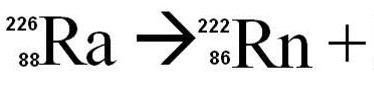
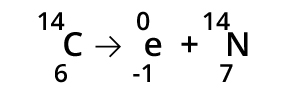
Complete the nuclear equation and determine the type of decay that is occurring in this reaction. 
a)
alpha
b)
beta
c)
gamma
d)
none
52.
Alpha particles have a _____ charge.
a)
+2
b)
0
c)
+1
d)
-1
53.
Barium-122 has a half-life of 2 minutes. A fresh sample weighing 80 g was obtained. If it takes 10 minutes to set up an experiment using barium-122, how much barium-122 will be left when the experiment begins?
a)
0.25g
b)
2.5g
c)
25g
d)
80g
54.
What is the missing isotope that will balance the following nuclear equation?
94Be  +  11H →  _____  +  42He
a)
105B
b)
105Ne
c)
63Li
d)
63C
55.
The time taken for half of an amount of radioactive atoms to decay.
a)
Nuclear fusion
b)
Full-life
c)
Dead time
d)
Half-life
56.
What is NOT a characteristic of an alpha particle?
a)
A negatively charged electron
b)
Stopped by paper
c)
A positively charged particle
d)
Low penetration
57.
When a nucleus undergoes nuclear decay by gamma rays, the atomic number of the element....
a)
remains the same
b)
  decreases by one.
c)
increases by one.
d)
increases by two.
58.
The process of the production of lighter nuclei from heavier nuclei is called
a)
mass energy
b)
magneticism
c)
fusion
d)
fission
59.
Radioactive materials have unstable...
a)
electrons
b)
protons
c)
nuclei
d)
neutrons
60.
The process by which nuclei having low masses are united to form nuclei with larger masses is ____.  
a)
a chain reaction 
b)
fission
c)
a chemical reaction 
d)
fusion 
61.
What is NOT a characteristic of gamma radiation?
a)
Most dangerous type of radiation
b)
High energy, high penetration
c)
stopped by thin metal
d)
Stopped by several feet of concrete or several inches of lead
62.
Which is not true of radioactive decay?
a)
It is a result of instability in atoms
b)
It happens only in nuclear power plants
c)
Radioactivity can be useful
d)
It is hazardous to human health
63.
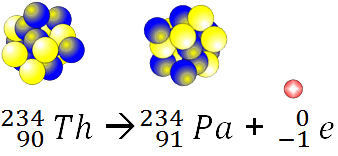
Which type of nuclear radiation is being emitted here?
a)
Alpha
b)
beta
c)
gamma 
d)
none
64.
Isotopes of the same element have different ____________. 
a)
 numbers of protons  
b)
numbers of electrons
c)
 symbols 
d)
numbers of neutrons
65.
When does radioactive decay occur?
a)
When the nucleus of an isotope is unstable
b)
When the nucleus of an isotope is stable
c)
When the electrons of an isotope are spinning
d)
When the electrons of an isotope are shared with another isotope
66.
Takes two small nuclei and combines them into a larger nucleus
a)
fission
b)
fusion
67.
How do nuclear power-plants work?
a)
Fusion
b)
Half-life
c)
Fission
d)
Fusion or fission
68.
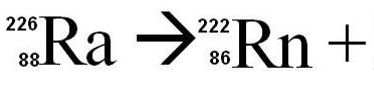
Complete the nuclear equation and determine the type of decay that is occurring in this reaction. 
a)
alpha
b)
beta
c)
gamma
d)
none
69.
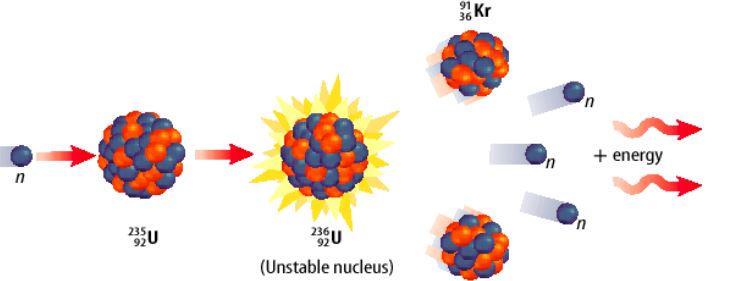
This is an example of...
a)
Fission  reaction
b)
Fusion reaction
c)
Decomposition reaction
d)
Decay
70.
Where does fusion occur naturally?
a)
Underwater
b)
All around us
c)
In the radioactive waste
d)
On the sun
71.
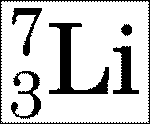
How many protons are in this atom?
a)
3
b)
4
c)
6
d)
10
72.
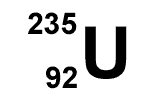
How many neutrons are in this isotope of Uranium?
a)
235
b)
92
c)
327
d)
143
73.
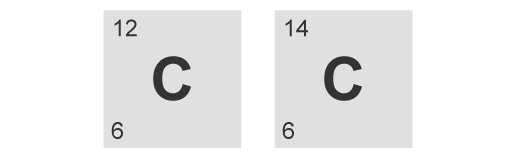
How are these isotopes different?
a)
Different atomic numbers
b)
Different number of protons
c)
Different number of neutrons
d)
Different number of electrons
74.
What is the mass number of at isotope that has 20 protons, 21 neutrons and 18 electrons?
a)
18
b)
20
c)
21
d)
41
75.
What type of nuclear equation is this?
a)
fusion
b)
fission
c)
alpha
d)
beta
76.
When neutrons produced react with other fissionable atoms, continuing the fission.
a)
Fission
b)
Chain Reaction
c)
Fusion
77.
What is the symbol for an alpha particle?
a)
42He
b)
0-1e
c)
0+1 e
d)
10n
78.
In the symbol 20682Pb what does 206 stand for?
a)
Mass number
b)
Atomic number
c)
Atomic mass
d)
Number of protons
79.
Balance the following equation:
146C --> 0-1e + ________
a)
145B
b)
146C
c)
147N
d)
42He
80.
What is the equation for the positron emission by oxygen-16?
a)
168O + 0+1e --> 169F
b)
168O --> 42He + 126C
c)
168O --> 0-1e + 169F
d)
168O --> 0+1e + 167N
81.

In the symbol 167N what the 7 stand for?

a)

Mass number

b)

Atomic number

c)

Atomic mass

d)

Number of neutrons

82.
Detects radiation by counting electric pulses carried by gas atoms ionized by radiation
a)
Geiger-Muller counter
b)
Scintillation counter
c)
Film badge
d)
Radioactive detective
83.
In an exothermic process the surrounding looses heat. 
a)
True
b)
False
84.
In an endothermic reaction the system is releasing energy.
a)
True
b)
False
85.
Is the combustion of gasoline endothermic or exothermic?
a)
Endothermic
b)
Exothermic
86.

During an endothermic reaction in a beaker if we are part of the surroundings and touched the beaker, it would feel _______.

a)

Warm

b)

Cold

c)

Bubbly

d)

Damp

87.
How can you convert Kelvin to Celcius?
a)
add 273
b)
subtract 273
c)
multiply by 273
d)
divide by 273
88.
How much heat does an aluminum block absorb if 10.00 grams ae heated from 25.0oC to 50.0oC? the specific heat of aluminum is .900J/goC
a)
450
b)
-450
c)
225
d)
-225
89.
A 24.0 gram sample of copper was heated from 25.0oC to 500.0oC, 4378J of heat were absorbed, what is the specific heat of copper?
a)
.384
b)
49909200
c)
2.60
d)
8.77
90.
When you dropped a hot metal sample into room temperature water in the lab what happened?
a)
the heat from the metal traveled into the water
b)
the cool from the water traveled into the hot metal
c)
both of the other answers are correct
91.
Exothermic reactions are reactions that
a)
release heat
b)
do not involve heat
c)
absorb heat
d)
take place instantaneously
92.
A process that absorbs heat is a(n) _______________ reaction?
a)
polythermic
b)
ergothermic
c)
exothermic
d)
endothermic
93.
Consider the reaction: 2 H2O + energy --> 2H2 + O2
a)
exothermic, releasing energy
b)
exothermic, absorbing energy
c)
endothermic, absorbing energy
d)
endothermic, releasing energy
94.
Heat flows from _______ to ______ objects
a)
cooler to warmer
b)
warmer to warmer
c)
warmer to cooler
d)
cooler to cooler
95.
Heat is measured in 
a)
joules
b)
grams
c)
degrees celcius
96.
Energy can not be created or destroyed, it can only be transferred refers to the....
a)
law of conservation of energy
b)
law of conservation of mass
c)
life facts
d)
law of conservation of chemistry
97.
The specific heat(c) of copper is 0.39 J/g °C. What is the temperature change(∆t) when 100 Joules of heat(Q) is added to 20 grams?
a)
12.82 °C
b)
24.12°C
c)
351 °C
98.
Heat transfer by conduction occurs when...
a)
particles bump into each other
b)
large numbers of atoms move from place to place
c)
atoms give off heat in the form of electromagnetic waves
d)
electromagnetic waves travel from place to place through a vacuum
99.
Heat transfer by convection occurs when...
a)
electrons bump into other electrons
b)
large numbers of atoms move from place to place
c)
atoms give off heat in the form of electromagnetic waves
d)
electromagnetic waves travel from place to place through a vacuum
100.
Heat travels from the sun to the earth by the process of...
a)
conduction
b)
convection
c)
radiation
d)
insulation
101.
The first law of thermodynamics states that energy is
a)
created
b)
destroyed
c)
conserved
d)
created and destroyed
102.
20 g of water. specific heat of water is 4.18 J/g°C.  temperature changes from 25° C to 20° Chow much heat energy (q) moves from the water to the surroundings?
a)
400 J
b)
210 J
c)
80 J
d)
4.18 J
103.
An exothermic reaction would show energy as a _________ in the chemical equation.
a)
reactant
b)
product
104.
The warm air from this heater creates a current when the warm air rises and the cold air sinks.
a)
conduction
b)
convection
c)
radiation
105.
At the beach on a hot day, the reason the water feels cool compared to the hot sand is due to which property?
a)
Mass density
b)
Temperature
c)
Specific heat
d)
Thermal conductivity
106.

Match the word with the picture

a)

barber

b)

astronaut

c)

mechanic

d)

pilot

107.
Which gas law uses a term defined as one mole of a material with a volume of one liter at STP
a)
ideal gas law
b)
combined gas law
c)
Dalton's law of partial pressure
d)
none of the above
108.
What 2 variables are used in a Hot Air Balloon? 
[Hint:  Space and Heat]
a)
Pressure and Volume
b)
Volume and Temperature
c)
Temperature and Pressure
d)
Pressure, Temperature and Volume 
109.

Which of these is the Ideal Gas Law?

a)

PV=nRT

b)

P1V1/T1=P2V2/T2

c)

Q=mCΔT

d)

ΔG=ΔH-ΔS

110.

Which of the following is the strongest base?

a)

oven cleaner - 13.5

b)

lemon juice - 2.5

c)

soap - 10

d)

blood - 7.4

111.

Which of the following is the weakest base?

a)

oven cleaner - 13.5

b)

lemon juice - 2.5

c)

soap - 10

d)

blood - 7.4

112.

Which of the following is the strongest acid?

a)

oven cleaner - 13.5

b)

lemon juice - 2.5

c)

soap - 10

d)

blood - 7.4

113.

Solutions that have more OH– ions than H+ ions are

a)

acids

b)

bases

c)

enzymes

d)

neutral

114.

Which of these pH values represent an acid?

a)

4

b)

8

c)

10

d)

12

115.

Milk is a very weak acid. What might its pH value be?

a)

6.5

b)

7.8

c)

4.2

d)

12.2

116.

Which of the following is an acid?

a)

vinegar

b)

bleach

c)

sugar in water

d)

starch in water

e)

toothpaste in water

117.

The pH value of an acid represents its __________ of positive ions in the solution

a)

amount

b)

concentration

c)

color

d)

charge

118.

The strongest bases have pH values close to

a)

0

b)

14

c)

7

d)

5

119.
Which of the following word pairs correctly completes the sentence below?
_______ are corrosive substances characterized as having a strong smell, a sour taste, and a _______.
a)
Acids; pH less than 7
b)
Acids; pH greater than 7
c)
Bases; pH greater than 7
d)
Bases; pH less than 7
120.
If an acid is combined with a base of equal strength, the result will most likely be
a)
a neutral solution.
b)
a stronger acid.
c)
impossible to tell without testing the pH.
d)
a stronger base
121.
Human blood has a pH between 7.35 and 7.45. Which of the following best describes human blood?
a)
strongly acidic
b)
slightly acidic
c)
strongly basic
d)
slightly basic
122.
Pure water has a pH of 7. Pure water _______.
a)
is a base
b)
is a neutral substance
c)
could be either an acid or a base
d)
is an acid
123.
The pH scale is a range from:
a)
1-7
b)
0-14
c)
1-5
d)
1-20
124.
A solution has a pH of 7.0.  What would happen to the pH if H ions were added?
a)
pH would go up
b)
pH would go down
c)
pH would stay the same
d)
None of these
125.
A solution has a pH of 7.0.  What would happen to the pH if OH ions were added?
a)
pH would go up
b)
pH would go down
c)
pH would stay the same
d)
None of these
126.
If the [H+] of a solution is 1 x 10⁻² mol/L the pH is
a)
2
b)
12
c)
-2
d)
1
127.
If the pH of a solution is 5.6 the pOH is
a)
6.5
b)
12.4
c)
8.4
d)
5.6
128.
A  pH and a pOH will add up to:
a)
0
b)
7
c)
14
d)
1.0 x 10⁻¹⁴
129.
If the [OH-] of a solution is 2.7 x 10⁻⁴ mol/L the pOH of the solution is
a)
10.44
b)
3.56
c)
1.00
d)
-4.43
130.
If the pH of a solution is 7 the solution is said to be
a)
Acidic
b)
Basic
c)
Neutral
d)
Tasty