
 Worksheets
APES Fall Semester Review
Total questions: 130
Worksheet time: 2hrs 34mins
Name
Class
Date
1.

Which element accumulates in the environment due to use of fertilizers?
a)
oxygen
b)
hydrogen
c)
nitrogen
d)
carbon
2.
Which has the least negative impact on wildlife habitat?
a)
agriculture
b)
development
c)
deforestation
d)
recreation
3.
Which is true of urban sprawl?
a)
it occurred in the 1800s
b)
it lasted 20 years in the 1990s
c)
it began in 1950 and continues until today
d)
it began in the 1990s and continues to today
4.
The large scale removal of trees by cutting or burning is called _______________.
a)
urbanization
b)
deforestation
c)
desertification
d)
overpopulation
5.
The movement of people from rural areas to big cities is called ________.
a)
urbanization
b)
deforestation
c)
desertification
d)
excommunication
6.
What are some bad things attributed to population growth?
a)
autism & genetic diseases
b)
religious conflict
c)
low wages & unemployment
d)
burning fossil fuels & increased CO2 production
7.
What are some reasons deforestation occurs?
a)
clearing land for agriculture, ranching, and mining
b)
just wanting to destroy things
c)
Population moving from rural areas to cities
d)
to make room for infrastructure
8.
This fire burns undergrowth and leaf litter. It kills seedling and small trees. It can protect the forest from pathogens.
a)
Crown
b)
Ground
c)
Surface
9.
Which of the following type of tree harvesting is the most detrimental to the environment?
a)
Strip Cutting
b)
Selective Cutting
c)
Clear Cutting
d)
Partial Harvest
10.
Which of the following is a threat to forest ecosystems?
a)
climate change
b)
unsustainable logging
c)
invasive species
d)
All of these
11.
Unfenced grasslands in tropical and temperate climates that supply forage for grazing animals are called
a)
rangeland
b)
pastures
c)
savannah
d)
steppes
12.
The best example of a surface fire is
a)
the type of fire that burns seedlings, small trees, and leaf litter, but not mature trees and most animals
b)
fire that is deliberately set, frequently in the tropical rainforest, after the trees have been cut down
c)
fires that occur along newly exposed edges of forest after fragmentation has occurred
d)
fire that allows dead wood, leaves, and other flammable ground litter to accumulate
13.
The best example of selective cutting is
a)
loggers cut small groups of intermediate or mature trees, resulting in less erosion and loss of nutrients on the hillside
b)
loggers cut a thin strip of trees along a hillside, the forest naturally regenerates, and then they cut a new strip next to the regenerated one
c)
a managed forest containing one or two species of trees, one section is clear-cut and replanted. It will be clear cut again once the trees are large enough
d)
loggers cut all trees in an area, resulting in a loss of nutrients in the soil and in sediment gathering in the stream downslope
14.
Which of the following is NOT an economic service provided by forests?
a)
provide habitat
b)
recreation
c)
lumber
d)
job opportunities
15.
The amount or concentration of H+ ions (H3O+) in a solution with a value below 7 on a scale from 1 to 14.
a)
acid
b)
base
c)
anion
d)
cation
16.
The amount or concentration of OH- ions in a solution with a value above 7 on a scale from 1 to 14.
a)
acid
b)
base
c)
anion
d)
cation
17.
The number of protons and neutrons in an element (atom)
a)
Atomic number
b)
Atomic mass
c)
The negative charged particle in the nucleus of an atom
d)
The sum of the particles in the nucleus of an atom
18.
The number of protons in an element
a)
Atomic number
b)
Atomic mass
c)
The negative charged particle in the nucleus of an atom
d)
The particle without a charge in the nucleus of an atom
19.
Neither mass or energy can be created or destroyed.
a)
First Law of Thermodynamics
b)
Second Law of Thermodynamics
c)
Murphy's Law
d)
DeWeese's Law
20.
When mass or energy changes form, it drops to a lower quality of mas or energy and heat is given off as a result.
a)
First Law of Thermodynamics
b)
Second Law of Thermodynamics
c)
Murphy's Law
d)
DeWeese's Law
21.
The splitting of the nucleus of an atom into nuclei of lighter atoms, accompanied by the release of energy.
a)
Fusion
b)
Fission
c)
Fishin
d)
Phishin
22.
A nuclear reaction in which atomic nuclei of low atomic number join together to form a heavier nucleus with the release of energy..
a)
Fusion
b)
Fission
c)
Fuzeon
d)
Phishin
23.
What is the charge of an electron?
a)
+
b)
-
c)
neutral
d)
It varies with the chemical bonding
24.
Matter is anything that has
a)
mass
b)
weight
c)
a sense of direction
d)
gravitational pull
25.

In this pH table, what substance is the most acidic?
a)
Ammonia
b)
Bleach
c)
Gastric juice
d)
Urine
26.
What is the charge of a proton?
a)
+
b)
-
c)
neutral
d)
It varies with the chemical bonding
27.
What is the charge of a neutron?
a)
+
b)
-
c)
It has mass but no charge
d)
It varies with the chemical bonding
28.
Which biome is characterized by low temperatures and low amounts of rainfall?
a)
tundra
b)
desert
c)
temperate deciduous forest
d)
tropical rain forest
29.
Which biome covers most of the land mass near the Earth's equator?
a)
tundra
b)
desert
c)
grassland
d)
tropical rainforest
30.
Which biome is found on the mountain above the tree line?
a)
grassland
b)
deciduous forest
c)
tundra
d)
tropical forest
31.
Which biome, because of its climate, has the largest number of species of plants and animals?
a)
tundra
b)
desert
c)
tropical rainforest
d)
pine forest
32.
One characteristic feature of tundra is that only the surface thaws in the summer and refreezes in the winter, leaving a layer of permanently frozen subsoil. This characteristic is known as
a)
glaciation
b)
permafrost
c)
crystallization
d)
soilfrost
33.
Which type of trees is found in a temperate forest?
a)
deciduous
b)
evergreen
c)
ginko
d)
palm
34.
Which biome receives between 0 to 25 centimeters of rain per year, has a temperature range of 0 to 50 degrees Celsius, has poor soil, and is home to lizards, scorpions, and snakes?
a)
desert
b)
mountain
c)
taiga
d)
tundra
35.
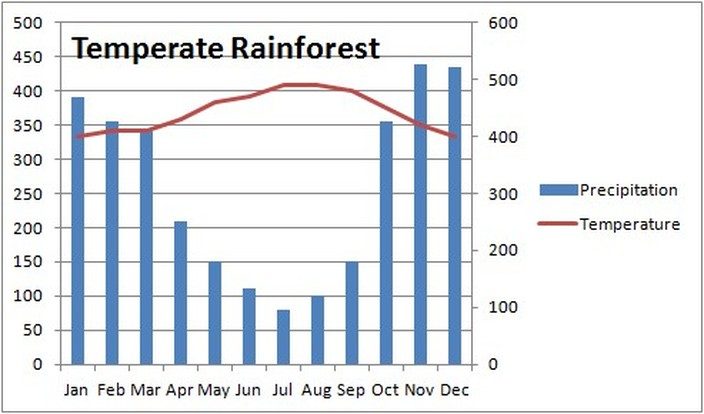
The most important abiotic factors when studying biomes are...
a)
Food and Water
b)
Water and Sunlight
c)
Temperature and Oxygen
d)
Water and Temperature
36.
Areas defined by their geographical location and ecological similarity are called?
a)
ecozones
b)
biotopes
c)
biomes
d)
biodomes
37.
Primary succession would occur on a
a)
meadow destroyed by flood
b)
meadow destroyed by overgrazing
c)
newly created volcanic island
d)
section of a forest destroyed by an avalanche
38.
Which of the following is not a density-dependent factor?
a)
emigration
b)
predation
c)
competition
d)
geographic isolation
39.
The use of Earth's renewable and nonrenewable natural resources in ways that do not constrain resource use in the future
a)
sustainability
b)
conservation
c)
preservation
d)
network
40.
All living organisms on Earth, including plants and animals, as well as microorganisms
a)
biosphere
b)
atmosphere
c)
lithosphere
d)
hydrosphere
41.
The thin layer of gases surrounding Earth
a)
atmosphere
b)
biosphere
c)
hydrosphere
d)
lithosphere
42.
Composed of living organisms
a)
biotic
b)
abiotic
c)
biosphere
d)
atmosphere
43.
The long-term average weather condition at a particular location
a)
climate
b)
weather
c)
region
d)
hearth
44.
The scientific study of ecosystems
a)
ecology
b)
ecosystem
c)
cultural ecology
d)
cartography
45.
A group of living organisms and the abiotic spheres with which they interact
a)
ecosystem
b)
ecology
c)
cultural ecology
d)
biotic
46.
All of the water on and near Earth's surface
a)
hydrosphere
b)
atmosphere
c)
biosphere
d)
lithosphere
47.
Something produced in nature more slowly than it is consumed by humans
a)
nonrenewable resource
b)
renewable resource
c)
preservation
d)
resource
48.
Composed of nonliving or inorganic matter
a)
abiotic
b)
biotic
c)
conservation
d)
biosphere
49.
Something produced in nature more rapidly than it is consumed by humans
a)
renewable resource
b)
non-renewable resource
c)
preservation
d)
possibilism
50.
A substance in the environment that is useful to people, is economically and technologically feasible to access, and is socially acceptable to use
a)
resource
b)
renewable resource
c)
non-renewable resource
d)
sustainability
51.

In a population of spiders there are three different sizes: small, medium, and large.
---The large spiders are easily seen by predators.
---Small spiders have a difficult time finding food.
What will most likely happen to this population of spiders after many generations?
---The large spiders are easily seen by predators.
---Small spiders have a difficult time finding food.
What will most likely happen to this population of spiders after many generations?
a)
Small and large spiders will mutate
b)
Medium spiders will be the most plentiful
c)
Large spiders will learn to hide from predators
d)
Small and medium spiders will be the least plentiful
52.

The habitat of a moth species included trees with both light and dark colored bark.Therefore the moth species included both light and dark colored variants.Then the light-colored trees were wiped out by a disease, and within a few years nearly all the moths in this forest were dark colored. Which of the following choices BEST explains what happened?
a)
The light moths that survived all had dark offspring in order to adapt to the change.
b)
The dark moths were less visible to predators, so mostly light moths were eaten.
c)
The few light moths that survived did not mate, and therefore they had no offspring.
d)
The light moths changed their wing pigments to darker colors to avoid being eaten.
53.
Which statement best explains how natural selection occurs?
a)
when adaptations help an organism reproduce and survive.
b)
when organisms are geographically isolated.
c)
when an organism’s offspring grow vestigial structures.
d)
when characteristics from the parent organism are inherited.
54.
How is secondary succession different from primary succession?
a)
Secondary succession occurs after a disturbance in an area that was previously uninhabited.
b)
Secondary succession occurs after a disturbance in an area in which the soil has remained intact.
55.

What does this picture represent?
a)
species diversity
b)
ecosystem diversity
c)
genetic diversity
d)
biodiversity
56.
Globally, the leading cause of biodiversity loss is
a)
invasive species
b)
poaching and overharvesting
c)
pollution
d)
habitat change and loss
57.

Characteristic or trait that helps an organism survive in its environment
a)
skills
b)
speciation
c)
natural instinct
d)
adaptation
58.

Charles Darwin noticed that birds of the Galapagos Islands were very similar in size and shape but their beaks were very different. What is the explanation for birds having different beaks?
a)
gathering food
b)
building nest
c)
fighting
d)
scaring predators
59.
Which of the following describes the importance of biodiversity to an ecosystem?
a)
a. People like to be able to see all the different plants and animals
b)
b. If there aren�t all the different species, there will be resources that aren�t being used
c)
c. Biodiversity is not as important as many people think
d)
d. Biodiversity can help minimize the effects of losing a species.
60.
What is the main suspected environmental problem associated with the burning of fossil fuels?
a)
a. Depletion of fresh water
b)
b. Depletion of ozone
c)
c. Global cooling
d)
d. Global warming
61.
Which human activity would be most destructive to the biodiversity of the biosphere?
a)
a. The burning of wood and coal in rural areas
b)
b. The release of species of freshwater trout in lakes
c)
c. The removal of plants from the food webs they support
d)
d. The removal of erosion barriers from forest boundaries
62.
What affect will continued rise in global temperature most likely have on worldwide biodiversity?
a)
a. It will have no effect as there is plenty of time for organisms to adapt
b)
b. It will increase due to warmer temperatures
c)
c. It will increase due to greater plant production from more CO2
d)
d. It will decrease due to massive habitat destruction
63.
Why are invasive species such a problem in their new ecosystem?
a)
a. The new ecosystem isn�t adapted to their presence
b)
b. The new ecosystem is probably weaker than the native one
c)
c. They have mutations making them more adapted to the new ecosystem
d)
d. They cause mutations in the native species
64.
Programs that breed animals in captivity then release them to the wild are called...
a)
Kidnapping
b)
Breeding Buildings
c)
Captive Breeding Programs
d)
Catch and Release Programs
65.
Biologists put extra effort into protecting these because they have many species living in them.
a)
Cities
b)
Biodiversity Hotspots
c)
Farms
d)
Conservation stations
66.
The excessive use of a species that has economic value.
a)
Biodiversity
b)
Natural resources
c)
Overexploitation
d)
population growth
67.
The species that plays the biggest role in the habitat is?
a)
Smaller species
b)
Larger species
c)
Keystone Species
d)
Evolving species
68.
An event in which a large percentage of all living species become extinct in a relatively short period of time.
a)
Habitat fragmentation
b)
Mass extinction
c)
Overexploitation
d)
Background extinction
69.
Charles Darwin’s observation that finches of different species on the Galápagos Islands have many similar physical characteristics supports the hypothesis that these finches
a)
have the ability to interbreed.
have the ability to interbreed.
have the ability to interbreed.
b)
acquired traits through use and disuse.
c)
all eat the same type of food.
d)
descended from a common ancestor.
70.

Which of the following is a term for a group of similar organisms that can reproduce fertile offspring?
a)
individual
b)
population
c)
species
d)
fossil
71.
The introduction of Alien species affects biodiversity negatively if the alien species;
a)
has a faster growth rate than native species
b)
outcompetes the native species for resources
c)
carries a new pathogen into the native species habitat
d)
all of the above.
72.
What is THE most major cause of extinction today?
a)
habitat destruction by humans
b)
poaching
c)
disease
d)
hunting
73.

What is the role of the snake in this food web?
a)
Primary consumer
b)
Secondary consumer
c)
Tertiary consumer
d)
Producer
74.
Define habitat fragmentation.
a)
The excessive use of a species that has economic value.
b)
All species dying in one area
c)
The different environmental conditions that occur along the boundaries of an ecosystem.
d)
The separation of an ecosystem into small areas.
75.
What is a Endemic ?
a)
Found only in one specific geographic area
b)
Any materials or organism in the biosphere
c)
The variety of species in the biosphere decreases
d)
An event in which large percentage of all living species
76.
What is Genetic Diversity ?
a)
The variety of genes or inhertable characteristics that are present in a population
b)
Technique of adding essential materials to a degraded ecosystem
c)
Found only in one specific geographic area
d)
Any materials or organism in the biosphere
77.
What is Species Diversity ?
a)
The Variety of ecosystems that are present in the biosphere
b)
An event in which large percentage of all living species
c)
One of the factors that is increasing the current rate of life extinction
d)
The number of different species and the relative abundance of each species
78.
What is Ecosystem Diversity ?
a)
The variety of ecosytems that are present in the biosphere
b)
An event in which large percentage of all living species
c)
The separation of an ecosystem into small pieces of land
d)
Found only in one specific geographic area
79.

What type of growth model is this?
a)
exponential growth model
b)
logistic growth model
c)
Type I curve
d)
Type III curve
80.
relationship in which two species live closely together
a)
resource
b)
mutualism
c)
succession
d)
symbiosis
81.
symbiotic relationship in which one organism benefits and the other organism is harmed
a)
secondary succession
b)
predation
c)
pioneer species
d)
parasitism
82.
the species that starts life in primary succession
a)
pioneer species
b)
succession
c)
nitrogen fixation
d)
cellular respiration
83.
a relationship between two in which the predator feeds on the prey
a)
chemosynthesis
b)
predation
c)
cellular respiration
d)
commensalism
84.
symbiotic relationship in which one organisms benefits and the other organism is not affected
a)
invasive (non-native) species
b)
mutualism
c)
nitrogen fixation
d)
commensalism
85.
symbiotic relationship in which both organisms benefit
a)
competition
b)
Mutualism
c)
nitrogen fixation
d)
energy pyramid
86.
Many members of one species in an area
a)
Ecosystem
b)
community
c)
biodiversity
d)
population
87.
Consumer that eats plants
a)
heterotroph
b)
herbivore
c)
producer
d)
community
88.
Populations of different organisms living in an area
a)
species
b)
community
c)
niche
d)
biome
89.
All the living and non-living in an area
a)
ecosystem
b)
carnivore
c)
niche
d)
population
90.
Organisms move away from an area
a)
Competition
b)
Predation
c)
Emigration
d)
Immigration
91.
What do you call a period of rapid growth?
a)
Exponential growth
b)
Logistic growth
c)
Emigration
d)
Mortality
92.
An environmental factor such as predation, disease, and competition that depends on the number of members in a population per unit
a)
dispersion
b)
density- independent factor
c)
density- dependent factor
d)
population growth rate
93.
population numbers get too large for the environment to support it and growth slows
a)
Exponential growth
b)
Logistic growth
c)
Natality
d)
Emigration
94.
Any factor that limits population growth
a)
Limiting Factor
b)
Immigration
c)
Succession
d)
Abiotic Factor
95.
When a population has reached carrying capacity
a)
Growth & Immigration are equal to Death & emigration
b)
Growth & Immigration are less than Death & emigration
c)
Growth & Immigration are greater than Death & emigration
d)
Growth is exponential
96.
What factor describes when populations increase because animals are moving into a population?
a)
Emigration
b)
Limiting Factors
c)
Immigration
d)
Exponential Growth
97.
The graph of logistic growth can be described as...
a)
S-shaped
b)
J-shaped
c)
W-shaped
d)
U-shaped
98.

The step in the nitrogen cycle where bacteria convert ammonia (NH3) to nitrate (NO3-) is:
a)
nitrification
b)
ammonification
c)
nitrogen fixation
d)
assimilation
99.
The process where some bacteria remove nitrate from the soil by converting it to nitrogen gas is:
a)
nitrification
b)
nitrogen fixation
c)
denitrification
d)
nitrification
100.
Nitrogen is essential for living organisms to make:
a)
Lipids
b)
Carbohydrates
c)
Proteins
d)
Fats
101.
Nitrogen gas accounts for what percentage of the atmosphere?
a)
55%
b)
5%
c)
Less than 1%
d)
78%
102.
Biogeochemical cycles:
a)
only include processes conducted by or within living organisms.
b)
describe the movement of water and other materials throughout the abiotic and biotic environment.
c)
only pertain to exchanges and interactions that occur within the atmosphere.
d)
are used to describe the attempts of humans to recycle various pollutants.
103.
Which of the following can naturally "fix" atmospheric nitrogen so plants can utilize it?
a)
only bacteria
b)
bacteria and lightening
c)
herbivores
d)
carnivores
104.
Which of the following leads to a decrease in birthrates among women?
a)
Higher Education
b)
High Infant Mortality Rate
c)
No Prenatal Care
d)
No contraceptives
105.
Birthrate remains high, death rate begins to fall, total population increasing
a)
Stage 1 Demographic Transition
b)
Stage 2 Demographic Transition
c)
Stage 3 Demographic Transition
d)
Stage 4 Demographic Transition
106.
All of the following are density independent factors EXCEPT
a)
Limited food
b)
Earthquakes
c)
Hurricanes
d)
Torandoes
107.
The measure of the quality of life is also known as the
a)
Total Fertility Rate
b)
Replacement Level Fertility
c)
Infant Mortality Rate
d)
Birth Rate
108.
The most populous country in the world
a)
China
b)
India
c)
US
d)
Brazil
109.
A pyramid shaped age structure diagram would represent what type of growth?
a)
Declining
b)
Stable
c)
Rapid
110.
The number of children an average woman would have during her reproductive years
a)
Birthrate
b)
IMR
c)
TFR
d)
Life expectancy
111.
All of the following are characteristics of R selected species except
a)
No prenatal care
b)
Short Lifespan
c)
Early reproductive age
d)
Few Offspring
112.
The number of individuals an environment can support is known as the
a)
Total Fertility Rate
b)
Exponential Growth
c)
Limiting Factor
d)
Carrying Capacity
113.
Biotic Potential has
a)
Limiting Factors
b)
Reached Carrying Capacity
c)
Has No limiting Factors
d)
Scarce Resources
114.
A country that represents stable growth
a)
Japan
b)
Germany
c)
Afghanistan
d)
Canada
115.
A country that represents Rapid Growth
a)
United States
b)
Russia
c)
China
d)
Iraq
116.
A population experiencing declining growth
a)
Russia
b)
Nigeria
c)
United States
d)
Australia
117.
A small community started out with 10 people in year 1. During year 1 they had 10 births and 5 deaths. What was this community's growth rate for year 1?
a)
50 %
b)
5 %
c)
75 %
d)
1.5 %
118.

In what year did exponential growth start to occur for the population on the graph?
a)
1850
b)
1900
c)
1825
d)
1800
119.
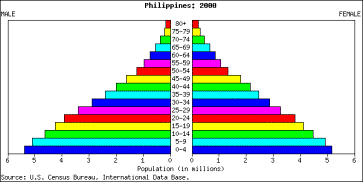
According to the population pyramid of this country, its population is most likely...
a)
growing slowly.
b)
growing rapidly.
c)
decreasing.
d)
not changing.
120.
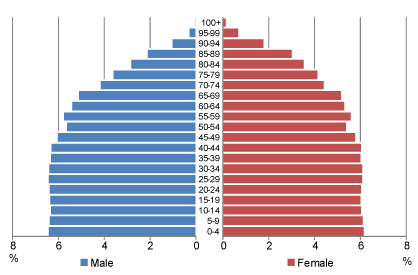
What kind of growth is this country experiencing?
a)
Exponential Growth
b)
Stable Growth
c)
Declining Growth
121.
Which statement about human population growth is LEAST likely to be correct?
a)
Modern medicine has allowed human populations to extend well past the earth's carrying capacity, as more people survive for longer.
b)
Technological advances in farming and medicine will allow human populations to continue to grow without natural limits.
c)
Advances in agriculture have allowed the world's food supply to expand dramatically in the last 100 years.
d)
Worldwide, humans are reproducing more quickly than mortality is removing people from the population.
122.
The most populous country in the world are China, India, and
a)
Indonesia
b)
Russia
c)
The United States
d)
Mexico
123.
Factors that affect the total fertility rate of the human population include which of the following?
I. Cultural traditions
II. Government policies and economic incentives
III. Education level and economic opportunities for females
I. Cultural traditions
II. Government policies and economic incentives
III. Education level and economic opportunities for females
a)
I only
b)
II only
c)
I and II only
d)
I, II, and III
124.
Which of the following is NOT a MAIN environmental problem?
a)
Resource Depletion
b)
Pollution
c)
Loss of Biodiversity
d)
Poverty
125.
A resource that can be replaced relatively quickly by natural processes.
a)
Renewable Resource
b)
Non Renewable Resource
c)
Biodegradable
d)
Non Biodegradable
126.
Resources are said to be __________ when a large fraction of the resource has been used up
a)
Depleted
b)
Extinct
c)
Abundant
127.
An undesired change in air, water or soil that adversely affects the health, survival, or activities of humans or other organisms.
a)
Pollution
b)
Loss of Biodiversity
c)
Natural Resource Depletion
128.
The __________ Revolution was characterized by a shift from human and animal power to fossil fuels (coal and oil)
a)
Agricultural
b)
Industrial
c)
Tragedy of the Commons
129.
True or False: We need the Nitrogen cycle, Carbon cycle, and Water Cycle to survive.
a)
True
b)
False
130.
Matter
a)
a measurement of the amount of matter an object contains
b)
anything that occupies space and has mass
c)
the smallest particle that can contain the chemical porperties of an element
d)
a particle that contains more than one atom
100 %

