
 Worksheets
Chapman Midterm Review Honors Chemistry
Total questions: 132
Worksheet time: 2hrs 26mins
Name
Class
Date
1.
Determine if Barium Sulfide is Ionic or covalent
a)
Ionic
b)
Covalent
2.
Which of the following is the correct name for MgF2?
a)
Magnesium Fluorine
b)
Magnesium Difluoride
c)
Magnesium Fluoride
3.
Which of the following is the correct name for BaO?
a)
Barium Oxygen c.
b)
Barium (I) Oxide
c)
Barium Oxide
4.
Which of the following is the correct name for PbCl4?
a)
Lead Chloride
b)
Lead (I) Chloride
c)
Lead (IV) Chloride
5.
Which of the following is the correct formula for copper (I) sulfide?
a)
CuS
b)
Cu2S
c)
CuSO4
6.
Which of the following is the correct name for Na2SO4?
a)
Sodium sulfide
b)
Sodium disulfite
c)
Sodium sulfate
7.
Which of the following is the correct name for Fe2(SO4)3?
a)
Iron (II) Sulfate
b)
Iron (II) Sulfite
c)
Iron (III) Sulfate
8.
Which of the following is the correct formula for calcium phosphate?
a)
Ca3(PO4)2
b)
Ca2(PO4)3
c)
CaPO4
9.
Which of the following is the correct formula for sodium carbonate?
a)
NaC2
b)
Na2CO3
c)
Na3CO
10.
Permanganate
a)
NH4+
b)
NO2-
c)
NO3-
d)
MnO4-
11.

How many lone pairs are in this molecule's structure?
a)
6
b)
2
c)
0
d)
4
12.
VSEPR stands for ________ theory.
a)
Valence Structure of Electron Pyramids and Regression
b)
Varied Structures of Electrons Paired and Replaced
c)
Varied Shell Energy of Protons and Radiation
d)
Valence Shell Electron Pair Repulsion
13.
A bond where electrons are NOT shared equally?
a)
polar covalent
b)
nonpolar covalent
14.
What is the empirical formula of the following molecular formula: C3H6
a)
C3H6
b)
CH2
c)
C2H4
d)
CH3
15.
What is the empirical formula for the following molecular formula: C5H12
a)
C5H12
b)
CH3
c)
CH2
d)
C2.5H6
16.
Which pair has the same empirical formula?
a)
NaCrO4 and Na2Cr2O7
b)
C2H4O2 and C6H12O6
c)
C3H6O3 and C2H6O2
d)
CH4 and C2H6
17.

In which region would the nonmentals be found?
a)
1
b)
4
c)
3
d)
5
18.
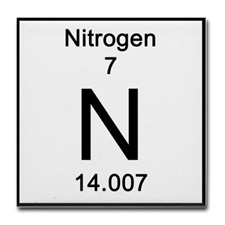
What is the number of protons that the element in this image contain?
a)
14
b)
7
c)
15
d)
18
19.

What is the atomic mass of "F"
a)
9
b)
18
c)
17
d)
19
20.
The positive particles of an atom are
a)
electrons
b)
positrons
c)
neutrons
d)
protons
21.
the central region of an atom where its neutrons and protons are is its
a)
nucleus
b)
electron cloud
c)
core
d)
center
22.
Something that is made up of only one kind of atom is known as _________________.
a)
a molecule
b)
a compound
c)
an element
d)
a proton
23.
A "group" is a ____________ on the periodic table.
a)
column
b)
row
24.
A "period" is a ____________ on the periodic table.
a)
column
b)
row
25.
Helium, neon, argon, krypton, xenon, and radon are known as _____________.
a)
halogens
b)
noble gases
c)
metalloids
d)
transition elements
26.
Is melting butter for popcorn a chemical or physical change?
a)
chemical
b)
physical
27.

Is burning wood a chemical or physical change?
a)
chemical
b)
physical
28.
When you break a cracker into pieces it is a
a)
Chemical change
b)
Physical change
c)
Chemical Weathering
d)
Physical Weathering
29.
Which is a chemical change?
a)
freezing fruit juice
b)
slicing a potato
c)
boiling water
d)
copper metal turning green
30.
Which is not a sign of a chemical change?
a)
water evaporating
b)
gas bubbles
c)
color change
d)
temperature change
31.
Most elements on the periodic table are
a)
metals
b)
nonmetals
c)
metalloids
32.
Why would a ball float on top of water?
a)
the ball is more dense than water
b)
the ball is less dense than water
c)
they both have equal densities
33.
An element is composed of only one type of
a)
atom
b)
molecule
c)
compound
d)
mixture
34.
Which of the following cannot be broken down into a simpler substance?
a)
water
b)
sand
c)
the element silver
35.
A substance is dull, brittle and does not conduct electricity. It is most likely a
a)
metal
b)
nonmetal
c)
metalloid
36.
Which of the following is a sign that a chemical reaction has occurred?
a)
change in shape
b)
melting
c)
formation of a gas
d)
dissolving
37.
What does the Law of Conservation of Mass state?
a)
Matter cannot be gained or lost in a chemical reaction.
b)
Matter can only be lost in a chemical reaction.
c)
Matter can only be gained in a chemical reaction.
d)
Matter can be gained and lost in a chemical reaction.
38.
What atom matches this electron configuration?
1s22s22p63s2
1s22s22p63s2
a)
Neon
b)
Magnesium
c)
Aluminum
d)
Potassium
39.
What electron configuration matches an oxygen atom?
a)
1s22s22p63s2, 3p64s23d104p5
b)
1s22s22p4
c)
1s22s22p6
d)
1s22s22p63s23p64s23d1
40.

How many electrons does Si contain? (click to see image)
a)
14
b)
28
c)
2
d)
4
41.
What do you start electron configuration with?
a)
1s2
b)
1d10
c)
1f14
d)
1p6
42.
What is the electron configuration of Ag?
a)
1s2 2s2 2p6 3s2 3p6 4s2 3d10 4p6 5s1 4d10
b)
[Kr] 5s2 4d9
c)
1s2 2s2 2p6 3s2 3p6 4s2 4p6 5s2 4d9
d)
1s2 2s2 2p6 3s2 3p6 3d10 4s2 4d10 4p6 5d10 5s2 4d9
43.
There are 4 different types of subshells s,p,d,f
a)
true
b)
false
44.
Identify the Electron Configuration for Aluminum (Al)
a)
1s2 2s2 2p6 3s2 3p1
b)
1s2 2s2 2p6 3s2 3p3
c)
1s2 2s2 2p6 3s2 4p1
45.
The ________________ tells you how many energy levels are used in an element.
a)
group number
b)
atom
c)
protons
d)
period number
46.
The characteristics or properties of metals include
a)
shiny and solid
b)
ductile and malleable
c)
lose electrons
d)
all of the above
47.
True or False - An energy level has to be full before moving on to the next energy level?
a)
true
b)
false
48.
How many valence electrons do elements in group 17 have in their outer energy level?
a)
7
b)
17
c)
1
d)
0
49.
Water is an element?
a)
true
b)
false
50.
Most of the mass in an atom is made up of _____________________?
a)
protons and electrons
b)
protons and neutrons
c)
neutrons and electrons
d)
electrons and quarks
51.
The group number tells us how many _________ there are in an element.
a)
groups
b)
valence electrons
c)
energy levels
d)
chemicals
52.
If there is no subscript, there is ______ atom(s) of that element.
a)
0
b)
2
c)
only 1
d)
1 million
53.

How many atoms of Hydrogen are in this compound
a)
1
b)
2
c)
3
d)
4
54.
an atom with atomic number 6 would have how many protons
a)
6
b)
12
c)
3
d)
cannot be determined
55.
Particles in an atom that are neutral and have no charge are
a)
negatrons
b)
electrons
c)
neutrons
d)
protons
56.
How many valence electrons does Chlorine have?
a)
5
b)
2
c)
7
d)
5
57.
How many valence electrons does phosphorus have?
a)
5
b)
2
c)
8
d)
15
58.
What element has the valence shell configuration
3s2 3p2
3s2 3p2
a)
Al
b)
B
c)
Si
d)
Ga
59.
Name the compound AlBr3
a)
aluminum bromide
b)
aluminum tribromide
c)
aluminum bromine
d)
monoaluminum tribromide
60.
Name the compound Na2O
a)
Sodium Oxide
b)
Sodium Dioxide
c)
Sodium Oxygen
d)
Natride Oxide
61.
According to VSEPR, molecules adjust their shapes to keep which of the following as far away as possible?
a)
Pairs of valence electrons
b)
Inner shell electrons
c)
Mobile Electrons
d)
Electrons closest to the nucleus
62.
Which of the following shapes has unshared pairs of electrons on the central atom?
a)
Bipyramidal
b)
Bent
c)
Trigonal Planar
d)
Tetrahedral
63.
Is salt (NaCI) a compound or a element
a)
Compound
b)
element
64.
Boiling water
a)
Chemical Change
b)
Physical Change
65.
What is the formula for nitrogen trifluoride
a)
NF3
b)
N2F3
c)
NF
d)
NFL
66.
What is the formula for Tetraphosphorus decoxide
a)
(PO4)4O2
b)
P4O2
c)
P4O10
d)
none of the above
67.
phosphate
a)
PO32-
b)
PO33-
c)
PO42-
d)
PO43-
68.
chlorate
a)
ClO21-
b)
ClO31-
c)
ClO41-
d)
ClO1-
69.
cyanide
a)
CN2-
b)
CN1-
c)
CN21-
d)
CNO1-
70.
carbonate
a)
C4-
b)
CO42-
c)
CO32_
d)
CO31-
71.
sulfate
a)
SO22-
b)
SO43-
c)
SO32-
d)
SO42-
72.
nitrate
a)
N3-
b)
NO21-
c)
NO2-
d)
NO31-
73.
ammonium
a)
NH41+
b)
NH42+
c)
NH31+
d)
NH32+
74.
hydroxide
a)
H1-
b)
H1+
c)
OH1-
d)
OH21-
75.

What geometry will this molecular structure have?: CCl4
a)
bent
b)
tetrahedral
c)
linear
d)
trigonal pyramidal
76.
Will this molecule be polar or nonpolar? CCl4
a)
polar
b)
nonpolar
77.

Will this molecule be polar or nonpolar? PH3
a)
polar
b)
nonpolar
78.

What geometry will this molecular structure have?: CS2
a)
bent
b)
tetrahedral
c)
linear
d)
trigonal pyramidal
79.

Will this molecule be polar or nonpolar? CS2
a)
polar
b)
nonpolar
80.
True or False: A PHYSICAL CHANGE does NOT create a different kind of matter.
a)
True
b)
False
81.
Baking a cake is an example of a...
a)
Physical Change
b)
Chemical Change
82.
How are covalent bonds explained?
a)
When one atom takes the other atom's electron
b)
When the atom shares an electron with an another atom
c)
When the two nucleus merge
d)
When the neutrons leave the nucleus
83.
Which of the following has the most number of O?
a)
2Mg3(PO4)2
b)
4AlPO4
c)
3Al(NO3)3
d)
15KOH
84.
A copper penny can turn green if it reacts with carbon dioxide and water. This is an example of a(n)___.
a)
physical change
b)
chemical change
c)
physical property
d)
chemical property
85.
The process of changing into entirely new substances
a)
chemical change
b)
physical change
86.
The change of state from a liquid to a gas
a)
evaporation
b)
condensation
87.
The change of state from a gas to a liquid
a)
condensation
b)
evaporation
88.
Calculate the density of a 200 g rectangular block with the following demensions:
length= 5 cm, width = 6 cm, height = 2 cm
length= 5 cm, width = 6 cm, height = 2 cm
a)
3.33 g/cm3
b)
4.3 g/cm3
c)
40 g/cm3
d)
33.3 g/cm3
89.
Mass = 35 g
Volume = 17 mL
Density = ?
Volume = 17 mL
Density = ?
a)
20.06 g/mL
b)
2.06 g/mL
c)
10.06 g/mL
d)
1.06 g/mL
90.
Experimental Value = 86 cm
Accepted Value = 78 cm
Percent Error?
Accepted Value = 78 cm
Percent Error?
a)
12%
b)
10 %
c)
8%
d)
6%
91.
How many molecules are in 9.44 moles of aluminum chloride?
a)
5.68 molecules AlCl3
b)
5.68x1024 molecules AlCl3
c)
0.705 molecules AlCl3
d)
1.25x10²³ molecules AlCl3
92.
How many moles are in 16.94g of water?
a)
16.94 mol H2O
b)
0.9401 mol H2O
c)
305.3 mol H2O
d)
1.063 mol H2O
93.
On Periodic Table, how are elements ordered?
a)
color
b)
shape
c)
atomic number
d)
alphabetically
94.
How many elements are in the this compound?
H2CO4N5
H2CO4N5
a)
11
b)
4
c)
12
d)
5
95.
What make atoms react with each other and create bonds?
a)
The atomic number
b)
The atomic Mass
c)
The electrons of the outer shell
d)
The electrons of the inner shell
96.
What is the noble gas configuration for boron?
a)
[He]1s22s2
b)
[He]2s22p2
c)
[He]2s22p1
d)
[Li]2s22p1
97.
[Ne]3s23p1 is the noble gas configuration for which element?
a)
scandium
b)
boron
c)
nitrogen
d)
aluminum
98.
What is the noble gas configuration for Argon?
a)
[Ne]2s22p6
b)
[He]2s22p6
c)
[He]3s23p6
d)
[Ne]3s23p6
99.
What is the noble gas configuration for phosphorus?
a)
[Ar] 3p5
b)
[He] 3s2 3p5
c)
[Ne] 3s2 3p3
d)
[Na] 3s2 3p5
100.
What is the noble gas configuration for Neon?
a)
[Ne]
b)
[He]2s22p6
c)
[F]2p1
d)
[Ne]2s21p6
101.
What is the symbol for iron?
a)
I
b)
Ir
c)
Fe
102.
When an atom loses electrons it becomes
a)
a positive ion
b)
a negative ion
c)
both positive and negative ion
d)
a neutral ion
103.
What is the mass number defined as?
a)
the number of protons
b)
the number of protons and neutrons
c)
the number of neutrons
d)
the number of protons and electrons
104.
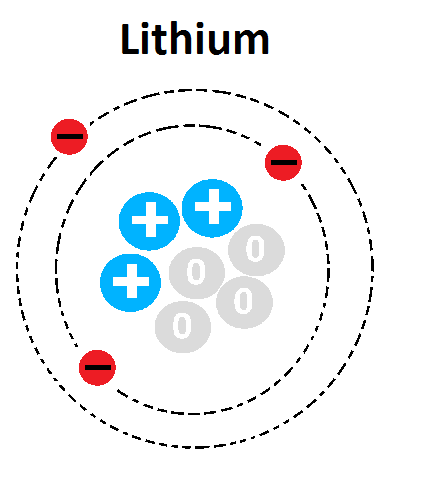
What is the atomic number of this atom?
a)
1
b)
3
c)
4
d)
7
105.
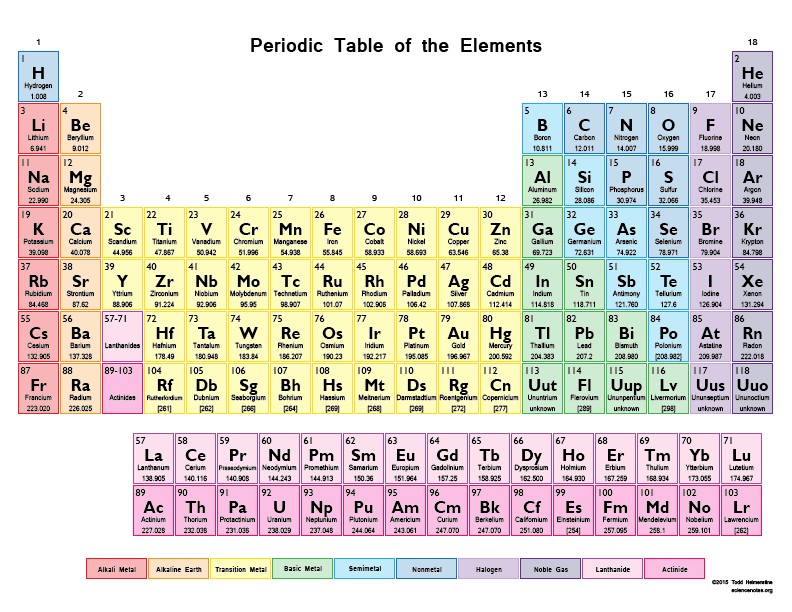
How many protons are in a sodium atom? (tap to enlarge the periodic table)
a)
Sodium has 1 proton.
b)
Sodium has 3 protons.
c)
Sodium has 11 protons
106.
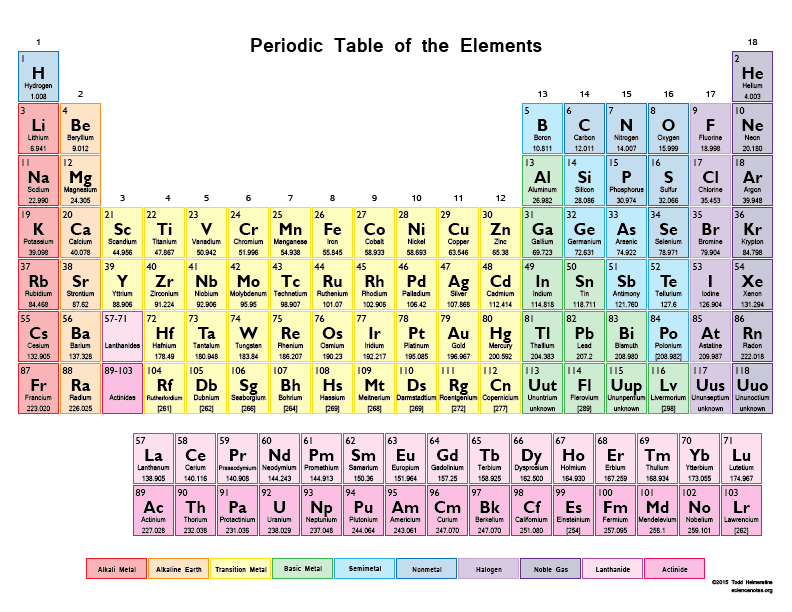
How many neutrons does an atom of the isotope Neon-22 have? (tap to enlarge the image)
a)
12
b)
10
c)
22
d)
20
107.

What electron geometry will this molecular structure have?: H2S
a)
bent
b)
tetrahedral
c)
linear
d)
trigonal pyramidal
108.

Will this molecule be polar or nonpolar? H2S
a)
polar
b)
nonpolar
109.

What shape will this molecular structure have?: PH3
a)
bent
b)
tetrahedral
c)
linear
d)
trigonal pyramidal
110.
Where are electrons?
a)
Nucleus
b)
Electron Cloud
c)
Hiding
d)
No Where
111.
Which of the following is an example of a physical change?
a)
a car rusting
b)
cutting a piece of wood
c)
acid rain corroding a barn door
d)
water seperating into hydrogen and oxygen atoms.
112.

What is the number 22?
a)
Atomic Number
b)
Atomic Mass
c)
Element Name
d)
Chemical Symbol
113.
How many different elements are represented in the compound?
Na2CO3
Na2CO3
a)
1
b)
2
c)
3
d)
4
114.
Which of the following is a sign that a chemical reaction has occurred?
a)
change in shape
b)
melting
c)
formation of a precipitant
d)
dissolving
115.
A substance that is lustrous, malleable, and conducts heat and electricity well. The substance is most likely:
a)
metal
b)
nonmetal
c)
metalloid
116.
Which of the following is the correct formula for calcium chloride?
a)
CaCl
b)
Ca2Cl
c)
CaCl2
117.
What is the formula for disulfur trioxide?
a)
S3O2
b)
SO
c)
S2O3
d)
S2O
118.
Name the compound P2O5
a)
Phosphorus Oxide
b)
Pentaphosphorus Dioxide
c)
Diphosphorous pentoxide
d)
Phosphoric Oxygen
119.
What is the formula for potassium hydroxide
a)
KH
b)
KOH
c)
K2OH
d)
K(OH)2
120.
The subatomic particle with a negative charge is the
a)
electron
b)
proton
c)
neutron
d)
nucleus
121.
You are given the following percentages: 40.05% S and 59.95% O. Find the empirical formula for these elements. (keep two decimal places throughout calculations)
a)
SO
b)
SO2
c)
SO3
d)
SO4
122.
What is the empirical formula if you have 88.80% copper and 11.20% oxygen?
a)
Cu3O8
b)
CuO4
c)
Cu2O
d)
Cu4O10
123.
What is the molecular formula if the empirical formula is C2H5 and the molecular molar mass is 58.14 g/mol?
a)
C2H5
b)
C4H10
c)
C1H2.5
d)
C4H8
124.
What is the percent by mass of magnesium in MgO?
a)
20%
b)
40%
c)
50%
d)
60%
125.
What is the percent composition by mass of sulfur in the compound MgSO4 (gram formula mass = 120 g/mol)?
a)
20%
b)
27%
c)
46%
d)
53%
126.
What is the percent by mass of fluorine in CaF2 (gram-formula mass = 78 g/mol)?
a)
24%
b)
49%
c)
51%
d)
65%
127.
Experimental Value = 50 cm
Accepted Value = 55 cm
Percent Error = ?
Accepted Value = 55 cm
Percent Error = ?
a)
9%
b)
-9%
c)
10 %
d)
-10%
128.
The deer population is estimated to be 17,600 in northern Illinois, but an actual count was 21,300. What is the percent error?
a)
21%
b)
17.37%
c)
17.4%
d)
21.02%
129.
During the school fire drill the actual count of students was between 1380 and 1402. What is the most the percent error could be? Round your answer to the nearest tenth of a percent.
a)
1.6%
b)
1.56%
c)
1.59%
130.
Particles in an atom that are neutral and have no charge are
a)
negatrons
b)
electrons
c)
neutrons
d)
protons
131.
How many valence Electrons does Copper Have?
1s2 2s2 2p6 3s2 3p6 4s2 3d9
1s2 2s2 2p6 3s2 3p6 4s2 3d9
a)
8
b)
9
c)
17
d)
2
132.
Breaking a window or crumpling a piece of paper are examples of a....
a)
Physical Change
b)
Chemical Change
100 %

