
 Worksheets
AP Chemistry Unit 1 MCQ 1.5 minutes
Total questions: 135
Worksheet time: 3hrs 23mins
Which of the following represents a pair of isotopes?


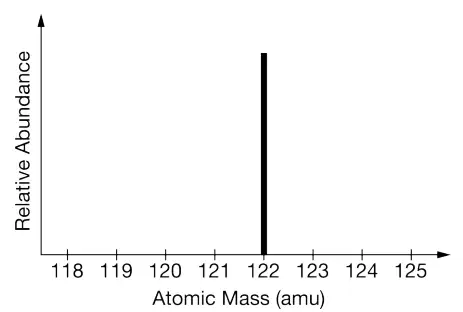
The elements I and Te have similar average atomic masses. A sample that was believed to be a mixture of I and Te was run through a mass spectrometer, resulting in the data above. All of the following statements are true. Which one would be the best basis for concluding that the sample was pure Te?
Te forms ions with a −2 charge, whereas I forms ions with a −1 charge.
Te is more abundant than I in the universe.
I consists of only one naturally occurring isotope with 74 neutrons, whereas Te has more than one isotope.
I has a higher first ionization energy than Te does
Which of the following has the lowest first-ionization energy?
Cs
Pb
Br
Se
Which of the following has the highest electronegativity?
Cs
Pb
Br
Se
Which of the following has the largest atomic radius?
Cs
Pb
Br
Se
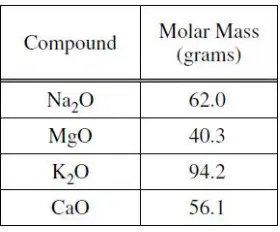
According to the information in the table above, a 1.00 g sample of which of the following contains the greatest mass of oxygen?
Na2O
MgO
K2O
CaO
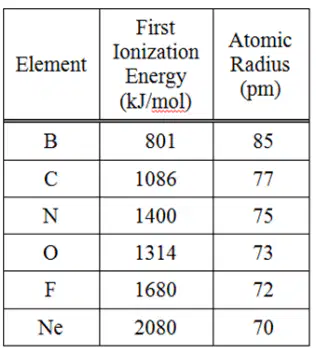
The table above shows the first ionization energy and atomic radius of several elements. Which of the following best helps to explain the deviation of the first ionization energy of oxygen from the overall trend?
The atomic radius of oxygen is greater than the atomic radius of fluorine.
The atomic radius of oxygen is less than the atomic radius of nitrogen.
There is repulsion between paired electrons in oxygen’s 2p orbitals.
There is attraction between paired electrons in oxygen’s 2p orbitals.
Which of the following best helps to account for the fact that the Fion is smaller than the O2- ion?
F- has a larger nuclear mass than O2- has.
F- has a larger nuclear charge than O2- has.
F- has more electrons than O2- has.
F- is more electronegative than O2- is.
Two different ionic compounds each contain only copper and chlorine. Both compounds are powders, one white and one brown. An elemental analysis is performed on each powder. Which of the following questions about the compounds is most likely to be answered by the results of the analysis?
What is the density of each pure compound?
What is the formula unit of each compound?
What is the chemical reactivity of each compound?
Which of the two compounds is more soluble in water?
A student conducts an experiment to determine the percentage of silver in an alloy by first reacting the alloy with nitric acid. The student then precipitates the Ag+ (aq) by adding excess NaCl (aq) to form AgCl (s) according to the equation.
Ag+ (aq) + Cl- (aq) --> AgCl (s) The precipitate is filtered, dried, and weighed.
Which of the following indicates the effect on the calculated percentage of silver if the precipitate was not dried completely before weighing it, and explains why?
The calculated percentage is too low because the additional water will cause a significant quantity of the AgCl (s) to dissolve and wash through the filter paper.
The calculated percentage is too low because water has a significantly lower molar mass than AgCl (s), which reduces the average mass of the precipitate.
The calculated percentage is the same because the additional water does not affect the mass of the alloy, and the student will react the same mass of Ag regardless.
The calculated percentage is too high because the additional water adds mass to the AgCl (s), and the student will calculate a higher mass of Ag in the sample.
To gravimetrically analyze the silver content of a piece of jewelry made from an alloy of Ag and Cu, a student dissolves a small preweighed sample in HNO3(aq). Ag+ (aq) and Cu2+(aq) ions form in the solution. Which of the following should be the next step in the analytical process?
Centrifuging the solution to isolate the heavier ions
Evaporating the solution to recover the dissolved nitrates
Adding enough base solution to bring the pH up to 7.0
Adding a solution containing an anion that forms an insoluble salt with only one of the metal ions
Consider atoms of the following elements. Assume that the atoms are in the ground state. Which of the following atoms contains exactly two unpaired electrons?
S
Ca
Ga
Br
Consider atoms of the following elements. Assume that the atoms are in the ground state. Which of the following atoms contains only one electron in the highest occupied energy sublevel?
S
Ca
Ga
Br
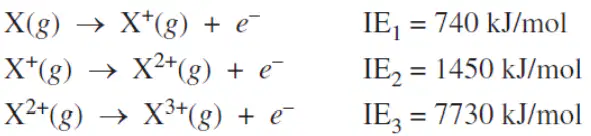
For element X represented above, which of the following is the most likely explanation for the large difference between the second and third ionization energies?
The effective nuclear charge decreases with successive ionizations.
The shielding of outer electrons increases with successive ionizations.
The electron removed during the third ionization is, on average, much closer to the nucleus than the first two electrons removed were.
The ionic radius increases with successive ionizations.
Atoms of Mg combine with atoms of F to form a compound. Atoms of which of the following elements combine with atoms of F in the same ratio?
Li
Ba
Al
Cl
. In his atomic theory, Dalton proposed that all atoms of a given element are identical. Which of the following observations provides the best evidence that the proposal is incorrect?
The mass spectrum of Cu has a peak at 63 amu and another peak at 65 amu.
The ionic radius of Cl- is 0.181 nm, and the atomic radius of Cl is 0.079 nm.
The dipole moment of O3 is 0.53 debye, and the dipole moment of O2 is 0.00 debye.
Elemental P can exist in both white and red forms.

A certain element has two naturally occurring isotopes, as shown in the table. The element’s average atomic mass is closest to which of the following?
185.0 amu
185.6 amu
186.3 amu
187.0 amu

An experiment is performed to measure the mass percent of CaCO3 (s) in eggshells. Five different samples of CaCO3 (s) of known mass react with an excess 2.0 M HCl (aq) of in identical sealed, rigid reaction vessels. The pressure of the gas produced is measured with a pressure gauge attached to the reaction vessel. Since the reaction is exothermic, the reaction system is cooled to its original temperature before the pressure is recorded. The experimental data are used to create the calibration line below. The mass percent of CaCO3 (s) in the eggshell sample is closest to
30%
45%
60%
75%
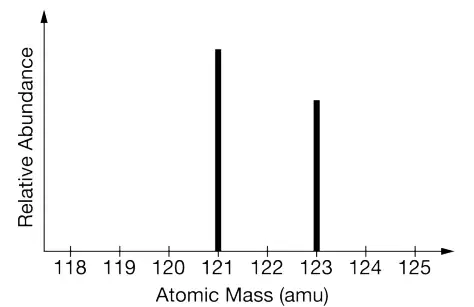
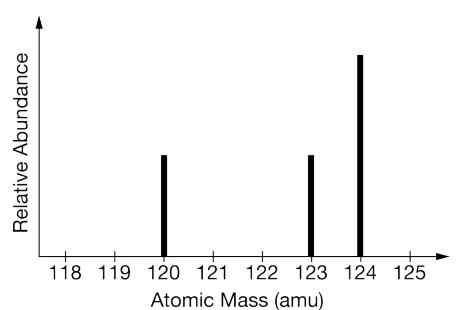
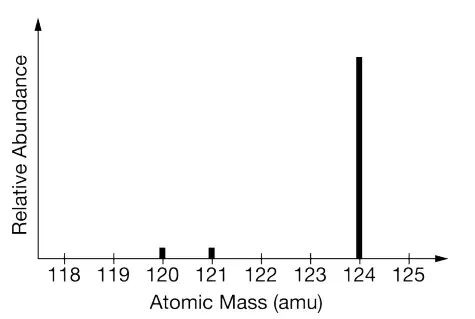
The mass spectrum of the element Sb is most likely represented by which of the following?
X + O3 → XO + O2
XO + O3 → X + 2 O2
–––––––––––––––––––––
2 O3 → 3 O2
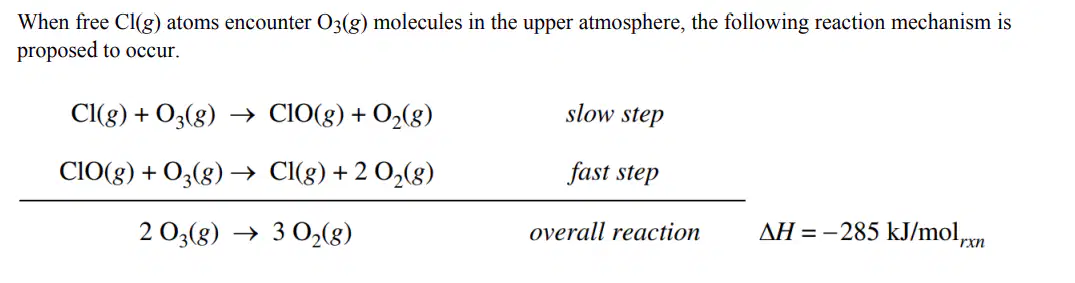
The proposed mechanism can be written in a more general form, as shown above. Species other than Cl can also decompose O3 through the same mechanism. Which of the following chemical species is most likely to decompose O3 in the upper atmosphere through the above mechanism?
He
Br
N2
O2
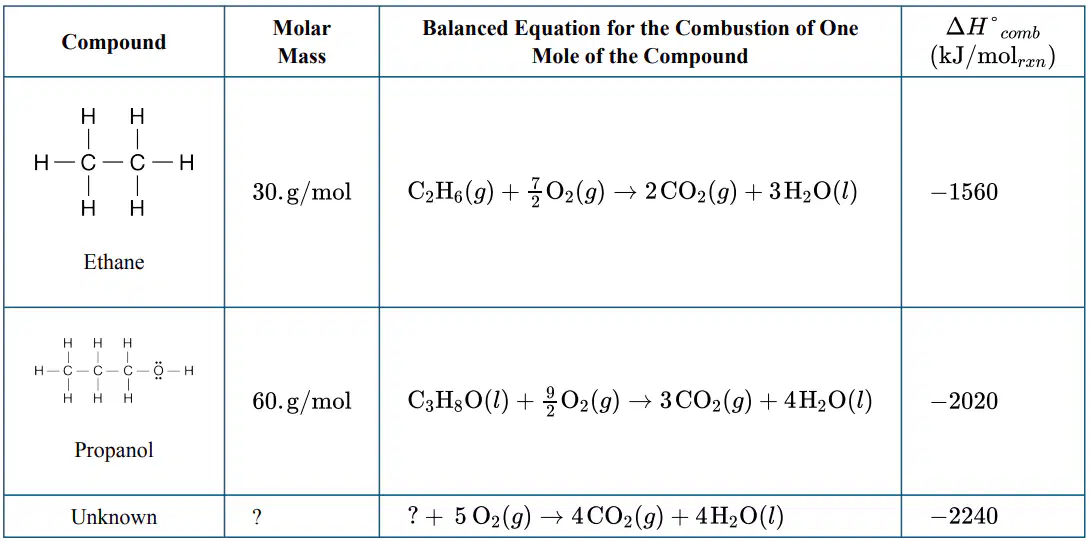
Which of the following is the molecular formula of the unknown compound?
C4H8
C4H8O
C4H4O2
C4H8O2
Which of the following correctly compares periodic properties of two elements and provides an accurate explanation for that difference?
The first ionization energy of Al is greater than that of B because Al has a larger nuclear charge than B does.
The first ionization energy of F is greater than that of O because O has a higher electronegativity than F has.
The atomic radius of Ca is larger than that of Mg because the valence electrons in Mg experience more shielding than the valence electrons in Ca do.
The atomic radius of Cl is smaller than that of S because Cl has a larger nuclear charge than S does.
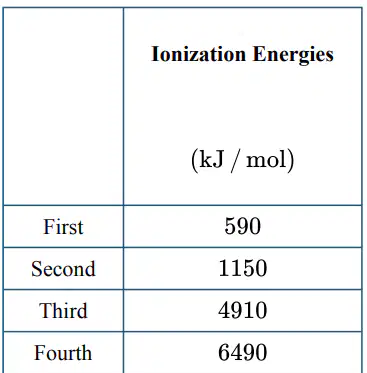
Based on the ionization energies of element X given in the table above, which of the following is most likely the formula of the compound formed between element X and SO42-?
XSO4
X2SO4
X2(SO4)3
X(SO4)2
In which of the following compounds is the mass ratio of chromium to oxygen closest to 1.62 to 1.00?
CrO3
CrO2
Cr2O
Cr2O3
Based on the positions of elements in the periodic table, which of the following groups contains compounds that are most likely to have similar chemical properties?
KCl, KBr, and KI
AsCl3, SCl2, and ClF
CF4, PF3, and SeF2
NH3, H2O, and HF
Cu(s) + 4 HNO3(aq) → Cu(NO3)2(aq) + 2 NO2(g) + 2 H2O(l)
Each student in a class placed a 2.00 g sample of a mixture of Cu and Al in a beaker and placed the beaker in a fume hood. The students slowly poured 15.0 mL of 15.8 M HNO3(aq) into their beakers. The reaction between the copper in the mixture and the HNO3(aq) is represented by the equation above. The students observed that a brown gas was released from the beakers and that the solutions turned blue, indicating the formation of Cu2+(aq). The solutions were then diluted with distilled water to known volumes.
The students determined that the reaction produced 0.010 mol of Cu(NO3)2. Based on the measurement, what was the percent of Cu by mass in the original 2.00 g sample of the mixture?
16%
32%
64%
96%
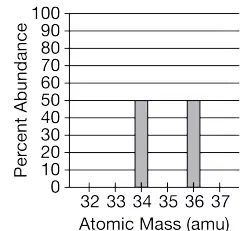
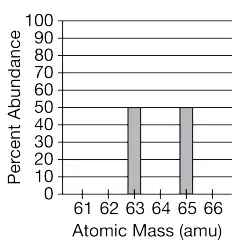
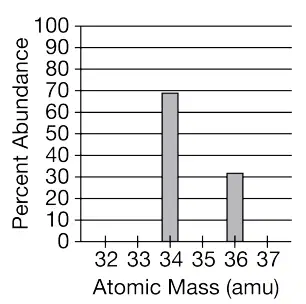
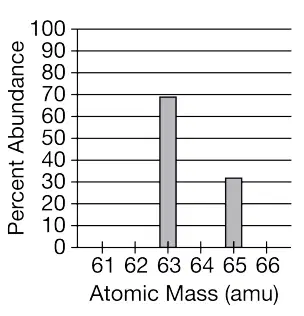
Copper consists of two naturally occurring isotopes, one with 34 neutrons and one with 36 neutrons. Which of the following is the mass spectrum of a representative sample of Cu?

A group of students was asked to recover Cu(s) from a blue-green aqueous solution containing an unknown concentration of Cu2+(aq) . The students took a 100.0 mL sample of the solution and added an excess of 1.0 M Na3PO4(aq), causing the Cu2+(aq) to precipitate as Cu3(PO4)2(s), as shown in step 1 below.
The mass of the Cu(s) produced in step 3 was slightly more than the mass predicted from the 4.6 g of Cu3(PO4)2 (s) recovered from step 1. Which of the following could account for the discrepancy in the yield of Cu(s) from step 3 ?
All of the Cu3(PO4)2(s) dissolved in the HCl(aq).
Some of the Cu(s) adhered to the side of the funnel used to filter the solution.
Some unreacted Zn(s) was mixed in with the Cu(s).
Too much Na3PO4 (aq) was added to the original Cu2+(aq) solution.
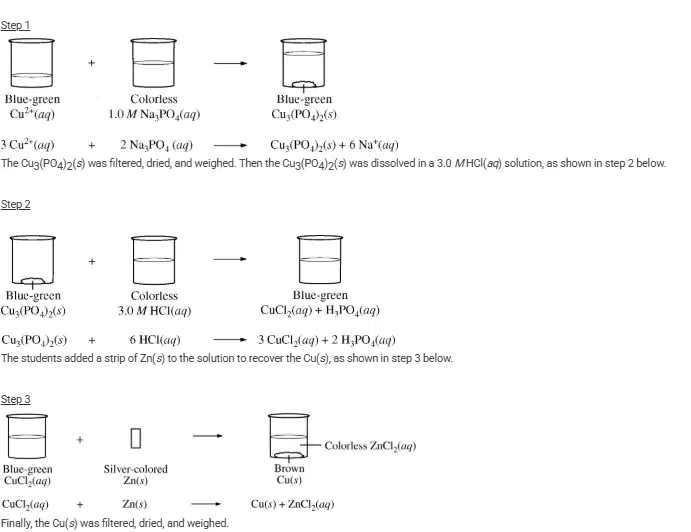
A group of students was asked to recover Cu(s) from a blue-green aqueous solution containing an unknown concentration of Cu2+(aq) . The students took a 100.0 mL sample of the solution and added an excess of 1.0 M Na3PO4(aq), causing the Cu2+(aq) to precipitate as Cu3(PO4)2(s), as shown in step 1 below. Finally, the Cu(s) was filtered, dried, and weighed.
The mass of the Cu(s) produced in step 3 was slightly more than the mass predicted from the 3.8 g of Cu3(PO4)2(s) recovered from step 1. Which of the following could account for the discrepancy in the yield of Cu(s) from step 3 ?
All of the Cu3(PO4)2(s) dissolved in the HCl(aq).
Some of the Cu(s) adhered to the side of the funnel used to filter the solution.
Some unreacted Zn(s) was mixed in with the Cu(s).
Too much Na3PO4(aq) was added to the original Cu2+(aq) solution.
Which of the following best helps to explain why the electron affinity of Br has a greater magnitude than that of I?
Br has a lower electronegativity than I does.
Br has a lower ionization energy than I does.
An added electron would go into a new shell in Br but not in I.
There is a greater attraction between an added electron and the nucleus in Br than in I.
31. Which of the following best helps explain why the electronegativity of Cl is less than that of F?
The mass of the Cl atom is greater than the mass of the F atom.
The Cl nucleus contains more protons than the F nucleus contains.
When Cl and F forms bonds with other atoms, the Cl bonding electrons are more shielded from the positive Cl nucleus than the F bonding electrons are shielded from the positive F nucleus.
Because Cl is larger than F, the repulsions among electrons in the valence shell of Cl are less than the repulsions among electrons in the valence shell of F.
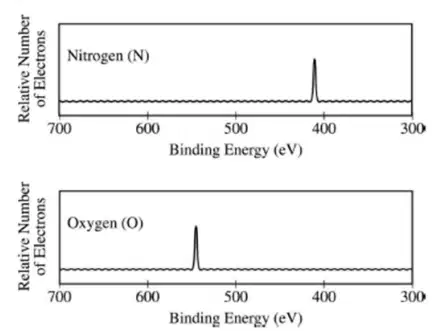
The photoelectron spectra above show the energy required to remove a 1s electron from a nitrogen atom and from an oxygen atom. Which of the following statements best accounts for the peak in the upper spectrum being to the right of the peak in the lower spectrum?
Nitrogen atoms have a half-filled p subshell.
There are more electron-electron repulsions in oxygen atoms than in nitrogen atoms.
Electrons in the p subshell of oxygen atoms provide more shielding than electrons in the p subshell of nitrogen atoms.
Nitrogen atoms have a smaller nuclear charge than oxygen atoms.
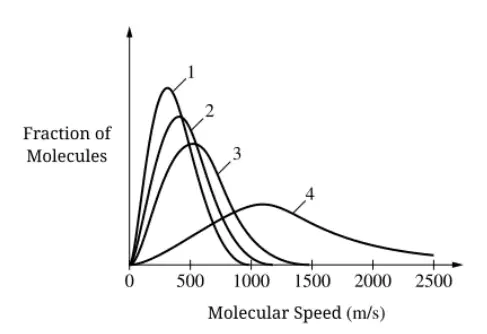
The curves in the figure represent the distribution of the molecular speeds for the gases H2, O2, N2, and CH4 at the same temperature. Which curve corresponds to the distribution for CH4?
1
2
3
4
The effective nuclear charge experienced by the outermost electron of Na is different than the effective nuclear charge experienced by the outermost electron of Ne. This difference best accounts for which of the following?
Na has a greater density at standard conditions than Ne.
Na has a lower first ionization energy than Ne.
Na has a higher melting point than Ne.
Na has a higher neutron-to-proton ratio than Ne.
Which of the following is the ground-state electron configuration for the Na+ ion?
1s22s22p5
1s22s22p6
1s22s22p63s1
1s22s22p63s2
Which of the following ground-state electron configurations represents the atom that has the lowest first-ionization energy?
1s22s1
1s22s22p2
1s22s22p6
1s22s22p63s1
Which of the following is the electron configuration of an excited atom that is likely to emit a quantum of energy?
1s22s22p63s23p1
1s22s22p63s23p5
1s22s22p63s1
1s22s22p63s13p1
An unknown element, X, forms a compound with barium with the formula of BaX2. Which of the following could be the electron configuration of a neutral atom of element X?
[Ne] 3s2
[Ne] 3s23p2
[Ne] 3s23p5
[Ne] 3s23p6
Which of the following is the ground-state electron configuration of the F- ion?
1s22s22p4
1s22s22p5
1s22s22p6
1s22s22p63s2
Which of the following best represents the ground-state electron configuration for an atom of selenium?
1s22s22p63s23p3
1s22s22p63s23p4
1s22s22p63s23p64s23d104p4
1s22s22p63s23p64s23d104p5
The elements in which of the following have most nearly the same atomic radius?
Be, B, C, N
Ne, Ar, Kr, Xe
C, P, Se, I
Cr, Mn, Fe, Co
A sample of a compound that contains only the elements C, H, and N is completely burned in O2 to produce 44.0 g of CO2, 45.0 g of H2O, and some NO2 . A possible empirical formula of the compound is
CH2N
CH5N
C2H5N
C3H3N2
A 23.0g sample of a compound contains 12.0g of C, 3.0g of H, and 8.0g of O. Which of the following is the empirical formula of the compound?
CH3O
C2H6O
C3H9O2
C4H12O2
A sample of a compound contains 3.21 g of sulfur and 11.4 g of fluorine. Which of the following represents the empirical formula of the compound?
SF2
SF3
SF4
SF6
What is the empirical formula of an oxide of chromium that is 48 percent oxygen by mass?
CrO
CrO2
CrO3
Cr2O3
When hafnium metal is heated in an atmosphere of chlorine gas, the product of the reaction is found to contain 62.2 percent Hf by mass and 37.4 percent Cl by mass. What is the empirical formula for this compound?
HfCl2
HfCl3
HfCl4
Hf2Cl3
A compound contains 1.10 mol of K, 0.55 mol of Te, and 1.65 mol of O. What is the simplest formula of this compound?
KTeO
KTe2O
K2TeO3
K2TeO6
A compound contains 30. percent sulfur and 70. percent fluorine by mass. The empirical formula of the compound is
SF
SF2
SF4
SF6
If a pure sample of an oxide of sulfur contains 40. percent sulfur and 60. percent oxygen by mass, then the empirical formula of the oxide is
SO3
SO4
S2O6
S2O8

Based on the ionization energies of element X given in the table above, which of the following is most likely the empirical formula of an oxide of element X?
XO2
X2O
X2O3
X2O5

The ionization energies of an unknown element, X, are listed in the table above. Which of the following is the most likely empirical formula of a compound formed from element X and phosphorus, P ?
XP
X3P
X3P2
X3P4
After completing an experiment to determine gravimetrically the percentage of water in a hydrate, a student reported a value of 38 percent. The correct value for the percentage of water in the hydrate is 51 percent. Which of the following is the most likely explanation for this difference?
Strong initial heating caused some of the hydrate sample to spatter out of the crucible.
The dehydrated sample absorbed moisture after heating.
The crucible was not heated to constant mass before use.
Excess heating caused the dehydrated sample to decompose
The percentage of silver in a solid sample is determined gravimetrically by converting the silver to Ag+ (aq) and precipitating it as silver chloride. Failure to do which of the following could cause errors in the analysis?
I. Account for the mass of the weighing paper when determining the mass of the sample
II. Measure the temperature during the precipitation reaction
III. Wash the precipitate
IV. Heat the AgCl precipitate to constant mass
I only
I and IV
II and III
I, III, and IV
Silicon crystals are semiconductors. Which of the following is a correct reason for the increase in the conductivity of Si crystals when a small fraction of Si atoms are replaced with those of a different element?
P atoms introduce additional mobile negative charges.
P atoms introduce additional mobile positive charges.
Ge atoms have more electrons than Si atoms have.
Ge atoms are much smaller than Si atoms
A sample of a pure compound is analyzed and found to contain approximately 30 percent N and 70 percent O by mass. The formula for the compound could be
NO
NO2
N2O
N2O2
1s22s22p63s23p3 Atoms of an element, X, have the electronic configuration shown above. The compound most likely formed with magnesium, Mg, is
MgX
MgX2
MgX3
Mg3X2
Given that the density of Hg(l) at 0°C is about 14 g mL-1, which of the following is closest to the volume of one mole of Hg(l) at this temperature?
0.070 mL
0.14 mL
1.4 mL
14 mL

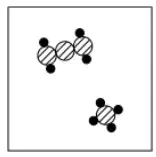
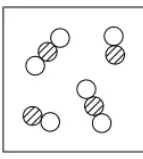
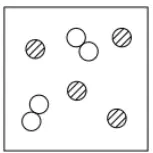
Which of the following samples contains the greatest percentage of carbon by mass?

Which of the following represents the ground state electron configuration for the Mn3+ ion? (Atomic number Mn = 25)
1s22s22p63s23p63d4
1s22s22p63s23p63d54s2
1s22s22p63s23p63d24s2
1s22s22p63s23p63d84s2
The compound CCl4 is nonflammable and was once commonly used in fire extinguishers. On the basis of the periodic properties, which of the following compounds can most likely be used as a fire-resistant chemical?
BCl3
CH4
CBr4
PbCl2
Complete combustion of a sample of a hydrocarbon in excess oxygen produces equimolar quantities of carbon dioxide and water. Which of the following could be the molecular formula of the compound?
C2H2
C2H6
C4H8
C6H6
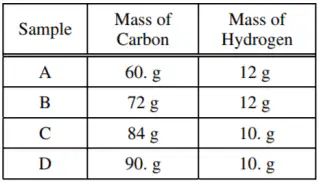
The masses of carbon and hydrogen in samples of four pure hydrocarbons are given above. The hydrocarbon in which sample has the same empirical formula as propene, C3H6?
Sample A
Sample B
Sample C
Sample D
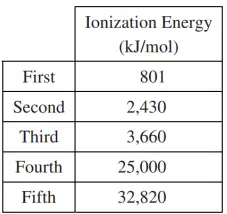
The first five ionization energies of a second-period element are listed in the table above. Which of the following correctly identifies the element and best explains the data in the table?
B, because it has five core electrons
B, because it has three valence electrons
N, because it has five valence electrons
N, because it has three electrons in the p sublevel

The complete photoelectron spectrum of a pure element is shown in the diagram above. According to the complete photoelectron spectrum, which of the following is the identity of the element?
Be
C
O
Ne
If peaks 1 and 2 represent sublevels, which of the following sublevels is represented by peak 3?
s
p
d
f
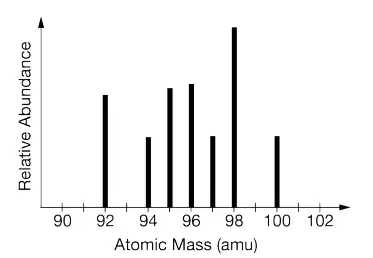
Which of the following elements has the mass spectrum represented above?
Nb
Mo
U
Cf
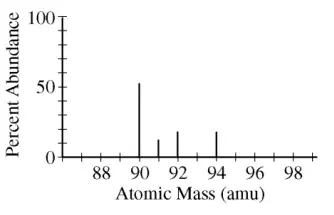
The mass spectrum of an average sample of a pure element is shown in the figure above. Which of the following is the identity of the element?
Y
Zr
Nb
Th
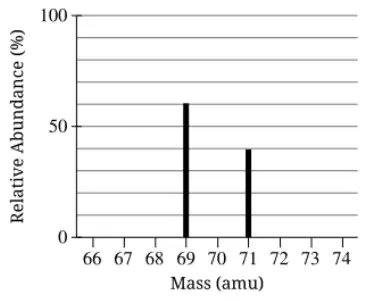
The mass spectrum of an element is represented above. Which of the following is most likely the identity of the element?
Ga
Ge
Tm
Lu
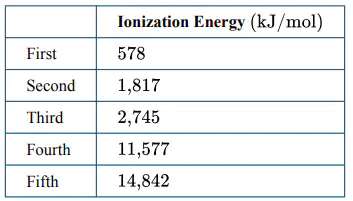
The first five ionization energies of an unknown element are listed in the table above. Which of the following statements correctly identifies the element and cites the evidence supporting the identification?
Na, because of the large difference between the first and the second ionization energies
Al, because of the large difference between the third and fourth ionization energies
Si, because the fifth ionization energy has the greatest value
P, because a neutral atom of P has five valence electrons
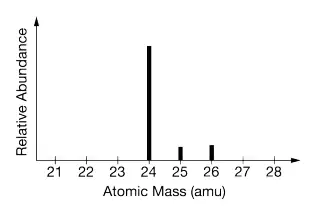
The mass spectrum of a sample of a pure element is shown above. Based on the data, the peak at 26 amu represents an isotope of which of the following elements?
Al with 13 neutrons
Mg with 14 neutrons
Fr with 26 neutrons
Ti with 26 neutrons
Which of the following represents an electron configuration that corresponds to the valence electrons of an element for which there is an especially large jump between the second and third ionization energies? (Note: n represents a principal quantum number equal to or greater than 2.)
ns2
ns2np1
ns2np2
ns2np3
A sample of a solid labeled as NaCl may be impure. A student analyzes the sample and determines that it contains 75 percent chlorine by mass. Pure NaCl(s) contains 61 percent chlorine by mass. Which of the following statements is consistent with the data?
The sample contains only NaCl(s).
The sample contains NaCl(s) and NaI(s).
The sample contains NaCl(s) and KCl(s).
The sample contains NaCl(s) and LiCl(s).
The mass percent of carbon in pure glucose, C6H12O6, is 40.0 percent. A chemist analyzes an impure sample of glucose and determines that the mass percent of carbon is 38.2 percent. Which of the following impurities could account for the low mass percent of carbon in the sample?
Water, H2O
Ribose, C5H10O5
Fructose, C5H10O5, an isomer of glucose
Sucrose, C12H22O11
A student has a 1g sample of each of the following compounds: NaCl, KBr, and KCl. Which of the following lists the samples in order of increasing number of moles in the sample?
NaCl < KCl < KBr
NaCl < KBr < KCl
KCl < NaCl < KBr
KBr < KCl < NaCl
A student obtains a sample of a pure solid compound. In addition to Avogadro’s number, which of the following must the student know in order to determine how many molecules are in the sample?
Mass of the sample, volume of the sample
Mass of the sample, density of the sample
Molar mass of the compound, mass of the sample
Molar mass of the compound, density of the sample
Which of the following forms monatomic ions with a 2- charge in solutions?
F
S
Mg
Ar
Which of the following best accounts for the decrease in the first-ionization energy of the alkaline earth metals going down the group?
The number of protons in the nucleus increases, resulting in increased attraction between the nucleus and the electron being removed.
The number of protons in the nucleus increases, resulting in a greater effective nuclear charge attracting the electron being removed.
The number of electron shells increases, resulting in a greater average distance between the nucleus and the electron being removed.
The number of electron shells increases, resulting in less shielding between the nucleus and the electron being removed.
Which of the following correctly identifies which has the higher first-ionization energy, Cl or Ar, and supplies the best justification?
Cl, because of its higher electronegativity
Cl, because of its higher electron affinity
Ar, because of its completely filled valence shell
Ar, because of its higher effective nuclear charge
To determine the percentage of water in a hydrated salt, a student heated a 1.2346 g sample of the salt for 30 minutes; when cooled to room temperature, the sample weighed 1.1857 g. After the sample was heated for an additional 10 minutes and again cooled to room temperature, the sample weighed 1.1632 g. Which of the following should the student do next?
Use the smallest mass value to calculate the percentage of water in the hydrated salt.
Repeat the experiment with a new sample of the same mass and average the results.
Reheat the sample until its mass is constant.
Use the average of the mass values obtained after the two heatings to calculate the percentage of water in the hydrated salt.
Which of the following elements has the largest first ionization energy?
Be
Li
Na
Mg

The four species above have the same electron configuration, 1s22s22p63s23p6. Which of the following statements correctly identifies the species with the largest radius and provides an explanation based on Coulomb’s law?
Cl-, because its nuclear charge exerts the least attractive force on the electrons in the 3p sublevel.
Ar, because it is a neutral atom and the net force on the electrons in the 3p sublevel is zero.
K+, because the loss of an electron results in a smaller attractive force between the nucleus and the electrons in the 3p sublevel.
Ca2+, because the large positive charge on a cation causes increased repulsion among the electrons in the 3p sublevel.
Which of the following lists chemical species in order from largest to smallest radius?
S1- > O > F
O > O2- > Ne
K+ > Ar > Cl
Na > Mg2+ > Mg

A 0.35 g sample of Li(s) is placed in an Erlenmeyer flask containing 100 mL of water at 25°C. A balloon is placed over the mouth of the flask to collect the hydrogen gas that is generated. After all of the Li(s) has reacted with H2O(l), the solution in the flask is added to a clean, dry buret and used to titrate an aqueous solution of a monoprotic acid. The pH curve for this titration is shown in the diagram. What will be the effect on the amount of gas produced if the experiment is repeated using 0.35 g of K(s) instead of 0.35 g of Li(s) ?
No gas will be produced when K(s) is used.
Some gas will be produced but less than the amount of gas produced with Li(s).
Equal quantities of gas will be produced with the two metals.
More gas will be produced with K(s) than with Li(s).

The ionization energies for element X are listed in the table above. On the basis of the data, element X is most likely to be
Mg
Al
Si
P
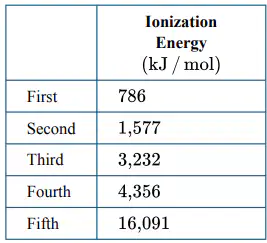
Based on the successive ionization energies of element X shown in the table above, which of the following is most likely the formula of the compound produced when element X sreacts with fluorine?
XF
XF2
XF4
XF5
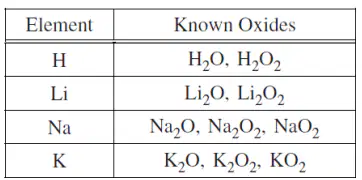
Based on the information above and periodic trends, which of the following is the best hypothesis regarding the oxide(s) formed by Rb?
Rb will form only Rb2O.
Rb will form only Rb2O2.
Rb will form only Rb2O and Rb2O2.
Rb will form Rb2O, Rb2O2, and RbO2.
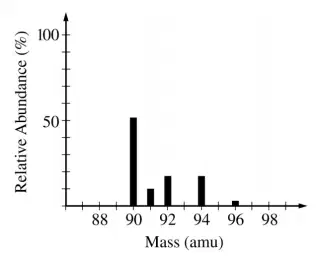
The mass spectrum of element X is presented in the diagram above. Based on the spectrum, which of the following can be concluded about element X?
X is a transition metal, and each peak represents an oxidation state of the metal.
X contains five electron sublevels.
The atomic mass of X is 90.
The atomic mass of X is between 90 and 92.
M+ is an unknown metal cation with a +1 charge. A student dissolves the chloride of the unknown metal, MCl, in enough water to make 100.0 mL of solution. The student then mixes the solution with excess AgNO3 solution, causing AgCl to precipitate. The student collects the precipitate by filtration, dries it, and records the data shown below. (The molar mass of AgCl is 143 g/mol.)
Mass of unknown chloride, MCl 0.74 g
Mass of filter paper 0.80 g
Mass of filter paper plus AgCl precipitate 2.23 g
What is the identity of the metal chloride?
NaCl
KCl
CuCl
LiCl
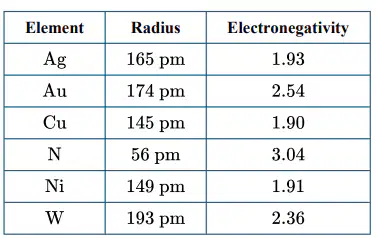
Which of the following best explains why Au has a larger radius than Cu does?
Au has a larger electronegativity than Cu does.
Au has more occupied electron shells than Cu does.
Au has more protons than Cu does.
Au is more dense than Cu is.
A student is given two 10g samples, each a mixture of only NaCl (s) and KCl (s) but in different proportions. Which of the following pieces of information could be used to determine which mixture has the higher proportion of KCl (s)?
The volume of each mixture
The mass of Cl in each mixture
The number of isotopes of Na and K
The reaction of each mixture with water
A solution of methanol, CH3OH, in water is prepared by mixing together 128 g of methanol and 108 g of water. The mole fraction of methanol in the solution is closest to
0.80
0.60
0.50
0.40
A solution is prepared by adding 16 g of CH3OH (molar mass 32 g) to 90. g of H2O (molar mass 18 g). The mole fraction of CH3OH in this solution is closest to which of the following?
0.1
0.2
0.3
0.4

A sample of carbonate rock is a mixture of CaCO3 and MgCO3. The rock is analyzed in a laboratory, and the results are recorded in the table above. Which columns in the table provide all the information necessary to determine the mole ratio of Ca to Mg in the rock?
1, 2, 5
2, 5 ,6
3, 4, 6, 7
2, 3, 4, 5
A compound made up of only carbon and hydrogen is completely combusted in excess O2 (g). Equimolar quantities of CO2 (g) and H2O (g) are produced. Which of the following could be the molecular formula of the compound?
CH4
C2H2
C2H4
C2H6
What number of moles of O2 is needed to produce 14.2 grams of P4O10 from P? (Molecular weight P4O10 = 284)
0.0500 mole
0.125 mole
0.250 mole
0.500 mole
A student determines the concentration of an NaBr (aq) solution by adding AgNO3 (aq) until no more AgBr (s) precipitate is formed. The precipitate is filtered out of the solution and then dried and weighed. The student uses the mass of the precipitate to determine the concentration of the NaBr (aq) solution. Which of the following could result in the student calculating a concentration of NaBr (aq) that is higher than the actual concentration?
The AgBr (s) was not completely dried before being weighed.
Some of the AgBr (s) fell off the filter paper onto the balance while being weighed.
An insufficient amount of AgNO3 (aq) was added, so some NaBr (aq) was left in solution.
The filter paper had a hole in it, so some of the AgBr (s) precipitate washed through the filter paper.
A student has two samples of NaCl, each one from a different source. Assume that the only potential contaminant in each sample is KCl. The student runs an experiment to determine the percent by mass of chlorine in each sample. From the results of this experiment alone, which of the following questions is most likely to be answered?
Which sample has the higher purity?
Which sample has the higher density?
What is the source of the contaminants present in each of the samples?
Which sample came from a salt mine, and which sample came from the ocean?
In 1.00 mol of potassium zirconium sulfate trihydrate, K4Zr(SO4)4 • 3H2O, there are
3 × 6.02 × 1023 hydrogen atoms
6.02 × 10²³ sulfur atoms
4 × 6.02 × 1023 potassium atoms
4 moles of zirconium atoms
How many carbon atoms are contained in 2.8 g of C2H4?
1.2 x 10²³
3.0 x 10²³
6.0 x 10²³
1.2 x 1024
A 100.0 g sample of which of the following compounds contains the most molecules?
CO2
SO2
H2O
N2O
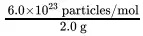
Which of the following numerical expressions gives the number of particles in 2.0 g of Ne?
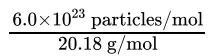


Which of the following shows the correct number of protons, neutrons, and electrons in a neutral cesium-134 atom?




Of the following electron configurations of neutral atoms, which represents an atom in an excited state?
1s22s22p5
1s22s22p53s2
1s22s22p63s1
1s22s22p63s23p5
Which of the following lists Mg, P, and Cl in order of increasing atomic radius?
Cl < P < Mg
Cl < Mg < P
Mg < P < Cl
Mg < Cl < P
A 1.50 g sample of an oxide of vanadium is separated into its elements, resulting in 1.02 g V and 0.48 g O. Which of the following is the formula of the oxide?
V2O
VO2
V2O3
V2O5
A student determines that an unknown compound contains 49 percent C by mass. Which of the following could be the compound?
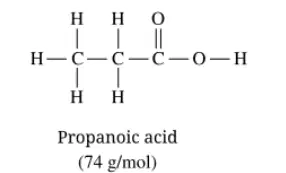
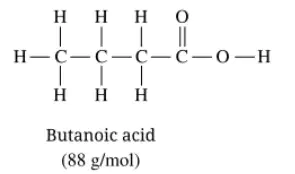

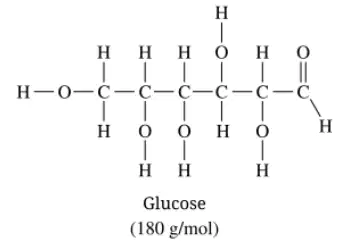
A sample of CaCO3 (molar mass 100. g) was reported as being 30. percent Ca. Assuming no calcium was present in any impurities, the percent of CaCO3 in the sample is
30%
70%
75%
100%

The photoelectron spectra for H and He are represented in the image. Which of the following statements best accounts for the fact that the peak on the He spectrum is farther to the left and higher than the peak on the H spectrum?
He has an additional valence electron in a higher energy level than the valence electron in H.
He has a greater nuclear charge than H and an additional electron in the same energy level.
He has a completely filled valence shell in which the electrons are a greater distance from the nucleus than the distance between the H nucleus and its electrons.
It takes longer for the electrons in He to be removed due to the higher nuclear mass of He.
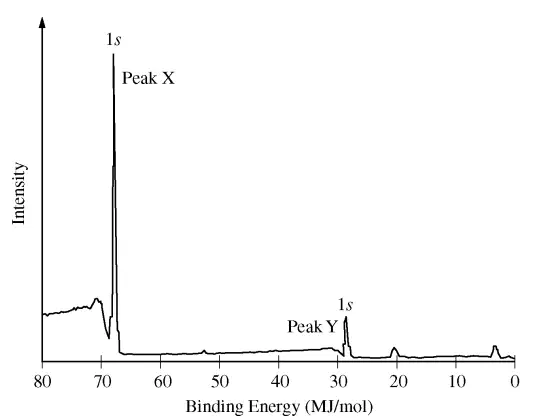
A sample containing atoms of C and F was analyzed using x-ray photoelectron spectroscopy. The portion of the spectrum showing the 1s peaks for atoms of the two elements is shown above. Which of the following correctly identifies the 1s peak for the F atoms and provides an appropriate explanation?
Peak X, because F has a smaller first ionization energy than C has.
Peak X, because F has a greater nuclear charge than C has.
Peak Y, because F is more electronegative than C is.
Peak Y, because F has a smaller atomic radius than C has.
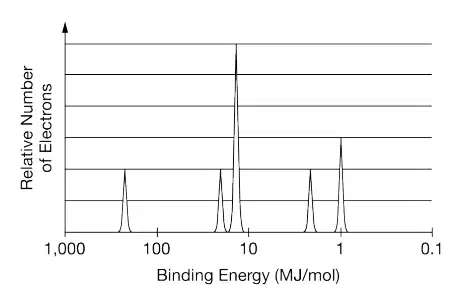
The complete photoelectron spectrum of an element is given above. Which of the following electron configurations is consistent with the spectrum?
1s22s22p1
1s22s22p63s23p3
1s22s22p63s23p6
1s22s22p63s23p64s23d5
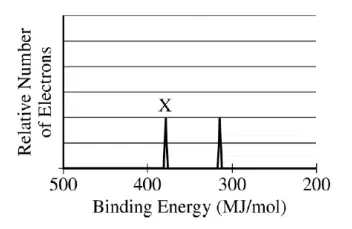
The photoelectron spectra of the 1s electrons of two isoelectronic species, Ca2+ and Ar, are shown above. Which of the following correctly identifies the species associated with peak X and provides a valid justification?
Ar, because it has completely filled energy levels
Ar, because its radius is smaller than the radius of Ca2+
Ca2+, because its nuclear mass is greater than that of Ar
Ca2+, because its nucleus has two more protons than the nucleus of Ar has
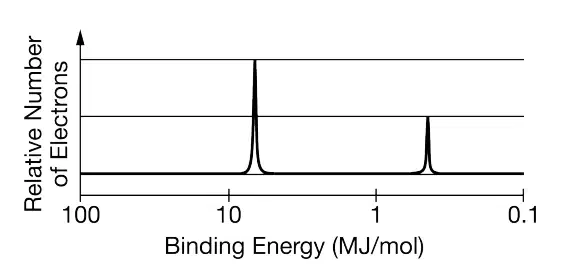
The complete photoelectron spectrum for an element is shown above. Which of the following observations would provide evidence that the spectrum is consistent with the atomic model of the element?
A neutral atom of the element contains exactly two electrons.
The element does not react with other elements to form compounds.
In its compounds, the element tends to form ions with a charge of +1.
In its compounds, the element tends to form ions with a charge of +3.
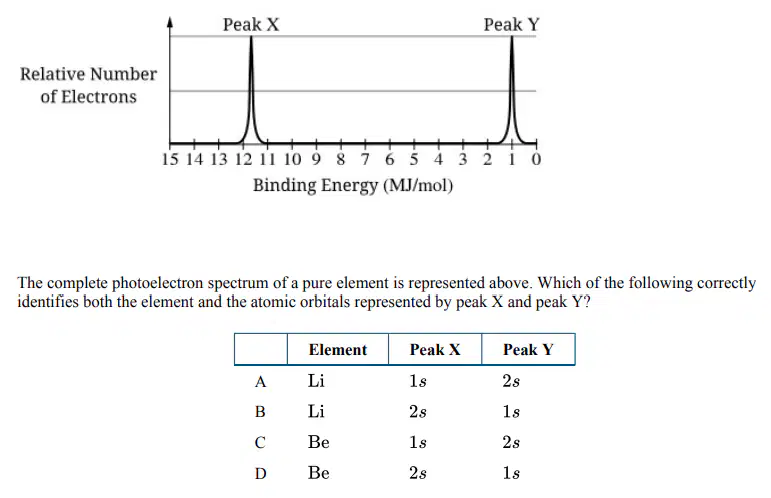
The complete photoelectron spectrum of a pure element is represented above. Which of the following correctly identifies both the element and the atomic orbitals represented by peak X and peak Y?
A
B
C
D

The photoelectron spectrum for the element nitrogen is represented above. Which of the following best explains how the spectrum is consistent with the electron shell model of the atom?
The leftmost peak represents the valence electrons.
The two peaks at the right represent a total of three electrons.
The electrons in the sublevel 1s have the smallest binding energy.
The electrons in the 2p sublevel have the smallest binding energy.
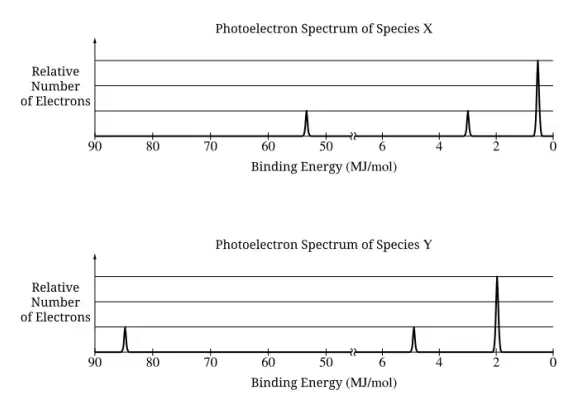
The complete photoelectron spectra for two species, X and Y, are represented in the following diagrams. One of the species is a neutral atom and the other species is a negatively charged ion. Both species have the same electron configuration. Which of the following can be inferred from the spectra?
X has a larger nuclear charge than Y has; therefore, X is neutral and Y is negatively charged.
X has a larger nuclear charge than Y has; therefore, Y is neutral and X is negatively charged.
X has a smaller nuclear charge than Y has; therefore, X is neutral and Y is negatively charged.
X has a smaller nuclear charge than Y has; therefore, Y is neutral and X is negatively charged.
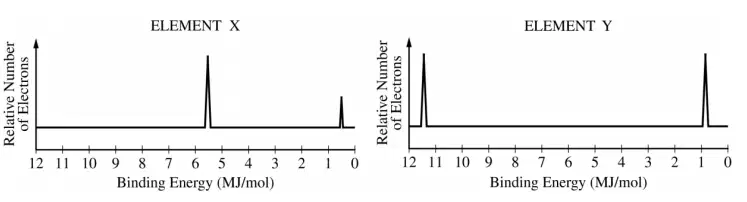
The complete photoelectron spectra of neutral atoms of two unknown elements, X and Y, are shown above. Which of the following can be inferred from the data?
Element X has a greater electronegativity than element Y does.
Element X has a greater ionization energy than element Y does.
Element Y has a greater nuclear charge than element X does.
The isotopes of element Y are approximately equal in abundance, but those of element X are not.
Equal masses of He and Ne are placed in a sealed container. What is the partial pressure of He if the total pressure in the container is 6 atm?
1 atm
2 atm
3 atm
5 atm
How many protons, neutrons, and electrons are in an 5626Fe atom?




A 5.0 g sample of MgCl2 may contain measurable amounts of other compounds as impurities. Which of the following quantities is (are) needed to determine that the sample is pure MgCl2?
The color and density of the sample
The mass of Mg in the sample only
The number of moles of Cl in the sample only
The mass of Mg and the mass of Cl in the sample
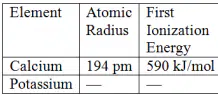
Based on periodic trends and the data in the table above, which of the following are the most probable values of the atomic radius and the first ionization energy for potassium, respectively?
242 pm, 633 kJ/mol
242 pm, 419 kJ/mol
120 pm, 633 kJ/mol
120 pm, 419 kJ/mol
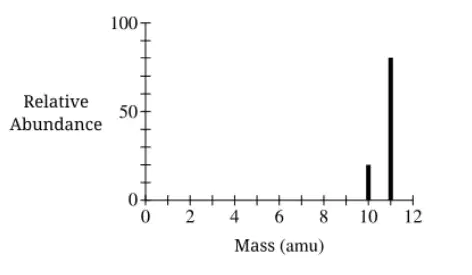
Based on the mass spectrum of a sample of boron shown above, how many neutrons are in the most common isotope of boron?
5
6
10
11
Which of the following correctly compares the atomic radius of F to that of O and provides the best explanation?
The atomic radius of F is larger than that of O because F has more occupied subshells than O does.
The atomic radius of F is larger than that of O because F has more protons in the nucleus than O does.
The atomic radius of F is smaller than that of O because F has a greater effective nuclear charge than O does.
The atomic radius of F is smaller than that of O because valence electrons in F experience more shielding than those in O.
A student has samples of two pure compounds, XClO3 and ZClO3, which contain unknown alkali metals X and Y. The student measures the mass of each sample and then strongly heats the samples to drive off all the oxygen, leaving solid residues of XCl and ZCl. The student measures the mass of the solid residue from each sample. Which of the following questions can be answered from the results of the experiment?
Which has the greater molar mass, X or Z?
Which has the higher boiling point, X or Z?
Which has the higher melting point, XCl or ZCl?
Which has the greater density, XCl or ZCl?
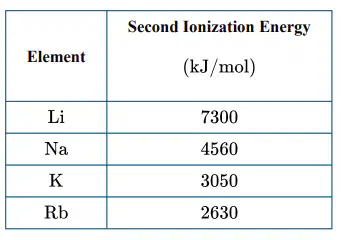
The decrease in the second ionization energy of alkali metals going down the group, as shown in the table above, can be best attributed to a decrease in the coulombic force of attraction due to
the removal of core electrons
an increase in effective nuclear charge
an increase in the average distance of the outermost electron from the nucleus
a decrease in electron-electron repulsion within the outermost shell
If Na reacts with chlorine to form NaCl, which of the following elements reacts with Na to form an ionic compound in a one-to-one ratio, and why?
K, because it is in the same group as Na.
Mg, because its mass is similar to that of Na.
Ar, because its mass is similar to that of Cl.
Br, because it has the same number of valence electrons as Cl.

All the chlorides of the alkaline earth metals have similar empirical formulas, as shown in the table above. Which of the following best helps to explain this observation?
Cl2 (g) reacts with metal atoms to form strong, covalent double bonds.
Cl has a much greater electronegativity than any of the alkaline earth metals.
The two valence electrons of alkaline earth metals are relatively easy to remove.
The radii of atoms of alkaline earth metals increase moving down the group from Be to Ra.
RbCl has a high boiling point. Which of the following compounds is also likely to have a high boiling point, and why?
NO, because its elements are in the same period of the periodic table.
ClF, because its elements are in the same group of the periodic table
Cl2O, because its elements have similar electronegativities and it is a covalent compound.
CsCl, because its elements have very different electronegativities and it is an ionic compound.
Which of the following species has the electron configuration 1s22s22p63s23p6?
O
Ne
K+
Cl+

Both structure 1 and structure 2 shown are needed to describe the N2O molecule. Which of the following indicates the better resonance structure and best explains why? (Formal charges are provided in circles on the diagrams.)
Structure 1, because it has two double bonds and is therefore more symmetrical.
Structure 1, because the negative formal charge is on the more electronegative element
Structure 2, because the triple bond between the two nitrogen atoms is stronger than the double bond.
Structure 2, because the negative formal charge is on the more electronegative element.
Which of the following properties generally decreases across the periodic table from sodium to chlorine?
First ionization energy
Atomic mass
Electronegativity
Atomic radius
When a 3.22 g sample of an unknown hydrate of sodium sulfate, Na2SO4 ⋅ x H2O(s), is heated, H2O (molar mass 18 g) is driven off. The mass of the anhydrous Na2SO4(s) (molar mass 142 g) that remains is 1.42 g. The value of x in the hydrate is
0.013
1.8
6.0
10.
Which of the following elements has the largest first ionization energy?
Li
Be
C
N
Zn(s) is used to reduce other compounds in chemical reactions. If a chemist needs a substance that is more effective in its reducing ability, which of the following species would be the best choice?
Na
H+
K+
Cl-
Which of the following ions has the same number of electrons as Br-?
K+
Sr2+
I-
Cl-
Which of the following best helps to explain why Na (s) is more reactive with water than Mg (s) is?
Na (s) is softer than Mg (s).
The atomic mass of Na is less than that of Mg.
The Na+ ion has weaker coulombic attraction to an anion than the Mg2+ ion has.
The first ionization energy of Na is less than that of Mg.

