wayground logo

Free Printable Worksheets

Font size

S
M
L
XL
Worksheets

Unit 3 Review: Atomic Theory

Total questions: 140

Worksheet time: 4hrs 44mins

Name
Class
Date
1.

Who discovered that the atom had an small, dense, positively charged center?

a)

Ernest Rutherford

b)

J.J Thomson

c)

Robert Millikan

d)

John Dalton

2.

Who named the positive center of the atom the "nucleus?"

a)

Democritus

b)

Dalton

c)

Thomson

d)

Rutherford

3.

Who discovered that atoms are mostly empty space?

a)

Dalton

b)

Thomson

c)

Rutherford

d)

Bohr

4.

Who proposed that electrons move around the nucleus in circular orbits?

a)

Dalton

b)

Thomson

c)

Rutherford

d)

Bohr

5.
Which scientist saw the atom as a solid sphere?
a)
Dalton
b)
Thomson
c)
Rutherford
d)
Bohr
6.

Who came up with the"solar system" model of the atom?

a)

J.J. Thompson

b)

Ernest Rutherford

c)

Neils Bohr

d)

James Chadwick

7.
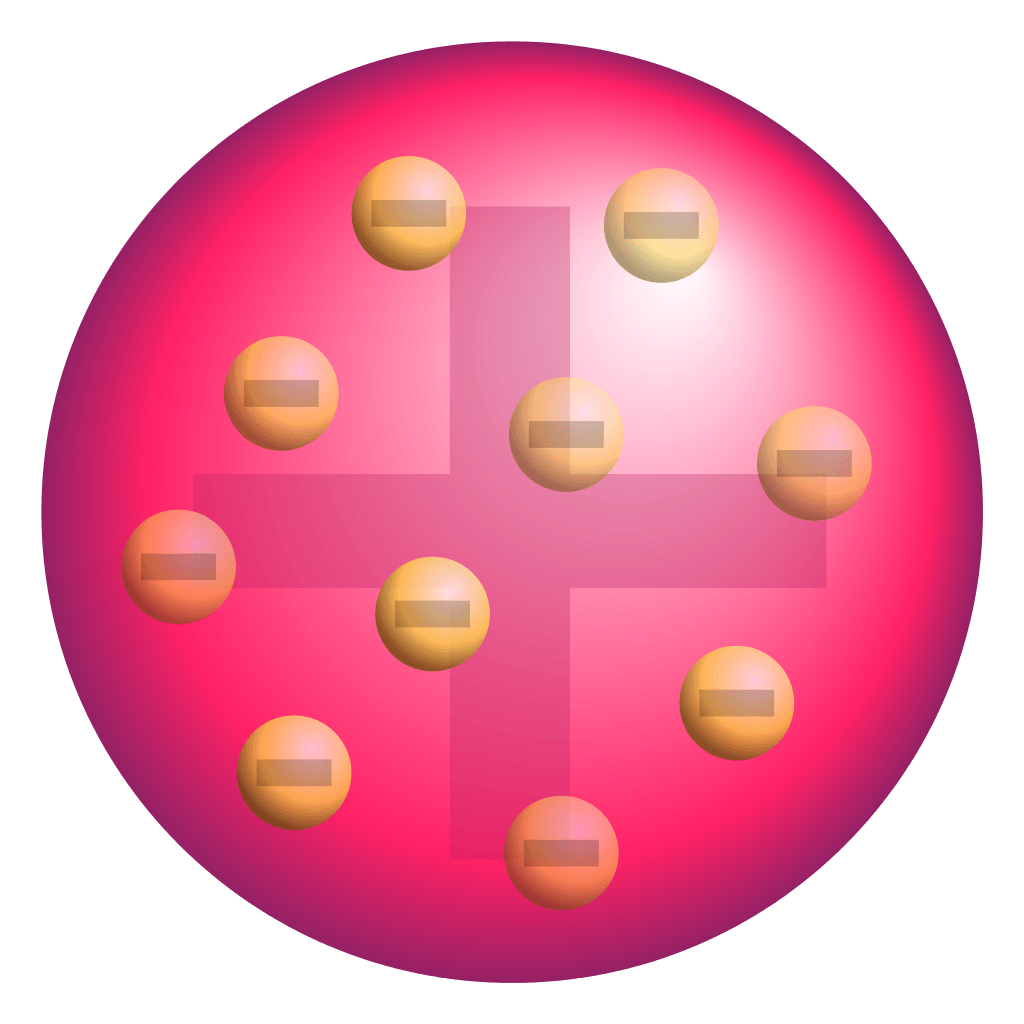
Who's model is this?
a)
Thomson
b)
Rutherford
c)
Democritus
d)
Bohr
8.
Who came up with this model?
a)
Dalton
b)
Thomson
c)
Rutherford
d)
Bohr
9.
In the Thomson Model, he discovered the existence of what particle?
a)
Electrons
b)
Protons
c)
Neutrons
d)
Quarks
10.
Discovered particles in the nucleus of atoms, neutrons
a)
Niels Bohr
b)
Ernest Rutherford
c)
J.J. Thomson
d)
James Chadwick
11.

Who proposed the quantum mechanical model of the atom?

a)

Schrodinger & Heisenberg

b)

John Dalton

c)

Niels Bohr

d)

Ernest Rutherford

12.
Rutherford’s experiment determined that the nucleus of an atom is tiny, dense and  ______ charged. 
a)
neutrally
b)
negatively
c)
positively
13.
Which two particles make up the nucleus of an atom?
a)
Protons and Electrons
b)
Protons and Neutrons
c)
Molecules and Compounds
d)
Neutrons and Electrons
14.

What is at the center of every atom?

a)

An electron

b)

A compound

c)

A molecule

d)

A nucleus

15.
What is the role of an electron in an atom?
a)
Electrons live inside the nucleus and carry a neutral charge.
b)
Electrons circle the nucleus and have a positive charge.
c)
Electrons circle the nucleus and have a negative charge.
d)
Electrons live inside the nucleus and have a negative charge.
16.
Which of the following determines the type of element that an atom makes?
a)
The size of the nucleus.
b)
The number of protons.
c)
How much the atom weighs.
d)
The number of neutrons.
17.
A proton is a _____ charged particle.
a)
Negatively
b)
Positively
18.
An electron is a _____ charged particle.
a)
Positively
b)
Negatively
19.
What is an atomic number?
a)
The sum of protons and neutrons in an atom.
b)
The sum of protons and electrons in an atom.
c)
The number of protons in an atom of a specific element.
d)
The number of neutrons in a specific element.
20.

The number of neutrons equals...

a)

atomic number - mass number

b)

Protons - neutrons

c)

Electrons - protons

d)

mass number - atomic number

21.
What charge does a neutron have?
a)
positive
b)
negative
c)
no charge
d)
neutral
22.
Where are protons located in the atom?
a)
orbitals
b)
nucleus
c)
rings
d)
positive
23.
Where are electrons located in the atom?
a)
Nucleus
b)
Shells/orbitals
c)
rings
d)
center
24.
The number of protons plus neutrons.
a)
Mass number
b)
Mass Weight
c)
Atomic number
d)
Atomic weight
25.
all matter is made of what 
a)
energy 
b)
atoms 
c)
electrons 
d)
compounds 
26.

How many protons are in Gold

a)

79

b)

197

c)

118

d)

276

27.

How many electrons are in Gold

a)

79

b)

118

c)

197

d)

276

28.

How many neutrons are in Gold

a)

118

b)

79

c)

197

d)

276

29.

How many Neutrons are in Neon

a)

10

b)

21

c)

20

d)

30

30.

How many electrons are in Potassium

a)

19

b)

39

c)

20

d)

58

31.

How many protons are in Neon

a)

10

b)

20

c)

21

d)

30

32.

How many neutrons are in Potassium

a)

19

b)

20

c)

39

d)

58

33.

How many neutrons are in Tungsten

a)

110

b)

74

c)

183

d)

258

34.

How many neutrons does a Hydrogen atom have?

a)

1

b)

2

c)

3

d)

0

35.

What is the atomic weight of Iron?

a)

26

b)

55.845

c)

56

d)

30

36.
Why are ions charged particles?
a)
The number of electrons does not equal the number of protons.
b)
The number of protons does not equal the number of neutrons.
c)
The number of neutrons does not equal the number of electrons.
d)
The electric charges of the electrons and protons cancel each other out.
37.
Cations are...
a)
Positive
b)
Negative
c)
Neutral
d)
Purring
38.
Anions are...
a)
Positive
b)
Negative
c)
Neutral
d)
Crying
39.
Make sure you get enough Potassium in your diet!
a)
Huh?
b)
K
c)
I <3 bananas
d)
Sure
40.

Na ionizes to a charge of _______

a)

+1

b)

+2

c)

-1

d)

-2

41.

Li ionizes to a charge of _________

a)

+2

b)

+1

c)

-1

d)

-2

42.

Rb ionizes to a charge of _________.

a)

+2

b)

+1

c)

-1

d)

-2

43.

Be ionizes to a charge of ________.

a)

+1

b)

+2

c)

-1

d)

-2

44.

Mg ionizes to a charge of ______.

a)

+1

b)

+2

c)

-1

d)

-2

45.

Ca ionizes to a charge of _______.

a)

+1

b)

+2

c)

-1

d)

-2

46.

N ionizes to a charge of _______.

a)

+3

b)

-3

c)

+2

d)

-2

47.

P ionizes to a charge of _______.

a)

+3

b)

-3

c)

+2

d)

-2

48.

O ionizes to a charge of ________.

a)

+1

b)

+2

c)

-1

d)

-2

49.

S ionizes to a charge of _______.

a)

-2

b)

-1

c)

+1

d)

+2

50.

Cl ionizes to a charge of _________.

a)

-2

b)

-1

c)

+1

d)

+2

51.

F ionizes to a charge of ________.

a)

-2

b)

-1

c)

+1

d)

+2

52.

Br ionizes to a charge of ________

a)

-1

b)

-2

c)

+1

d)

+2

53.
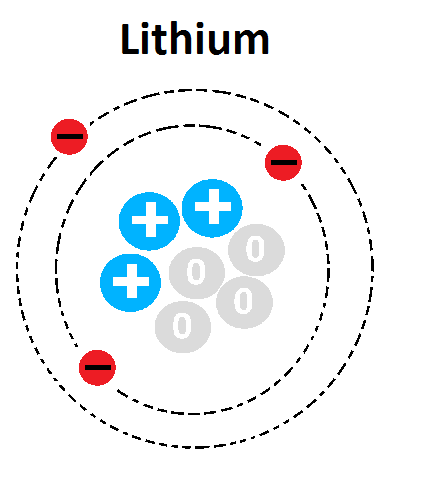
A neutral atom of Lithium has 3 p+, 4 n, and 3 e-. The Lithium atom pictured is a....
a)
Positive ion
b)
Negative ion
c)
Isotope
d)
Neutral atom
54.
If an atom has more protons than electrons, it is a(n)
a)
Positive ion
b)
Negative ion
c)
Isotope
d)
Neutral atom
55.
If an atom has more electrons than protons, it is a(n)
a)
Positive ion
b)
Negative ion
c)
Isotope
d)
Neutral atom
56.
If an atom has an equal number of protons and electrons it is a...
a)
Positive ion
b)
Negative ion
c)
Isotope
d)
Neutral atom
57.
A neutral atom of Boron has 5 p+, 6 n, and 5 e-. The Boron atom pictured is a....
a)
Positive ion
b)
Negative ion
c)
Isotope
d)
Neutral atom
58.
A neutral atom of Boron has 5 p+, 6 n, and 5 e-. The Boron atom pictured is a....
a)
Positive ion
b)
Negative ion
c)
Isotope
d)
Neutral atom
59.

How many electrons does this magnesium ion have?

a)

24

b)

12

c)

10

d)

14

60.

How many neutrons does this Neon atom have?

a)

21

b)

11

c)

10

d)

12

61.
What is the number of neutrons?
a)
34
b)
79
c)
45
d)
35
62.
How many electrons does S2- have?
a)
2
b)
14
c)
16
d)
18
63.
What is the mass number of Sr-80?
a)
38
b)
42
c)
80
d)
118
64.
How many electrons does Ba2+ have?
a)
2
b)
54
c)
56
d)
58
65.
Describe the number of protons and electrons in Fe2+.
a)
26 protons 24 electrons
b)
26 electrons 24 protons
c)
26 protons 28 electrons
d)
28 protons 26 electrons
66.

How many electrons are found in the following ion?

a)

3

b)

7

c)

10

d)

14

67.
What is an isotope? 
a)
A charged atom
b)
An atom with different amounts of neutrons
c)
An atom with different amounts of protons
d)
A neutral atom
68.
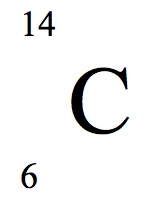
The photo above shows the isotopic notation for which isotope?
a)
Carbon 12
b)
Carbon 13
c)
Carbon 14
d)
Carbon 15
69.
How many neutrons does a Carbon 13 atom have?
a)
6
b)
5
c)
7
d)
8
70.
How many neutrons does a Sodium 24 isotope have?
a)
12
b)
13
c)
14
d)
15
71.
What element is this?
a)
Helium
b)
Hydrogen
c)
Argon
d)
Silver
72.
?
a)
Lithium
b)
Boron
c)
Carbon
d)
Neon
73.
What is the mass number of this atom?
a)
1
b)
3
c)
4
d)
7
74.
?
a)
Beryllium
b)
Boron
c)
Barium
d)
Bromine
75.

How many valence electrons should Oxygen have in its Lewis dot model?

a)

5

b)

6

c)

7

d)

8

76.

How many valence electrons should Lithium have in its Lewis dot model?

a)

1

b)

2

c)

3

d)

4

77.

How many valence electrons should Magnesium have in its Lewis dot model?

a)

1

b)

2

c)

3

d)

4

78.

How many electrons should Boron have around its Lewis dot model?

a)

1

b)

2

c)

3

d)

4

79.

This could be the dot diagram of

a)

Mg

b)

Cl

c)

C

d)

O

80.
Which has the greater EN: 
Cl or Al?
a)
Cl
b)
Al
81.
Which has the greater EN: 
N or C?
a)
C
b)
N
82.
Which has the greater EN: 
H or F?
a)
H
b)
F
83.
Which of the following will have a larger radius than Zinc?
a)
Gallium
b)
Aluminum
c)
Magnesium
d)
Strontium
84.
Which of the following will have a lower ionization energy than Scandium (Sc)?
a)
Helium (He)
b)
Titanium (Ti)
c)
Calcium (Ca)
d)
Magnesium (Mg)
85.
Which atom has the largest atomic radius?
a)
potassium
b)
rubidium 
c)
francium
d)
cesium
86.
As you move down the periodic table atoms get bigger.  This is because ____________.
a)
The atoms have more mass.
b)
The atoms have more protons.
c)
The atoms have more energy levels
d)
The atoms have more nuetrons
87.
As you move across the periodic table atoms tend to get smaller because, ______________.
a)
the atoms have more mass.
b)
the atoms have less mass
c)
the atoms have more protons.
d)
the atoms have less electrons.
88.
Atoms that have a high electronegativity, _______________.
a)
give up their electrons more easily.
b)
hold on to their electrons more tightly.
c)
have more electron shells.
89.
Electronegativity is...
a)
how good an atom is at attracting electrons
b)
the ability of an atom to lose electrons
c)
the energy required to remove an electron from a specific atom
d)
how easy it is to make friends. 
90.
Ionization energy is...
a)
the energy required to add an electron to a specific atom
b)
how much energy it takes to remove an electron from an atom
c)
the energy required to shield the outer electrons from the nucleus
d)
a measure of the ability of an atom to attract electrons
91.

Which color on the image of the periodic table corresponds with the halogens.

a)

red

b)

black

c)

blue

d)

orange

92.

Which color on the image of the periodic table corresponds with the lanthanides.

a)

red

b)

black

c)

blue

d)

orange

93.

Which color on the image of the periodic table corresponds with the noble gases.

a)

red

b)

black

c)

blue

d)

orange

94.

Which color on the image of the periodic table corresponds with the transition metals.

a)

red

b)

black

c)

blue

d)

orange

95.

Which color on the image of the periodic table corresponds with the metalloids.

a)

bright yellow

b)

gold

c)

teal

d)

light blue

96.

Which color on the image of the periodic table corresponds with the alkaline earth metals.

a)

yellow

b)

dark yellow

c)

blue/green

d)

teal

97.

Which family of elements reacts violently with water and exposure to oxygen?

a)

alkali metals

b)

alkaline earth metals

c)

lanthanides

d)

actanides

e)

transition metals

98.

The periodic table is mostly comprised of what type of element?

a)

Metals

b)

Nonmetals

c)

Metalloids

99.

What is the most reactive nonmetal?

a)

Fluorine

b)

Iodine

c)

Chlorine

d)

Bromine

100.

Which family of elements does not combine with other elements unless under special conditions in a laboratory?

a)

Noble gases

b)

Halogens

c)

Metalloids

d)

Alkaline earth metals

e)

Actinides

101.

Which of the following is most reactive?

a)

Lithium

b)

Potassium

c)

Sodium

d)

Cesium

102.

An atom has 18 protons and 8 valence electrons. Which statement would best identify this element?

a)

The element is "happy" or stable because its outer energy level is filled.

b)

The element has an atomic mass of 18.

c)

The element is highly reactive with eight electrons in its outer shell.

d)

The element is a metal.

103.

How many valence electrons makes most atoms stable (nonreactive)?

a)

2

b)

8

c)

1

d)

4

104.
How do you determine the number of valence electrons an element has?
a)
Look at its period
b)
Look at its group
c)
Look at its atomic number
d)
Look at its atomic mass
105.
Atoms on which side of the Periodic Table will tend to LOSE electrons?
a)
Right
b)
Left
c)
Middle
d)
No atoms lose electrons
106.
Atoms on which side of the Periodic Table will tend to GAIN electrons?
a)
Right
b)
Left
c)
Middle
d)
No atoms lose electrons
107.
Which is the electron configuration for an oxygen atom?
a)
1s22s22p63s23p64s2
b)
1s22s22p4
c)
1s22s22p6
d)
1s22s22p63s23p6
108.
What atom matches this electron configuration?
1s2s2p3s2
a)
Neon
b)
Magnesium
c)
Aluminum
d)
Potassium
109.
What is the maximum number of electrons that an orbital can have?
a)
1 electron
b)
2 electrons
c)
3 electrons
d)
4 electrons
110.
How many valence electrons are represented here?
a)
7
b)
5
c)
2
d)
8
111.
How many d orbitals are there in a given sublevel?
a)
1
b)
3
c)
5
d)
7
112.
How many p orbitals are there in a sublevel?
a)
2
b)
1
c)
4
d)
3
113.
What is this element? 
1s22s22p63s23p6
4s23d104p6
a)
Argon
b)
Krypton
c)
Selenium
d)
Bromide
114.
What atom matches this electron configuration?
[Xe] 6s2 4f14 5d9
a)
Mercury
b)
Gold
c)
Platinum
d)
Thallium
115.
What is the shorthand electron configuration for Sulfur atom?
a)
[Ar] 3p4
b)
[He] 3s23p4
c)
[Ne] 3s23p4
d)
[Na] 3s23p3
116.
What element has the valence shell configuration
3s2 3p2
a)
Al
b)
B
c)
Si
d)
Ga
117.
Which element is pictured?
a)
neon
b)
fluorine
c)
magnesium
d)
argon
118.
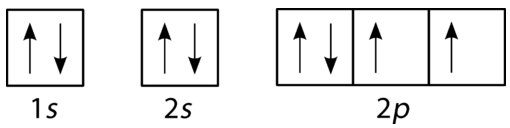
This orbital diagram represents:  
a)
C
b)
B
c)
N
d)
O
119.
What is incorrect about this orbital diagram?
a)
Both arrows in the 2p box should be pointing up
b)
There is nothing incorrect with this diagram
c)
In the 2p box there should only be 1 electron in the first 2p box and one in the 2nd 2p box
d)
All the arrows should be pointing up.
120.
Which orbital shows a violation of Hund's Rule?
a)
A
b)
B
c)
C
d)
D
121.
This orbital diagram represents:  
a)
C
b)
B
c)
N
d)
O
122.

Which elements are shiny?

a)

metals only

b)

nonmetals only

c)

metals and nonmetals

d)

metals and MAYBE metalloids

123.

Which elements are to the right of the zig zag?

a)

metals

b)

nonmetals

c)

metalloids

124.

Sulfur is considered:

a)

malleable

b)

brittle

c)

ductile

d)

a good conductor

125.

Which elements are to the LEFT of the zigzag?

a)

metals

b)

nonmetals

c)

metalloids

126.
Brittle
a)
Metal
b)
Nonmetal
127.
Which of these is a property of metals?
a)
It's malleable
b)
It can't conduct electricity
c)
They are used in food
d)
It's very brittle
128.
Good conductor of heat
a)
Metal
b)
Nonmetal
129.
All of the following would classify an element as a metal except?
a)
Dull
b)
Luster
c)
Malleable
d)
Hard
130.
Silicon is a semiconductor and has properties of both metals and nonmetals. What type of element is Silicon? 
a)
Metal
b)
Nonmetal
c)
Metalloid
d)
Pretty
131.
Which electromagnetic waves have the highest frequencies and the shortest wavelengths?
a)
microwaves
b)
visible light
c)
gamma rays
132.
How much of the electromagnetic spectrum is made up of visible light?
a)
only a small portion
b)
a very l;arge portion
c)
about half
133.
Which of the following has wavelengths longer than microwaves?
a)
Infrared waves
b)
Radio waves
c)
Visible light
134.
Which of the following lists the electromagnetic waves in order of increasing wavelength?
a)
X-rays, visible light, radio waves
b)
gamma rays, microwaves, UV rays
c)
infrared rays, radio waves, x-rays
135.
Coulombic Attraction is the attraction between __________ charged particles.
a)
same 
b)
oppositely
c)
two positively
d)
two negatively
136.
An example of Coulombic Attraction in an atom is between
a)
protons and neutrons
b)
neutrons and electrons
c)
protons and electrons
d)
protons and protons
137.
As the distance between protons and electrons increases, the force of attraction
a)
remains the same
b)
increases
c)
decreases
d)
is not affected
138.
What are the two variables that affect Coulombic Attraction?
a)
Distance  and number of protons
b)
Number of neutrons and number of protons
c)
Number of neutrons and number of electrons
d)
solids or liquids
139.
24.1% of all the isotopes of a an element have a mass of 75.23 amu, 48.7% have a mass of 74.61 amu, and 27.2% have a mass of 75.20 amu.
What is the average mass of this element?
a)
74.92 amu
b)
24.97 amu
c)
75.01 amu
d)
74.51 amu
140.

Why should you never trust atoms?

a)

They are bad at recalling information.

b)

They are trying to scam you out of money.

c)

They make up everything.