
 Worksheets
AP Chem Lab
Total questions: 141
Worksheet time: 11hrs 24mins
The density of an unknown gas is 2.00 grams per Liter at 3.00 atmosphere pressure and 127oC. What is the molar mass of this gas?
(254/3) R
188 R
(800/3) R
600 R
A gaseous mixture containing 7.0 moles of nitrogen, 2.5 moles of oxygen, and 0.5 moles of helium exerts a total pressure of 0.90 atmosphere. What is the partial pressure of the nitrogen?
0.13 atm
0.27 atm
0.63 atm
0.90 atm
A 2.00-liter sample of nitrogen gas at 27° C and 600. millimeters of mercury is heated until it occupies a volume of 5.00 liters. If the pressure remains unchanged, the final temperature of the gas is
68o C
120o C
477o C
677o C
A sample of 0.010 mole of oxygen gas is confined at 127°C and 0.80 atmosphere. What would be the pressure of this sample at 27°C and the same volume?
0.10 atm
0.20 atm
0.60 atm
0.80 atm
A sample of 3.0 grams of an ideal gas at 127°C and 1.0 atmosphere pressure has a volume of 1.5 liters. Which of the following expressions is correct for the molar mass of the gas? The ideal gas constant, R, is 0.08 (L ⋅ atm)/(mole ⋅ K).
[(0.08)(400)] /[(3.0)(1.0)(1.5)]
[(1.0)(1.5)]/ [(3.0)(0.08)(400)]
[(0.08)(1.0)(1.5)] /[(3.0)(400)]
[(3.0)(0.08)(400)] /[(1.0)(1.5)]
Samples of F2 gas and Xe gas are mixed in a container of fixed volume. The initial partial pressure of the F2 gas is 8.0 atmospheres and that of the Xe gas is 1.7 atmospheres. When all of the Xe gas reacted, forming a solid compound, the pressure of the unreacted F2 gas was 4.6 atmospheres. The temperature remained constant. What is the formula of the compound?
XeF
XeF3
XeF4
XeF6

The system shown above is at equilibrium at 28 °C. At this temperature, the vapor pressure of water is 28 millimeters of mercury. The partial pressure of O2(g) in the system is
28 mm Hg
56 mm Hg
133 mm Hg
161 mm Hg
At 25°C, a sample of NH3 (molar mass 17 grams) effuses at the rate of 0.050 mole per minute. Under the same conditions, which of the following gases effuses at approximately one-half that rate?
O2 (molar mass 32 g/mol)
He (molar mass 4.0 g/mol)
CO2 (molar mass 44 g/mol)
Cl2 (molar mass 71 g/mol)
NH4NO3(s) → N2O(g) + 2 H2O(g)
A 0.03 mol sample of NH4NO3(s) is placed in a 1 L evacuated flask, which is then sealed and heated. The NH4NO3(s) decomposes completely according to the balanced equation above. The total pressure in the flask measured at 400 K is closest to which of the following? ( The value of the gas constant, R, is 0.082 L atm mol–1 K–1)
3 atm
1 atm
0.5 atm
0.1 atm
A flask contains 0.25 mole of SO2(g), 0.50 mole of CH4(g), and 0.50 mole of O2(g). The total pressure of the gases in the flask is 800 mm Hg. What is the partial pressure of the SO2(g) in the flask?
600 mm Hg
250 mm Hg
200 mm Hg
160 mm Hg
A hydrocarbon gas with an empirical formula CH2 has a density of 1.88 grams per liter at 0°C and 1.00 atmosphere. A possible formula for the hydrocarbon is
CH2
C2H4
C3H6
C4H8
Hydrogen gas is collected over water at 24° C. The total pressure of the sample is 755 millimeters of mercury. At 24° C, the vapor pressure of water is 22 millimeters of mercury. What is the partial pressure of the hydrogen gas?
22 mm Hg
733 mm Hg
755 mm Hg
760 mm Hg
A sample of 9.00 grams of aluminum metal is added to an excess of hydrochloric acid. The volume of hydrogen gas produced at standard temperature and pressure is
22.4 Liters
11.2 Liters
7.46 Liters
5.60 Liters
An excess of Mg(s) is added to 100. mL of 0.400 M HCl. At 0ºC and 1 atm pressure, what volume of H2 gas can be obtained?
22.4 mL
44.8 mL
224 mL
448 mL
W(g) + X(g) → Y(g) + Z(g)
Gases W and X react in a closed, rigid vessel to form gases Y and Z according to the equation above. The initial pressure of W(g) is 1.20 atm and that of X(g) is 1.60 atm. No Y(g) or Z(g) is initially present. The experiment is carried out at constant temperature. What is the partial pressure of Z(g) when the partial pressure of W(g) has decreased to 1.0 atm?
0.20 atm
0.40 atm
1.0 atm
1.2 atm
According to kinetic molecular theory, in which of the following gases will the root mean square speed of the molecules be the highest at 200ºC?
SF6
H2O
HCl
Cl2
None, the molecules of all gases have the same root mean square speed at any given temperature.
A sample of a gas (5.0 mol) at 1.0 atm is expanded at constant temperature from 10.0 L to 15.0 L. The final pressure is ___ atm.
1.5 atm
15 atm
0.67 atm
3.3 atm
7.5 atm
A sample of He gas (2.35 mol) occupies 57.9 L at 300.0 K and 1.00 atm. The volume of this sample is ___L at 423 K and 1.00 atm.
0.709 L
57.9 L
41.1 L
81.6 L
1.41 L
The density of N2O at 1.52 atm and 45.2ºC is ____ g/L.
0.388 g/L
2.58 g/L
9.99 g/L
1.76 g/L
18.2 g/L
The volume of a sample of gas (2.49 g) is 752 mL at 1.98 atm and 62ºC. What is the gas?
NO2
SO3
SO2
Ne
NH3
The pressure in a 12.2 L vessel that contains 2.34 g of carbon dioxide, 1.73 g of sulfur dioxide and 3.33 g of argon; all at 42ºC is ____ mmHg.
116 mmHg
395 mmHg
134 mmHg
263 mmHg
0.347 mmHg
Gases generally have
low density
high density
closely packed particles
no increase in volume when temperature is increased
no decrease in volume when pressure is increased
Pressure is
defined as the mass that an object exerts when at rest
measured in Newtons
defined as the number of moles of substance divided by the mass of the substance
defined as the force per unit area
measured in grams
A gas sample is held at constant pressure. The gas occupies 3.62 L of volume when the temperature is 21.6°C. Determine the temperature at which the volume of the gas is 3.42 L.
312K
278K
20.4K
295K
552K
A balloon has a volume of 2.32 liters at 24.0°C. The balloon is heated to 48.0°C. Calculate the new volume of the balloon.
2.32L
2.51L
2.15L
4.64L
1.16L
You are holding four identical balloons each containing 10.0 g of a different gas. The balloon containing which gas is the largest balloon?
H2
He
Ne
O2
All have the same volume.
Under what conditions does ideal gas behavior break down?
low pressure and low temperature
low pressure and high temperature
high pressure and low temperature
high pressure and high temperature
Under what conditions do gases behave ideally?
low pressure and low temperature
low pressure and high temperature
high pressure and low temperature
high pressure and high temperature
Rank the following gases in order of INCREASING root mean square velocity. The gases are at 1.5 atm and 33ºC. The sample contains 15.5 g of each gas.
Xe, Ne, Ar, He and N2
Xe < Ne < Ar < He < N2
He < N2 < Xe < Ne < Ar
Xe < Ar < N2 < Ne < He
Ar < He < N2 < Xe < Ne
The gases are all moving with the same speed since they have equal masses and are at the same temperature.
Rank the following gases in order of INCREASING kinetic energy. The gases are at 1.5 atm and 33ºC. The sample contains 15.5 g of each gas.
Xe, Ne, Ar, He and N2
Xe < Ne < Ar < He < N2
Xe < Ne < N2 < Ar < He
N2 < Ar < He < Xe < Ne
He < Xe < Ne< N2 < Ar
The gases all have the same kinetic energy since the temperature is the same.
Convert 191 mmHg to atm.
145000 atm
0.251 atm
890 atm
3.55 atm
1.23 x 10³ atm
Convert 191 atm to kPa.
194 kPa
1.94 x 10⁴ kPa
25.5 kPa
1.89 kPa
45600 kPa
In an experiment 201 mL of hydrogen is collected over water at 27ºC at a total barometric pressure of 733 torr. The vapor pressure of water at 28ºC is 26.7 torr. What is the partial pressure of the dry hydrogen gas in atm?
0.929
760
706
1.00
0.964
A sample of He gas (3.0 L) at 5.6 atm and 25ºC was combined with 4.5 L of Ne gas at 3.6 atm and 25ºC at constant temperature in a 9.0 L flask.
The total final pressure in the flask is ___ atm. Assume the initial pressure in the flask was 0.0 atm.
24 atm
2.6 atm
9.2 atm
1.0 atm
3.7 atm
Arrange the following gases in order of INCREASING average root mean square velocity (molecular speed) at 25ºC.
Cl2, O2, F2, N2
Cl2 < O2 < F2 < N2
N2 < F2 < Cl2 < O2
Cl2 < F2 < O2 < N2
F2 < N2 < Cl2 < O2
N2 < Cl2 < F2 < O2
A sample of oxygen gas was found to effuse at a rate equal to 2 times that of an unknown gas. The molecular mass of the unknown gas is ____ g/mol.
128 g/mol
8.0 g/mol
32 g/mol
16 g/mol
64 g/mol
At 333 K, which of the pairs of gases below would have the most nearly identical rates of effusion?
CO and CO2
CO and N2
NO2 and N2O4
N2O and NO2
N2 and O2
SO2 (5.0 g) and CO2 (5.0 g) are placed in a 750 mL container at 50.0ºC. The partial pressure of SO2 in the container is ____ atm.
1.60 atm
2.76 atm
4.02 atm
0.192 atm
6.78 atm
Use the following equation (balance it): NaH + H2O --> NaOH + H2
A sample of NaH weighing ___ g will produce 982 mL of hydrogen gas at 28ºC and 765 torr, when the hydrogen is collected over water. The vapor pressure of water at this temperature is 28 torr.
0.960 g
925 g
0.0388 g
2.93 g
0.926 g
The pressure in a 12.2 L vessel that contains 2.34 g of carbon dioxide, 1.73 g of sulfur dioxide and 3.33 g of argon; all at 42ºC is ____ mmHg.
116 mmHg
395 mmHg
134 mmHg
263 mmHg
0.347 mmHg
Use the following reaction (balance it): calcium sulfite reacts with excess hydrochloric acid to produce water vapor, sulfur dioxide gas and calcium chloride.
What volume (in mL) of sulfur dioxide can be produced by 3.82 g of calcium sulfite when the final pressure of SO2 is 827 torr at 44ºC?
1.39 x 10⁻⁴ mL
0.106 mL
1.00 x 10⁻³ mL
761 mL
578 mL
The volume of a sample of gas (2.49 g) is 752 mL at 1.98 atm and 62ºC. What is the gas?
NO2
SO3
SO2
Ne
NH3
The density of N2O at 1.52 atm and 45.2ºC is ____ g/L.
0.388 g/L
2.58 g/L
9.99 g/L
1.76 g/L
18.2 g/L
A sample of He gas (2.35 mol) occupies 57.9 L at 300.0 K and 1.00 atm. The volume of this sample is ___L at 423 K and 1.00 atm.
0.709 L
57.9 L
41.1 L
81.6 L
1.41 L
A sample of a gas (5.0 mol) at 1.0 atm is expanded at constant temperature from 10.0 L to 15.0 L. The final pressure is ___ atm.
1.5 atm
15 atm
0.67 atm
3.3 atm
7.5 atm
According to kinetic molecular theory, in which of the following gases will the root mean square speed of the molecules be the highest at 200ºC?
SF6
H2O
HCl
Cl2
None, the molecules of all gases have the same root mean square speed at any given temperature.

A 7.23 gram sample of PCl5 is placed in an evacuated 5.00 liter flask and is completely vaporized at 252°C. The pressure if no chemical reaction were to occur is calculated to be 0.299 atm. PCl5 at this temperature will actually partially dissociate according the above equation. The observed pressure is found to be 0.400 atm. In view of this observation, calculate the partial pressure of PCl5 in the flask at 252°C.
0.101 atm
0.198 atm
0.133 atm
0.400 atm

A
B
C
D

A
B
C
D

A
B
C
D

A
B
C
D

A
B
C
D

A
B
C
D

A
B
C
D

A
B
C
D

A
B
C
D

A
B
C
D

A
B
C
D

A
B
C
D

A
B
C
D

A
B
C
D

A
B
C
D

A
B
C
D

A
B
C
D

A
B
C
D

A
B
C
D

A
B
C
D

A
B
C
D

A
B
C
D

A
B
C
D

A
B
C
D

A
B
C
D

A
B
C
D

A
B
C
D

A
B
C
D

A
B
C
D

A
B
C
D

A
B
C
D

A
B
C
D

A
B
C
D

A
B
C
D

Which type of IMF is pictured above?
Dipole-Dipole Interaction
Ion-Dipole Interaction
Hydrogen Bonds
Covalent Bond
Ionic Bond

Which type of IMF is pictured above?
Dipole-Dipole Interaction
Ion-Dipole Interaction
Hydrogen Bonds
Covalent Bond
Ionic Bond
Which of the following would experience dipole-dipole forces of attraction between molecules?


For which of the following would hydrogen bonding occur between molecules?


Rank these in order of strength:
covalent bond
dispersion force
hydrogen bond
dipole-dipole attraction
dipole-dipole > covalent bond > hydrogen bond > dispersion
dispersion > dipole-dipole > hydrogen bond > covalent bond
covalent bond > hydrogen bond > dipole-dipole > dispersion
hydrogen bond > dipole-dipole > dispersion > covalent bond
Which intermolecular force is present in Cl2?
dipole dipole
H-bond
dispersion
metallic

Which line segment represents ONLY the solid state?
A-B
B-C
C-D
D-E
Which of the following has the highest boiling point?
H2
NH3
N2
O2
H2S has what kind of intermolecular force?
Dipole-Dipole
London
Hydrogen bonds
Ionic
What explains the very high melting and boiling point of water?
Strong dipole-dipole bonds between water molecules
Strong hydrogen bonds between water molecules
London forces which are present in all molecules
Asymmetrical shape of the polar bonds.

What phase change occurs if the substance's pressure increases from point A to point B?
melting
freezing
vaporization
condensation

Which molecule will have hydrogen bonds with other molecules in the sample?
a) CO2
b) HCN
c) C2H2
none of the above
Crystalline solids _____
have their particles arranged randomly
have highly ordered structures
are usually very soft
exist only at high temperatures
What is the predominant intermolecular force in CCl4?
London dispersion forces
ion-dipole attraction
ionic bonding
dipole-dipole attraction
The shape of a liquid's meniscus is determined by ____.
the viscosity of the liquid
the type of material the container is made of
the relative magnitudes of cohesive forces in the liquid and adhesive forces between the liquid and its container
the amount of hydrogen bonding in the liquid
Which type of solid is hard, brittle, and nonconducting unless molten or dissolved in H2O?
Ionic
Molecular
Metallic
Covalent Network
Which type of solid has mobile electrons in the crystal (sea of electrons)?
Ionic
Molecular
Metallic
Covalent Network
Which type of solid typically has the lowest melting point of the four types of crystals?
Ionic
Molecular
Metallic
Covalent Network
Which type of solid has strong covalent bonds between neighboring atoms?
Ionic
Molecular
Metallic
Covalent Network
Which is an example of an ionic crystal?
SiO2
NaCl
SO3
Li
Which is an example of a molecular crystal?
SiO2
NaCl
NH3
Mg
Which is an example of a metallic crystal?
SiO2
NaCl
NH3
Fe
Which is an example of an covalent network crystal?
SiO2
NaCl
NH3
Fe
Why does it take less energy to melt methane (CH4) than it does to melt ice (water)?
Methane is held together by stronger intermolecular forces.
Ice is held together by stronger intermolecular forces.
Ice is colder than methane.
Ice is affected by only dispersion forces.

The following properties are all characteristics of ionic compounds EXCEPT
high melting and boiling points
soft
crystal lattice structure
conduct electricity when dissolved in water
Why are metals able to conduct electricity as solids?
core electrons are mobile, allowing electricity to flow through the metal
valence electrons are mobile, allowing electricity to flow through the metal
protons are mobile, allowing electricity to flow through the metal
the metal cations are mobile, allowing electricity to flow through the metal
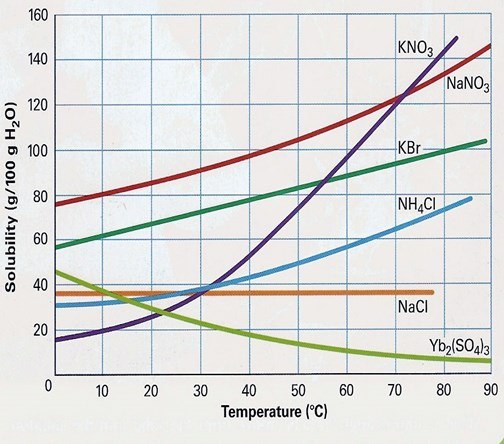
At 30'C, which substance has the lowest solubility?
KNO3
KBr
NaCl
Yb2(SO4)3
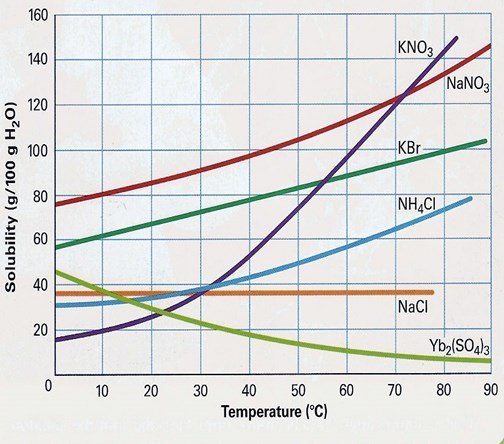
At which temperature do KBr and KNO3 have the same solubility?
60
55
50
Never
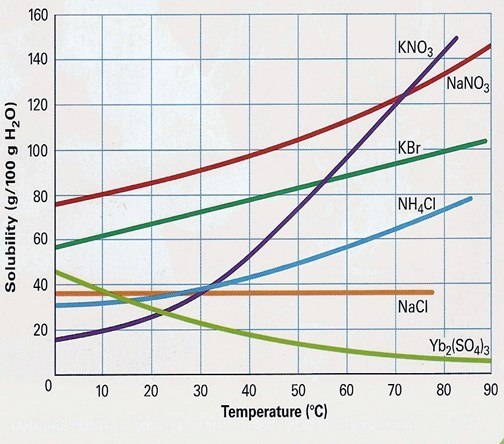
The solubility of Yb2(SO4)3 ________________ with added temperature.
increases
decreases
remains the same
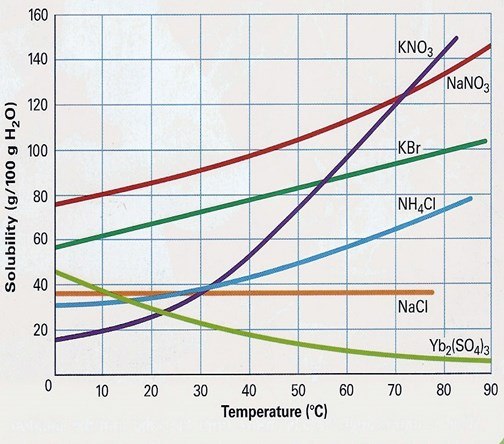
At 80'C, KBr's solubility is:
100
90
80
0
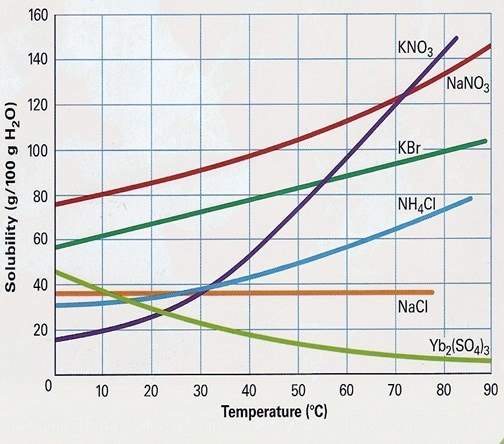
Determine the solubility for the substances at 55'C and arrange them in order from lowest to highest solubility.
NaCl, NH4Cl, KBr, NaNO3
NaCl, NH4Cl, NaNO3, KBr
NH4Cl, NaCl, NaNO3, KBr
NaNO3, KBr, NH4Cl, NaCl
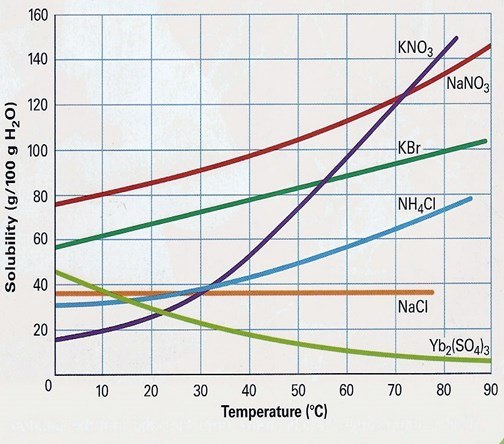
At 10'C, NaNO3's solubility is 80 g/100 g of H2O. Based on this information, what would the solubility be in 50 g of H2O.
40
80
160
16
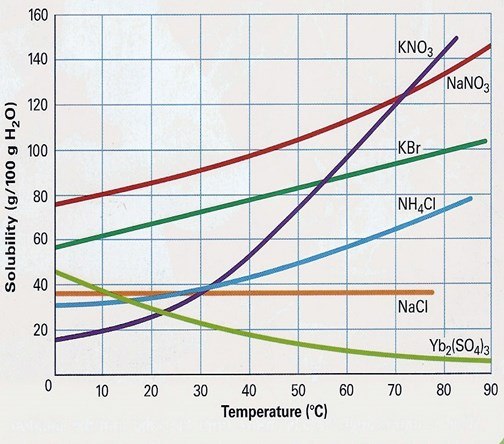
Identify if the following solution would be saturated, unsaturated, or supersaturated: 103 g KBr at 70'C.
Unsaturated
Saturated
Supersaturated
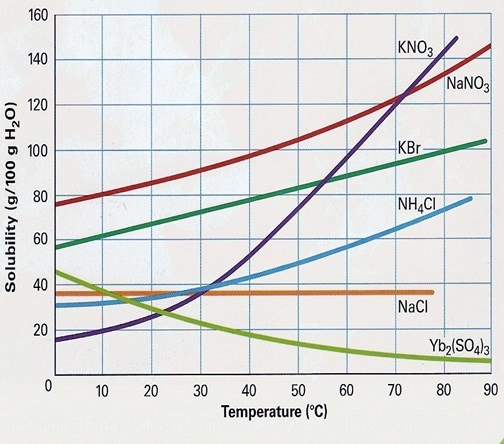
Identify how many grams of KNO3 is required to make a saturated solution at 40'C.
50 g
45 g
60 g
33 g
How could you change a saturated solution to an unsaturated solution?
Add solvent
Add solute
Water becomes __________ changing from a solid to a liquid
more dense & more kinetically chaged
less dense & less kinetically charged
more dense & less kinetically charged
less dense & more kinetically charged
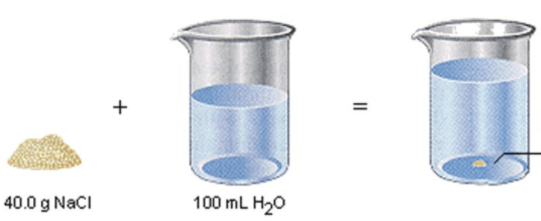
Identify the saturation associated with the product of this experiment.
Unsaturated
Saturated
Supersaturated
Identify a method to decrease the dissolving rate of a solution:
decrease the temperature
add KE
stir the solution
increase the temperature
A wave with a large wavelength will have a ______ frequency and _____ energy
high, low
high, high
low, high
low, low
What is the speed of light?
3.0x10⁸ ms
3.0x10⁸ m/s
6.626x10⁻³⁴ Js
6.626x10⁻³⁴ J/s
The frequency of violet light is 7.5x10¹⁴ Hz. What is its wavelength?
4.0x10⁻⁷ m
4.0x10⁷ m
2.25x10²³m
2.25x10²³ Hz

If short wavelength has more ENERGY than long wavelength, which color Lightsaber is the most dangerous, or powerful?
Red
Orange
Blue
Green

The number of waves that pass a fixed point in a given amount of time is...
frequency
wave speed
amplitude
wavelength
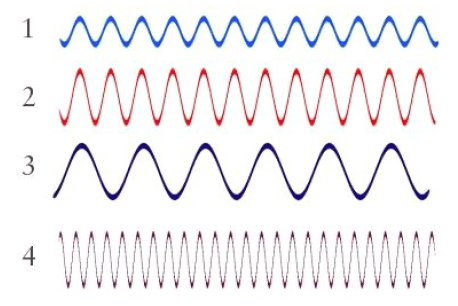
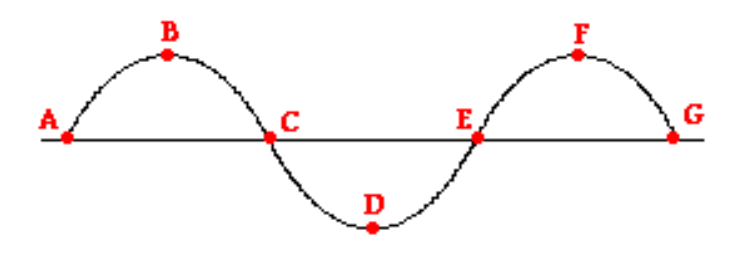
Which letter(s) represent the wavelength?
A & B
B & D
B & F
C & E
4.10 x 10⁻¹² m. What is the frequency?

