
 Worksheets
Honors Chem Unit 3 Liquids
Total questions: 143
Worksheet time: 3hrs 36mins
Define polar covalent bond
transfer of electrons
equal sharing of electrons
unequal sharing of electrons
delocalized sea of valence electrons
Define nonpolar covalent bond
transfer of electrons
equal sharing of electrons
unequal sharing of electrons
delocalized sea of valence electrons
Define ionic bond
transfer of electrons
equal sharing of electrons
unequal sharing of electrons
delocalized sea of valence electrons
What type of bond?
H-H
nonpolar covalent bond
polar covalent bond
ionic bond
metallic bond
What type of bond?
C-H
nonpolar covalent bond
polar covalent bond
ionic bond
metallic bond
What type of bond?
Na-Cl
nonpolar covalent bond
polar covalent bond
ionic bond
metallic bond
Which of the following is not a property of covalent molecules?
non-lustrous, various colors
brittle
poor conductors of heat and electricity
nonmetallic oxides are acidic and covalent
form cations by gaining electrons

Will bonds form between molecules at point A? Why or why not?
no, the nuclei are too close and repel each other
no, the distance between the atoms is too greate
yes, the bonds form when the energy between them is greatest
no, the bond will only form when energy is zero
Will bonds form between molecules at point D? Why or why not?
no, the nuclei are too close and repel each other
no, the distance between the atoms is too greate
yes, the bonds form when the energy between them is greatest
no, the bond will only form when energy is zero
Of C=C, C=C, or C-C, which has the shortest bond length and greatest bond energy?
C-C
C=C
C=C
Bond energy (aka bond enthalpy)
energy required when breaking a bond, or energy released when a bond is formed
number of chemical bonds
distance between two atomic nuclei in angstroms or picometers
Bond order
energy required when breaking a bond, or energy released when a bond is formed
number of chemical bonds
distance between two atomic nuclei in angstroms or picometers

A potential energy diagram for H2, HBr, and Br2 was created but not labeled. Which line corresponds with H2?
A
B
C

Which of the following bonds will be most polar?
Si-O
C-H
O-O
B-F

What hybridization exists for the compound CH2O?
sp3
sp2
sp
there is no hybridization
Which is the correct Lewis structure for the compound CH2O?


A resonance structure for CH2O is shown in the picture. Why is this not the best resonance structure?
because the carbon only has 6 valence electrons
because the oxygen doesn't have a full octet
because the formal charges of oxygen and carbon aren't equal to zero
because the hydrogens don't have a full octet

Which color graph would be the plot for the molecule with the shortest bond length?
purple graph
blue graph
red graph
What is the VSEPR theory used to predict?
Bond Strength
Polarity
Molecular Shape
Electronegativity
Draw the Lewis Dot structure for ICl2- and determine its predicted molecular geometry.
see-saw
trigonal bipyramidal
linear
bent
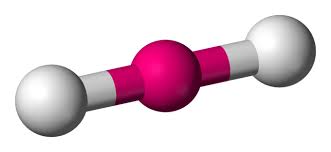
What is the hybridization of a linear molecule?
sp
sp2
sp3
sp3d

Which of the following is octahedral?
SCl6
XeI4
NBr5
CH4
Which of the following hybrid orbitals is used by the central atom for bonding in CO32-?
sp2
sp3
sp3d
sp3d2
Molecule CO2
undergoes sp2 hybridisation
has 2 σ bond and 2 π bond
undergoes sp3d hybridisation
is trigonal planar molecule
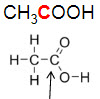
What is the hybridization of the Carbon atom indicated by the arrow?
sp hybridization
sp2 hybridization
sp3 hybridization
dsp3 hybridization
Name the type of bonding in which the electrons are shared.
Ionic bonding
Covalent bonding
Metallic bonding
The energy required to break the bonds between two covalently bonded atoms
bond dissociation energy
activation energy
none of these

Which of the following is the correct Lewis Structure for the molecule fluorine (F2)?
A
B
C
D

what type of bond is the strongest
single
Double
coordination
triple
In covalent bonding, electrons are
shared
transferred
wiped out
What is the correct Lewis Structure for ammonia (NH3)


What are valence electrons?
sum of the protons and neutrons
protons minus electrons
electrons in the inner shells
electrons in the outer shell

This could be the dot diagram of
Mg
Cl
C
O
Which of the following best describes why molecules have certain geometries
The unshared pairs of electrons & the bonding pairs of electrons on the central atom are experiencing repulsive forces
The unshared pairs of electrons & the bonding pairs of electrons on the central atom are experiencing attractive forces
The unshared pairs of electrons & the bonding pairs of electrons on the largest atom are experiencing repulsive forces
The bonding pairs of electrons on the atom with the most unshared pairs are experiencing repulsive forces
A lone pair is defined as
A pair of bonding electrons
One non-bonding electron
A pair of non-bonding electrons
A pair of electrons on the central atom
How many regions of electron density surround the carbon in carbon tetrachloride?
1
2
3
4

Will this molecule be polar or nonpolar? PH3
polar
nonpolar
Which Lewis Dot Model drawing correctly shows an O2 molecule?


When you have Br-Br, what is the polarity?
Polar
nonpolar
Ionic

When you have H-Cl, what is the polarity?
nonpolar
polar
ionic
Which of the following molecules, based on the elements present, would be most polar?
HF
H2
HCl
HBr
Which molecule contains bonds with a GREATER polarity?
HCl
CCl4

Partial charges like the ones shown here are called:
dipoles
deltas
ions
magnetic poles

Is this molecule polar or non-polar?
Polar
Non-polar

Is this molecule polar or non-polar?
Polar
Non-polar

Is this molecule polar or non-polar?
Non-polar
Polar

Is this molecule polar or non-polar?
Non-polar
Polar
A difference in electroegativity of 2.1 will result in what type of bond?
ionic
covalent
polar covalent
The type of bond that two elements will form is dependent on
the atomic radius of each atom
the ionization enegry of each atgr
the number of valence electrons of each atom
the electronegativity of each atom
A difference in electronegativity of 0.8 will result in what type of bond?
ionic
covalent
polar covalent
The greater the difference in electronegativity, the
greater the ionic character
the stronger the bond
the longer the bond length
the higher the bond energy
The energy it takes to break a covalent bond is called
bond energy
lattice energy
kinetic energy
electronegativity
The bond length describes the distance between two atoms where the potential energy is
highest
lowest
same
A double bond is longer and less stable than a single bond.
True
False
To draw a Lewis dot model you have to know
the period an element is in
the group an element is in
the number of valence elcctrons an atom has
the number of energy levels an atom has
Which elements do NOT get octets when covalently bonding?
H
B
C
N
Electrons that are not involved in bonding are called (a) .

The dotted lines in this structure represent
a hybrid bond that is halfway between a double and single bond
equivalent resonance structures
delocalised electrons
When there is more than one possible Lewis structure, (a) helps you determine the most stable one.

What is the formal charge on the sulfur atom?
(a)

What is the formal charge on the top oxygen atom?
(a)
What is the formal charge on the oxygen atom on the right?
(a)
Draw the net dipole on this molecule.


How many sigma bonds are found in the molecule shown?
3
9
13
14

How many pi bonds are found in the molecule shown?
2
3
6
9

Describe the hybridization of the carbon on the far right containing a triple bond.
sp
sp2
sp3

Identify the IMF between the two iodine molecules shown.
London Dispersion Force
Hydrogen bonding
dipole-dipole
ion-dipole

Identify the IMF occurring between Na+ and H2O, as shown in the diagram.
London Dispersion Force
Ion-Dipole
Dipole-Dipole
Hydrogen bonding
sp
sp2
sp3
sp3d
sp
sp2
sp3d
sp3d2

sp2
sp3
sp3d
sp3d2

0
1
2
3

Classify the following molecule.
polar
nonpolar

Is the following molecule polar or nonpolar?
polar
nonpolar

Is the following molecule polar or nonpolar?
polar
nonpolar

Classify the following molecule.
polar
nonpolar

Does this compound have a dipole moment?
Yes
No
A nonpolar compound can only contain nonpolar bonds.
True
False
What can cause molecules to lack a dipole moment even if they possess polar bonds?
The presence of only nonpolar bonds
The random arrangement of polar bonds
The symmetrical arrangement of polar bonds that cancel each other out
The complete absence of bonds
This is an example of a(n) (a) .
Which intermolecular force requires hydrogen and one of the following: nitrogen, oxygen, fluorine?
Dipole-dipole
Hydrogen bonding
London dispersion forces

What kind of force is the arrow pointing to?
Intramolecular Force
Intermolecular Force
The weaker the intermolecular forces of a substance the _____________ the boiling point
higher
lower
In a polar covalent bond, the electrons gather around...
Mostly the atom with the greatest electronegativity
The atom with the lowest electronegativity
Each atom equally
Only the atom with the greatest electronegativity
In a nonpolar covalent bond, the electrons gather around...
Mostly the atom with the greatest electronegativity
The atom with the lowest electronegativity
Each atom Equally
Only the atom with the greatest electronegativity
Which of the following properties of substances is NOT determined by IMFs?
Melting/boiling point
Vapor pressure
Density
Shape and color
Match the Following
Hydrogen Bond
Present in Polar involving N, O, F
London Dispersion Forces
Present in both Polar and Non Polar Molecules
Dipole- Dipole
Polar Substances only
covalent bond
London forces
hydrogen bond
dipole-dipole attraction
dipole-dipole>covalent bond>hydrogen bond>London
London>dipole-diple>hydrogen bond>covalent bond
covalent bond>hydrogen bond>dipole-dipole>London
hydrogen bond>dipole-dipole>London>covalent bond

Which type of IMF is responsible for the attraction pictured above?
Dipole-Dipole Interaction
Ion-Dipole Interaction
Hydrogen Bonds
Covalent Bond
Ionic Bond

Which type of IMF is responsible for the attraction pictured above?
Dipole-Dipole Interaction
Ion-Dipole Interaction
Hydrogen Bonds
Covalent Bond
Ionic Bond

Which type of IMF is responsible for the attraction pictured above?
Dipole-Dipole Interaction
Ion-Dipole Interaction
Hydrogen Bonds
Covalent Bond
Ionic Bond
Chromatography separates solutions on the basis of _____ while distillation separates solutions on the basis of ______.
IMFs; solubility
solubility; conductivity
IMFs; boiling point
boiling point; solubility
In paper chromatography, if water is the mobile phase, what kind of substance will move up the farthest?
polar substance
non polar substance
“More polarizable” refers to which Intermolecular Force?
hydrogen bonding
london dispersion
dipole dipole
List ALL the Intermolecular forces that exist in PCl3
hydrogen bonding, london dispersion
london dispersion, hydrogen bonding, dipole dipole
london dispersion, dipole dipole
london dispersion
Name a property that decreases as Intermolecular Forces increase.
Vapor pressure
Conductivity
Melting point
Solubility
Name a property that increases as Intermolecular Forces increase.
Vapor pressure
Conductivity
Melting point
Solubility
What causes gas pressure?
large space between the molecules
random motion of particles
collisions with the walls of the container
Polar substances will dissolve in what type of substances?
Ionic
Polar
Non-Polar
Metallic
"Like dissolves like" is the easy way to remember the previous question, but what molecular property is causing that to be true?
Boiling Point
IMFs
Melting Point
Vapor Pressure

Ink can be separated by a method of -----------------------------------------------
distillation
filtration
chromatography
sedimentation
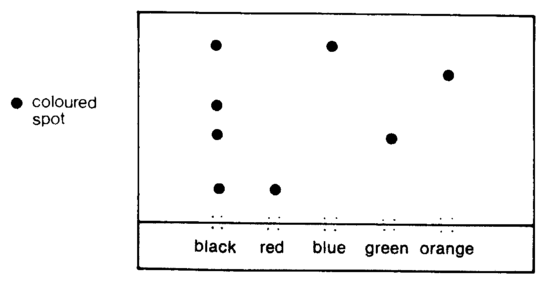
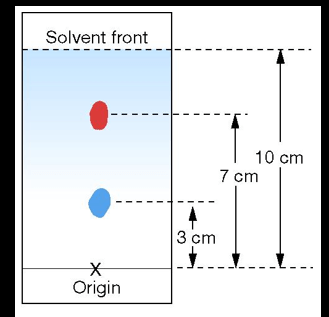

In paper chromatography, the LEAST soluble solute ____.
does not move from the start point
stays closest to the start point
travels furthest away from the start point
can be found in the middle of the chromatogram

Octane (C8H18- nonpolar hydrocarbon) and water
Soluble (miscible)
Insoluble (immiscible)
Partially soluble
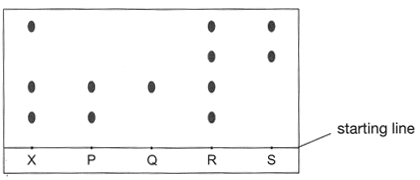

Which molecule will have hydrogen bonds with other molecules in the sample?
a) CO2
b) HCN
c) C2H2
none of the above
Which of the following will have the highest heat of vaporization?
CH4
C2H6
C3H8

