
 Worksheets
Bohr models, electron configurations, and periodic trends
Total questions: 139
Worksheet time: 7hrs 29mins
Select the two statements that are TRUE:
Electrons release energy when they move to a higher energy state
Electrons release energy when they move to a lower energy state
Electrons absorb energy when they move to a higher energy state
Electrons absorb energy when they move to a lower energy state
Compare the energy released when an electron moves down 6 energy levels vs. 4 levels.
More energy is released when it moves down 4 levels
Less energy is released when it moves down 4 levels
The same amount of energy is release if the electron started in the same level
The same amount of energy is release if the electron ended in the same level
During a flame test, ions of a specific metal are heated in a flame. A characteristic color of light is emitted by these ions in the flame when the electrons _______________.
Gain energy as they return to their ground state
Gain energy as they move to their excited state
Emit energy as they return to their ground state
Emit energy as they move to their excited state
If a light wave has a frequency of 2.0 hz, what is the wavelength?
1.3 x 10^-33 hz
1.5 x 10^8 hz
6.0 x 10^8 hz
7.0 x 10^-9 hz
How much energy is in a photon with a frequency of 3.0 hz?
2.0 x 10^-33 J
2.2 x 10^-34 J
4.5 x 10^-33 J
9.0 x 10^8 J
How much energy is in a photon with a wavelength of 0.50 m?
6.0 x 10^8 J
1.5 x 10^8 J
4.0 x 10^-25 J
9.9 x 10^-26 J
In the Bohr model of the atom, in which orbit is an electron in its lowest energy state?
in the orbit closest to the nucleus
in the orbit farthest from the nucleus
in the electron cloud
midway between two orbits
All of the elements in a period (row) have the same number of (a) .
All of the elements in a group (column) have the same number of (a) . (except He)
electrons
energy levels
What is the Bohr Model of Carbon in the ground state?
6 protons, 6 neutrons, 6 electrons with 2 in the first shell and 4 in the second shell
6 protons, 6 neutrons, 6 electrons with 4 in the first shell and 2 in the second shell
6 protons, 6 neutrons, 6 electrons with 3 in the first shell and 3 in the second shell
6 protons, 6 neutrons, 6 electrons with 1 in the first shell and 5 in the second shell
The lowest energy state of an atom is called its:
ground state
ionized state
initial energy state
final energy state
Which of the transitions below for a hydrogen
atom involves the least energy?
𝑛= 5 𝑡𝑜 𝑛 = 3
𝑛 = 5 𝑡𝑜 𝑛 = 4
𝑛 = 2 𝑡𝑜 𝑛 = 5
𝑛I= 4 𝑡𝑜 𝑛 = 7
A photon has a frequency of 4,3 x 10¹⁴ Hz, the energy of this photon is ___________ _J and the wavelength is ______nm
2.8 x 10⁻¹⁹ and 7 x 10⁻⁷
2.8 and 700
2.8 x 10⁻¹⁹ and 700
2.8 and 7
A photon has a frequency of 4.3 x 10¹⁴ Hz, the energy of this photon is ___________ _J and the wavelength is ______m
2.8 x 10⁻¹⁹ and 7 x 10⁻⁷
2.8 and 700
2.8 x 10⁻¹⁹ and 700
2.8 and 7
1s22s22p63s23p64s23d10
1s22s22p63s2

1s22s22p63s2

1s22s22p63s23p64s23d10


How many electrons can the d sublevel (the d orbitals) hold?
14
10
2
6
Choose the correct shortcut configuration for iodine.
[Ar]4s24d104p5
[Kr]5s24d105p5
[Xe]5s25d105p5
none of the above
Each row on the periodic table represents:
an energy level
a sublevel
an electron
an orbital
Which area on the periodic table represents the electrons in the "d" sublevel (d orbitals)?
representative elements
columns 3-8
rare earth elements
transition elements
Which periodic table family below has their last, most energetic electron in their electron configuration in the s-block?
Alkaline Earth
Halogens
Noble Gases
Transition Metals
Each orbital can hold how many electrons?
5
4
8
2

What is incorrect about this orbital diagram?
Both arrows in the 2p box should be pointing up
There is nothing incorrect with this diagram
In the 2p box there should only be 1 electron in the first 2p box and one in the 2nd 2p box pointing in the same direction.
All the arrows should be pointing up.
In an electron configuration, what follows 4s?
4p
3d
4s
2f


Choose the Noble Gas that you would use to begin the shorthand configuration of the following element.
Iron
[He]
[Ne]
[Ar]
[Kr]
Choose the Noble Gas that you would use to begin the shorthand configuration of the following element.
Plutonium (Pu)
[Xe]
[Ne]
[Rn]
[Kr]

What is the shorthand configuration for Tin?
[Xe]5s24d105p2
[Xe]5s24d105p2
[Kr]5p2
[Kr]5s24d105p2
What is the shorthand configuration for Lead?
[Xe]6s24f145d106p2
[Xe]6s25d106p2
[Rn]6s25d106p2
[Rn]6s24f145d106p2
A substance with characteristics of metals and nonmetals.
metalloid
element
compound
atom

What orbital is shown in the picture?
s orbital
p orbital
d orbital
f orbital
Which quantum number represents the shape of the orbital?
principal energy (n)
angular momentum (l)
magnetic (m)
spin
Which quantum number represents the orientation of the orbital?
principal quantum number
azimuthal (angular momentum) quantum number
magnetic quantum number
spin quantum number
When atoms _____________ energy, their electrons move to higher energy levels. These electrons _____________ energy by emitting light when they return to lower energy levels.
lose, absorb
absorb, lose
lose, lose
absorb, absorb
Which form of radiation has the highest frequency?
radio waves
ultraviolet
x-ray
gamma


Put the visible light colors in order from lowest energy to highest energy

Each element produces its own pattern of emission spectra lines because each element has its own distinct
Speed of light
Electron configuration
Number of neutrons
None of these

If an electron moves from n=4 to n=2 it ____
absorbs energy
emit energy
Which of the following states that electrons occupy orbitals of lowest energy first?
Hund’s Rule
Aufbau Principle
Pauli Exclusion Principle
What does the Pauli Exclusion Principle state?
An orbital can only hold a maximum of 2 electrons, each with opposite spins
An orbital can hold a minimum of 6 electrons, each with opposite spins
An orbital can hold a maximum of 6 electrons, each with the same spin
An orbital can hold a maximum of 2 electrons, each with the same spin
Which of the following is NOT a possible pair of quantum numbers?
2p
2d
4p
4f
What does the 1 in "1s" stand for?
energy level
s orbitals
p orbitals
the number of electrons
What element has the electron configuration 1s2 2s2 2p6 3s2 3p5?
Chlorine
Argon
Fluorine
Sulfur
Bromine
How many electrons are in 1s2 2s2 2p4?
5
6
8
13
What is the noble gas configuration for Cobalt?
[Kr] 4s2 3d7
[Kr] 4s2 4d7
[Ar] 4s2 3d7
[Ar] 4s2 4d7
What is the noble gas configuration for 1s2 2s2 2p6 3s2?
[He] 3s2
[Ne] 3s2
[Ar] 3s2
[Ar] 4s2
Which of the following will have similar properties to 1s2 2s2 2p6 3s2 3p2?
carbon
calcium
chlorine
cesium

Match the parts of the electron configuration to what it represents.
1
Energy Level
s
Orbital
2
Electrons
Finish the electron configuration for chlorine:
1s2 2s2 (a) 3s2 3p6
Match the group to the configuration that it ends with.
s1
alkali metals
s2
alkaline earth metals
p5
halogens
p6
noble gases

How many electrons can the second energy level hold?
18
6


Which shows the correct orbital diagram for Cobalt?


This shape is that of a/n:
s orbital
p orbital
d orbital
f orbital
Which element is the least reactive?
Li
Ne
B
C
metal
nonmetal
metalloid
nonexistent

What is the name of group number 1?
halogens
noble gases
alkali metals
alkaline earth metals
What is the name of group number 2?
transition metals
halogens
metaloids
alkaline earth metals
where are the metaloids found
far left, vertical
stair step/diagonal
far right horizontal
at the bottom
What group number are the halogens found?
18 (8A)
1
2
17 (7A)
Periodic law states that the elements are arranged according to their atomic ________ so that elements with similar chemical properties are in the same ________ and properties repeat periodically.
numbers, rows
masses, rows
masses, column
numbers, column
A row on the Periodic Table of Elements
family
period
row
isotope
Which element has similar chemical properties as sodium but has 7 energy levels?
Francium (Fr)
Cesium (Cs)
Rubidium (Rb)
Potassium (K)
Elements that have the same number of energy levels are said to be in the same ______.
group
period
family
classification
Which of the following groups would be the most REACTIVE METALS?


Which has the greater Electronegativity:
Cl or Al?
Which has the greater Electronegativity:
N or C?
the number of protons and electrons increases, so attraction to electrons increases
just the number of electrons increases
Put in order from biggest to smallest (decreasing atomic radius)
Calcium
Iron
Zinc
Bromine
Krypton
Which of these is a distinguishing property for the noble gases?
Soft - can cut with a plastic knife
Unreactive - don't give or receive electrons
Shiny - exhibits luster
Poor conductors of electricity
An unknown element is observed to be shiny, malleable, ductile, and is found to conduct heat and electricity very well. What group might this element fall into?
Alkali metals
Alkali earth metals
Transition metals
Non-metals
Which of these are not good conductors of heat & electricity?
metalloids
alkali earth metals
transition metals
non-metals

The shaded elements here are known as the...
Noble Gases
Halogens
Non-Metals
Transition Metals
The elements in the d-block of the periodic table are known as...
Alkali metals
Transition metals
Noble gases
non-metals
Most of the elements on the periodic table are...
Metals
Non-metals
As you look down a group, ionization energy and electronegativity
increases
decreases
As you look from left to right across a period, ionization energy and electronegativity both
increase
decrease

Which element has the greater ionization energy?
Magnesium (Mg)
Phosphorus (P)

Which element has the greater ionization energy?
Iodine (I)
Chlorine (Cl)
P, Cs, Co, Sr
What color of the rainbow has the longest wavelength?
red
blue
green
violet
Pick the sentence that best describes the relationship between wavelength and energy of light.
As the wavelength gets longer the energy of light increases.
As the wavelength gets shorter the energy of light increases.
A photon with a long wavelength will have high energy.
These are not related.
The colors emitted by an element (Emission spectra) are
Unique to that type of element
The same for every element
Depends on the amount of energy in the element
Elements do not emit colors
An electron that jumps multiple orbitals compared to an electron that jumps only one will release
a shorter wavelength of color
a longer wavelength of color
no wavelengths of color
all the wavelengths of color

True or False: The ground state is the highest energy state of an atom.
True
False

Diagram below shows
Continuous spectrum
Absorption spectrum
Emission Line spectrum
Absorption Line spectrum
A particle of light is called a...
Photoelectron
Photon
Proton
Electron

The unknown emissions spectra belongs to the element
Hydrogen
Mercury
Neon
Sodium


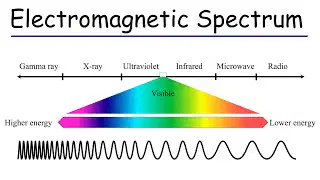


Which wave has a higher frequency?
A
B
A certain photon of light has a wavelength of 4.22x10⁻⁷nm. What is the frequency?
7.11x10¹⁴ Hz
7.11Hz
1.41x10⁻¹⁵ Hz
-1.41x10¹⁵ Hz
What is the energy of a quantum of light with a frequency of 7.39x10¹⁴Hz.(E=Hv)
4.88x10¹⁹ J
4.88x10⁻¹⁹ J
2.22x10²³ J
2.22x10⁻²³ J
What is the wavelength for a quantum of light with energy of 7.56x10⁻¹⁹J?
2.62x10⁻⁷m
2.62x10⁷m
2.64x10-45m
2.64x1045m
The number of waves that pass a fixed point in a given amount of time is...
frequency
wave speed
amplitude
wavelength

