
 Worksheets
(Optional) PS Unit 2 Test Review
Total questions: 141
Worksheet time: 4hrs 11mins
2H2 + O2 --> 2H2O
2H2 + O2 --> 2H2O
Al + O2 --> 2Al2O3
HgO --> Hg + O2
Mg + __HCl ---> MgCl2 + H2
_CF4 + _Br2 -- _CBr4 + _F2
NaCl + Ca(NO3)2 -->
KClO3 --> KCl + O2
2Na + Cl2 --> 2NaCl

What type of reaction involves the breaking down of a substance into simpler substances?
Single Replacement Reaction
Double Replacement Reaction
Synthesis Reaction
Decomposition Reaction

What type of reaction involves 2 substances combining to form 1 new compound?
Decomposition Reaction
Single Replacement Reaction
Double Replacement Reaction
Synthesis Reaction

What type of reaction involves one element replacing another element in a compound?
Single Replacement Reaction
Double Replacement Reaction
Synthesis Reaction
Decomposition Reaction
What type of reaction involves ions from 2 compounds exchanging places to form 2 completely new compounds?
Single Replacement Reaction
Double Replacement Reaction
Synthesis Reaction
Decomposition Reaction

What are the reactants in the chemical equation pictured?
CH4 and CO2
CH4 and O2
CO2 and H2O
O2 and H2O

What are the products of the chemical reaction pictured?
CH4 and CO2
CH4 and O2
CO2 and H2O
O2 and H2O
What type of chemical reaction is this one?
Al(OH)3 --> Al2O3 + H2O
Decomposition
Combustion
Synthesis
Single Replacement
What type of chemical reaction is this one?
CUO + CO2 --> CuCO3
Decomposition
Combustion
Synthesis
Single Replacement
What type of chemical reaction is this one?
Ca + MgCl2 --> CaCl2 + Mg
Decomposition
Combustion
Synthesis
Single Replacement
3KOH + H3PO4 --> K3PO4 + 3H2O
Combination
Decomposition
Single replacement
Double replacement
Combustion reactions will always involve
Oxygen and a solid
Liquid nitrogen and heat
Oxygen and heat/energy
CO and H2O
When Lead Nitrate reacts with potassium iodide, Yellow precipitate of ............. is formed
PbI2
KNO3
Pb(NO3)2
PbIO3
Balancing this reaction:
____ CH4 + ____ O2 ---> ___ CO2 + ____ H2O
2,1,3,1
1,2,1,2
1,2,2,1
2,1,1,2
Balance this reaction:
____ Na3PO4 + ____ KOH ---> ____ NaOH + ____ K3PO4
1,3,3,1
1,3,2,1
2,3,3,1
1,1,3,1
Balance this reaction:
____ NaF + ____ Br2 ---> ___ NaBr + ____ F2
3,1,2,1
1,2,3,4
2,1,2,1
1,2,1,2


Two chemicals reacted and one of the products stays dissolved in the solution. What symbol is used to indicate this?
(s)
(l)
(aq)
(g)
Predict the products for this substance: Al2O3 → ? + ?
Al + O2
O2 + Al3
Al2 + O3
Al + O
Al3 + O
Predict the products if Calcium Carbonate reacts with Silver Sulfate.
CaCO3 + Ag2SO4 → ?
Ag2CO3 + Ca2SO4
AgCO3 + CaSO4
CaSO4 + Ag2CO3
Ag(CO3)2 + CaSO4
In a reaction, Barium Chloride reacts with Potassium Carbonate to produce Barium Carbonate and Potassium Chloride. Determine the solubility of each product. Which answer choice correctly states one of the products?
BaCl2 (aq)
KCl (s)
BaCO3 (s)
K2CO3 (aq)
BaCO3 (aq)
If Ethylene (C2H4) reacts with Oxygen gas in a chemical reaction, what are the products?
C2O2 + H4
CO2 + H2 + O2
CO + H2
CO2 + H2O
Barium Bromide reacts with Lithium Phosphate to yield Lithium Bromide and Barium Phosphate. What substance forms the precipitate in this reaction?
Lithium Phosphate
Lithium Bromide
Barium Bromide
Barium Phosphate
Cu+ AgNO3-->
C2H4 + 2 O2 -->
Mg + Al(OH)3 →
4Fe + 3O2 → 2Fe2O3
2H2O2 →2 H2O + O2
Fe + CuSO4 -> Cu + FeSO4
What are the products of this reaction?
Cu2+ + AgNO3 →
Cu(NO3)2 + Ag
CuNO3 + Ag
CuAg + NO3
Cu + AgNO3
Write a balanced reaction for this reaction [Zn has a charge of 2+]
Zn(s) + H2S(aq) →
ZnS + H
ZnS + H2
ZnS2 + H
Zn2S + H2
Write a balanced equation for this DR reactions
NaOH + Fe(NO3)3 -->
NaFe + OH(NO3)3
2NaNO3 + 3Fe(OH)3
NaNO3 + FeOH
3NaNO3 + Fe(OH)3
K + HCl -->
Predict the products for the this reaction:
Mg + CuCl2 →
MgCl2 + Cu
MgCl + Cu
MgCu + Cl2
CuMg + Cl2
Predict the products for the this reaction: [Ag has a charge of 1+]
Ag3N + KCl →
AgCl + K3N
AgK + ClN3
AgN3 + KCl
KAg + N3Cl
What are the correct formulas and coefficients for the products of the following single-replacement reaction?
Ag + K2SO4 →
No Reaction
K2 + AgSO4
2K + Ag(SO)4
2K + AgSO4
When electrons are transfered from cations to anions a(an) ________ bond is formed
polar covalent
nonpolar covalent
ionic
metallic
When electrons are shared a(an) ________ bond is formed
ionic
covalent
metallic
Of these 3 molecules, which represents a covalent bond?
O2
NaI2
HBr
MgO
All elements are made up of tiny particles called _____________
cells
matter
atoms
elements
A(an) __________ bond exists between two nonmetals.
ionic
covalent
What is a negatively charged atom called?
Anion
Cation
Ion
Why do atoms bond?
They typically don't bond
To add or take away energy levels
To have a full valence shell.
To have a full inner shell
What charge would a potassium (K) ion have?
+1
-1
+2
-2

What is a valence electron?
an electron that is found in the outermost shell of an atom.
an electron found in the innermost shell of an atom.
an electron found in the middle shell.
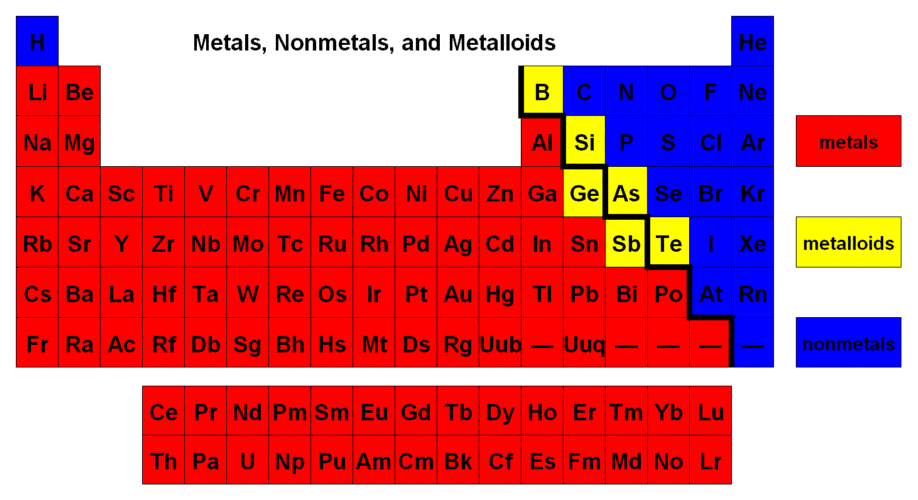
What usually forms the positive ion?
Metal
Nonmetals
None
Which category of elements usually form negative ions?
metals
nonmetals
metalloids
noble gases
How many valence electrons does an atom of phosphorus have?
3
2
5
8
What is the name of K2O?
Dipotassium monoxide
Dipotassium oxygen
Potassium oxide
Potassium oxygen
What is the name of NF3?
Mononitrogen trifluoride
Nitrogen trifluoride
Nitrogen flouride
Nitrogen fluorine
What is the name for CO?
Copper Oxide
Carbon monoxide
Monocarbon oxide
Copper monoxide
A group of covalent bond atoms are called a _________________
compound
molecule
ion
chemical
Chemical bonding happens between _________________ of an element.
atoms
protons
neutrons
element
How would you draw a Lewis dot diagram for Magnesium?



How many electrons are needed in the outer energy levels of an atom, in order for that atom to be stable?
6
1
8
2

Looking at your Periodic Table, what kind of bond would NaF create?
Covalent
Molecular
Ionic
Metallic
Cr3+ O2-
Name the following ionic compound: Cr(NO2)3
Chromium nitrite
Chromium nitride
Chromium (III) nitride
Chromium (III) nitrite
Al3+ O2-
Name the following compound: NaNO3
Sodium Nitrogen Oxide
Sodium nitrate
Sodium nitrite
Sodium nitride
What is the name of NH4Cl?
Nitrogen tetrahydrogen chloride
Ammonium chlorine
Ammonium chloride
Ammonium chlorate
Name the following ionic compound: MgSO4
Magnesium sulfoxide
Magnesium sulfide
Magnesium sulfate
Magnesium oxide
Name the following ionic compound: LiNO3
Lithium nitrate
Lithium (III) nitrate
Lithium nitride
Lithium oxide
Name this compound: NH4F
Ammonia fluoride
Ammonium fluorite
Ammonia fluorate
Ammonium fluoride
Name the following ionic compound: Cr(NO2)3
Chromium nitrite
Chromium nitride
Chromium (III) nitride
Chromium (III) nitrite
What is the correct name of Fr2CO3
Francium carbide
Francium carbonate
Francium (II) carbonate
Francium (I) carbonate
Name the following compound: FeCl3
Iron (II) chloride
Iron (III) chloride
Iron chlorate
Iron (III) chlorate
The name of Cu₃N₂ is
Copper (III) nitride
Copper (II) nitride
Copper nitride
Tricopper dinitride
what is the chemical formulas for copper (II) chloride?
CuCl2
CuCl
Cu2Cl
Cu2Cl2
Write the formula for copper (I) phosphide
Cu3P
CuP
Cu1P
CuP3
What is the name of Si2Cl6?
Disilicon hexachlorine
Disilicon hexachloride
Silicon hexachloride
Silicon chloride
A polyatomic ion is a group of covalently bonded atoms that __________________.
is neutral
has a charge
When naming a transition metal ion that can have more than one common ionic charge, the numerical value of the charge is indicated by a __________.
prefix
suffix
superscript after the name
Roman numeral following the name
Which of the following is true about the composition of ionic compounds?
They are composed of anions and cations.
They are composed of anions only.
They are composed of cations only.
They are formed from two or more nonmetallic elements.
What is the correct name for the compound CoCl2?
Cobalt (I) chlorate
Cobalt (I) chloride
Cobalt (II) chlorate
Cobalt (II) chloride
MgO
Magnesium monoxide
Magnesium oxide
Magnesium (II) oxide
Monomagnesium monoxide
Dihydrogen monoxide
HO2
H(II)O
H2O
OH2
Covalent compound names include
roman numerals
prefixes
polyatomic ions
endins in -ate
The roman numerals in a name is always in what type of compound?
covalent
ionic
there are never roman numerals in a name
If a compound's name ends in anything besides -ide we know:
not enough information
it is covalent
it is ionic
it includes a polyatomic ion

