wayground logo

Free Printable Worksheets

Font size

S
M
L
XL
Worksheets

Physical Science 2022 Unit 1: Matter in Motion

Total questions: 141

Worksheet time: 2hrs 33mins
Name
Class
Date
1.
A pure substance that cannot be broken down into other substances by chemical or physical means. 
a)
compound          
b)
atom
c)
mixture 
d)
element
2.
What is an example of a mixture?
a)
iron
b)
ice
c)
soil
d)
gold
3.
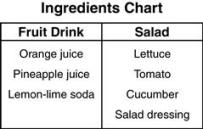
Jorge prepared a drink and salad for dinner. The chart lists the ingredients for both.
Using the information in the chart, which statement is the BEST description of the drink and salad?
a)
The salad and fruit drink are both mixtures.
b)
The salad and the fruit drink are both solutions.
c)
The fruit drink is a mixture because the ingredients can't be separated.
d)
The salad is a solution because the ingredients can't be separated.
4.
A pure substance that cannot be broken down into other substances by chemical or physical means. 
a)
compound          
b)
atom
c)
mixture 
d)
element
5.
A mixture that is uniform and well mixed is _____.
a)
homogeneous
b)
hetergeneous
c)
pure substance
d)
compoud
6.
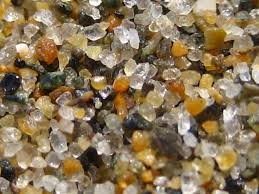
The picture shown here is what type of mixture?
a)
homogeneous
b)
hetergeneous
c)
pure substance
d)
element
7.
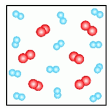
This diagram represents a _____.
a)
pure substance that is a compound
b)
mixture of elements
c)
pure substance that is an element
d)
mixture of compounds
8.

Which of these is an element?

a)

Salt (NaCl)

b)

Water (H20)

c)

Oxygen (O)

d)

Carbon Dioxide (CO2)

9.

Which of these is a compound?

a)

Aluminium (Al)

b)

Carbon Dioxide (CO2)

c)

Nitrogen (N)

d)

Sand

10.

Which of these is a mixture?

a)

Laundry Detergent

b)

Salt (NaCl)

c)

Oxygen (O)

d)

Fluorine (Fl)

11.

Air is:

a)

An element

b)

A compound

c)

A mixture

d)

None of these

12.

___________ are the smallest unit of an element that maintains the properties of that element.

a)

Atoms

b)

Elements

c)

Compounds

d)

Mixtures

13.

An _______________ is made up of one or more of the same kind of atom chemically combined.

a)

atom

b)

element

c)

molecule

d)

compound

14.

A ______________ is made up of different kinds of atoms chemically combined.

a)

element

b)

compound

c)

mixture

d)

molecule

15.

True or False: elements AND compounds are pure substances.

a)

True

b)

False

16.

Which of the following is classified as a pure substance?

a)

Lemonade

b)

Fruit punch

c)

ketchup

d)

Helium

17.

What is this?

a)

Atoms of an element

b)

Mixture

c)

Compound

d)

Molecules

18.

What are these?

a)

Molecules of compounds

b)

Elements

c)

An atom

d)

Mixture

19.

This is

a)

a compound.

b)

an element.

c)

an atom.

d)

a mixture.

20.

Which of the following is NOT a mixture?

a)

milk

b)

lemonade

c)

vegetable salad

d)

aluminum

21.
Physical or Chemical change:
Ice melts
a)
physical change
b)
chemical change
22.
Physical or Chemical change:
milk sours
a)
physical change
b)
chemical change
23.
Physical or Chemical change:
a bicycle changes color as it rusts
a)
physical change
b)
chemical change
24.
Substances that exist before the reaction
a)
products
b)
subscripts
c)
reactants
d)
coefficients
25.
A reaction that releases heat (energy)
a)
endothermic
b)
exothermic
c)
balanced
d)
reactants
26.
2H2O + Na2 ---> 3Na2O2H
How many hydrogen atoms are on the reactants side of the equation?
a)
2
b)
3
c)
4
d)
6
27.
True or False:
Energy may be gained or lost during a chemical reaction.
a)
True
b)
False
28.
The arrow in a chemical equation reads as this
a)
balanced
b)
atoms
c)
reactants
d)
produces
29.
The ability to burn is a ___ property.
a)
physical
b)
chemical
c)
conservitive
d)
reversed
30.
Dissolving a solid into a liquid is a ___.
a)
physical change
b)
chemical change
31.
An equation with an equal number of atoms on each side
a)
unbalanced equation
b)
similar equation
c)
altered equation
d)
balanced equation
32.
A change in a substance that only affects size, shape or state of matter.
a)
chemical change
b)
physical change
c)
chemical property
d)
endothermic
33.
The substances formed during a chemical reaction are called ___.
a)
protons
b)
neutrons
c)
reactants
d)
products
34.
This tells you the number of atoms of each element present in a chemical formula
a)
products
b)
reactants
c)
subscript
d)
element
35.
A process that produces a chemical change is a
a)
physical change
b)
chemical reaction
c)
endothermic
d)
physical reaction
36.
Substances on the left side of a chemical equation
a)
products
b)
subscripts
c)
reactants
d)
coefficients
37.

2H2O + S2 ---> 4SO2

How many sulfur (S) atoms are on the products' side of the equation?

a)

2

b)

3

c)

4

d)

6

38.

2H2O + S2 ---> 4SO2

What is the number four called in front of the SO2?

a)

subscript

b)

coefficient

c)

median

d)

reactant

39.

___ change - causes the identity of a substance to change; something new is formed.

a)

formation

b)

physical

c)

chemical

d)

conservation

40.

A characteristic that can be observed using our senses is a ___.

a)

chemical property

b)

physical property

c)

melting point

d)

chemical change

41.

A property that is observed without making changes to the substance.

a)

Chemical Reaction

b)

Chemical Property

c)

Physical Property

d)

Physical Reaction

42.

Which of the following properties can be used to identify an unknown substance?

a)

Temperature

b)

Mass

c)

Density

d)

All of the Above

43.

When baking soda mixes with vinegar, a chemical reaction occurs. This reactivity is an example of a _______________.

a)

Chemical Property

b)

Physical Property

44.

What are the units for density?

a)

g

b)

mL

c)

g/mL

d)

mL/g

45.

What are the units for mass?

a)

g

b)

mL

c)

g/mL

d)

mL/g

46.

What are the units for volume?

a)

g

b)

mL

c)

g/mL

d)

mL/g

47.

Water has a density of 1g/mL. If a rock has a density of 1.2g/mL, what will happen when it is placed in water?

a)

The rock will sink.

b)

The rock will float.

c)

The rock will react with the water.

d)

The rock will change the water.

48.

Calculate the mass if the density is 2g/mL and the volume is 10mL.

a)

5g

b)

20g

c)

5mL

d)

20g/mL

49.

Which object would float in water?

a)

Button (density = .79g/mL)

b)

Rock (density = 3.2g/mL)

c)

Penny (density = 1.3g/mL)

d)

Ball (density = 1.9 g/mL)

50.

Solubility is an example of a....

a)

Physical Property

b)

Chemical Property

51.

Calculate the volume is the mass is 35g and the density is 7g/mL.

a)

245g

b)

245mL

c)

.2mL

d)

5mL

52.

Which of the following is an example of a chemical change?

a)

Cutting paper

b)

Sugar burning

c)

Freezing water

53.

The mass of an empty graduated cylinder is 75g. After adding 25mL of vinegar to the graduated cylinder, the mass of the graduated cylinder with the vinegar increased to 85g. What is the mass of vinegar?

a)

85g

b)

75g

c)

10g

d)

160g

54.

Calculate the density if the mass is 2g and the volume is 2mL.

a)

2 g/mL

b)

1 mL/g

c)

2 mL/g

d)

1 g/mL

55.

Flammability is a ________ property.

a)

Physical

b)

Chemical

56.

Which equation would you use to calculate mass?

a)

Density divided by Volume

b)

Volume divided by Density

c)

Density multiplied by Volume

d)

Mass plus Volume

57.

Which equation would you use to calculate density?

a)

Mass divided by Volume

b)

Volume divided by Mass

c)

Mass multiplied by Volume

d)

Mass plus Volume

58.

Which equation would you use to calculate volume?

a)

Density divided by Mass

b)

Mass divided by Density

c)

Density multiplied by Volume

d)

Mass plus Volume

59.
What Is Matter?
a)
Anything That has weight and takes up space.
b)
Anything that you can see or taste.
c)
What you can touch.
d)
you and go throught this.
60.
What Is Volume?
a)
How heavy something is.
b)
The amount of space taken up by and object.
c)
How a liquid flows.
d)
The international unit of measurement.
61.
A gas
a)
has a definite shape but no definite volume
b)
has a definite volume but no definite shape
c)
has fast-moving particles
62.
At higher temperatures
a)
particles in an object have less energy
b)
particles in an object move faster
c)
a gas contracts
63.
The opposite phase of melting is 
a)
freezing 
b)
sublimation
c)
condensation 
d)
deposition 
64.
Melting
a)
liquid to solid
b)
solid to liquid
c)
solid to gas
d)
gas to liquid
65.
Freezing
a)
Solid to gas
b)
Liquid to solid
c)
Gas to solid
d)
Liquid to gas
66.
Boiling
a)
liquid to gas
b)
gas to solid
c)
gas to liquid
d)
solid to liquid
67.
Which state of matter has tightly packed molecules?
a)
solid
b)
liquid
c)
gas
68.
What are the states of matter?
a)
solid, liquid, and juice
b)
solid and liquid
c)
solid and gas
d)
solid, liquid, and gas
69.
The drops of water that appear on the outside of a glass of cold juice on a warm day are an example of?
a)
sublimation
b)
condensation
c)
evaporation
70.
Define a liquid.
a)
Indefinite shape, indefinite volume
b)
Definite shape, definite volume
c)
Found in stars
d)
Definite volume, indefinite shape
71.
Which of these is an example of sublimation?
a)
water turning to ice
b)
ice cream dripping
c)
a puddle drying up
d)
dry ice being used to make fog
72.
How are the particles moving in liquids?
a)
Sliding past one another
b)
moving past one another with great speed
c)
vibrating in a fixed postion
73.
What would cause a decrease in particle movement?
a)
decrease atoms
b)
increase in space between atoms
c)
decrease in temperature
d)
increase in mass
74.
Solids are described as having a 
a)
definite shape and indefinite volume
b)
indefinite shape and indefinite volume
c)
definite shape and definite volume
d)
indefinite shape and definite volume
75.
Liquids are described as having a 
a)
definite shape and indefinite volume
b)
indefinite shape and indefinite volume
c)
definite shape and definite volume
d)
indefinite shape and definite volume
76.
Gases are described as having a 
a)
definite shape and indefinite volume
b)
indefinite shape and indefinite volume
c)
definite shape and definite volume
d)
indefinite shape and definite volume
77.
Gas particles have the ________ kinetic energy because they move the fastest.
a)
least
b)
most
78.
When a liquid changes its phase and turns into a solid it is known as
a)
condensation.
b)
melting.
c)
vaporization.
d)
freezing or solidification.
79.
When a gas changes its phase and turns into a liquid it is known as
a)
condensation.
b)
sublimation.
c)
vaporization.
d)
freezing or solidification.
80.
When a gas changes its phase and turns into a solid it is known as
a)
deposition.
b)
sublimation.
c)
condensation.
d)
freezing or solidification.
81.
When a solid changes its phase and turns into a gas it is known as
a)
deposition.
b)
melting.
c)
condensation.
d)
sublimation.
82.
All phase changes are
a)
chemical changes
b)
chemical reactions
c)
physical changes
d)
irreversable
83.
During a phase change, the temperature remains the same
a)
True
b)
False
84.
What kind of energy is added to or removed from matter to cause a phase change?
a)
Radiation
b)
Heat
c)
Solar
d)
Wind
85.
Which state of matter take up ALL the space inside a container? 
a)
solid
b)
liquid
c)
gas
d)
all of the above
86.
Electrically charged state of matter similar to a gas.
a)
temperature
b)
liquid
c)
plasma
d)
gas
87.

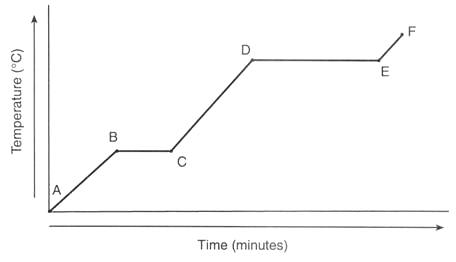
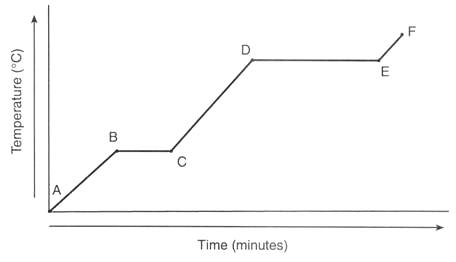
What is happening at point B if heat is entering the matter?

a)

melting

b)

freezing

c)

evaporating

d)

condensing

88.

What is happening at point B is heat is leaving the matter?

a)

melting

b)

freezing

c)

evaporating

d)

condensing

89.

What is happening at point D as heat is removed?

a)

evaporating

b)

condensing

c)

boiling

d)

melting

90.

Dry ice changing from solid to gas is called

a)

diffusing

b)

melting

c)

condensation

d)

sublimation

91.

Water vapor changing directly into a solid is called

a)

condensation

b)

evaporation

c)

sublimation

d)

deposition

92.

Molecules in a solid look like:

a)
b)
c)
d)
93.

Molecules in a gas look like:

a)
b)
c)
d)
94.

Molecules in a liquid look like:

a)
b)
c)
d)
95.

When temperature is increased, these molecules will become:

a)

solid

b)

liquid

c)

gas

96.

When temperature is decreased, these molecules will become:

a)

solid

b)

liquid

c)

gas

97.

When temperature is decreased, these molecules will become:

a)

solid

b)

liquid

c)

gas

98.

When temperature is increases, these molecules will become:

a)

solid

b)

liquid

c)

gas

99.

What do gases and liquids have in common?

a)

Both have definite shape

b)

Both take the shape of its container

c)

Both have definite volume

d)

Both do not have definite volume

100.

What do liquids and solids have in common?

a)

Both have definite volume

b)

Both have definite shape

c)

Both take the shape of its container

d)

Both can be compressed

101.
Which segment represents the heat of fusion?
a)
A-B
b)
B-C
c)
C-D
d)
D-E
102.
In which segment is the kinetic energy remaining constant?
a)
A-B
b)
B-C
c)
C-D
d)
E-F
103.
Which process takes the longest to occur?
a)
melting
b)
boiling
c)
freezing
d)
heating the solid
104.
What state(s) of matter are present at D-E?
a)
Solid-liquid
b)
Liquid
c)
Liquid-gas
d)
Gas-Solid
105.
Between which points is the temperature of the substance increasing?
a)
A-B only. 
b)
A-B, C-D, E-F
c)
B-C only. 
d)
B-C, D-E
106.
Between which points is the temperature of the substance remaining constant?
a)
A-B only. 
b)
A-B, C-D, E-F
c)
B-C only. 
d)
B-C, D-E
107.
Between which points is the substance changing state?
a)
A-B only. 
b)
A-B, C-D, E-F
c)
B-C only. 
d)
B-C, D-E
108.
This type of graph is called a:
a)
Phase diagram
b)
Heating curve
c)
State of matter
d)
Temperature chart
109.
What line segment represents only the solid state?
a)
A-B
b)
B-C
c)
C-D
d)
D-E
110.
Specific heat is....
a)
The measure of kinetic energy of an objects particles
b)
A measure of the energy needed to increase the average kinetic energy of the particles
c)
The heating caused by the motion of flluid due to temperature difference
d)
The transfer of energy by electromagnetic radiation
111.
What does temperature measure?
a)
Heat of Molecules
b)
ºC
c)
Average Kinetic Energy of Molecules
d)
Thermal Energy
112.
There are four cups of hot cocoa. The cup sizes are shown. The temperature of the cocoa in each cup is 25 degrees celsius. Which cup has the MOST thermal energy?
a)
Large cup (Trenta)
b)
Small cup (Tall)
c)
Medium cup (Venti)
d)
All three are the same temperature so they have the same thermal energy
113.
Copper, Stainless Steel, Carbon Steel, and Zinc were all heated using 10,000 JOULES of thermal energy.  What material would be have the LARGEST change in temperature?
a)
Copper
b)
Carbon Steel
c)
Zinc
d)
Stainless Steel
114.
A high specific heat means...
a)
It requires less energy to change temperature
b)
It requires more energy to change temperature
c)
It heats up very quickly
115.
Copper, Stainless Steel, Carbon Steel, and Zinc were all heated using 10,000 JOULES of thermal energy.  Based on the chart, which material would be have the SMALLEST change in temperature?
a)
Copper
b)
Carbon Steel
c)
Zinc
d)
Stainless Steel
116.
There are 2 pans of water, one has 100 mL in it and one has 1000mL. You add 4000 joules of energy,  which one has the bigger change in temperature?
a)
100 mL
b)
1000 mL
c)
They the same material so they both heat to the same temperature
d)
They both will cool down.
117.
If I have 2 blocks of Aluminium (one of 1kg and one of 10 kg) and heat them up with 6,000 Joules of energy.
Which one will have the SMALLEST change in temperature?
a)
1 kg
b)
10 kg
c)
They both heat up  to the same temperature
d)
It depends on the temperature of the room
118.
Which of the following would be the best insulator?
a)
air
b)
aluminum
c)
copper
d)
silver
119.
Copper, Stainless Steel, Carbon Steel, and Zinc were all heated using the same thermal energy.  What material would be the coolest after being heated?
a)
Copper
b)
Carbon Steel
c)
Zinc
d)
Stainless Steel
120.

The model shown represents the particles in a substances. Which of the following could be the substance?

a)

lightning

b)

water

c)

air

d)

a shoe

121.

Which diagram best shows why you can't walk through bricks?

a)

Diagram A

b)

Diagram B

c)

Diagram C

122.

A plasma can be made in a laboratory by

a)

cooling a gas to very low temperatures

b)

cooling a gas and reducing the pressure

c)

heating a gas to extremely hot temperatures

d)

heating a liquid to the point it turns into a gas

123.

At constant pressure, when the temperature of a gas is decreased, what happens to its volume?

a)

it decreases

b)

it will vary

c)

it increases

d)

it remains constant

124.

At constant pressure, how are the temperature and volume of a gas related?

a)

The are directly proportional

b)

They are inversely proportional

c)

They are constant

d)

They are indirectly proportional

125.

At constant temperature, when the volume of a gas is decreased, what happens to its pressure?

a)

It increases

b)

It decreases

c)

It will vary

d)

It remains constant

126.

At constant volume, when the temperature of a gas decreases, the pressure _______.

a)

decreases

b)

increases

c)

does nothing

d)

explodes

127.

If the sun shining through windows heats air in a sealed room, what happens to the air pressure in that room?

a)

It increases

b)

It decreases

c)

It will vary

d)

It remains constant

128.

When Martin pushes down on the handle of his bicycle pump, the air pressure within the pump _______.

a)

increases

b)

decreases

129.

At constant temperature, the pressure and volume of a gas are ______ proportional.

a)

inversely

b)

directly

130.

What causes a truck's tires to burst on long road trips?

a)

Hot temperatures increase the pressure inside the tire.

b)

Lower temperatures decrease the volume.

c)

Lower pressure is caused by lower temperatures.

131.

Predict: What do you think will happen when you dunk a balloon in ice water?

a)

The balloon will remain the same size because temperature change does not affect the volume.

b)

The ballon will become smaller because lower temperatures will cause the volume to decrease.

c)

The balloon will become larger because lower temperatures will cause the volume to increase.

132.

When a gas absorbs heat...

a)

The particles move faster.

b)

The particles move at the same rate of speed.

c)

The particles move slower.

133.

In order for gas particles to COLLIDE MORE OFTEN, would they need to be:

a)

at a higher temperature

b)

at a lower temperature

134.

In order for gas particles to COLLIDE MORE OFTEN, would they need to be:

a)

in a larger space

b)

in a smaller space

135.

In order for gas particles to COLLIDE MORE OFTEN, would there need to be:

a)

more of them

b)

less of them

136.

TRUE or FALSE:


The energy of gas particles decreases when the temperature decreases

a)

TRUE

b)

FALSE

137.

In order for gas particles to CREATE MORE PRESSURE, would they need to be:

a)

at a higher temperature

b)

at a lower temperature

138.

In order for gas particles to CREATE MORE PRESSURE, would they need to be:

a)

in a larger space

b)

in a smaller space

139.

In order for gas particles to CREATE MORE PRESSURE, would there need to be:

a)

more of them

b)

less of them

140.

Which container will have a lower pressure?

a)

left

b)

right

c)

they both have the same pressure

141.

When a cold tire is inflated to a certain pressure and then is warmed up due to friction with the road, the pressure increases. This happens because the

a)

air molecules hit the walls of the tire less frequently

b)

air molecules speed up and collide with the tire walls more often

c)

rubber in the tires reacts with oxygen in the atmosphere

d)

air molecules diffuse rapidly through the walls of the tire.