wayground logo

Free Printable Worksheets

Font size

S
M
L
XL
Worksheets

1st Semester Final Review

Total questions: 137

Worksheet time: 2hrs 56mins

Name
Class
Date
1.

What is the definition of Malleable?

a)

Can be stretched into thin wire

b)

A thing that is composed of two separate elements

c)

Can be pounded into a flat shape

d)

Negative ions gain electrons

2.

What is the definition of Ductile?

a)

Can be pounded into a flat shape

b)

A table of the chemical elements arranged in order of atomic number

c)

A group of atoms bonded together, representing the smallest fundamental unit of a chemical compound

d)

Can be stretched into wire

3.

True or False: Cations are positive ions that lose electrons

a)

False

b)

True

4.

True or False: Anions are negative ions that gain electrons

a)

True

b)

False

5.

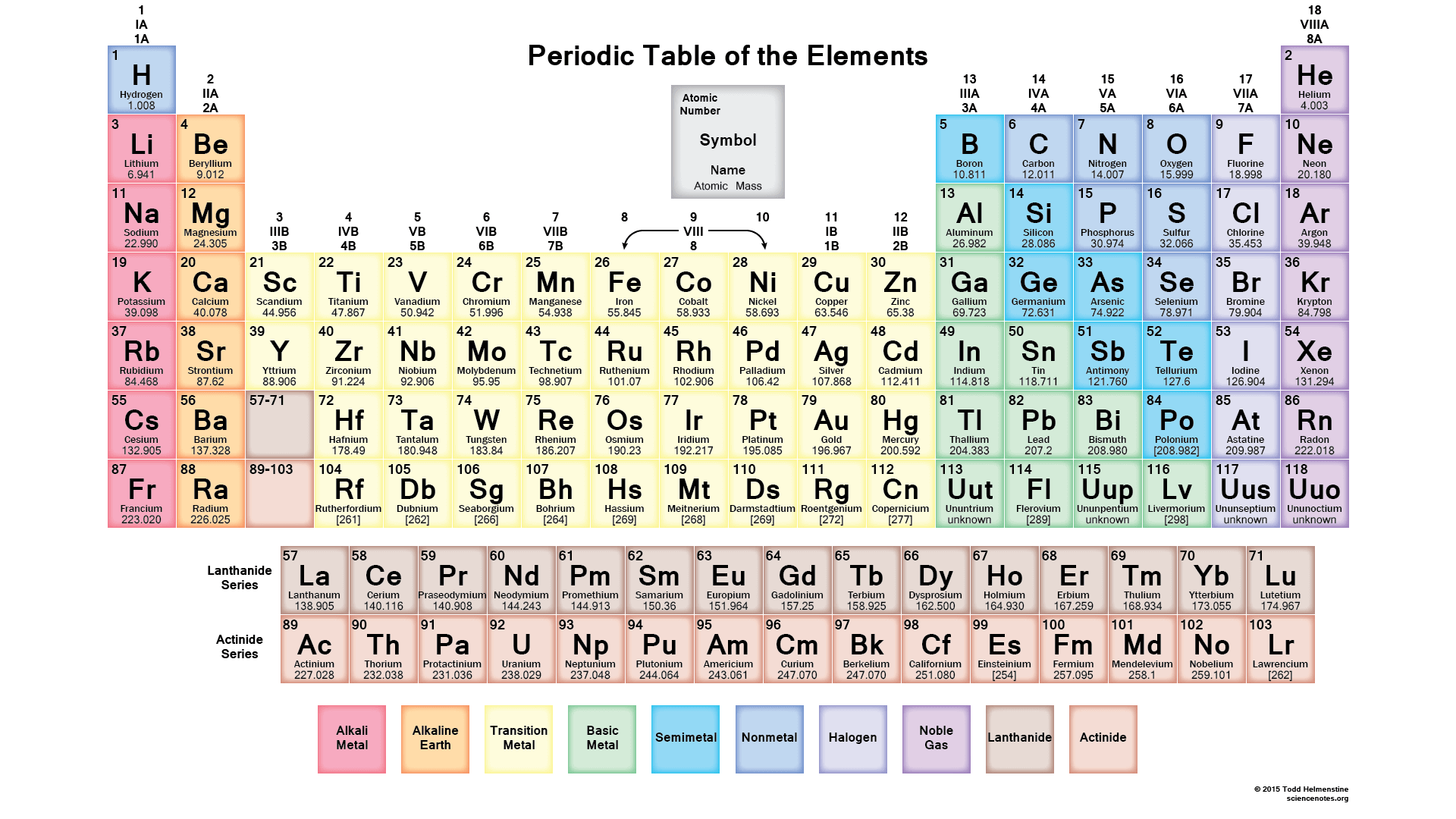
What is the atomic Mass of Copper?

a)

64

b)

29

c)

23

d)

63

6.

How many neutrons does an atom of Iron contain?

a)

55.847

b)

26

c)

30

d)

56

7.

How many electrons does a balanced atom of oxygen contain?

a)

8

b)

16

c)

0

d)

15.9994

8.

What is the charge of a neutron

a)

Neutral ; No charge

b)

Positive

c)

Positive or negative, depending on the atom

d)

Negative

9.

Where are protons located?

a)

In the energy levels surrounding the nucleus

b)

In the nucleus of an atom, with electrons

c)

In the nucleus of an atom, with neutrons

10.

Which of the following is represented by the Bohr Model?

a)

Cl

b)

F

c)

Ne

d)

Li

11.

How many electrons are in the outer most shell of Aluminum?

a)

2

b)

3

c)

1

d)

4

12.

How many electrons are in the outermost shell of Phosphorus?

a)

1

b)

6

c)

5

d)

4

13.
Sodium (Na) is found in group 
a)
1
b)
2
c)
3
d)
4
14.
What is the atomic number of the atom pictured? 
a)
9
b)
10
c)
18
d)
19
15.
An electron has a _____ charge.
a)
negative
b)
positive
c)
neutral
16.
Which of the following has a full valence shell?
a)
Oxygen
b)
Neon
c)
Barium
d)
Carbon
17.
If an atom loses two electrons what charge will it have?
a)
+ 2
b)
 - 2
c)
+1
d)
-1
18.
All chemical bonds involve two atoms sharing electrons.
a)
True
b)
False
19.
If an atom gains one electron what charge will it have?
a)
-2
b)
-1
c)
+1
20.
Covalent compounds
a)
Share electrons
b)
transfer electrons
c)
contain a sea of electrons
d)
conduct electricity
21.

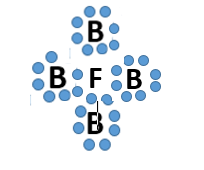
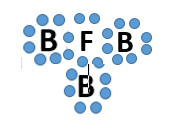
What is the correct Lewis structure for BF3?
a)
b)
c)
d)

BF3 (The formula is the Lewis Structure)

22.

What is the chemical formula for Lithium Nitride?

a)

Li3N

b)

LiN3

c)

NLi3

d)

N3Li

23.

What is the ionic formula for a bond between Calcium and Phosphorus?

a)

Ca2P3

b)

Ca3P2

c)

Ca2P5

d)

P5Ca2

24.

CaCl2 is an example of what type of bond?

a)

Covalent

b)

Metallic

c)

Ionic

25.

LiBr is called

a)

lithium bromine

b)

lithium (I) bromine

c)

lithium bromide

d)

lithuim (I) bromide

26.

Name the following ionic compound: BeCl2

a)

beryllium chlorine

b)

beryllium II chloride

c)

beryllium chloride

d)

beryllium dichloride

27.

Name the following ionic compound: Cs2S

a)

cesium sulfide

b)

cesium sulfate

c)

cesium II sulfate

d)

cesium II sulfide

28.
CsCl
a)
Monocesium monochloride
b)
Cesium monochloride
c)
Cesium Chloride
29.
MgS 
a)
Magnesium sulfide
b)
Monomagnesium monosulfide
c)
Magnesium monosulfide
30.
Na2S
a)

Disodium sulfide

Disodium sulfide

b)
Sodium sulfide
c)
Sodium monosulfide
31.
The chemical formula for an ionic compound of potassium and oxygen is
a)
KO.
b)
K2O.
c)
K2O2.
d)
KO2.
32.
Which of these compounds is ionic? 
a)
Carbon dioxide
b)
Dinitrogen Trioxide
c)
Silicon tetrachloride
d)
Lithium bromide
33.
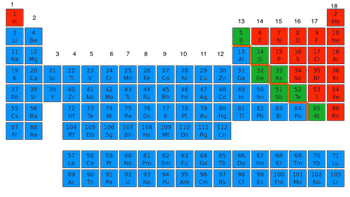
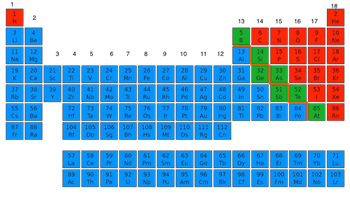
Where are metals located on the periodic table?
a)
Blue
b)
Green
c)
Red
34.
Where are the nonmetals located on the periodic table? 
a)
Blue
b)
Red
c)
Green
35.
Where are the metalloids located on the periodic table?
a)
Blue
b)
Red
c)
Green
36.
phosphorus trichloride
a)
KCl3
b)
PCl3
c)
K3Cl
d)
P3Cl
37.
diphosphorus pentoxide
a)
P2O5
b)
PO5
c)
P5O2
d)
P2O6
38.
The chemical formula of sulfur hexabromide is
a)
SBr₆
b)
S₆Br
c)
S(VI)Br
d)
S6Br
39.

What is the correct chemical formula for the butane molecule shown?

a)

C4H10

b)

C10H10

c)

C4H4

d)

C10H4

40.

In the diagram, letter D represents a

a)

subscript

b)

coefficient

c)

product

d)

equation

41.

In the diagram, letter E represents a

a)

subscript

b)

coefficient

c)

product

d)

equation

42.
Which are the reactants in the equation shown?
a)
H2O and CO2
b)
O2 and CH4
43.

Which is the product in the reaction shown?

a)

Al2O3

b)

Al

c)

O2

44.

How does the mass of products compare to the mass of reactants in a chemical reaction?

a)

reactants = products

b)

reactants > products

c)

reactants < products

45.

In the reaction shown below, 12 grams of AB break down into 8 grams of product A and an unknown amount of product B.


Using the law of conservation of mass, what will the mass of product B be?

a)

4 grams

b)

8 grams

c)

12 grams

d)

20 grams

46.

If 15mg of A react with 10mg of B, how much of product C will be produced?

a)

10mg

b)

15mg

c)

20mg

d)

25mg

47.
This equation is _________.
a)
balanced
b)
not balanced
48.
This equation is _________.
a)
balanced
b)
not balanced
49.

Substances react and the temperature of the mixture increases, the reaction is

a)

exothermic

b)

endothermic

c)

polythermic

d)

monothermic

50.

Choose the correct coefficients that balance the following equation.

Ca + N2 --->Ca3N2

a)

1,3,3

b)

2,3,1

c)

3,1,1

d)

4,1,3

51.

What type of reaction is occuring?

2 FeCl3 --> 2 Fe + 3 Cl2

a)

synthesis

b)

decomposition

c)

single replacement

d)

double replacement

52.

What type of reaction

is occurring?

Al + 3 Ag(NO3)--> 3 Ag + Al(NO3)3

a)

synthesis

b)

decomposition

c)

single replacement

d)

double replacement

53.

Select the coefficients to balance the following equation.

___Al + ___Ag(NO3) --> __Ag + __Al(NO3)3

a)

3,1,1,3

b)

1,3,3,1

c)

1,2,2,1

d)

2,1,1,2

54.

What type(s) of reaction is occurring?


4 Fe + 3 O2 --> 2 Fe2O3

a)

synthesis

b)

decomposition

c)

single replacement

d)

double replacement

55.

List the coefficients in order for this chemical equation:

3 FeO + Ca3P2 --> Fe3P2 + 3 CaO

a)

3,0,0,3

b)

3,1,1,3

c)

3,2,1,0

d)

4,3,3,1

56.
What kind of reaction is this:
2C3H7OH +9O2 -> 6CO2 + 8H2O
a)
Double Replacement
b)
Combustion
c)
Single Replacement
d)
Decomposition
57.

Balance the following equation.

Al + S--> Al2S3

a)

2,2,1

b)

2,4,1

c)

2,3,1

d)

3,1,1

58.
How many different types/classifications of Chemical Reactions have we learned about?
a)
3
b)
4
c)
5
d)
6
59.
Which of the following is NOT an indication of a chemical reaction?
a)
Formation of a precipitate
b)
Formation of a gas (bubbling)
c)
Heat is given off
d)
Mixing two chemicals together
60.
How many Sodium (Na) are in 6NaCl?
a)
1
b)
12
c)
6
61.
How many Aluminum are in Al2O3?
a)
3
b)
2
c)
5
62.
Number of C's in 2Na₂CO₃
a)
1
b)
2
c)
3
d)
5
63.
The law of conservation of matter states that
a)
chemical reactions change matter.
b)
in chemical reactions, the identity of reactants and products is conserved.
c)
atoms are neither created nor destroyed in chemical reactions.
d)
a chemical equation must be balanced.
64.
Balance this reaction: ____ NaF + ____ Br2 ---> ____ NaBr + ____ F2
a)
3,1,2,1
b)
1,2,3,4
c)
2,1,2,1
d)
1,2,1,2
65.

Which of the following is a velocity?

a)

4 m/s North

b)

561 km/hr towards New York

c)

0.9 cm/s to the apple

d)

All of the above

66.
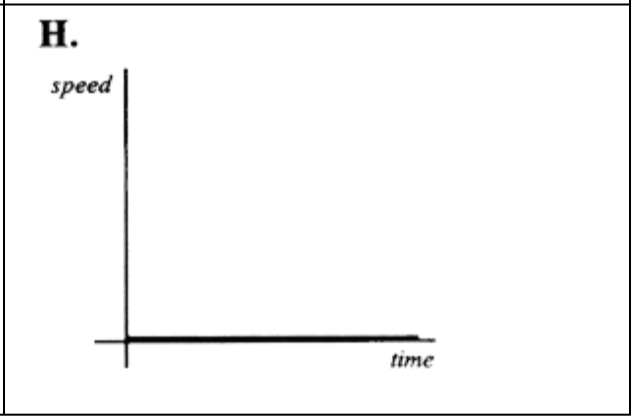
What is happening to the speed of the object in the graph?
a)
increasing
b)
no change
c)
decreasing
67.
What is happening to the speed of the object in the graph at interval B?
a)
increasing
b)
no change
c)
decreasing
68.
Which object is traveling the fastest?
a)
Biker
b)
Runner
c)
Walker
69.
What is the force diagram representing?
a)
balanced
b)
unbalanced
70.
Which direction will the object move?
a)
right
b)
left
c)
up
d)
down
71.
What is the net force on the object?
a)
200 N up
b)
600 N down
c)
400 N up
d)
400 N down
72.
A net force of 0N will cause an object to increase speed.
a)
True
b)
False
73.
Displacement is the total distance covered by an object.
a)
True
b)
False
74.
A combination of all forces acting on an object is known as
a)
Friction
b)
tensional force
c)
normal force
d)
net force
75.

Which of Newton's laws states that forces are applied in pairs to two different objects?

a)

1st

b)

2nd

c)

3rd

76.

Which of Newton's laws explains that an object at rest will stay at rest?

a)

1st

b)

2nd

c)

3rd

77.

Which object will accelerate the fastest?

a)

A 2kg object with 10N of force

b)

A 2 kg object with 2N of force

c)

A 10 kg object with 10 N of force

d)

A 10 kg object with 2N of force

78.

Which object has more inertia?

a)

Grasshopper

b)

Bowling ball

c)

Baseball

d)

Penny

79.

All objects exert a gravitational force on all other objects.

a)

True

b)

False

80.

What is force's unit?

a)

kg

b)

m

c)

m/s2

d)

N

81.

What is the value for acceleration on Earth?

a)

9.8 m/s2

b)

9.8 m/s

c)

6.7 m/s2

d)

6.7 m/s

82.
How much does a 125.0kg object weigh on Earth?
a)
784.0 N
b)
12.76 N
c)
1113 N
d)
1225 N
83.
Brakes stop/slow a car, shoes/pad press against a disk/drum. What type of frictional force?
a)
Fluid
b)
Rolling
c)
Sliding
d)
Static
84.
Which element is represented by the diagram?
a)
Magnesium
b)
Sodium
c)
Titanium
d)
Vanadium
85.
Which element could have the dot diagram shown?
a)
carbon
b)
helium
c)
magnesium
d)
potassium
86.
Which of the following is a synthesis reaction?
a)
2H2O --> 2H2 + O2
b)
Mg + 2HCl --> MgCl2 + H2
c)
2Cu + O2 --> 2CuO
d)
HCl + NaOH --> NaCl + H2O
87.
Force is ______?
a)
magnets
b)
static electricity
c)
a push or pull
d)
Star Wars
88.
Which of these is NOT a halogen?
a)
fluorine
b)
bromine
c)
carbon
d)
 astatine
89.
How many valence electrons does Iodine have?
a)
6
b)
16
c)
7
d)
17
90.
What is the left part of a chemical equation called?
H2 + O → H2O
a)
Reactants
b)
Products 
c)
Yields 
d)
Chemical Equation 
91.
3Ca + 2AlCl3 --> 3CaCl2 + 2Al
a)
Synthesis
b)
Decomposition
c)
Single diplacement
d)
Double displacement
92.
How many ATOMS of Oxygen are in 3Fe2O3
a)
2
b)
3
c)
6
d)
9
93.
Name the lab equipment. 
a)
wire gauze
b)
evaporating dish
c)
ring stand
d)
crucible
94.
Name the lab equipment.
a)
ring stand
b)
ring clamp
c)
Bunsen burner
d)
wire gauze
95.
Name the lab equipment. 
a)
test tube rack
b)
test tube holder
c)
tweezers
d)
tongs
96.
Name the lab equipment. 
a)
tweezers
b)
crucible tongs
c)
test tube holder
d)
test tube rack
97.
When should you use the safety shower?
a)
After P.E.
b)
After spilling chemicals onto your body
c)
Before going out on a date
d)
Never
98.
What should you do if you break glass in the lab?
a)
Tell the teacher, sweep up the glass, and put it in the broken glass container
b)
Tell the teacher, sweep up the glass, and dump it into the garbage
c)
Pick up the glass with your hands
d)
Ignore it; the teacher will clean it up
99.
Identify the equipment shown here:
a)
beaker
b)
Erlenmeyer flask
c)
Florence flask
d)
volumetric flask
100.
What is special about graduated cylinders?
a)
They hold large quantities of liquid safely
b)
They measure small amounts very accurately. We use them when precision is important.
c)
They allow us to examine the liquid, we use them when looking for suspended solids.
d)
They are easily heated. We use graduated cylinders to heat liquids
101.

Which of the following is the most accurate and precise for measuring the volume of a liquid?

a)

Beaker

b)

Erlenmeyer flask

c)

Graduated Cylinder

d)

Round bottomed flask

102.

Why would you wear goggles in the lab?

a)

to prevent eye strain

b)

to improve your vision

c)

for protection from UV rays

d)

for protection from chemicals, heat, or glassware

103.

The first thing you should do if you get injured in the lab is

a)

tell the instructor immediately

b)

see a doctor after school

c)

visit the school nurse after class

d)

apply first aid yourself

104.

Personal eyeglasses provide as much protection in a lab as

a)

a face shield

b)

safety glasses

c)

splashproof chemical goggles

d)

sunglasses

105.

Horseplay or practical jokes in the laboratory are

a)

always against the rules

b)

OK

c)

Acceptable if you are working alone

d)

Not a big problem as long as there are no injuries
106.
Scott travels north 5 miles and then goes west 3 miles before coming straight back south 2 miles. What is his distance?
a)
10
b)
7
c)
8
d)
6
107.
Bill runs 400 meters to Andy's house, turns around, and runs 400 meters back home.  What is Bill's distance?
a)
0 meters
b)
400 meters
c)
800 meters
d)
1600 meters
108.
Bill runs 400 meters to Andy's house, turns around, and runs 400 meters back home.  What is Bill's displacement?
a)
0 meters
b)
400 meters
c)
800 meters
d)
1600 meters
109.

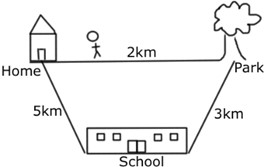
Jerry walked from home to school, then from the school to the park. What is his total distance?

a)

2 km

b)

5 km

c)

8 km

d)

10 km

110.
A person walks 50 meters directly north, stops, and then travels 32 meters directly south.  What is their displacement?
a)
82 meters
b)
18 meters
c)
28 meters
111.
Find the distance Sara walks from A to B,  B to C then C to D?
a)
11m
b)
3m
c)
5m
112.
A runner races in the 100 meter dash.  It takes her 10 seconds to finish.  What is her average speed?
a)
10 m/s
b)
1000 m/s
c)
100 seconds
d)
10 seconds
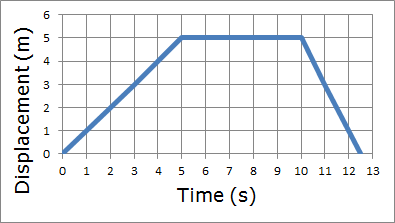
113.
What does this graph represent?
a)
Constant Speed
b)
Acceleration
c)
Not moving
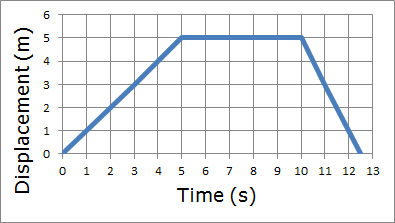
114.
According to the graph how far does the person travel in the first 5 seconds?
a)
2 m
b)
10 m
c)
0 m
d)
5 m
115.
What is the person doing from 5 seconds to 10 seconds?
a)
Walking 
b)
Running
c)
Standing Still 
d)
Walking Fast
116.
What is the speed of a cheetah that travels 112.0 m in 4.0 s?
a)
0.0357 m/s
b)
28 m/s
c)
0.036 m/s
d)
28.0 m/s
117.
When you look at the speedometer of your car, it tells you your....
a)
Average speed
b)
Instantaneous speed
118.
A car moves a distance of 1000 m with an average speed of 28 m/s.   Calculate the time.
a)
36 seconds
b)
28,000 seconds
c)
28 seconds
d)
972 seconds
119.
A cheetah runs with an average speed of 32 m/s for 30 seconds.  How far did the cheetah run?
a)
960 m
b)
1.07 m
c)
0.94 m
d)
62 m
120.
What is the speed of the red line?  
a)
4 m/s 
b)
16 m/s 
c)
32 m/s 
d)
2 m/s 
121.

A negative acceleration means that your object is _____.

a)

doing nothing

b)

moving in circles

c)

speeding up

d)

slowing down

122.

What is happening during point A to B?

a)

not moving

b)

increasing speed at a constant rate

c)

moving at a constant speed

d)

moving at 10 m/s2 acceleration

123.

What is happening during point C to D?

a)

not moving

b)

increasing speed at a constant rate

c)

moving at a constant speed

d)

moving at 0 m/s2 acceleration

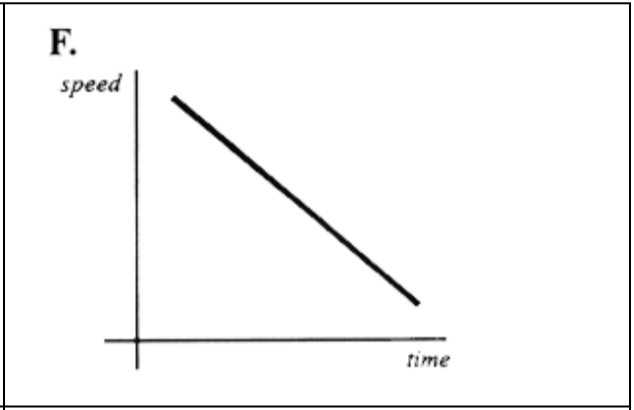
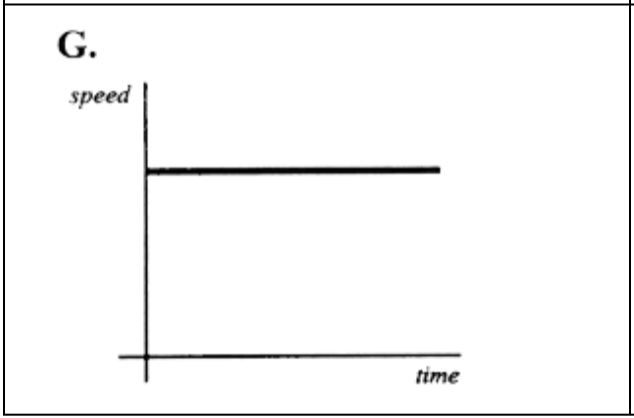
124.

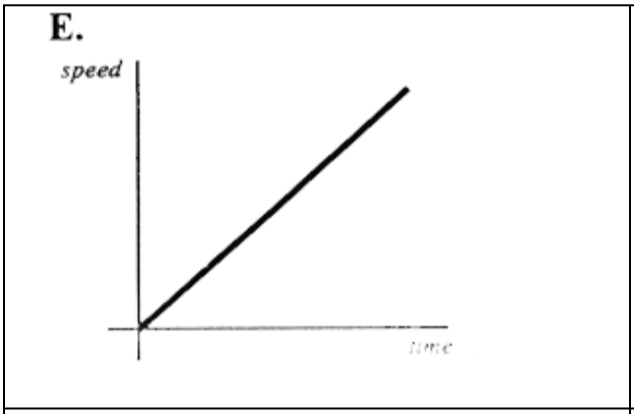
Match the graph to the description:

"The car is traveling at a constant speed."
a)
b)
c)
d)
125.

Match the graph to the description:

"The car is accelerating."

a)
b)
c)
d)
126.

Match the graph to the description:

"The car is slowing down."

a)
b)
c)
d)
127.

Match the graph to the description:

"The car is stationary."

a)
b)
c)
d)
128.

Mark slams on the brakes after traveling 25 m/s. It takes him 3 seconds to come to a complete stop. What is his acceleration?

a)

8.33 m/s2

b)

-8.33 m/s2

c)

75 m/s2

d)

-75 m/s2

129.
A drag racer accelerated from rest ( 0 m/s ) to 195 m/s in 6.5 s.  What was the acceleration?
a)
10 m/s
b)
30 m/s2
c)
-3 m/s2
d)
26 m/s
130.

What is happening to the car between 3-8 seconds?

a)

The car is stopped

b)

The car is traveling at a constant velocity of 0.5 m/s.

c)

The car has an acceleration of 0.5 m/s2.

d)

The car is going in the other direction.

131.

A car has an oil drip that drops every second. What is happening to the motion of the car shown above?

a)

Car is moving with a constant velocity

b)

Car is accelerating or speeding up

c)

Car is decelerating or slowing down

d)

Car is changing directions

132.
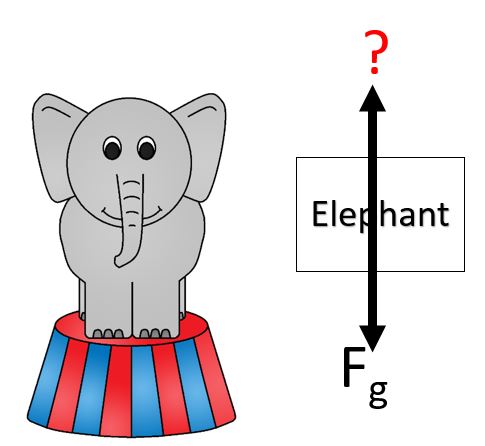
Name the missing force...
a)
weight force
b)
normal force
c)
applied force
d)
frictional force
133.
The force that pulls things toward earth.
a)
Speed
b)
Gravity
134.
You and your friend are playing tug of war. Your friend pulls with a force of 55 N to the right. You pull with a force of 65 N to the left. What is the net force on the rope?
a)
10 N left
b)
20 N
c)
10 N left
d)
10 N right
135.
Ted is trying to move a fridge through his house, he gets stuck on a carpet and even though he is pushing the fridge, it is not moving. What force is acting against him?
a)
gravity
b)
friction
c)
air
d)
mass
136.

A leftward force is applied to a crate to push it across the floor at a constant speed. Which is the correct force diagram?

a)
b)
c)
d)
137.

A rightward force is applied to a dresser to accelerate it to the right across the bedroom floor.

a)
b)
c)
d)