
 Worksheets
CHEM: Solubility
Total questions: 133
Worksheet time: 4hrs 36mins

What is a solvent
A liquid that will dissolve a solid solute
Another word for solution
A thing that make drinks change colour
Usually the solid about to be dissolved
What is Solubility?
If something dissolves in water
If something sinks in water
If something floats in water
None of the above
Salt has Solubility because it dissolves in water.
True
False
Which answer does NOT have solubility?
sugar
salt
oil
Which answer is Soluble in water?
rocks
honey
pepper
marbles
A homogeneous mixture is the same thing as...
a solution
a heterogeneous mixture
a compound
an element
The prefix hetero means...
same
different
together
awesome

Which substance is least soluble at 0 ºC?
KI
KNO3
KClO3
Ce2(SO4)3

How many grams are soluble in 100 g of water at 100 ºC?
300 grams
250 grams
100 grams
50 grams

When 40 grams of NaCl is dissolved in 100 grams of water at 90 ºC, the solution can be correctly described as:
supersaturated
saturated
unsaturated


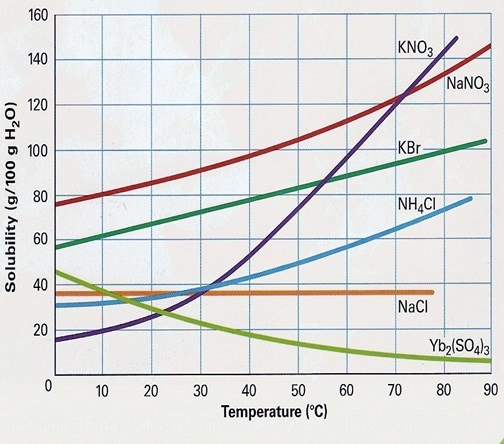
Identify how many grams of KNO3 is required to make a saturated solution at 40'C.
50 g
45 g
55 g
33 g

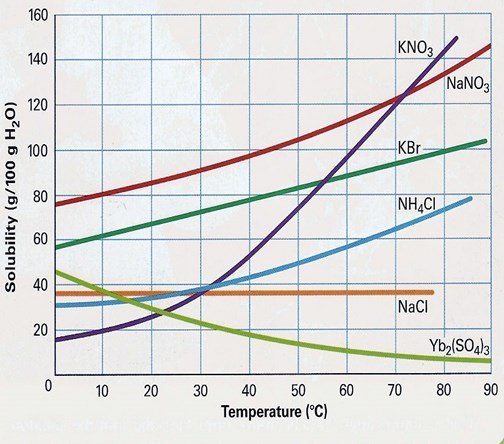
At which temperature do KBr and KNO3 have the same solubility?
60
55
50
Never
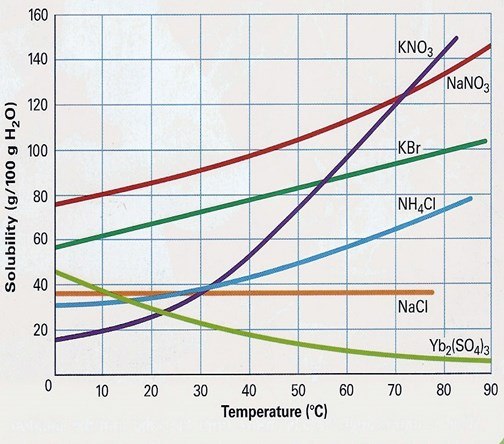
At 80'C, KBr's solubility is:
100
90
80
0
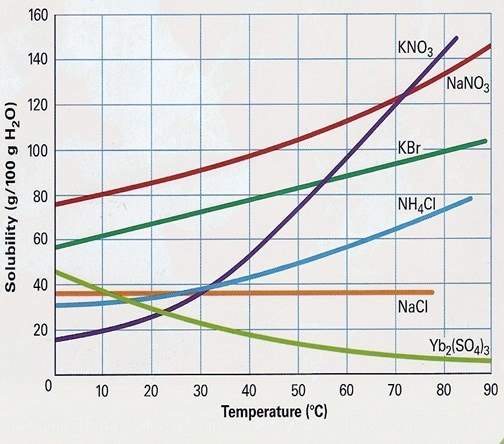
Determine the solubility for the substances at 55'C and arrange them in order from lowest to highest solubility.
NaCl, NH4Cl, KBr, NaNO3
NaCl, NH4Cl, NaNO3, KBr
NH4Cl, NaCl, NaNO3, KBr
NaNO3, KBr, NH4Cl, NaCl
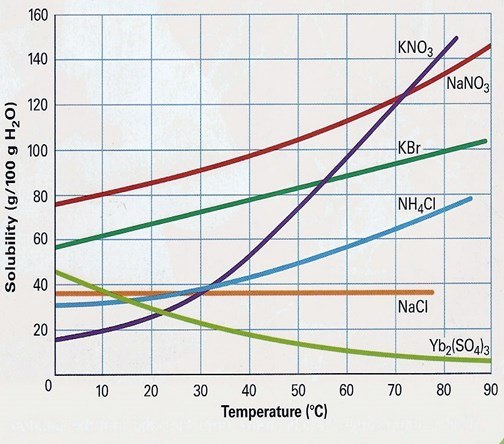
At 10'C, NaNO3's solubility is 80 g/100 g of H2O. Based on this information, what would the solubility be in 50 g of H2O.
40
80
160
16
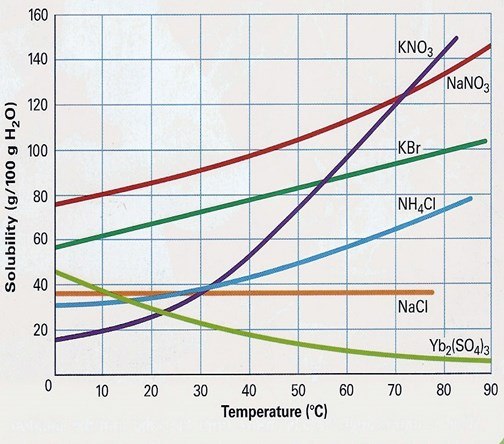
Identify if the following solution would be saturated, unsaturated, or supersaturated: 103 g KBr at 70'C.
Unsaturated
Saturated
Supersaturated
Identify how many grams of KNO3 is required to make a saturated solution at 40'C.
50 g
45 g
60 g
33 g
Water becomes __________ changing from a solid to a liquid
more dense & more kinetically chaged
less dense & less kinetically charged
more dense & less kinetically charged
less dense & more kinetically charged
Identify a method to decrease the dissolving rate of a solution:
decrease the temperature
add KE
stir the solution
increase the temperature

Which of the following would NOT increase the rate at which a sugar cube dissolves?
Reducing the amount of solvent
Crushing the sugar cube
Stirring the solution
Heating the solvent
You can make a solute dissolve more quickly in a solvent by
adding more solute.
adding ice.
heating the solvent.
removing some solvent.
When you measure how fast a solute dissolves, you are measuring the
amount of dissolving
rate of particle movement
amount of particle movement
rate of solubility
Which of the following does not affect the solubility of a solute in a solvent?
The rate of stirring
The size of the solute
The temperature of the solvent
The amount of the colloid added


Which of the following describes: Dissolved particles are distributed evenly and you can no longer see them.
conductivity
solution
mixture

How much C12H22O11 solute is saturated at 40 degrees?
240
220
230
250

What type of a solution is 260g sugar at 50ºC in 100g H2O?
Saturated
Unsaturated
Supersaturated

When a substance partially dissolves in a liquid, but some particles remain, which type of solubility is that known as?
High Solubility
Low Solubility
No Solubility
When the volume of solvent increases, the solubility of a solute at a given temperature...
increases
decreases
stays the same
When the volume of solvent increases, the mass of solute that can dissolve in a saturated solution...
increases
decreases
stays the same
In general as temperature decreases, the solubility...
increases
decreases
stays the same
Calculate the molarity of a solution containing 1.5 moles of NaCl in 0.5 L of solution
1.5
0.33 M
30 M
3 M
Water is called the ___________ _____________
universal solute
universal solvent
universal solution
Substances that dissolve in water are _____________, which means " water loving"
hydrophobic
hydrophilic
hyperactive
Substances that do not dissolve in water are called ________, which means " water fearing"
hydrophilic
hydrofearic
hydrophobic
Concentration of a solution can be expressed as a ratio :
C = M / M
C = V / M
C = M / V
Mass of a solute is measured in ________
liters
mL
grams
Volume of a liquid solution can be measured in ________
grams
moles
liters
A containers holds 2 grams of solute and 4 mL of solvent. What is the concentration of the solution ?
.125 g/mL
.25 g/mL
.50 g m/L
What is the concentration of a solution that has 4 g of sugar and 2 mL of water ?
2 g/L
4 g/L
8 g/ L
Solution A has a concentration of .4 g / L and solution B has a concentration of .9 g/L . Which solution has a higher concentration?
solution A
solution B
__________ is a measure of how easy a substance dissolves into another substance.
evaporation
concentration
solubility
Solubility is measured in _____ of solute per ________ mL of water
liters, 100
grams, 100
grams, 1
A substance with _______ solubility will dissolve ________ solute in 100 mL of water than a substance with _______ solubility
low, more, high
high, less, more
high, more, less
When mixing substances with different densities , substances with _________densities sink to the bottom .
higher
lower
neither they will be equal
Container A has 20 grams of sugar and 100 mL of water. Container B has 30 grams of sugar and 200 mL of water. What is Concentration of both containers?
A= .8 g/mL , B= .9 g/mL
A= .4 g/mL , B=8 g/mL
A= .2 g/mL , B= .15 g/mL

The X axis of this solubility graph shows what variable ?
saturation
grams
temperature

The Y axis of this graph shows what variable ?
temperature
celcius
solubility rate

What compound's solubility rate shows to be constant as temperature increases?
BaNo32
Na2So4
NaCL
What compound's solubility rate shows to be constant as temperature increases?
BaNo32
Na2So4
NaCL

How many grams of NaCl are required for the solution to become saturated at 10°C?
37 g
70 g
50 g
25 g

How many grams of ammonium chloride (NH4Cl) will dissolve at 90°C?
38 g
70 g
100 g
15 g

Which factor affecting solubility is shown in the picture?
temperature
height
stirring
particle size

Which factor is shown in the picture?
temperature
particle size
stirring
use of spoon
Why do sugar particles dissolve faster in hot water?
water particles move slow
water particles move fast
water particles settle down
water particles stay on top
What are the factors that affect solubility?
rate of stirring
particle size
temperature
all of these
Which of the following does not affect solubility of solutes?
Tempearture
Color
Size particles
Kind of solute
Which will dissolve faster crushed table salt or crystal of table salt?
crushed table salt
crystal of table salt
What would dissolve most slowly?
Large crystals in stirred water
Large crystals in unstirred water
Small crystals in stirred water
Small crystals in unstirred water
Molar mass of NaOH is ______________________
40 grams/mol
50 grams/mol
45 grams/mol
38 grams/nol
What is the molality of a solution made by dissolving 2 moles of NaOH in 400 grams of water?
5 mol/kg. solvent
4 mol/kg solvent
3 mol/kg. solvent
2.5 moles /kg solvent
Molarity is measured in _____.
moles per g.
mols per L.
moles per mm.
moles per mL.
What do molarity and molality have in common?
Both have "moles solute" in the numerator
Both have "kg solvent" in the denominator
Both have "L solution" in the denominator
Both have "moles solution" in the denominator
Which equation is used to find molarity?
Moles solute/L solution
Moles solute/kg solution
Moles solute/kg solvent
Grams solute/L solution
Which equation is used to find molality?
Moles solute/L solution
Moles solute/kg solution
Moles solute/kg solvent
Grams solute/L solution
What are the units of molarity?
M
m
Ml
Mr
What are the units of molality?
M
m
Ml
Mr
What is the molality of a solution in which 3.0 moles of NaCl is dissolved in 1.5 Kg of water?
2.0 M
0.22 m
135 m
2.0m
What is the molarity of a 0.5L sample of a solution that contains 60.0 g of sodium hydroxide (NaOH)
0.8 M
1.5M
3.0M
6.0M
A student is preparing solutions for a laboratory experiment by dissolving solid solutes in liquid solvents. Which action will increase the rate of solubility
lowering the temperature of the solvent
stirring the solute in the solution
increasing the pressure on the solution
increasing the particle size of the solute
What is the molarity of a 0.5L sample of a solution that contains 60.0 g of sodium hydroxide (NaOH)
0.8 M
1.5M
3.0M
6.0M
What is the molality of a solution in which 3.0 moles of NaCl is dissolved in 1.5 Kg of water?
2.0 M
0.22 m
135 m
2.0m
suppose a hydrochloric acid solution contains 36 g of HCl and 64 g of H2O.what is the mole fraction of HCl?
0.78
0.99
0.22
3.6
What is the molality of a solution made by dissolving 2 moles of NaOH in 400 grams of water?
5 mol/kg. solvent
4 mol/kg solvent
3 mol/kg. solvent
2.5 moles /kg solvent
What is the mass of 0.75 moles of (NH4)3PO4? (Ar: N=14, H=1,P=31, 0=16)
101.75 g
121.75 g
111.75 g
131.75 g
What is the molarity in 650. ml of solution containing 63 grams of sodium chloride, NaCl?
2.4 M
0.86 M
1.657 M
0.541 M
What is the molarity in 650. ml of solution containing 63 grams of sodium chloride?
a. 2.4 M
b. 0.54 M
c. 0.86 M
d. 1.7 M
A beaker contain 795 mL of 0.35M of Na2SO4 solution. Calculate the mass of Na2SO4.
39.55 g
40.00 g
39.05 g
39.5 g
A 40mL, 0.25 mol L−1 HCl solution is mixed with 15mL, 0.6 mol L−1 H2SO4 solution. Calculate the concentration of H+ ion in the combined solution.
0.49 M
0.50 M
0.60 M
0.51 M
The density of aqueous solution containing 10% of ethanol, C2H5OH by mass is 0.984 gmL-1. Calculate its molality.
2.314m
2.251m
2.415m
2.154m
Calculate the molality of 3.0 mol dm-3 sucrose, C12H22O11 if the density of the solution is 1.35 g cm-3.
9.26 m
9.20 m
9.19 m
9.23 m

