Wayground logo

Free Printable Worksheets

Font size

S
M
L
XL
Worksheets

8th Grade Review

Total questions: 133

Worksheet time: 24hrs 31mins

Name
Class
Date
1.
What kind of properties can only be observed when a substance changes into a different substance?
a)
physical properties
b)
chemical properties
c)
liquid properties
d)
real properties
2.
Which of the following is a sign that a chemical reaction has occurred?
a)
change in shape
b)
melting
c)
formation of a gas
d)
dissolving
3.
Is hammering wood together to build a house a chemical or physical change?
a)
chemical
b)
physical
4.
Is melting butter for popcorn a chemical or physical change?
a)
chemical
b)
physical
5.
Is bleaching your hair a physical or chemical change?
a)
physical
b)
chemical
6.
Is burning wood a chemical or physical change?
a)
chemical
b)
physical
7.
A change in the size, shape, or state of matter.
a)
chemical change
b)
physical change
c)
chemical reaction
d)
electron change
8.
Which of the following is NOT an example of a physical change?
a)
crumpled paper
b)
pencil sharpening
c)
shrunken clothing
d)
sour milk
9.
Photosynthesis is an example of a
a)
physical change
b)
chemical change
10.
When you break a cracker into pieces it is a 
a)
Chemical change
b)
Physical change
c)
Chemical Weathering
d)
Physical Weathering
11.
Adding baking soda and vinegar together and it fizzes and creates carbon dioxide.
a)
Chemical
b)
Physical
12.
what is the definition of chemical change?
a)
any change that results in the formation of new chemical substances. 
b)
changing clothes
c)
matter cannot be created or destroyed, only change form
d)
changes affecting the form of a chemical substance, but not its chemical composition.
13.
which one is the definition of chemical property?
a)
a property or characteristic of a substance that is observed during a reaction where the chemical composition of a substance is changed
b)
any change that results in the formation of new chemical substances
c)
combustibility
14.

Jack has a rock. The rock has a mass of 14g and a volume of 2cm3. What is the density of the rock?

a)

7 mL

b)

7 g/cm3

c)

28 g/cm3

d)

1/7 g/cm3

15.

What is the formula for density?

a)

density = mass x volume

b)

density = mass/volume

c)

density = mass + volume

d)

density = mass - volume

16.
Which particle has a positive charge?
a)
electron
b)
orbital
c)
proton
d)
neutron
17.
Choose the particle that has no charge.
a)
nucleus
b)
neutron
c)
proton
d)
electron
18.
This particle determines what element you have - the elements identity.
a)
electron
b)
proton
c)
neutron
d)
valence shell
19.
An electron has a _____ charge.
a)
negative
b)
positive
c)
neutral
20.
Describe an Electron Cloud?
a)
the mist outside of an atom
b)
home of the protons
c)
where electrons are located
d)
nucleus
21.

What are the maximum number of electrons that go on the first energy level of the electron cloud?

a)

2

b)

4

c)

6

d)

8

22.
Which particles make up the nucleus of an atom?
a)
protons and neutrons
b)
electrons and protons
c)
electrons, protons, and neutrons
d)
electrons and neutrons
23.
The particles of the atom you can find by knowing the atomic number.
a)
neutrons
b)
protons and electrons
c)
protons and neutrons
d)
atomic mass
24.
The subatomic particle that determines the identity of an element.
a)
neutron
b)
proton
c)
electron
d)
outer shell
25.

What charge does the nucleus have and why?

a)

positive - the neutrons do not have a charge

b)

positive - the neutrons and protons are positively charged particles

c)

neutral - the neutral charge dominates the positive charge

d)

neutral - electrons cancel out the positive charge of the atom

26.
Matter that cannot be broken down into a simpler substance – building blocks of life.
a)
neutron
b)
atom
c)
electron
d)
quarks
27.
Most of the mass of an atom is contained here.
a)
electron orbitals 
b)
nucleus
c)
shells
d)
atomic #
28.
What is the number that gives you the element and the number of protons contained in each elemental atom?
a)
atomic mass
b)
mass number
c)
symbol
d)
atomic #
29.

What is the difference between the atomic mass and the atomic number?

a)

atomic mass = number of neutrons; atomic number = protons + neutrons

b)

Atomic mass = number of electrons; atomic number = number of protons

c)

atomic mass = protons + neutrons; atomic number = protons

d)

atomic mass = number of electrons; atomic number = protons + electrons

30.

What is the role of electrons within the atom?

a)

Electrons are outside the nucleus and have a negative charge.

b)

Electrons are in the nucleus and have a negative charge.

c)

Electrons are outside the nucleus and have a positive charge.

d)

Electrons are in the nucleus and have a positive charge.

31.

Which statement is true?

a)

The nucleus is found in the center of atoms and contains protons and electrons.

b)

The nucleus is found in the center of atoms and contains protons and neutrons.

c)

Neutrons have a negative charge.

d)

Electrons have a neutral charge.
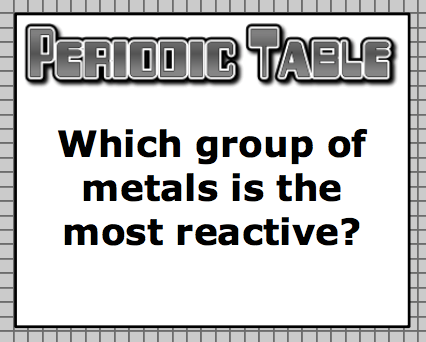
32.
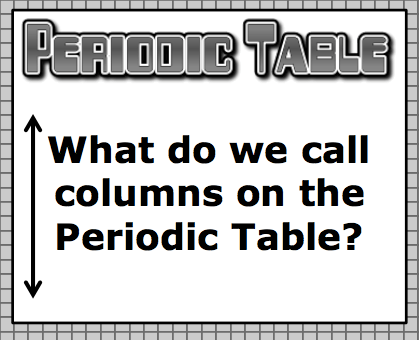
a)
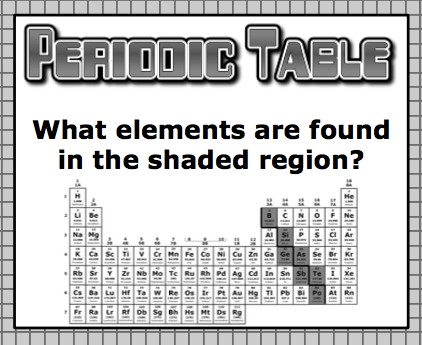
Periods
b)
Groups
33.
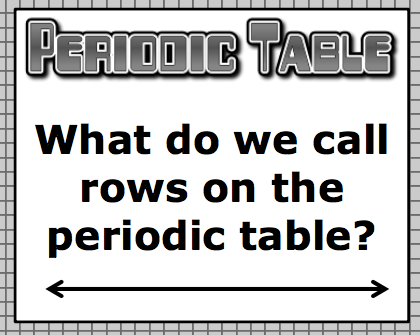
a)
Periods
b)
Groups
34.
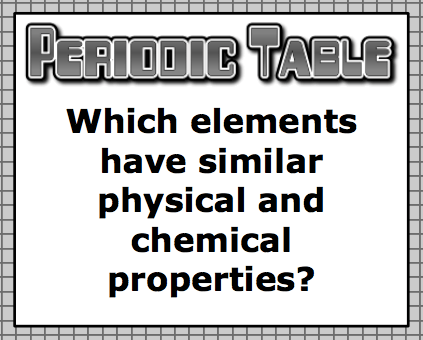
a)
energy levels
b)
valence electrons
c)
protons
d)
neutrons
35.
a)
energy levels
b)
valence electrons
c)
protons
d)
neutrons
36.
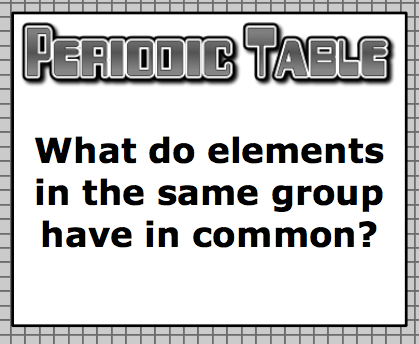
a)
Same group
b)
Same period
37.
a)
Group 1
b)
Group 17
c)
Group 2
d)
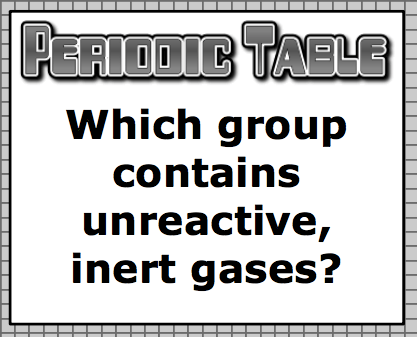
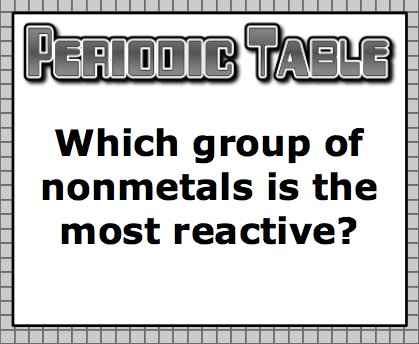
Group 18
38.
a)
Group 1
b)
Group 17
c)
Group 18
d)
Group 2
39.
a)
Group 1
b)
Group 17
c)
Group 18
d)
Group 2
40.
a)
Metals
b)
Nonmetals
c)
Metalloids
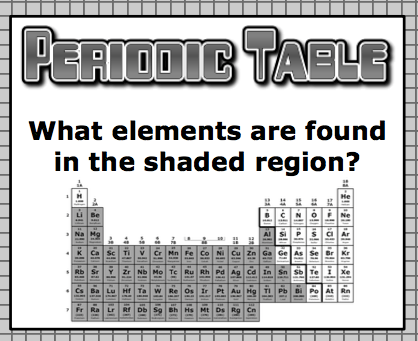
41.
a)
Metals
b)
Nonmetals
c)
Metalloids
42.
a)
Metals
b)
Nonmetals
c)
Metalloids
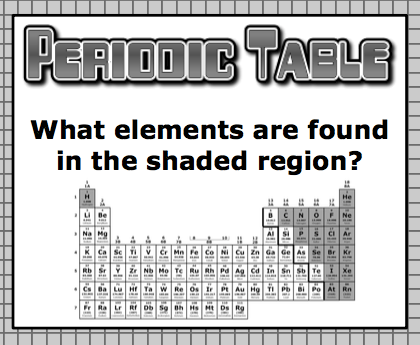
43.
a)
Metals
b)
Nonmetals
c)
Metalloids
44.
a)
Metals
b)
Nonmetals
c)
Metalloids
45.
a)
Metals
b)
Nonmetals
c)
Metalloids
46.

An atom as 18 protons and 18 valance electrons. Which statement would best identify this element?

a)

The element is highly reactive with eight electrons in the outer shell.

b)

The element has an atomic mass of 18.

c)

The element is “happy” or stable because its outer energy level is filled.

d)

The element is a metal.

47.

Sodium (Na) is a highly reactive element. Which characteristic of sodium is responsible for its reactivity?

a)

Number of protons

b)

Atomic mass

c)

Nonmetal

d)

It has one valance electron

48.

Number 13 is point at:

a)

Atomic Mass

b)

Atomic Number

c)

Element Name

d)

Element Symbol

49.

Number 14 is pointing at:

a)

Atomic mass

b)

Atomic number

c)

Element Name

d)

Element Symbol

50.

Number 15 is pointing at:

a)

Atomic mass

b)

Atomic number

c)

Element name

d)

Element symbol

51.

Number 16 is pointing at:

a)

Atomic mass

b)

Atomic number

c)

Element Name

d)

Element Symbol

52.
Ionic Bonding involves...
a)
The transfer of protons
b)
The transfer of nuetrons 
c)
The transfer of electrons
d)
None Of the above
53.
Covalent compounds
a)
Share electrons
b)
transfer electrons
c)
contain a sea of electrons
d)
conduct electricity
54.
What two types of atoms make a covalent bond?
a)
2 Nonmetals
b)
1 Nonmetal and 1 Metal
c)
2 Metals
d)
2 Noble Gases
55.
What charges attract?
a)
Opposite
b)
Same
56.
What charges repel?
a)
Same
b)
Opposite
57.
What elements generally make an ionic bond?
a)
metal and nonmetal
b)
2 or more nonmetals
c)
metal
d)
none of the above
58.
What elements generally make a covalent bond?
a)
metal and nonmetal
b)
2 or more nonmetals
c)
metal
d)
none of the above
59.
What is a valence electron?
a)
an electron that is found in the outermost shell of an atom. 
b)
an electron found in the innermost shell of an atom.
c)
an electron found in the middle shell.
60.
How many valence electrons in this structure?
a)
6
b)
5
c)
4
d)
7
61.
What is the tiniest particle in the entire universe?
a)
cells
b)
gases
c)
atoms
d)
liquids
62.
What is the picture displayed?
a)
Atom
b)
Element
c)
Molecule
d)
Compound
63.
What is the picture displayed?
a)
atom
b)
element
c)
molecule
d)
compound
64.
What is the picture displayed?
a)
atom
b)
element
c)
molecule
d)
compound
65.
Are these molecules also compounds?
a)
YES
b)
NO
66.
Are these molecules also compounds?
a)
YES
b)
NO
67.
What does the Law of Conservation of Mass state?
a)
Matter cannot be gained or lost in a chemical reaction.
b)
Matter can only be lost in a chemical reaction.
c)
Matter can only be gained in a chemical reaction.
d)
Matter can be gained and lost in a chemical reaction. 
68.
What is the left part of a chemical equation called?
2H2 + O2 --> 2H2O
a)
Reactants
b)
Products 
c)
Yields 
d)
Chemical Equation 
69.
What is the right part of a chemical equation called...
2H2 + O2 --> 2H2O
a)
Reactants
b)
Products 
c)
Yields 
d)
Chemical Equation 
70.
What is the total number of atoms present in 5Na3PO4
a)
5
b)
40
c)
55
d)
8
71.
How many Mn atoms are found in the following compound?
3Cr(MnO4)6
a)
3
b)
4
c)
6
d)
18
72.
What is the little number after an element in a chemical equation called.
Example: H2
a)
Coefficient 
b)
Subscript
c)
Atom
d)
Equation
73.
How many elements are in C6H12O6?
a)
1
b)
2
c)
3
d)
4
74.
Element or compound?
H2O
a)
Element
b)
Compound
75.
Element or compound?
O2
a)
Element
b)
Compound
76.
What is the number before a chemical formula called?
Ex: 2H2 + O2 --> 2H2O
a)
Coefficient
b)
Subscript
c)
Atom
d)
Equation
77.
How many atoms of carbon (C) are in C6H12O6?
a)
3
b)
6
c)
12
d)
24
78.
How many HCl molecules do you need to balance this equation? 
Mg +  __HCl --->  MgCl2 + H2
a)
1
b)
2
c)
3
d)
4
79.
Which is a type of Asexual Reproduction
a)
Sexual 
b)
Binary fission
c)
Cells 
d)
organism 
80.
What are some of the facts about asexual reproduction?
a)
Takes only one mate to reproduce and takes a longer time to reproduce
b)
Takes a shorter amount of time to reproduce and it takes two mates to reproduce
c)
Reproduces diverse offspring and takes a longer time to reproduce
d)
Takes only one mate to reproduce and takes a shorter time to reproduce
81.
What are some of the facts about sexual reproduction?
a)
Takes two mates to reproduce and takes a longer time to reproduce
b)
Takes one mate to reproduce and takes a shorter amount of time to reproduce
c)
Takes two mates to reproduce and takes a shorter amount of time to reproduce
d)
Takes one mate to reproduce and takes a shorter amount of time to reproduce
82.
Where does an off spring get its traits in asexual reproduction?
a)
From both parents
b)
From only one parent
c)
From neither parent
d)
There are no traits handed down
83.
What percentage of chromosomes are handed down by a sperm cell?
a)
75%
b)
25%
c)
50%
d)
100%
84.
Sexual reproduction requires _____ parents and asexual reproduction requires ___ parents
a)
1,1
b)
2,2
c)
2,1
d)
1,2 
85.
What is an advantage of sexual reproduction?
a)
Allows genetic variation
b)
Only needs one parent
c)
Happens very quickly
d)
Offspring are exact copies of parent
86.
What is one disadvantage of sexual reproduction?
a)
Only one parent needed
b)
Off spring are exact copies of parents
c)
Happens very quickly
d)
Needs two parents
87.
When a starfish grows a new body off a broken arm, what kind of reproduction is this?
a)
Sexual
b)
Differentiation
c)
Asexual 
d)
Specialization
88.

The smallest biological unit of a living organism is a ____________.

a)

Cell

b)

Compound

c)

Element

d)

Molecule

89.

Which organism receives all of its genes from one parent?

a)

Bear

b)

Rabbit

c)

Spider

d)

Bacteria

90.

Which is NOT an advantage of sexual reproduction?

a)

Diverse offspring

b)

Removes bad genes from the population

c)

Identical DNA

d)

Does not necessarily have same weaknesses in DNA as the parents

91.

Pairs of thread-like molecules, which live in the cell’s nucleus, and carries heredity information are called ____.

a)

Chromosomes

b)

Genes

c)

DNA

d)

Mitosis

92.

Which statement gives an advantage of asexual reproduction?

a)

There is no genetic variation in the next generation.

b)

An individual organism does not have to compete and find an appropriate mate.

c)

The offspring from asexual reproduction will be weaker.

d)

An individual must compete with others for the right to reproduce.

93.

Organisms can reproduce through either sexual or asexual reproduction. Which of these procedures greater genetic diversity in the next generation?

a)

Sexual reproduction because it has a higher mutation rate.

b)

Asexual reproduction because it has a higher mutation rate.

c)

Sexual reproduction because it combines genetic material from two parents.

d)

Asexual reproduction because it combines genetic material from two parents.

94.

Which is NOT an advantage for asexual reproduction?

a)

Less genetic variation

b)

No need for a mate

c)

Quick

d)

Produces more offspring

95.

Which statement is true about reproduction?

a)

Sexual reproduction requires two parents and offspring have identical DNA

b)

Sexual reproduction requires only one parent

c)

Asexual reproduction requires one parent and offspring have identical DNA

d)

Asexual reproduction requires two parents with identical DNA

96.

What kind of cells are made in MEIOSIS?

a)

Haploid Gametes

b)

Diploid Somatic Cells

c)

Skin Cells

d)

Liver Cells

97.

A human body (somatic) cell usually has how many chromosomes?

a)

6

b)

22

c)

4

d)

46

98.
The cells produced via meiosis are called:
a)
sex cells
b)
somatic cells
c)
body cells
d)
skin cells
99.
Why do we need meiosis?
a)
To double the number of chromosomes going into sex cells
b)
To halve the number of chromosomes going into sex cells
c)
To triple the number of chromosomes going into sex cells
d)
To not change the number of chromosomes going into sex cells
100.
What causes genetic variation in meiosis?
a)
chromosomes lining up
b)
crossing over of chromosomes
c)
separation of chromosomes
d)
chromosomes pulling apart
101.

The chromosomes that pair up during meiosis, are called __________ chromosomes.

a)

heterozygous

b)

asexual

c)

homologous pairs

d)

genes

102.
How many daughter cells are produced at the end of meiosis?
a)
1
b)
2
c)
3
d)
4
103.

Which of the following will only show if two alleles are present?

a)

a dominant trait

b)

heterozygous

c)

a recessive trait

d)

hybrid

104.
Heterozygous is when...
a)
the alleles are the same
b)
the alleles are different
c)
the alleles are absent
d)
the alleles are present
105.
In a heterozygous genotype, the ___________ allele takes over in the phenotype.
a)
recessive
b)
dominant
c)
lower case letter
d)
both 
106.
T - tall and t = short
In the punnett square below, what belongs in the missing square
a)
tt
b)
Tt
c)
Bb
d)
TT
107.
Which of the following alleles is homozygous (purebred) recessive?
a)
Tt
b)
tt
c)
TT
d)
t
108.

Genetic variation occurs in what type of reproduction?

a)

Asexual

b)

Sexual

c)

Both

d)

None

109.

The ____________ represents the genetic makeup of an organism, while the _________ represents the appearance of an organism.

a)

Genotype, phenotype

b)

Phenotype, genotype

c)

allele, gene

d)

gene, alelle

110.
Animals must eat other organisms for food, so they are classified as--
a)
heterotrophs
b)
autotrophs
c)
eukaryotic
d)
prokaryotic
111.
When DNA is contained in a nucleus, the cell is
a)
eukaryotic
b)
prokaryotic
c)
unicellular
d)
multicellular
112.
All organisms that do not fit into plant, fungi, and animal kingdoms but have a nucleus are:
a)
archaebacteria
b)
eubacteria
c)
protists
d)
fungus
113.
All of the following have a nucleus except...
a)
Bacteria
b)
Animalia
c)
Plantae
d)
Protista
114.
Which kingdom is autotrophic AND has a cell wall?
a)
Bacteria
b)
Fungi
c)
Plantae
d)
Protista
115.
What is the difference between Archaebacteria and Eubacteria?
a)
Bacteria is eukaryotic
b)
Archaebacteria is multicellular
c)
Archaebacteria can live in extreme environments
d)
They are the same
116.
Which kingdom do humans belong to?
a)
Plantae
b)
Fungi
c)
Animalia
d)
Protista
117.
What are the three domains?
a)
Archaea, Bacteria, and Eubacteria
b)
Archaea, Protista, and Eubacteria
c)
Archaea, Bacteria, and Eukarya
d)
Archaea, Fungi, Animalia
118.
Organisms that are classified as unicellular are --
a)
seen with the naked eye
b)
many celled organisms
c)
single celled organisms
d)
able to make their own food
119.
What type of organism makes its own food internally?
a)
heterotroph
b)
autotroph
c)
carnivore
d)
omnivore
120.
Almost all bacteria are...
a)
Unicellular
b)
Multicellular
121.
What is the most specific level of classification?
a)
Family
b)
Domain
c)
Species
d)
Carolus Linnaeus
122.
What is classification
a)
put similar objects in groups
b)
sorting them
c)
classifing things
d)
ordering things
123.
Survival of the Fittest and Evolution were proposed by what scientist?
a)
Charles Darwin
b)
Albert Einstein
c)
Steven Hawking
d)
Isaac Newton
124.
When every organism of a species has died.
a)
Evolution
b)
Natural Selection
c)
Extinction
d)
Artificial Selection
125.
Where the better adapted organisms survive to pass traits along to offspring.
a)
Evolution
b)
Natural Selection
c)
Extinction
d)
Artifical Selection
126.
The theory of evolution by natural selection means that what is changing over time?
a)
The inherited traits of a population.
b)
The acquired traits of a population.
c)
Hair color and eye color
d)
Attractive features.
127.
Why are advantageous traits more likely to be passed onto offspring?
a)
Because they are more likely to survive and reproduce.
b)
Because they come from dominant alleles.
c)
Because they come from recessive alleles.
d)
Because the trait is an acquired phenotype.
128.
Mutations are a change in what?
a)
DNA
b)
tRNA
c)
genotype
d)
phenotype
129.
What is the advantage of having different shaped beaks?
a)
To look different from other species.
b)
To be able to eat the food readily available in the environment.
c)
To protect itself against predators.
d)
To protect itself against prey.
130.
Which organisms are most likely to survive?
a)
the best adapted
b)
the fastest
c)
the strongest
d)
the most domesticated (tamed)
131.
Do organisms "decide" to evolve and change?
a)
Yes, they know they need to change to survive 
b)
No, they change because of natural selection
132.
The differences among a species, like different bird beaks, are called
a)
genes.
b)
variations.
c)
traits.
d)
theories.
133.
What process is being shown in this image?
a)
Variation
b)
Natural Selection
c)
Selective Breeding
d)
Homeostasis