wayground logo

Free Printable Worksheets

Font size

S
M
L
XL
Worksheets

Weather Unit Review

Total questions: 135

Worksheet time: 2hrs 9mins

Name
Class
Date
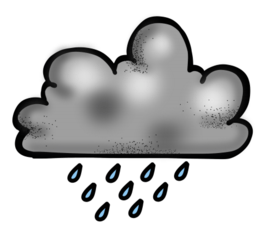
1.
What part of the water cycle does this picture show?
a)
condensation
b)
precipitation
c)
evaporation
d)
transpiration
2.
Which of these is an example of precipitation?
a)
snow
b)
air
c)
clouds
d)
vapor
3.
What is it called when plants give off water vapor as a waste product?
a)
condensation
b)
evaporation
c)
sublimation
d)
transpiration
4.
When water condenses, the water vapor in the air gets ___________ and changes back into liquid.
a)
cold
b)
hot
c)
warm
d)
solid
5.
What is the water cycle?
a)
the 3 forms of water
b)
the movement of water on, above, or below the surface of the Earth
c)
when water melts
d)
when clouds form
6.
Precipitation happens when clouds of water droplets are too ______________.
a)
cold
b)
light
c)
heavy
d)
hot
7.
Where is most water found on Earth?
a)
glaciers
b)
lakes
c)
rivers
d)
oceans
8.
What is the energy source for the water cycle?
a)
the sun
b)
the earth
c)
water
d)
the moon
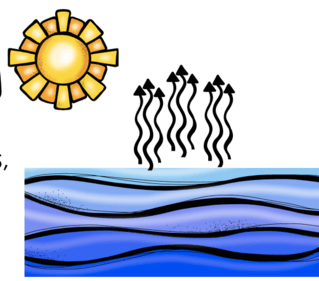
9.
What part of the water cycle does this picture show?
a)
condensation
b)
precipitation
c)
evaporation
10.
What is evaporation?
a)
The part of the water cycle when the sun heats up water, turning it from a liquid into water vapor or steam. It rises from the ground into the air.
b)
The part of the water cycle when the water vapor in the air gets cold. The water turns back into a liquid and forms clouds.
c)
The part of the water cycle when clouds get heavy and can no longer hold the liquid water. This causes the water to fall from the sky to the earth as rain, snow, sleet, or hail.
11.
What is condensation?
a)
The part of the water cycle when the sun heats up water, turning it from a liquid into water vapor or steam. It rises from the ground into the air.
b)
The part of the water cycle when the water vapor in the air gets cold. The water turns back into a liquid and forms clouds.
c)
The part of the water cycle when clouds get heavy and can no longer hold the liquid water. This causes the water to fall from the sky to the earth as rain, snow, sleet, or hail.
12.
What is precipitation?
a)
The part of the water cycle when the sun heats up water, turning it from a liquid into water vapor or steam. It rises from the ground into the air.
b)
The part of the water cycle when the water vapor in the air gets cold. The water turns back into a liquid and forms clouds.
c)
The part of the water cycle when clouds get heavy and can no longer hold the liquid water. This causes the water to fall from the sky to the earth as rain, snow, sleet, or hail.
13.
Which is the opposite of condensation?
a)
runoff
b)
evaporation
c)
precipitation
d)
transpiration
14.
Clouds are made up of tiny drops of ______ or ice. The moisture in the cloud affects the weather.
a)
dust
b)
water
c)
cloud particles
d)
precipitation
15.
They are highest clouds in the sky. They look curly, white and feathery. Usually mean good weather.
a)
Cumulus
b)
Cumulonimbus
c)
Cirrus
d)
Stratus
16.
This is sometimes called a thunderhead cloud. It looks very tall like mountains and heavy rain comes from it. 
a)
Cumulus
b)
Cirrus
c)
Stratus
d)
Cumulonimbus
17.
They are low in the sky and look soft and fluffy. 
a)
Cirrus
b)
Cumulonimbus
c)
Cumulus 
d)
Stratus
18.
Which cloud brings nice weather?
a)
Cumulonimbus
b)
Cumulus
c)
Stratus
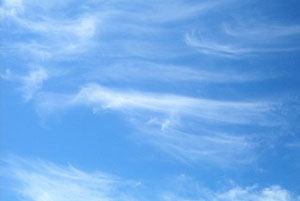
19.
what type of cloud is shown?
a)
cumulus
b)
cirrus
c)
stratus
20.
what type of cloud is shown?
a)
cumulus
b)
cirrus
c)
stratus
21.
Dew is most likely to form 
a)
after heavy rain on a humid day
b)
when humid air contacts cold ground
c)
when the snow on the ground melts
d)
during windy nights when it rains
22.
During which part of the water cycle does a cloud form?
a)
Evaporation
b)
Precipitation
c)
condensation
d)
Run off
23.
Clouds form when...
a)
liquid water is heated and evaporates to become water vapor in the atmosphere.
b)
water vapor in the atmosphere cools and condenses becoming water droplets in the atmosphere
c)
water droplets float upwards and gather together in the atmosphere to form a cloud.
24.
Clouds are classified by their
a)
color and size
b)
color and shape
c)
height and size
d)
height and shape
25.
Identify this cloud type (in the pic behind the question)
a)
cirrus
b)
cumulus
c)
stratus
d)
cumulonimbus
26.
Clouds form with 
a)
atmospheric dust, low pressure, and moist air
b)
high pressure, high temperatures, and condensation nuclei
c)
low temperatures, zero dust particles, and dry air
d)
dry air, condensation nuclei, and low pressure 
27.
This type of cloud is thin, wispy, and made of ice crystals
a)
cumulus cloud
b)
stratus cloud
c)
cirrus cloud
d)
cumulonimbus cloud
28.
what type of cloud is shown?
a)
cumulus
b)
cirrus
c)
stratus
29.
what type of cloud is shown?
a)
cumulus
b)
cirrus
c)
stratus
30.

What is it called when water changes from a liquid to a gas?

a)

EVAPORATION

b)

PRECIPITATION

c)

TRANSPIRATION

31.

high, thin wispy

a)

stratus

b)

cirrus

c)

alto cumulus

d)

cumulus

32.

billowy, pillowy, pictures

a)

cirrus

b)

stratus

c)

cumulus

d)

contrail

33.

long, grey, dark

a)

alto cumulus

b)

cirrus

c)

mammatus

d)

stratus

34.

medium height

a)

cumulus

b)

lenticular

c)

contrail

d)

alto stratus

35.

medium height

a)

alto cumulus

b)

cirrus

c)

stratus

d)

cumulonimbus

36.

high, combo

a)

stratus

b)

cumulus

c)

cirrostratus

d)

contrail

37.

high combo

a)

nimbostratus

b)

cumulonimbus

c)

cirrus

d)

cirrocumulus

38.

winter storm cloud

a)

cumulus

b)

nimbostratus

c)

cirrus

d)

mammatus

39.

thunderstorm cloud

a)

stratus

b)

cirrus

c)

cumulonimbus

d)

contrail

40.

from the plane

a)

stratus

b)

contrail

c)

mammatus

d)

cumulus

41.

hang down, grape-like

a)

cirrus

b)

contrail

c)

mammatus

d)

altocumulus

42.

mistaken for UFOs

a)

stratus

b)

cirrus

c)

lenticular

d)

contrail

43.

low, combo

a)

cirrus

b)

contrail

c)

stratocumulus

d)

mammatus

44.

Which form of severe weather is characterized by violent wind that twists, lifting and destroying everything in its path?

a)

thunderstorm

b)

flood

c)

tsunami

d)

tornado

45.

Which of the following is the correct thing to do if you are caught outside during a

Tornado?

a)

find a low place, like a ditch, and lie down as flat as you can until the tornado passes

b)

run away from the tornado

c)

climb a tree

d)

get in your car

46.

Which of the following storms is a large storm that forms over warm ocean water that spins in a circular pattern around the eye of the storm?

a)

thunderstorm

b)

hurricane

c)

tornado

d)

flood

47.

I am a severe storm that uses heavy rains to flood dry lands. My lightning can cause fires, and my strong winds can blow over trees and power lines. What am I?

a)

hurricane

b)

tornado

c)

thunderstorm

d)

blizzard

e)

flood

48.

I am a dangerous cloud that uses my very strong and fast winds to tear apart buildings, and when I tough the ground, I destroy everything in my path. What am I?

a)

blizzard

b)

thunderstorm

c)

tornado

d)

hurricane

49.

What type of clouds are formed very high, and appear to be thin and wispy?

a)

cirrus

b)

stratus

c)

cumulus

d)

cumulonimbus

50.

What is NOT an example of a safety precaution during a tornado?

a)

Seek shelter in a low area like a ditch if you are outside.

b)

Stay in your car.

c)

Get in a room with no windows.

51.

Which of the following is NOT an example of a safety precaution to take during a thunderstorm?

a)

Stand under a tree

b)

Stay inside

c)

Stay away from windows.

d)

Stay out of water.

52.
Do sea breezes typically happen during the day or night?
a)
Day
b)
Night
53.
Do land breezes typically happen during the day or night?
a)
Day
b)
Night
54.
During a land breeze which way does the wind blow?
a)
from the sea to the land
b)
from the land to the sea
55.
During a sea breeze which way does the wind blow?
a)
from the land to the sea
b)
from the sea to the land
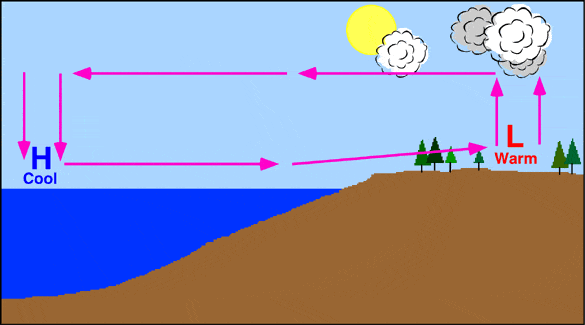
56.
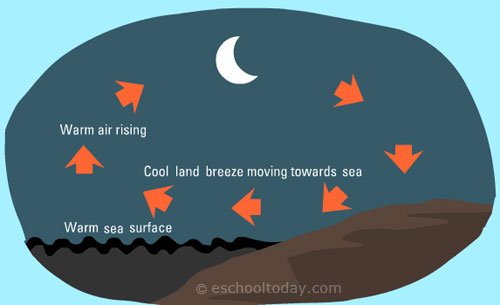
Is this a land or a sea breeze?
a)
land breeze
b)
sea breeze
57.
Is this a land or a sea breeze?
a)
land breeze
b)
sea breeze
58.
When warm air rises, ______ pressure forms at the surface of the land or sea.
a)
high
b)
some
c)
low
d)
none
59.
How does the air move in a land breeze?
a)
From east to west
b)
From west to east
c)
From the land to the ocean
d)
From the ocean to the land
60.
The strength of a sea breeze depends on
a)
the heat of the day
b)
the difference between the temperature of the sea and the land
c)
the wind speed
d)
the amount of precipitation that day
61.
How does the air move in a sea breeze?
a)
wind moves from north to south
b)
wind moves from ocean to the land
c)
wind moves from the land to the ocean
d)
wind moves from south to north
62.
In a sea breeze, the air is warmer above the _____.
a)
land
b)
ocean
c)
sky
d)
beach
63.
Where does the initial source of energy come from that creates winds?
a)
the moon
b)
the sun
c)
the Earth's surface
d)
the rotation of the Earth
64.
Why does warm air rise?
a)
Warm air is more dense than cooler air.
b)
Warm air has more pressure than cooler air.
c)
Warm air is less dense than cooler air.
d)
Warm air has a higher dew point than cooler air.
65.

Land breeze and sea breezes are caused by the different _________ between land and water surfaces.

a)

rotations

b)

temperatures

c)

gases

d)

solids

66.
Is this a land or a sea breeze?
a)
land breeze
b)
sea breeze
67.

Air moves from _______ pressure to ________ pressure.

a)

high to low

b)

low to high

c)

high to high

d)

low to low

68.
This is a...
a)
Land Breeze
b)
Sea Breeze
69.
Which warms up faster during the day?
a)
Sea/Water
b)
Land
70.
The air warms up how?
a)
The sun heats the air directly
b)
The sun heats the Earth's surface. The surface then heats the air above it
71.
During the day which is coolest?
a)
A
b)
B
c)
C
d)
D
72.
The process that traps heat in our atmosphere is
a)
condensation.
b)
the Greenhouse Effect.
c)
Global Energy Systems.
d)
evaporation.
73.
Low pressure areas
a)
hold more water vapor.
b)
are cooler.
c)
are more stable.
d)
are heavier.
74.
being in or facing the direction FROM which the wind is blowing
a)
windward
b)
leeward
c)
rain shadow
d)
prevailing winds
75.
being in or facing the direction TOWARD which the wind is blowing
a)
windward
b)
prevailing winds
c)
leeward
d)
wind currents
76.
Movements of ocean water in a continuous flow are called?
a)
ocean currents
b)
global winds
c)
air mass
d)
front
77.
The _______ of  a mountain range is the side that receives a lot of precipitation.
a)
dry side
b)
leeward/dry side
c)
windward/wet side
d)
cloudy side
78.

What Is Dew point

a)

that xbox is better that the nintendo switch

b)

How big fortnite's community is

c)

the temperature to which air must be cooled to become saturated with water vapor.

d)

how humid the air can be

79.

why is it used to describe the weather.

a)

The amount of rebels lost in the revolutionary war

b)

to see how many kills you will get in fortnite before it dies

c)

to measure the amount of moisture in the air

80.
The phase change from water vapor to liquid water is known as:
a)
evaporation
b)
precipitation
c)
condensation
d)
sublimation
81.
Dew Point is the
a)
temperature air cools down to reach condensation (or turn into a liquid)
b)
temperature where ice melts to liquid water
c)
temperature where ice turns directly into water vapor
d)
time of day when dew on the ground disappears
82.
If the air is "saturated", that means:
a)
the air is full of water
b)
the air is partially full of water
c)
it's amount of water vapor in the atmosphere right now
d)
how much liquid water it potentially can hold
83.
Dew is most likely to form 
a)
after heavy rain on a humid day
b)
when humid air contacts cold ground
c)
when the snow on the ground melts
d)
during windy nights when it rains
84.
The name for the process in which water vapor changes back into a liquid is
a)
Evaporation
b)
Condensation
c)
Sublimation
d)
Deposition
85.
The temperature to which air must be cooled in order to become saturated is the: 
a)
Relative Humidity
b)
Mixing Ratio
c)
Dew Point Temperature
d)
Wet-bulb Temperature
86.
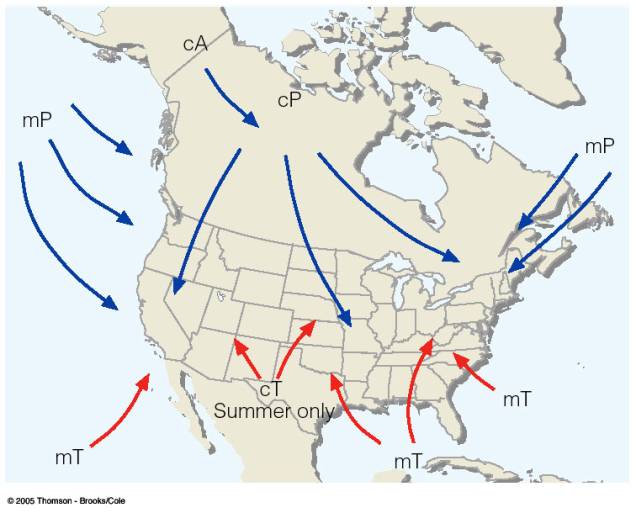
How do we name air masses?
a)
Water and temperature
b)
Air pressure
c)
Humidity and temperature
d)
Cold and warm
87.
How do we characterize an air mass that forms over the ocean?
a)
Dry
b)
Wet
c)
Cold
d)
Warm
88.
How do we characterize an air mass that forms over land?
a)
Dry
b)
Wet
c)
Cold
d)
Warm
89.
How do we characterize an air mass that forms over near the equator?
a)
Dry
b)
Wet
c)
Cold
d)
Warm
90.
How do we characterize an air mass that forms near the poles?
a)
Dry
b)
Wet
c)
Warm
d)
Cold
91.
What's the humidity and temperature of a continental tropical air mass?
a)
Wet and cold
b)
Dry and warm
c)
Wet and warm
d)
Dry and cold
92.
What's the humidity and temperature of a maritime tropical air mass?
a)
Wet and cold
b)
Dry and warm
c)
Wet and warm
d)
Dry and cold
93.
What's the humidity and temperature of a maritime tropical air mass?
a)
Wet and cold
b)
Dry and warm
c)
Wet and warm
d)
Dry and cold
94.
A wet and cold air mass would be a...
a)
Maritime polar
b)
Continental polar
c)
Maritime tropical
d)
Continental tropical
95.
A dry and cold air mass would be...
a)
Maritime polar
b)
Continental polar
c)
Maritime tropical
d)
Continental tropical
96.
A dry and hot air mass would be...
a)
Maritime arctic
b)
Maritime tropical
c)
Continental tropical
d)
Continental polar
97.
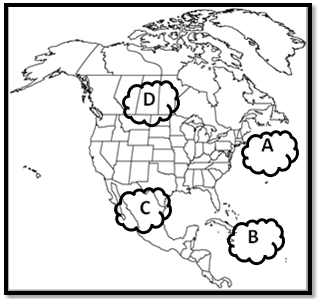
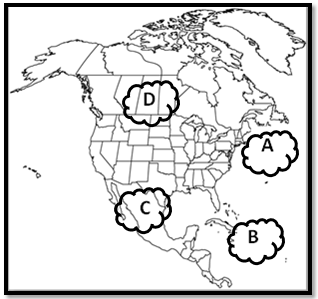
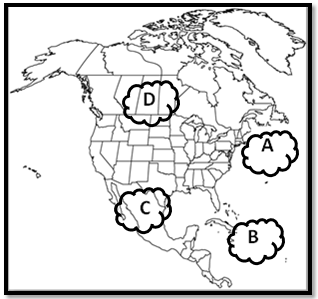
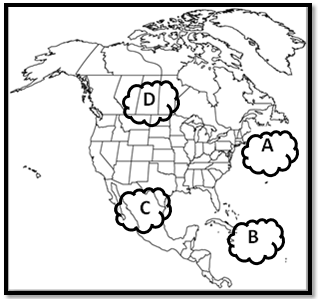
Which type of air would you find at air mass A?
a)
cold, dry
b)
warm, humid
c)
warm, dry
d)
cold, humid
98.
Which type of air would you find at air mass B?
a)
cold, dry
b)
warm, humid
c)
warm, dry
d)
cold, humid
99.
Which type of air would you find at air mass C?
a)
cold, dry
b)
warm, humid
c)
warm, dry
d)
cold, humid
100.
Which type of air would you find at air mass D?
a)
cold, dry
b)
warm, humid
c)
warm, dry
d)
cold, humid
101.
Where would you find a tropical maritime air mass?
a)
over the ocean, near the equator
b)
over the ocean, near the poles
c)
over a continent, near the equator
d)
over a continent, near the poles
102.
Which abbreviation of an air mass can be identified as dry and hot?
a)
cP
b)
mP
c)
cT
d)
mT
103.
Air travels
a)
from high pressure to low pressure
b)
from low pressure to high pressue
104.
What kind of breeze is this & what time of day/night would it form?
a)
Land breeze - daytime
b)
Land breeze - nighttime
c)
Sea breeze - daytime
d)
Sea breeze - nighttime
105.
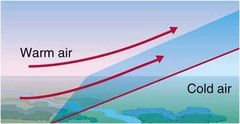
Which type of front is displayed?
a)
Cold
b)
Warm
c)
Stationary
d)
Occluded
106.
Which type of front is displayed?
a)
Cold
b)
Warm
c)
Stationary
d)
Occluded
107.
Which type of front is displayed?
a)
Cold
b)
Warm
c)
Stationary
d)
Occluded
108.
Which type of front is displayed?
a)
Cold
b)
Warm
c)
Stationary
d)
Occluded
109.
When two different air masses collide...
a)
A front forms
b)
They casually become one
c)
A new planet evolves
d)
Dinosaurs become extinct
110.
A source region
a)
provides an air mass with its characteristics
b)
is where power is generated
c)
is a small pool of water
d)
enable you to charge your phone
111.
A _______________ is formed when a warm and cold air mass meet
a)
front
b)
air mass
112.
What color is the symbol for a warm front?
a)
red
b)
blue
113.
What color is the symbol for a cold front ?
a)
red
b)
blue
114.
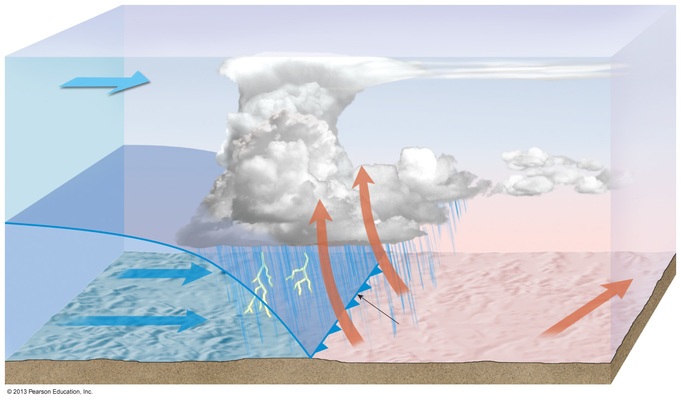
What type of storm front is this? 
a)
warm front
b)
cold front
c)
stationary front
d)
occluded front
115.
This is the symbol for a(n) _______________
a)
warm front
b)
cold front
c)
stationary front
d)
occluded front
116.
What type of storm front if this?
a)
Warm Front
b)
Cold Front
c)
Stationary Front
d)
Occluded Front
117.

Which is the correct symbol for a warm front?

a)
b)
c)
d)
118.

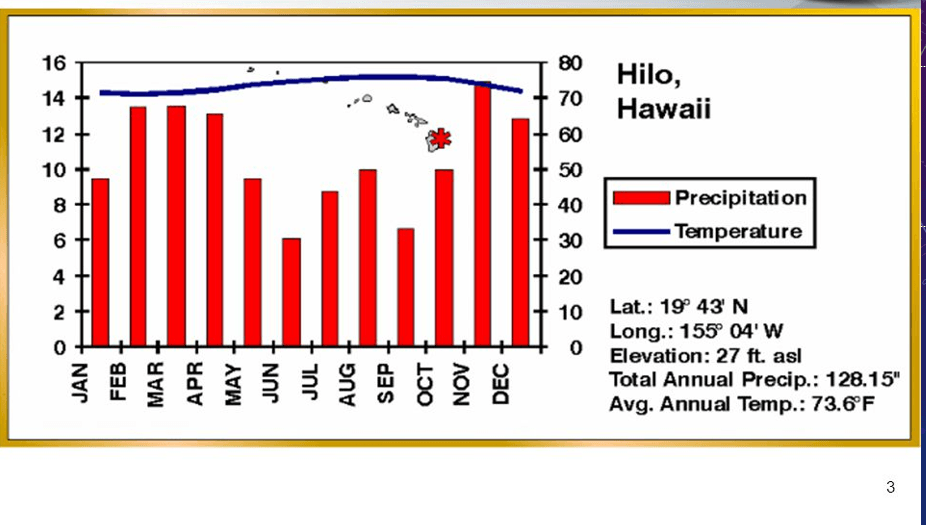
Which month has the coldest temperature?

a)

January

b)

April

c)

September

d)

March

119.

In which month do they get the most rain in this biome?

a)

January

b)

May

c)

August

d)

November

120.

When does the least precipitation occur?

a)

February - March

b)

April - May

c)

June - July

d)

November - December

121.

Which months have the warmest temperatures?

a)

December, January, February

b)

March, April, May

c)

June, July, August

d)

September, October, November

122.

When is there the most precipitation & highest temperatures?

a)

February

b)

July

c)

September

d)

December

123.
Is it weather or climate?
a)
Weather
b)
Climate
124.
Is it weather or climate?
a)
Weather
b)
Climate
125.

Fall here tends to be dry and cool.

a)

Weather

b)

Climate

126.

We average 200 inches of snow each winter.

a)

Weather

b)

Climate

127.

There is a hurricane affecting the Gulf Coast.

a)

Weather

b)

Climate

128.

In winter, I need to always wear a warm jacket.

a)

Weather

b)

Climate

129.

I need to wear a sweater and long pants today.

a)

Winter

b)

Climate

130.

I live in Tornado Alley, therefore there is the risk of experiencing a tornado each year.

a)

Weather

b)

Climate

131.

Living to the west of Lake Superior means we experience harsh winters with a lot of snow.

a)

Weather

b)

Climate

132.

Today the temperature was cold.

a)

Weather

b)

Climate

133.
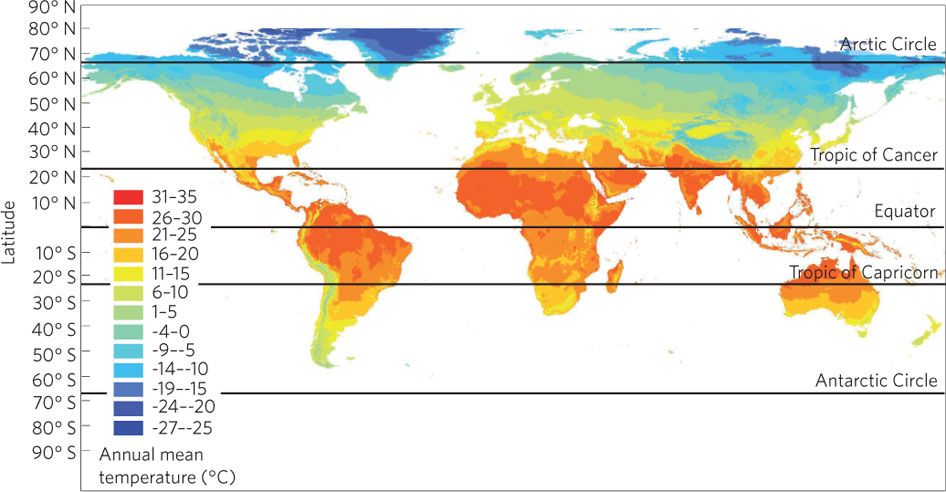
What does this picture show?
a)
weather
b)
climate
134.

In general, this week has been quite cold.

a)

Weather

b)

Climate

135.
Which of these best describes climate rather than weather?
a)
Wind speed is changing as a storm moves through an area.
b)
The temperature is decreasing in a slow-moving cold front.
c)
Annual high temperatuers in the summer have increased over many decades.
d)
The rainfall during one year was greater than teh rainfall during the next year.