wayground logo

Free Printable Worksheets

Font size

S
M
L
XL
Worksheets

Force, Motion, and Energy GMAS Review

Total questions: 135

Worksheet time: 2hrs 8mins

Name
Class
Date
1.
Wind pushes a toy sailboat across a pond. The boat moves in a straight path. What is changing?
a)
the boat’s direction
b)
the boat’s path
c)
the wind’s direction
d)
the boat’s position
2.
The position of a runner in a race changes as time passes. What could a reference point to describe the change in position? 
a)
the starting line
b)
the runner’s speed
c)
the runner’s right foot
d)
another runner
3.

Motion is measured as _____

a)

rate.

b)

velocity

c)

feet

d)

mph

4.

When an object’s distance from another object is changing,

a)

it is in motion.

b)

it is speeding.

c)

it has a high velocity.

d)

it is accelerating.

5.

Reference point can also be described as what?

a)

An ending point

b)

A starting point

c)

A description

d)

A location

6.

David walks 3 km north, and then turns east and walks 4 km. What is the distance?

a)

7 km

b)

3 km

c)

4 km

d)

1 km

7.

Which of the following dot diagrams shows an object that is accelerating

a)

A

b)

B

c)

Neither object is accelerating

d)

You can not tell from the dot diagram

8.
What is velocity?
a)
the quickness of an object
b)
the location of an object
c)
acceleration
d)
speed in a specific direction
9.

_______ is the length of the path between two points.

a)

distance

b)

reference

c)

statistic

d)

law

10.

Choose the answer that best fits: Acceleration is the...

a)

change of speed and/or direction over time

b)

change of speed over time

c)

change of direction over time

d)

increase of speed

11.

What is the unit for distance?

a)

feet (ft)

b)

meters (m)

c)

meters per second (m/s)

d)

meters per second per second (m/s/s or m/s2)

12.

What is the unit for velocity?

a)

feet (ft)

b)

meters (m)

c)

meters per second (m/s)

d)

meters per second per second (m/s/s or m/s2)

13.

What is the unit for acceleration?

a)

feet (ft)

b)

meters (m)

c)

meters per second (m/s)

d)

meters per second per second (m/s/s or m/s2)

14.
LT5: The rate at which velocity CHANGES is: 
a)
acceleration
b)
speed
c)
direction
d)
physics
15.
Why does a rolling ball stop?
a)
Gravity
b)
Friction
c)
Waterfalls
d)
Sand
16.
Wheels on a skateboard most likely experiences-
a)
Rolling Friction
b)
Sliding Friction
c)
Fluid Friction
d)
Static Friction
17.
What are 2 factors that determine the amount of friction between 2 objects?
a)
Force and roughness between surfaces
b)
hills and valleys and how smooth or rough the surface is
c)
Amount of force and amount of surface the comes in contact
d)
The force and the weight exerted on the surfaces
18.
In which of the following activities is friction harmful? 
a)
car engine parts wearing out
b)
a person walking
c)
an eraser erasing
d)
brakes stopping a car
19.
Balanced or unbalanced?
a)
balanced
b)
unbalanced
20.
What would you call a tree if you compared it with a moving car?
a)
reference point
b)
beacon
c)
compass
d)
friction
21.
What type of friction acts upon a non-moving object?
a)
Static Friction
b)
Kinetic Friction
c)
Rolling Friction
d)
Sliding Friction
22.
What is the net force on an object when you combine a force of 25 N West with a force of 10 N East?
a)
35 N West
b)
15 N East
c)
15 N West
d)
35 N East
23.
What causes a change in motion on an object?
a)
balanced force
b)
unbalanced force
c)
balanced mass
d)
unbalanced mass
24.

Describe the motion in the graph:

a)

Constant Speed (positive slope)

b)

Stopped (at rest)

c)

Acceleration (increasing speed)

d)

Return Home (negative slope)

25.

Describe the motion in the graph:

a)

Constant Speed (positive slope)

b)

Stopped (at rest)

c)

Acceleration (increasing speed)

d)

Return Home (negative slope)

26.

Describe the motion in the graph:

a)

Constant Speed (positive slope)

b)

Stopped (at rest)

c)

Acceleration (increasing speed)

d)

Return Home (negative slope)

27.

Describe the motion in the graph:

a)

Constant Speed (positive slope)

b)

Stopped (at rest)

c)

Acceleration (increasing speed)

d)

Return Home (negative slope)

28.
What does this graph represent?
a)
Constant Speed
b)
Acceleration
c)
Not moving
29.
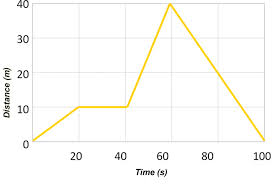
How long did it take this object to travel back to its reference/starting point?
a)
20 s
b)
30 s
c)
60 s
d)
100 s
30.
At 60 seconds, how far had this object traveled? 
a)
0 m
b)
10 m
c)
20 m
d)
40 m
31.
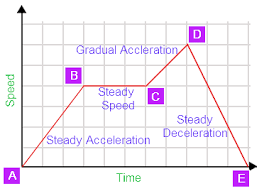
What is happening at D?
a)
Stationary
b)
Accelerating
c)
Fast steady speed; moving away from the starting position
d)
Slower steady speed; moving away from the starting position
32.
What is happening at C?
a)
Stationary
b)
Accelerating
c)
Fast steady speed; moving away from the starting position
d)
Slower steady speed; moving away from the starting position
33.
How long did it take this object to travel 10 m?
a)
0 s
b)
10 s
c)
15 s
d)
20 s
34.
Which runner had a head start?
a)
A
b)
B
c)
C
35.
What two measurements are necessary for calculating speed?
a)
Mass and time
b)
Temperature and mass
c)
Mass and distance
d)
Distance and time
36.
A measurement of how fast an object is moving
a)
Velocity
b)
Speed
c)
Vector
d)
Acceleration
37.

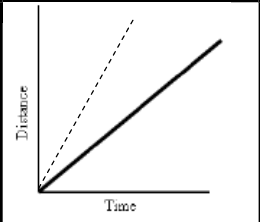
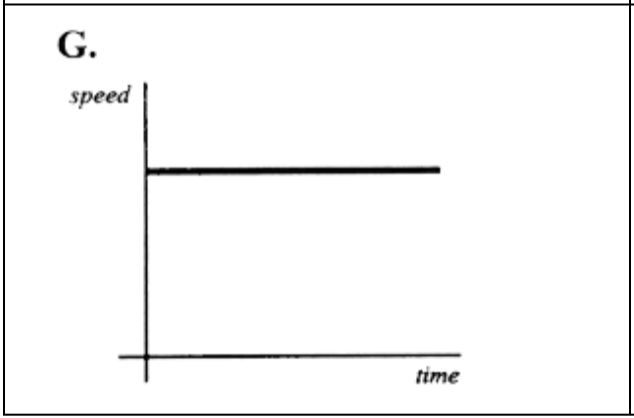
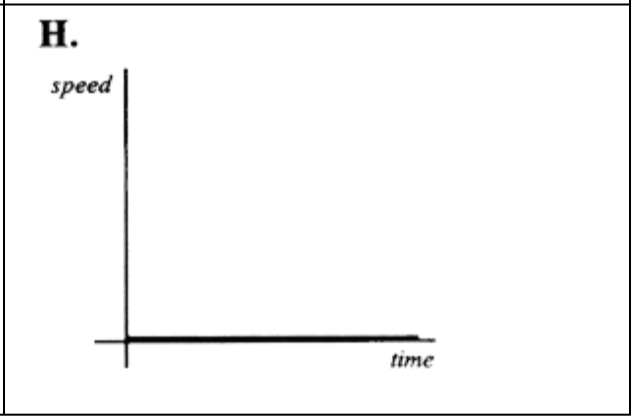
In which of the following graphs below are both runners moving at the same speed?

a)
b)
c)
d)
38.

Match the description to the graph:

"The car is coming back."

a)
b)
c)
d)
39.

Match the description to the graph:

"The car is traveling at a constant speed."

a)
b)
c)
d)
40.

Segment B-C The bus is _________________.

a)

at rest

b)

returning (to original position)

c)

moving forward

41.
What is the equation to calculate time?
a)
time = speed/distance
b)
time = distance/speed 
c)
time = speed x distance 
d)
time = distance x speed
42.

At what point is the speed the greatest?

a)

C-D

b)

B-C

c)

A-B

d)

D-E

43.

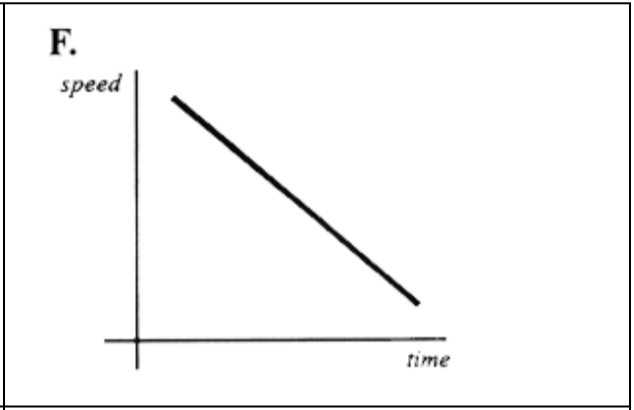
A negative acceleration means that your object is _____.

a)

doing nothing

b)

moving in circles

c)

speeding up

d)

slowing down

44.

What is happening during point A to B?

a)

not moving

b)

increasing speed at a constant rate

c)

moving at a constant speed

d)

moving at 10 m/s2 acceleration

45.

What is happening during point C to D?

a)

not moving

b)

increasing speed at a constant rate

c)

moving at a constant speed

d)

moving at 0 m/s2 acceleration

46.

Match the graph to the description:

"The car is traveling at a constant speed."
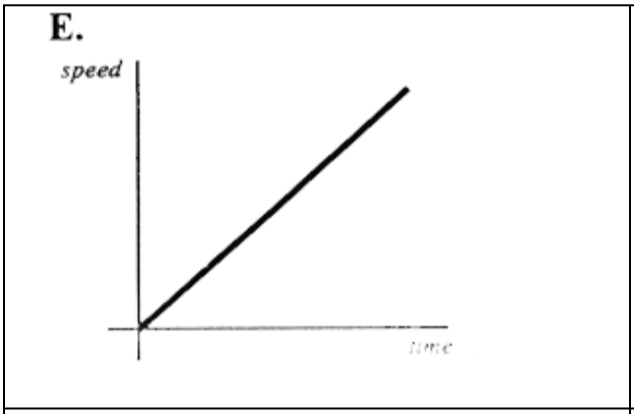
a)
b)
c)
d)
47.

Match the graph to the description:

"The car is accelerating."

a)
b)
c)
d)
48.

Match the graph to the description:

"The car is slowing down."

a)
b)
c)
d)
49.

Match the graph to the description:

"The car is stationary."

a)
b)
c)
d)
50.
A negative acceleration means that your object is _____. 
a)
Going to Wal-mart 
b)
running for president 
c)
speeding up 
d)
slowing down 
51.

A car has an oil drip that drops every second. What is happening to the motion of the car shown above?

a)

Car is moving with a constant velocity

b)

Car is accelerating or speeding up

c)

Car is decelerating or slowing down

d)

Car is changing directions

52.

What is happening to the car between 3-8 seconds?

a)

The car is stopped

b)

The car is traveling at a constant velocity of 0.5 m/s.

c)

The car has an acceleration of 0.5 m/s2.

d)

The car is going in the other direction.

53.
Some students observing a classroom device being used, noticed the below energy transformations. 
Electrical → Mechanical → Sound
Which device were the students most likely observing?
a)
A triple beam balance measuring an object’s mass.
b)
A pencil sharpener plugged into a wall outlet.
c)
A projector displaying a diagram on the screen.
d)
A working flashlight used to light up a dark corner.
54.
Which of these is an example of light energy being transformed into chemical energy?
a)
A glow stick lights up when broken.
b)
Water heated by the sun evaporates.
c)
A plant makes sugar in the sunlight.
d)
A battery causes a buzzer to vibrate.
55.
Which kind of energy change occurs when a candle is burning?
a)
Chemical to light.
b)
Light to electrical.
c)
Solar to heat.
d)
Chemical to electrical.
56.
Which type of energy transformation occurs when a flashlight shines?
a)
chemical → thermal → electrical
b)
chemical → electrical → light
c)
thermal → chemical → light
d)
chemical → electrical → chemical
57.
When water falls through a dam and turns a turbine connected to a generator, electricity is produced. This electricity is often used to light our homes and offices. Which of the following shows the energy transformations that occurs?
a)
electrical → light → mechanical
b)
chemical → mechanical → electrical
c)
mechanical → chemical → light
d)
mechanical → electrical → light
58.
A lamp that plugs into a wall socket draws energy which flows through a thin wire in the bulb causing it to glow. What energy transformations are taking place?
a)
chemical → light → electrical
b)
mechanical → sound → light
c)
thermal → solar → electrical
d)
electrical → thermal → light
59.
Which of the following best describes the energy transformations that occur when a flashlight that runs on batteries is turned on?
a)
chemical → light → electrical
b)
electrical → light → chemical
c)
light → electrical → chemical
d)
chemical → electrical → light
60.
Which of the following shows the correct order of the energy transformations that occur when green plants produce their food from the Sun’s energy?
a)
chemical → thermal
b)
light → chemical
c)
thermal → light
d)
chemical → electrical
61.
The picture shows a light bulb attached to a hand generator. What energy transformation occurs as the handle of the generator is turned?
a)
thermal → solar → light
b)
solar → light → electrical
c)
mechanical → electrical → light
d)
electrical → mechanical → light
62.

An amusement park engineer noticed that the roller coaster cart did not make it to the end of the track. He checks and determined that it was not a friction issue with the cart and track. Explain what he needs to do to help the cart reach the end of the track.

a)

Decrease the distance between the first and second hill to build more potential energy.

b)

Add another hill towards the end of the roller coaster to increase the amount of kinetic energy.

c)

Increase the height of the first hill to increase the amount of initial potential energy.

d)

Remove a hill and decrease the added friction at the end of the track.

63.

The NASCAR driver Jimmy Johnson raced around the track at a constant speed of 198 miles per hour. Is there acceleration, yes or no?

a)

Yes, the speed and direction changed

b)

No, nothing changed

c)

Yes, the speed changed

d)

Yes, the direction changed

64.

As the boat reached the dock, it came to a complete stop. Is there acceleration, yes or no?

a)

Yes, direction changed.

b)

No, nothing changed

c)

Yes, speed changed

d)

Yes, both speed and direction changed

65.

Frank throws the same ball three different times. The diagram below shows the top speed at which the ball traveled during each throw.

a)

The ball had the most kinetic energy during the first throw.

b)

The ball had the most kinetic energy during the third throw.

c)

The ball had the most kinetic energy during the second throw.

d)

The ball had the same kinetic energy during all three throws.

66.

Which situation is an example of increasing potential energy?

a)

Pulling a wagon uphill

b)

Emptying a bucket of water

c)

A cat jumping from a tree

d)

A bicyclist stopping at a stop sign

67.

Which example best illustrates kinetic energy?

a)

A light bulb that is turned on.

b)

A car that is parked on top of a hill.

c)

A comet that is flying through space.

d)

A battery that is connected to a circuit.

68.

A roller coaster car moves on a roller coaster track through positions w, x, y, and z. At what position will the roller coaster car most likely have the greatest kinetic energy?

a)

W

b)

X

c)

Y

d)

Z

69.

This graph relates speed and time of four cars (1, 2, 3, 4) traveling along a straight highway. Which two cars move with zero acceleration?

a)

1 and 4

b)

2 and 3

c)

1 and 2

d)

3 and 4

70.

The diagram below shows a model airplane. Which energy transformation occurs in a rubber band powered model airplane when it is flown?

a)

Thermal energy stored in the rubber band is transformed into chemical energy used by the propeller.

b)

Kinetic energy stored in the rubber band is transformed into thermal energy used by the propeller.

c)

Chemical energy stored in the rubber band is transformed into potential energy used by the propeller.

d)

Potential energy stored in the rubber band is transformed into mechanical energy used by the propeller.

71.

What is energy due to motion?

a)

kinetic energy

b)

potential energy

c)

thermal energy

d)

nuclear energy

72.

What is stored energy due to position above the ground?

a)

kinetic energy

b)

potential energy

c)

thermal energy

d)

nuclear energy

73.

What is the sum of kinetic energy and potential energy of a system?

a)

mechanical energy

b)

electrical energy

c)

moving energy

d)

nuclear energy

74.
Energy CAN BE
a)
changed in form
b)
destroyed
c)
eliminated
75.

How much KE is present at 100 m?

a)

15,000 J

b)

20,000 J

c)

35,000 J

d)

50,000 J

e)

0 J

76.

How much ME is present at 100 m?

a)

15,000 J

b)

20,000 J

c)

35,000 J

d)

50,000 J

e)

0 J

77.

How much KE is present at 30 m?

a)

15,000 J

b)

20,000 J

c)

35,000 J

d)

50,000 J

e)

0 J

78.

How much GPE is present at 30 m?

a)

15,000 J

b)

20,000 J

c)

35,000 J

d)

50,000 J

e)

0 J

79.

How much ME is present at 30 m?

a)

15,000 J

b)

20,000 J

c)

35,000 J

d)

50,000 J

e)

0 J

80.

How much GPE is present at 60 m?

a)

15,000 J

b)

20,000 J

c)

30,000 J

d)

50,000 J

e)

0 J

81.

How much KE is present at 60 m?

a)

15,000 J

b)

20,000 J

c)

30,000 J

d)

50,000 J

e)

0 J

82.

How much ME is present at 60 m?

a)

15,000 J

b)

20,000 J

c)

30,000 J

d)

50,000 J

e)

0 J

83.

What do you notice about the ME throughout the whole ski jump?

a)

It is the same as the GPE

b)

It is the same as the KE

c)

It is always different

d)

It never changes

84.
The force that pulls objects towards each other.
a)
gravity
b)
friction
c)
mass
d)
weight
85.
The amount of matter in an object
a)
gravity
b)
friction
c)
mass
d)
weight
86.
The measure of the force of gravity on an object.
a)
gravity
b)
friction
c)
mass
d)
weight
87.
Two factors that affect friction
a)
mass and distance
b)
types of surfaces and how hard they are pushed together
c)
force and distance
d)
mass and direction
88.
Two factors that affect gravity
a)
mass and distance
b)
types of surfaces and how hard they are pushed together
c)
force and distance
d)
mass and direction
89.
When two solid surfaces slide over each other.
a)
sliding friction
b)
rolling friction
c)
fluid friction
d)
static friction
90.
The force that keeps you from moving
a)
sliding friction
b)
rolling friction
c)
fluid friction
d)
static friction
91.
The force that fluids apply to a solid object
a)
sliding friction
b)
rolling friction
c)
fluid friction
d)
static friction
92.
The force of friction acts in the ___________ direction of the motion
a)
opposite
b)
same
93.
What is the force acting between any two objects in the known universe all the time?
a)
Gravitational Force 
b)
Force of Friction 
c)
Normal Force 
d)
Electromagnetic Force 
94.
To calculate net force, when forces are acting in the same direction, the forces are ...
a)
added 
b)
subtracted 
c)
mutiplied 
d)
divided 
95.
With unbalanced forces, the object will move in the direction of the _______ force.
a)
larger 
b)
smaller 
c)
equal 
96.
What type of fluid friction acts on an object moving through the air?
a)
Friction 
b)
Normal Force 
c)
Gravity 
d)
Air resistance 
97.
To calculate net force, when forces are acting in opposite directions, the forces are ...
a)
added 
b)
subtracted 
c)
multiplied 
d)
divided 
98.
Imagine you travel to another planets. What will change as you walk around the surface of the planet- your mass or your weight?
a)
Mass
b)
Weight 
c)
Both 
d)
Neither 
99.
How would the absence of friction affect a marble traveling on a long, straight path?
a)
The marble’s speed would decrease.
b)
The marble’s speed would increase.
c)
The marble would stop immediately. 
d)
The marble would remain at a constant speed.
100.
Which of the following will not change in different gravitational fields?
a)
weight
b)
force
c)
mass
d)
pounds
101.
What is the rate at which Earth's gravity accelerates objects in free fall?
a)
9.8 m/s2
b)
3.14159 km/hr/s
c)
13.7 m/s2
d)
42 km/h/s
102.
What is friction?
a)
It is a resistance force
b)
Friction  does not exist
c)
It is an imaginary force
d)
It is red
103.
How do you lower the friction force?
a)
By a smooth surface
b)
By a rough surface
c)
By not pushing hard
d)
By pushing down
104.

The main reason a baseball comes down when a boy tosses it up into the air is —

a)

magnetism is pulling the ball down

b)

the boy cannot see to catch it

c)

gravity is pulling down on the ball

d)

gravity pushes the ball in the air

105.

Boiling Water

a)

Conduction

b)

Convection

c)

Radiation

106.

Curling Iron

a)

Conduction

b)

Convection

c)

Radiation

107.

Weather Patterns

a)

Conduction

b)

Convection

c)

Radiation

108.

Sun Bathing

a)

Conduction

b)

Convection

c)

Radiation

109.

Mantle

a)

Conduction

b)

Convection

c)

Radiation

110.

Feet on Hot Sand

a)

Conduction

b)

Convection

c)

Radiation

111.

Lava Lamp

a)

Conduction

b)

Convection

c)

Radiation

112.

Microwaving Food

a)

Conduction

b)

Convection

c)

Radiation

113.

Heat Lamps

a)

Conduction

b)

Convection

c)

Radiation

114.

Cold Pack on Person

a)

Heat is transferred from the cold pack to the person.

b)

Heat is transferred from the person to the cold pack

c)

The cold pack is getting warmer. The person is getting colder.

d)

The cold pack is getting colder. The person is getting warmer.

115.

Hand Warmer in a Hand

a)

Heat is being transferred from the hand warmer to the hand.

b)

Heat is being transferred from the hand to the hand warmer.

c)

The hand is getting warmer. The hand warmer is getting cooler.

d)

The hand warmer is getting warmer. The hand is getting cooler.

116.

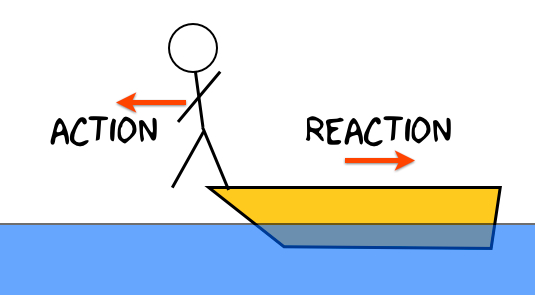
Which law does this image represent?

a)

1st Law

b)

2nd Law

c)

3rd Law

117.

Which law does this image represent?

a)

1st Law

b)

2nd Law

c)

3rd Law

118.

Which law does this image represent?

a)

1st Law

b)

2nd Law

c)

3rd Law

119.

As the fuel in a rocket ignites, the force of the gas expansion and explosion pushes out the back of the rocket and pushes the rocket forward.

a)

Newton's 1st Law

b)

Newton's 2nd Law

c)

Newton's 3rd Law

120.
A car speeding up, a dog slowing down and person turning around the block are examples of..
a)
Balanced Forces
b)
Unbalanced Forces
121.
What is Newton's First Law
a)
F=ma
b)
Every action has an equal and opposite reaction
c)
An object at rest stays at rest, an object in motion stays in motion. 
d)
Friction 
122.

This equation goes with which law?

a)

Newton's first law of motion

b)

Newton's second law of motion

c)

Newton's third law of motion

123.

A person is pushed forward into their seat belt when a car stops. Which law is this?

a)

Newton's 1st Law

b)

Newton's 2nd Law

c)

Newton's 3rd Law

124.

When the force on a car is doubled, the acceleration is doubled.

a)

Newton's 1st Law

b)

Newton's 2nd Law

c)

Newton's 3rd Law

125.

A skater pushes another skater forward, but the one pushing moves backwards.

a)

Newton's 1st Law

b)

Newton's 2nd Law

c)

Newton's 3rd Law

126.

The harder you hit a baseball, the faster it accelerates.

a)

Newton's 1st Law

b)

Newton's 2nd Law

c)

Newton's 3rd Law

127.

You push against a wall and the wall is pushing back on you.

a)

Newton's 1st Law

b)

Newton's 2nd Law

c)

Newton's 3rd Law

128.

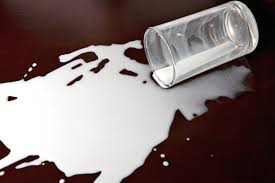
You are carrying a lunch tray when you bump into the edge of a table. Although the tray did not tip, your milk falls off of the front of the tray.

a)

Newton's

1st

Law of Motion

b)

Newton's

2nd

Law of Motion

c)

Newton's

3rd

Law of Motion

129.

Which law best explains why more force must be applied to the bowling ball to make it accelerate at the same rate as the tennis ball.

a)

Newton's 1st Law

b)

Newton's 2nd Law

c)

Newton's 3rd Law

130.
Which one needs a greater net force to move, a kilogram of feathers or a kilogram of iron? 
a)
feathers 
b)
iron
c)
same
d)
depends on their friction
131.
What law of motion does this picture represent?
a)
Newtons 1st law
b)
Newtons 4th law 
c)
Newtons 3rd law 
d)
Newtons 2nd law
132.

Which of the following has more inertia?

a)

Bowling ball

b)

Tennis ball

133.

Which of the following has less inertia?

a)

Feather

b)

Hammer

134.

Newton's Third Law says that forces must always occur in _____.

a)

pairs

b)

groups of 20 or more

c)

individual circumstances

d)

friction

135.

What measurement is used to measure force?

a)

Newtons

b)

Kelvin

c)

Kilos

d)

Moles