
 Worksheets
Updated 2025: Weathering/Erosion
Total questions: 137
Worksheet time: 2hrs 56mins
This kind of weathering causes the mineral composition of rocks to change
mechanical
chemical
permeable
general
Frost wedging causes mechanical weathering of rock by means of...
heating and cooling
plant growth
animal actions
freezing and thawing
The movement of rock particles by ice, wind, water, or gravity is called
erosion
mechanical weathering
chemical weathering
abrasion
Rapid chemical weathering can be caused by _____________, when rain mixes with air pollution.
carbon rain
acid rain
topsoil
subsoil
Glaciers move because of ______________.
ice
pressure
sliding
compression
Glaciers move because of ______________.
ice
pressure
sliding
compression
Where do continental glaciers still exist today?
Greenland and Antarctica
The Arctic Circle and Antarctica
Antarctica and Canada
Canada and The Arctic Circle
What type of soil is decayed matter that comes from dead plants and animals
humus
sand
clay
silt
Which of the following is NOT a classification of texture?
Sand
Silt
Clay
Rock
How is soil formed?
Rock erodes into tiny pieces and mixes with organic matter
Rocks break apart all on their own
Sunlight breaks the rocks apart
Organisms break down bedrock by consuming it
What are the two ultimate sources of energy that drive the erosion of Earth's surface?
tides and wind
the sun and gravity
fission and radiation
the Earth's mantle and core
Which of these is when carbonic acid breaks down minerals in rock?
sorting
saturation
capillary action
chemical weathering
Which of these statements holds true for the coarseness of sediment?
The depositional environment changes
The farther sediments travel from its source, the coarser the grains become.
The farther sediments travel from its source, the smoother the grains become.
The number of sedimentary rock features increases as the sediment is carried farther from its source


What is infiltration?
The process by which water sinks into the ground
The zone where there are still air spaces left between the particles.
The process by which water vapor turns into liquid water and forms fog or clouds.
The process by which water does not sink into the ground, but rather travels along the surface.

When a glacier moves, it picks up and carries the rocks with it. These rocks are weathered by:
abrasion
exfoliation
thermal expansion
hydrolysis
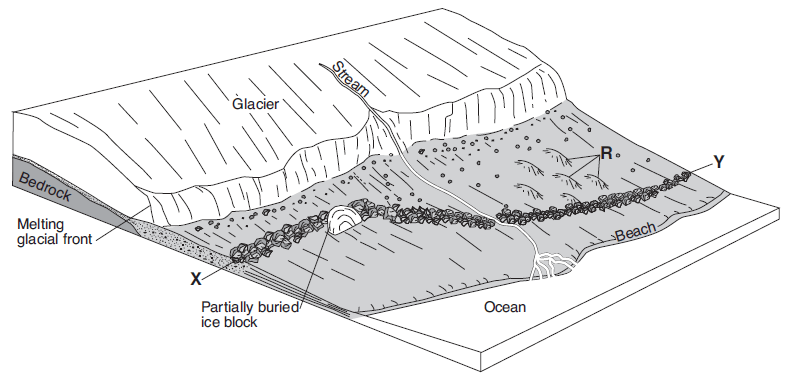
The elongated hills labeled R are most useful in determining the
age of the glacier
direction of movement of the glacier
size of the glacier
velocity of the glacier
A U-shaped Valley is formed by a-
River
Wind
Glacier
Rainfall
U shaped valleys are created by
glaciers
gravity
wind
water
Scratches in bedrock are found in areas where ______ have moved over the surface.
glaciers
rivers
wind
sand dunes
A glacier melts depositing piles of unsorted sediment called
glacial till
drumlin
kettle lake
outwash plain
What will be the most probable arrangement of rock particles deposited directly by a glacier?
sorted and layered
sorted and not layered
unsorted and layered
unsorted and not layered
The farthest point that a glacier traveled before it receded or melted away.
terminal moraine
outwash plain
drumlin
kettle lake
Large boulders that are deposited by melting glaciers
glacial erratics
drumlins
moraines
glacial till
An elongated hill of glacial sediment
drumlin
moraine
outwash plain

Drumlins are useful in determining
direction the glacier moved
how thick the glacier was
how fast the glacier moved
the age of the glacier

The photograph shows scratched and grooved
bedrock with boulders on its surface. The scratches and grooves were most likely created when
alternating thawing and freezing of water cracked the bedrock
flooding from a nearby lake covered the bedrock
a glacier dragged rocks over the bedrock
rocks from a landslide slid along the bedrock

The cross sections show a three-stage sequence in the development of a glacial feature. Which glacial feature has formed by the end of stage 3?
kettle lake
finger lake
drumlin
parallel scratches

The diagram represents a stream valley. Which diagram below best shows how this valley might be modified after a glacier has moved through it?


Which type of mass movement is caused by the freeze-thaw cycle of water?
frost wedging
mudflow
creep
earthflow
the downslope movement of loose sediments and rock that has been weathered
weathering
mass wasting
earthquake
deposition
Which of the following forces has the biggest impact on mass wasting?
momentum
sliding friction
rolling friction
gravity
When a block of material moves across a flat, inclined surface _____ has occurred.
a rock fall
mudflow
slide
chemical weathering
the downward movement of a block of material on a curved surface is called ____
slide
slump
mudflow
creep
Mass wasting can be triggered by all of the following except which one?
water
removal of plants
sun
earthquakes
Rockfalls and rock slides are most likely caused by ____
carbonation
frost wedging
oxidation
acid precipitation
In which area are slumps most likely to occur?
muddy hillsides
high mountains with loose soil
curved surfaces with clay soil
the base of a cliff where ocean waves crash
The process responsible for moving material downslope under the influence of gravity is called ___.
erosion
weathering
mass movement
soil formation
What is the force behind mass movements?
the sun's energy
flowing water
gravity
moving ice
Which of the following is NOT true about mass movement?
Some mass movement is too slow to be seen.
Mass movement always leads to landslides.
Gravity is the driving force behind all mass movements.
Mass movement is always downslope.
What factor commonly triggers mass movements?
saturation of surface materials with water
earthquakes
removal of vegetation
Why can the removal of vegetation trigger mass movements?
The soil loses nutrients and begins to crumble.
The plant roots bind the soil and regolith together.
The shaking triggers mass movements.
The plant roots lubricate the loose sediment.
Oversteepened slopes often lead to mass movements because...
...the angle of their slope is between 50 and 60 degrees.
...plants cannot grow on them.
...the angle of their slope is less than 50 degrees.
...the angle of their slope is greater than 40 degrees.
During what season would you expect mass movements to be a greater threat?
a dry summer
a wet spring before vegetation is growing
a wet spring with lots of growing vegetation
a dry autumn after the leaves have turned
A mass movement that involves the sudden movement of a block of material is called a ___.
rockfall
slide
slump
flow
When a block of material moves downslope along a curved surface, the type of mass movement is called ___.
a rockfall
a rockslide
a slump
creep
What is the slowest type of mass movement?
a slump
a rockfall
an earthflow
creep
A relatively rapid form of mass movement that is most common in dry mountainous regions is ___.
creep
a mudflow
a slump
an earthflow
Which of the following statements best describes a slump?
slippage of a block of material moving along a curved surface
blocks of rock sliding down a slope
rapid flow of water-saturated debris, most common in mountainous areas
slow downhill movement of soil and regolith
Alternate freezing and thawing often leads to ___.
creep
slumps
mudflows
earthflows
The downslope movement of rock, regolith, and soil under the direct influence of gravity is called a(n) ___ ___.
(a)
The force that drives mass movements is (a) .
A landform called a stream valley is the most common result of ___ ___.
(a)
One trigger of mass movements is the pores in sediments filling with (a) .
One of the most dramatic triggers of sudden mass movements is a(n) (a) .
(a) , the slowest type of mass movement, involves the lifting and contracting of soil particles over time.
The downward movement of a block of material along a curved surface is called a(n) (a) .
Which of the following factors are important in triggering mass movements?
earthquakes
oversteepening of slopes
the removal of vegetation
the saturation of the soil with water
gravity
Waves ERODE the land by
picking up sediment like sand and gravel
abrasion
impact
all of the above
Waves shape the coast through erosion by breaking down rocks and ________ sand and sediment
moving
flying
dropping
When waves hit rocks with huge force, it causes rocks to
not change
break apart
get larger
Where rock is softer, waves erode it faster
True
Flase
Over time the waves may erode a small hollow area in a part of a rock called a
sea cave
sea arch
beach
non of the above
When waves erode softer a layer of softer rock and becomes completely hollowed through
sea cave
sea arch
beach
none of the above
Where wave-washed sediment along a coast drops
sea arch
sea cave
beach
None of the above
A wave DEPOSITION includes which feature?
sea arch
sea cave
beach
None of the above
Which of the following is considered a wave EROSION feature
beach
kettle
oxbow lake
sea cave
Which of the following is considered a wave EROSION feature
alluvial fan
beach
sea arch
plucking
Which image shows a sea cave?


None of the above
Which image shows a sea arch?
None of the above
Which image shows a beach?
None of the above
Which of these shows wave deposition?


Which of these shows wave erosion


The process that changes solid rock into sediments.
Fracture
Dissolution
Weathering
Erosion
The process that moves sediments
Erosion
Weathering
Dissolution
Fracture
The final result of oxidation is -
rust
frost
Weathering can change roads, sidewalks, buildings and sculptures over time.
True
False
Which is an example of chemical weathering?
A rock breaking into fragments.
Sediment being moved down a hillside.
A rock being scratched by rocks embedded in the bottom of a
glacier.
A rock dissolving in water.
If a flood picks up a house and moves it downstream, this is -
Chemical weathering
Physical weathering
Erosion
All of the above
Erosion is always followed by-
deposition
weathering
suspension
saltation
Factors that determine how much erosion runoff can cause include -
whether the land is bare or covered with plants.
how fast the water is moving.
how much water is flowing.
all of the above
Natural processes changing ecoregions include-
Weathering
Erosion
Deposition
All of the above
All are examples of the presence of humans changing ecoregions except
Construction of buildings
Building of a seawall to protect from storm surge
Ships moving in and out of ports
Hurricanes changing shorelines
We belong to which of the following Ecoregions?
The Plains Ecoregion
The Gulf Coast Prairies and Marshes Ecoregion
The Woodland Ecoregion
The Prairie Ecoregion
The repeated growth and melting of ice in pore space or fractures.
Physical Weathering
Chemical weathering
Frost wedging
Chemical weathering where iron reacts with oxygen
Oxidation
Sediment
Abrasion
Any of the various weatheringprocesses that cause physical disintegration of exposed rock without any change in the chemical composition.
Physical Weathering
Chemical weathering
Oxidation
The transport of sediments to a new location.
Erosion
Physical Weathering
Deposition
Chemical Weathering
Scraping of a rock surface by friction between rocks and moving particles during their transport by wind, glacier, waves, gravity, running water
Sediment
Frost wedging
Erosion
Abrasion
The process in which sediment is laid down.
Physical Weathering
Frost wedging
Erosion
deposition
Fine or small rock particles.
Sediment
Abrasion
Weathering
Oxidation
Weathering that alters the mineral composition, or chemical makeup, of rocks.
Physical Weathering
Chemical weathering
Frost wedging
Erosion
30% Sand, 30% Clay, 40% Silt
Loam
Silt Loam
Clay Loam
Silty Clay Loam
75% sand, 10% silt, 15% clay
Sandy Loam
Loamy Sand
Sand
Sandy Clay Loam
42% sand, 21% silt, 37% clay
Silty Clay Loam
Sandy Clay Loam
Loam
Clay Loam
27% sand, 52% silt, 21% clay
Silt
Silt Loam
Loam
Silty Clay Loam
15% sand, 35% silt, 50% clay
Clay
Silty Clay
Sandy Clay
Clay Loam
64% sand, 30% silt, 6% clay
Sandy Clay Loam
Loamy Sand
Sandy Loam
Loam
50% sand, 10% silt, 40% clay
Sandy Clay
Sandy Clay Loam
Clay Loam
Sand
10% sand, 30% silt, 60% clay
sandy clay
Clay Loam
Silty Clay
Clay
10% sand, 50% silt, 40% clay
Silty clay
Silty clay loam
Clay
Clay loam
40% sand, 50% silt, 10% clay
Loam
Silt loam
Sandy loam
Clay loam

